
Why certified labs are essential for reliable workplace testing
TL;DR:
- Certified labs are evaluated and continuously monitored to ensure testing accuracy and reliability.
- Using non-certified labs can lead to false positives, wrongful terminations, and costly legal issues.
- Employers should verify certification through official SAMHSA lists and ensure proper legal and safety procedures.
Why certified laboratories are essential for reliable workplace testing
A mother in Iowa lost her job after a drug test came back positive for cocaine. The result was wrong. Now she’s suing the lab. Stories like this aren’t outliers — they’re a warning that every HR professional and employer needs to hear. A single test from a non-certified lab can trigger wrongful termination, open your company to litigation, and expose workers to life-altering consequences. This article breaks down what certified laboratory testing means, why it matters for legal compliance, and exactly how to make the right choice for your workplace program.
Table of Contents
- What certified laboratory testing means
- Risks and consequences of using non-certified labs
- How certified labs protect employers and employees
- Best practices for choosing and working with certified labs
- Our take: Why cutting corners with lab certification is a costly gamble
- Certified laboratory solutions for confident workplace screening
- Frequently asked questions
Key Takeaways
| Point | Details |
|---|---|
| Certified labs reduce risk | Using certified laboratories dramatically lowers your chance of costly legal errors and safety issues in workplace drug testing. |
| Certification ensures compliance | Federal and DOT regulations often require certified labs, so choosing them keeps your workplace compliant. |
| Verification is straightforward | Employers can easily confirm a lab’s certification status using SAMHSA’s official resources. |
| Protects everyone involved | Certified labs protect not just organizations, but also the rights and livelihoods of employees. |
What certified laboratory testing means
The phrase “certified laboratory” gets used loosely, but in the context of workplace drug testing, it has a very specific legal and regulatory definition. A certified laboratory is one that has been evaluated, approved, and continuously monitored by a governing authority to ensure it meets strict standards for accuracy, reliability, and procedural integrity. This is not a one-time audit. It’s an ongoing commitment to quality that separates trustworthy labs from those operating without meaningful oversight.
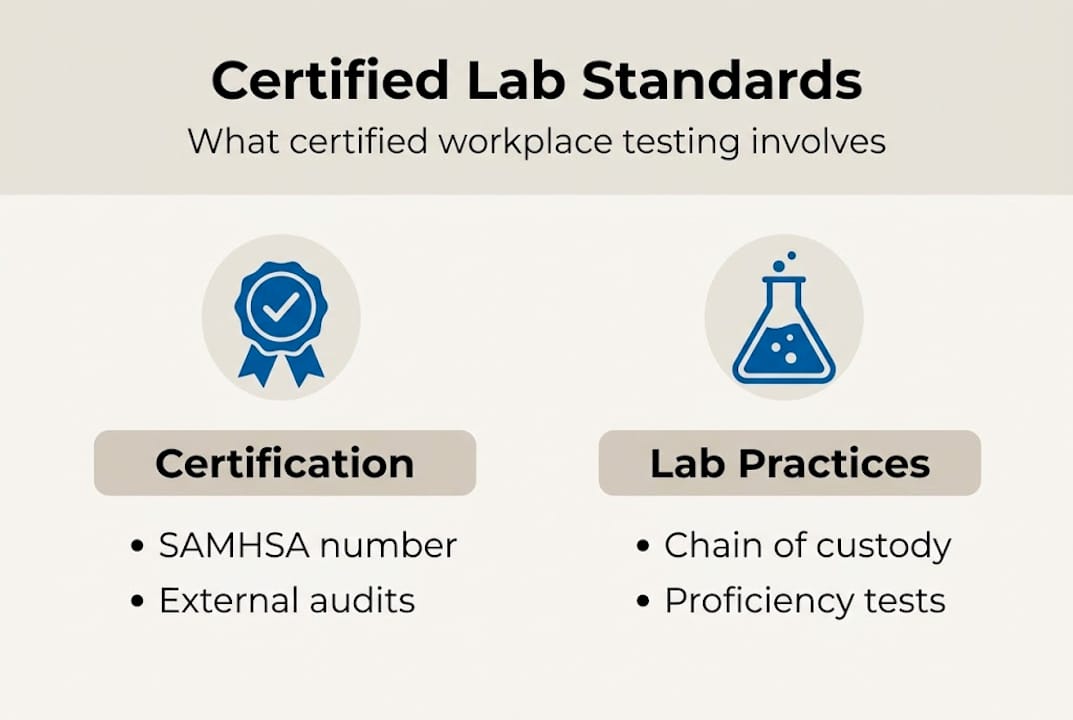
For most employers, the governing standard comes from the Substance Abuse and Mental Health Services Administration, better known as SAMHSA. Understanding SAMHSA lab certification is the first step in building a compliant testing program. SAMHSA-certified labs are the legal standard for federal and DOT-regulated workplace drug testing, and SAMHSA-certified labs are required for federal and DOT-regulated workplace drug testing to ensure compliance and reliability.
Beyond SAMHSA, other accreditation bodies include the College of American Pathologists (CAP), the Clinical Laboratory Improvement Amendments (CLIA), and ISO standards for laboratory quality management. Each of these frameworks requires labs to demonstrate technical competency and procedural rigor before they can legally issue results that affect employment decisions.
Here’s what certification actually involves in practice:
- Initial performance testing: A lab must complete at least three rounds of proficiency testing before it can be granted certification status.
- On-site inspection: Regulators physically inspect the facility to verify equipment, staffing qualifications, and standard operating procedures.
- Quarterly proficiency testing: Certified labs are tested on an ongoing basis using blind samples to confirm continued accuracy.
- Periodic re-inspection: Labs face recurring on-site evaluations to ensure nothing has slipped since the initial certification.
- Chain of custody documentation: Every sample must be tracked from collection through analysis with tamper-evident paperwork.
Pro Tip: Always ask a lab provider to share their current SAMHSA certification number. You can cross-reference it directly on the SAMHSA publicly available lab list to confirm their status before you sign any service agreement.
| Certification body | Who it applies to | Frequency of review |
|---|---|---|
| SAMHSA | Federal and DOT employers | Quarterly proficiency tests + periodic inspections |
| CAP | Clinical/forensic labs | Biannual inspection |
| CLIA | All labs processing human specimens | Every two years |
| ISO 17025 | Testing and calibration labs | Per accreditation cycle |
When you use accredited drug testing labs, you’re not just checking a compliance box. You’re building a documented, defensible process that protects both your organization and your employees if a result is ever challenged.
Risks and consequences of using non-certified labs
It’s tempting to cut costs on lab testing, especially when prices vary significantly between providers. But the financial logic breaks down quickly once you account for what happens when a non-certified lab produces an inaccurate result. The consequences are not hypothetical. They are documented, expensive, and often severe.

False positives are the most visible risk. An employee tests positive for a substance they never used, gets terminated, and then challenges the result. A high-profile case illustrates this exactly: an Iowa mother is now suing the testing lab after a false positive for cocaine led to her employment being terminated. This is not an isolated incident. Labs operating without rigorous oversight have been shown to produce these errors at alarming rates.
False negatives are equally dangerous, though they’re less visible until something goes wrong. When a drug-impaired employee is cleared by a flawed test, they return to work. If they operate heavy machinery, drive a commercial vehicle, or work in healthcare, the results can be catastrophic. An investigation into a flawed major testing lab revealed that these systemic errors were concealed for years, putting workers and the public in danger the entire time.
The financial and legal fallout from relying on non-certified labs includes:
- Wrongful termination lawsuits with settlements reaching into six figures
- Regulatory fines for employers in federally mandated testing industries
- OSHA and DOT penalties when impaired employees cause workplace accidents
- Reputational damage that affects recruiting, retention, and business relationships
- Loss of federal contracts for companies required to maintain drug-free workplace programs
A reliable screening guide for certified labs can help employers avoid these pitfalls before they become costly problems. The risks tied to non-certified testing also extend to broader workplace safety. When you explore workplace safety impact in detail, it’s clear that accurate testing is inseparable from a genuinely safe work environment.
For additional context on how medical testing risks compound in unregulated environments, the pattern is consistent: reduced oversight always increases the margin for error.
| Factor | Certified lab | Non-certified lab |
|---|---|---|
| Accuracy rate | Verified through proficiency testing | Unknown, unverified |
| Legal defensibility | Strong chain of custody documentation | Weak or missing documentation |
| Regulatory compliance | Meets SAMHSA, DOT, CLIA standards | May fail federal requirements |
| Employer liability | Significantly reduced | Significantly elevated |
| Employee protections | Built into protocol | Absent or informal |
The bottom line is stark: saving a few dollars per test by using a non-certified lab is one of the most expensive decisions an employer can make. The cost of a single wrongful termination lawsuit will dwarf years of savings on testing fees.
How certified labs protect employers and employees
Certification isn’t just about avoiding risk. It actively builds the infrastructure of fairness and accuracy that a defensible drug testing program requires. When a result is challenged in court, in an arbitration, or in a regulatory review, the lab’s certification status and documented processes are what determine whether the employer can stand behind that result with confidence.
Here’s how the certified lab process works to protect everyone involved:
- Chain of custody: Every specimen is assigned a unique identifier at collection and tracked through every step of handling and analysis. This documentation ensures the sample tested is definitively the one collected from the employee in question.
- Initial screening and confirmation: Certified labs use immunoassay screening as a first pass, then confirm any positive results using gas chromatography-mass spectrometry (GC-MS). This two-step process dramatically reduces the chance of a false positive reaching anyone’s HR file.
- Medical Review Officer (MRO) involvement: A licensed physician reviews all positive results before they are reported to the employer. The MRO contacts the employee to check for legitimate medical explanations, such as a valid prescription, before the result becomes official.
- Proficiency testing: As part of the certification process, labs regularly receive blind samples with known concentrations and must report accurate results. Failure to pass these checks triggers review and potential decertification.
- On-site inspection and re-inspection: SAMHSA drug testing resources confirm that certification involves initial rounds of performance testing plus on-site inspection, followed by quarterly proficiency testing and periodic inspections to verify ongoing compliance.
Pro Tip: When an employee disputes a drug test result, the employer’s strongest defense is documented chain of custody from a certified lab. Without it, even a legitimate positive can be challenged successfully in court.
For employers in safety-sensitive industries, certified lab testing is directly tied to workplace accident reduction. The data consistently shows that companies with rigorous, certified testing programs experience fewer on-the-job injuries, lower workers’ compensation costs, and stronger compliance records during regulatory audits.
“Certification is not a formality. It is the structural guarantee that results are accurate, processes are consistent, and both employers and employees are protected from errors that can change the course of a career or a legal case.”
Understanding the full lab-based testing benefits for employers makes clear why certified lab testing is a strategic investment rather than just a regulatory burden. The protections it provides flow in every direction: accurate results protect employees from wrongful termination, and documented processes protect employers from litigation.
Best practices for choosing and working with certified labs
Knowing that certified labs matter is one thing. Actually finding, vetting, and integrating a certified lab into your HR process is another. Here are the concrete steps that make the difference between a compliant program and a liability waiting to happen.
Step 1: Start with the SAMHSA list
The SAMHSA website maintains a publicly available, regularly updated list of all currently certified laboratories in the United States. This is your starting point, not a vendor’s marketing materials. Any lab claiming SAMHSA certification should appear on this list. If they don’t, walk away.
Step 2: Verify additional accreditations
For employers outside federally mandated testing industries, SAMHSA certification may not be legally required. But seeking labs with CAP, CLIA, or ISO accreditation still gives you a meaningful quality assurance baseline. Ask for copies of current accreditation certificates. A legitimate lab will provide these without hesitation.
Step 3: Ask the right questions
Before signing a contract with any lab provider, get clear answers to these questions:
- What is your current SAMHSA certification number and expiration date?
- Do you use a licensed Medical Review Officer for all positive results?
- What is your chain of custody procedure from sample collection to result reporting?
- How do you handle split sample retesting requests from employees?
- What is your average turnaround time for confirmation testing?
Step 4: Avoid common selection mistakes
Many employers make the same errors when choosing a lab. The most common include selecting a provider based solely on price, skipping credential verification because the vendor seems professional, and assuming that a lab used by another company is automatically compliant. None of these assumptions are safe.
SAMHSA certification requirements make clear that the standards are detailed and ongoing. A lab certified two years ago may have lapsed. Always verify current status.
Reviewing SAMHSA test FAQs gives HR professionals specific guidance on what to expect from compliant lab testing, including result formats, timelines, and documentation requirements.
Step 5: Integrate results into your HR process correctly
A positive result from a certified lab is only as useful as your HR process for handling it. Your written HR drug testing policies should specify which tests are required for which roles, what happens when a result is positive, how split sample requests are managed, and what the appeals process looks like. This documentation protects you if a termination decision is ever challenged.
- Maintain copies of all chain of custody forms
- Store results securely and separately from general personnel files
- Train HR staff on how to communicate results to employees
- Document every step from the collection notice to the final employment decision
Our take: Why cutting corners with lab certification is a costly gamble
We’ve worked with employers across industries, and we’ve seen a pattern. The companies that resist certified lab testing almost always frame it as a cost issue. The testing fees are higher. The turnaround takes longer. There’s more paperwork. What they don’t account for is the asymmetry of the risk. The savings from using a cheaper, uncertified lab might be a few hundred dollars a year. The cost of a single wrongful termination lawsuit, a OSHA investigation triggered by an impaired worker’s accident, or a DOT audit that uncovers non-compliant testing practices can run into the hundreds of thousands.
But beyond the financial math, there’s an ethical dimension that doesn’t get discussed enough. A false positive doesn’t just cost an employee their job. It damages their reputation, disrupts their family’s finances, and can take years to legally resolve. That’s a serious harm caused not by malicious intent, but by a decision that prioritized cost savings over accuracy. When you choose certified labs, you’re not just protecting your organization — you’re honoring your responsibility to the people who work for you. Explore how workplace drug testing connects directly to both safety and ethical accountability in your role as an employer.
Certified laboratory solutions for confident workplace screening
If you’re ready to move your drug testing program onto solid, compliant ground, CountryWideTesting.com connects you directly with certified lab services designed for employers. Every lab in our network meets federal and regulatory standards, so your results are defensible, accurate, and legally sound.
Our lab testing services support both on-site collection and convenient mail-in options, including the SAMHSA mail-in confirmation test for employers who need federally compliant results without sacrificing ease of use. Whether you’re building a new workplace testing program or upgrading an existing one, we give you the infrastructure, the certified lab partnerships, and the documentation support to stay compliant and protect everyone in your organization.
Frequently asked questions
What is a certified laboratory?
A certified laboratory meets strict federal standards for testing reliability, accuracy, and ongoing quality assurance in workplace drug screening. SAMHSA-certified labs are the required standard for federal and DOT-regulated workplace drug testing.
Why should employers avoid non-certified labs?
Non-certified labs increase your risks for false results, legal disputes, and wrongful termination lawsuits. Real cases, including a false cocaine positive resulting in employment termination, show exactly how much damage a single inaccurate result can cause.
How can HR verify a lab is certified?
Check the lab directly on the SAMHSA certified lab list, which is publicly available and updated regularly to reflect current certification status.
Are certified labs required for DOT or federal workplace drug tests?
Yes, federal and DOT-regulated drug testing programs legally require SAMHSA-certified labs. Using a non-certified lab for these tests puts your entire compliance program at risk.
What ongoing checks do certified labs undergo?
Certified labs go through quarterly proficiency testing and periodic on-site inspections, ensuring their accuracy standards are maintained consistently over time.