
Workplace Lab Testing: Critical Role in Compliance
TL;DR:
- Nearly 1 in 4 Americans report illicit drug use, impacting workplaces and compliance needs.
- Employers must adhere to federal or state drug testing regulations, including certified labs and chain-of-custody.
- Building a defensible program requires proper documentation, certified labs, trained staff, and ongoing policy review.
Nearly 1 in 4 Americans reported past-year illicit drug use in 2024, totaling 73.6 million people aged 12 and older. For employers and HR teams, that statistic is not abstract. It shows up in your applicant pool, your workforce, and your liability exposure. Staying compliant with drug testing regulations requires more than a basic screening kit. It demands certified laboratories, documented procedures, and a clear understanding of the legal framework that governs every test you run. This article breaks down what the regulations actually require, how labs earn the right to process your specimens, and what practical steps you should take to build a defensible program.
Table of Contents
- Understanding compliance: Federal and state regulations
- Lab testing standards: SAMHSA certification and chain-of-custody
- Handling specimen validity, cheating, and edge cases
- Best practices: Applying lab testing for defensible workplace compliance
- Why lab testing compliance is misunderstood—and what really works
- Find compliant lab testing solutions for your workplace
- Frequently asked questions
Key Takeaways
| Point | Details |
|---|---|
| Regulatory compliance matters | Using certified labs and following DOT/state mandates protects employers from legal risk. |
| SAMHSA labs are recommended | Employers in both DOT and non-DOT sectors benefit from choosing SAMHSA-certified labs for defensible results. |
| Managing specimen validity | Proper testing procedures, chain-of-custody, and MRO review prevent cheating and ensure accurate screenings. |
| Apply best practices | Employers should follow annual reporting, stay updated on state law changes, and uphold ADA/privacy requirements. |
| Rapid action with trusted services | Accessible, compliant lab testing solutions help streamline workplace screening and compliance needs. |
Understanding compliance: Federal and state regulations
Drug testing compliance is not one-size-fits-all. Whether you fall under federal transportation regulations or operate as a private employer, the rules are different, and mixing them up creates real legal risk.
For employers regulated by the Department of Transportation (DOT), 49 CFR Part 40 is the governing standard. It requires the use of SAMHSA-certified laboratories (Substance Abuse and Mental Health Services Administration) and mandates strict chain-of-custody procedures for urine specimens. There is no flexibility here. If you employ commercial drivers, pilots, rail workers, or other safety-sensitive DOT-covered workers, you must comply with these rules or face serious penalties. Our guide on DOT drug testing setup walks through the specific steps to get your program structured correctly.
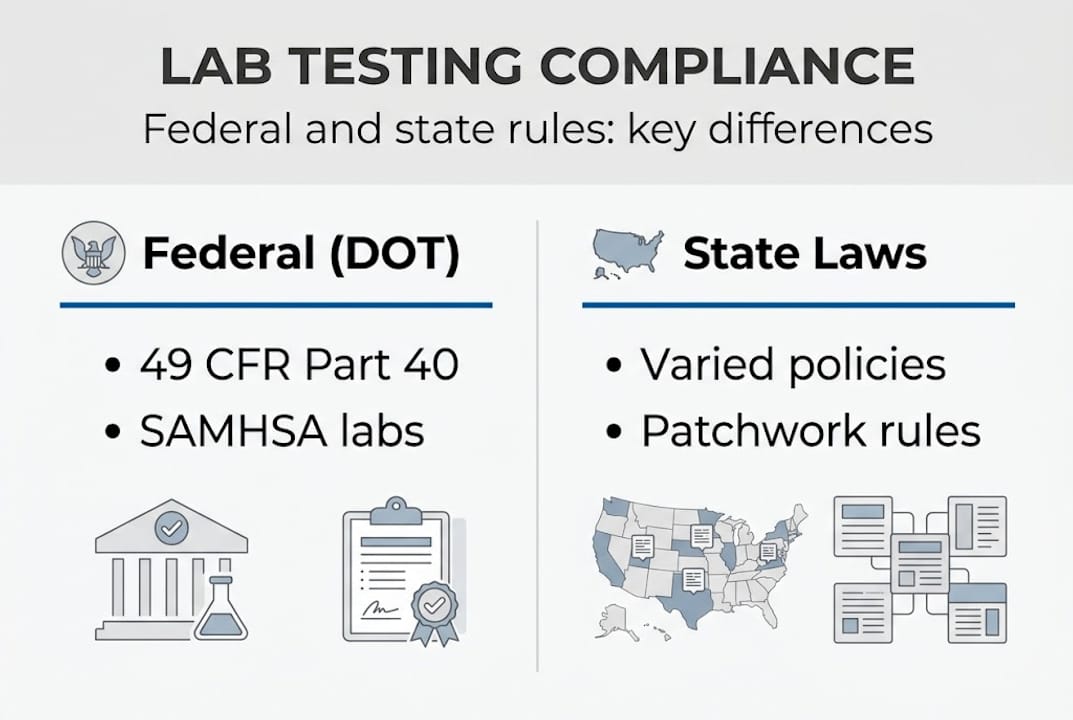
Non-DOT employers operate under a patchwork of state laws that vary significantly. Some states permit pre-employment, random, and for-cause testing with few restrictions. Others limit the circumstances under which you can test, require written policies, or mandate employee notification. And regardless of state rules, all employers must intersect their testing programs with federal laws like the Americans with Disabilities Act (ADA) and applicable privacy protections. Understanding your obligations under HIPAA and privacy regulations is essential for any compliant testing program.
Here is a quick comparison of the two frameworks:
| Factor | DOT-regulated employers | Non-DOT employers |
|---|---|---|
| Lab requirement | SAMHSA-certified only | SAMHSA recommended |
| Testing triggers | Defined by 49 CFR Part 40 | Defined by state law and policy |
| Chain-of-custody | Mandatory | Strongly advised |
| Random testing | Required for safety roles | Varies by state |
| ADA compliance | Required | Required |
Key compliance considerations for all employers:
- Put your policy in writing. A written drug-free workplace policy is the foundation of defensible testing.
- Train your supervisors. Reasonable suspicion testing requires supervisors who can document observable behavior.
- Stay current on state law. Cannabis legalization has changed testing rules in many states since 2020.
- Use certified labs. Even when not legally required, certified lab results are far more defensible in court or an audit.
Ignoring these layers does not just create compliance gaps. It creates exposure in wrongful termination suits, workers’ compensation disputes, and federal audits.
Lab testing standards: SAMHSA certification and chain-of-custody
Not all labs are equal. A SAMHSA-certified lab has passed rigorous federal inspections and maintains ongoing quality controls that generic or in-house labs simply cannot match. When your results need to hold up in an arbitration hearing, a federal audit, or a court proceeding, that certification is the difference between admissible evidence and a dismissed claim.
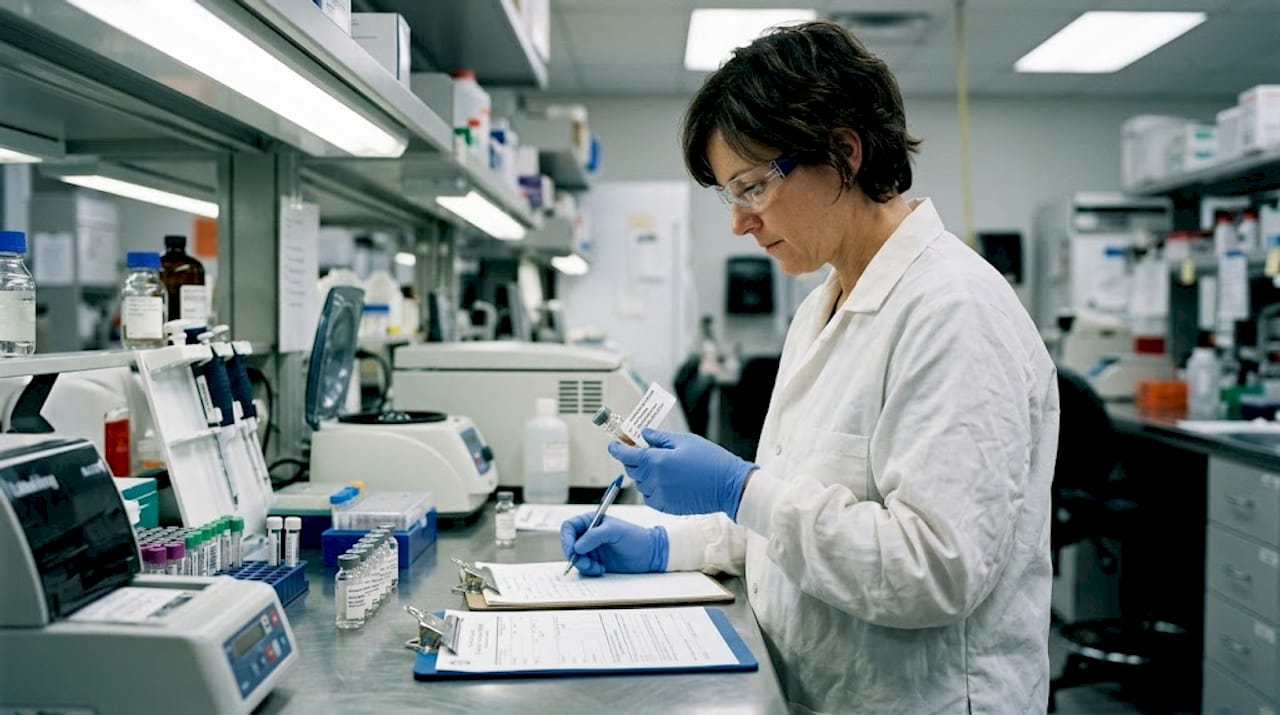
SAMHSA certification requires labs to demonstrate proficiency testing, quality assurance protocols, and compliance with federal workplace drug testing guidelines. The certification process is not a one-time approval. Labs must maintain continuous compliance, undergo regular inspections, and use approved testing methodologies. You can learn more about what SAMHSA certification actually involves and why it matters beyond just a label on a lab report.
Chain-of-custody (COC) is the documented trail that tracks a specimen from the moment of collection to the moment results are reported. Every hand-off, every transfer, every seal must be recorded. The quality-controlled results produced by SAMHSA labs depend entirely on this documentation. Without it, a positive result can be challenged on the grounds of potential contamination or mishandling, and courts have dismissed results for exactly this reason.
A specimen without a complete chain-of-custody record is legally worthless, regardless of what the lab found.
Here is what a proper chain-of-custody process looks like:
| Step | Action | Responsible party |
|---|---|---|
| Collection | Specimen collected, sealed, labeled | Collector |
| Documentation | CCF (Custody and Control Form) completed | Collector and donor |
| Transfer | Specimen shipped to certified lab | Courier |
| Receipt | Lab logs specimen arrival and condition | Lab technician |
| Analysis | Testing conducted per federal protocols | Lab analyst |
| Reporting | MRO reviews and certifies results | Medical Review Officer |
Pro Tip: Always verify that your collection site uses federal Custody and Control Forms (CCF) and that collectors are trained on proper sealing and labeling procedures. A broken seal or incomplete form can invalidate a result even before it reaches the lab.
For situations where you want to understand the scope of testing available, the seven panel SAMHSA testing option covers the standard federal panel substances. And if you are evaluating why urine remains the preferred specimen type for workplace programs, the benefits of urine testing are well established in both regulatory guidance and legal precedent.
Handling specimen validity, cheating, and edge cases
Even with certified labs and proper chain-of-custody procedures, some donors attempt to beat a drug test. Your program needs to be built to detect and respond to those attempts without creating its own legal vulnerability.
The most common specimen integrity issues labs encounter are:
- Adulteration. The donor adds a foreign substance to the specimen to mask drug presence. Labs detect this through pH and oxidant testing.
- Substitution. The donor submits a specimen that is not human urine. Labs check creatinine levels and specific gravity to identify this.
- Dilution. The donor drinks large amounts of water before collection, lowering drug concentration below detection thresholds.
- Invalid specimen. The specimen cannot be tested due to interference or unusual characteristics with no clear explanation.
When any of these conditions are detected, the MRO (Medical Review Officer) conducts a donor interview to determine whether a legitimate medical explanation exists. For adulterated and substituted specimens, legitimate medical explanations are rarely accepted. The result is typically reported as a refusal to test, which carries the same consequences as a positive result under DOT rules.
Preventing tampering starts at the collection site. Key controls include:
- Temperature checks. Urine must fall within the 90 to 100 degree Fahrenheit range at collection.
- Bluing agents. Toilet water is colored blue to prevent dilution with toilet water.
- Observed collection. Used in return-to-duty and follow-up situations, or where prior tampering is documented.
- Electronic CCF systems. Digital custody and control forms reduce documentation errors and improve audit trails.
Pro Tip: If you manage a safety-sensitive workforce, consult your Third-Party Administrator (TPA) about observed collection protocols before you need them. Having this process documented in your policy before an incident occurs makes enforcement far cleaner.
For situations like vehicle accidents or on-the-job incidents, your post-accident testing protocols need to be pre-defined and consistently applied to avoid discrimination claims.
Best practices: Applying lab testing for defensible workplace compliance
Knowing the rules is one thing. Building a program that holds up when it is actually challenged is another. Here are the practices that separate compliant programs from vulnerable ones.
Documentation is everything. Every test, every result, every MRO communication should be stored in a secure, retrievable format. DOT regulations require annual MIS reporting of your testing statistics, and those reports must be accurate. Errors in MIS data can trigger audits.
Actionable steps for HR teams:
- Review your written policy annually and update it when state laws or federal rules change.
- Confirm your collection sites are current on federal collector training requirements.
- Verify your lab’s SAMHSA certification status before each testing cycle.
- Ensure your MRO has current credentials and a documented review process.
- Keep all CCFs and lab reports for at least five years (DOT requirement).
- Train managers on what they can and cannot say when notifying an employee of a test requirement.
Here is a quick reference for building a defensible program:
| Element | Why it matters | Risk if missing |
|---|---|---|
| Written policy | Legal foundation | Discrimination exposure |
| SAMHSA-certified lab | Admissible results | Thrown-out evidence |
| Chain-of-custody forms | Specimen integrity | Challenge to validity |
| Trained MRO | Accurate result reporting | False positive liability |
| State law review | Jurisdictional compliance | Wrongful termination claims |
| MIS reporting (DOT) | Federal audit compliance | Fines and penalties |
If your workforce includes commercial vehicle operators, our compliance guide for truck drivers covers the 2026 requirements in detail. And for a broader overview of what DOT testing requires at each stage, the DOT drug test guidance resource covers the testing triggers, substances tested, and reporting obligations.
Why lab testing compliance is misunderstood—and what really works
Here is something most employers do not hear enough: the biggest compliance failures we see are not from bad intentions. They come from employers who thought a cheaper or faster option was good enough. They used a non-certified lab because it was convenient. They skipped a chain-of-custody form because it seemed like paperwork. Then a termination got challenged, and suddenly that cost-saving decision became a six-figure legal problem.
The uncomfortable truth is that drug testing compliance is judged at the moment of dispute, not the moment of collection. What passes scrutiny in a courtroom or federal audit is not whether you had a testing program. It is whether every step was documented, every lab was certified, and every MRO review was legitimate. Cutting corners on DOT drug testing essentials to save money is a bet you are likely to lose.
The employers who get this right treat lab certification and chain-of-custody documentation not as red tape but as legal protection. That shift in mindset changes how you select vendors, train collectors, and store records.
Find compliant lab testing solutions for your workplace
Understanding the regulatory framework is only useful if you can act on it. CountryWideTesting.com connects employers and HR teams with certified lab testing services that meet SAMHSA, CLIA, CAP, and ISO standards. Whether you need a structured employer program or a straightforward screening solution, the options are designed to be both compliant and accessible.
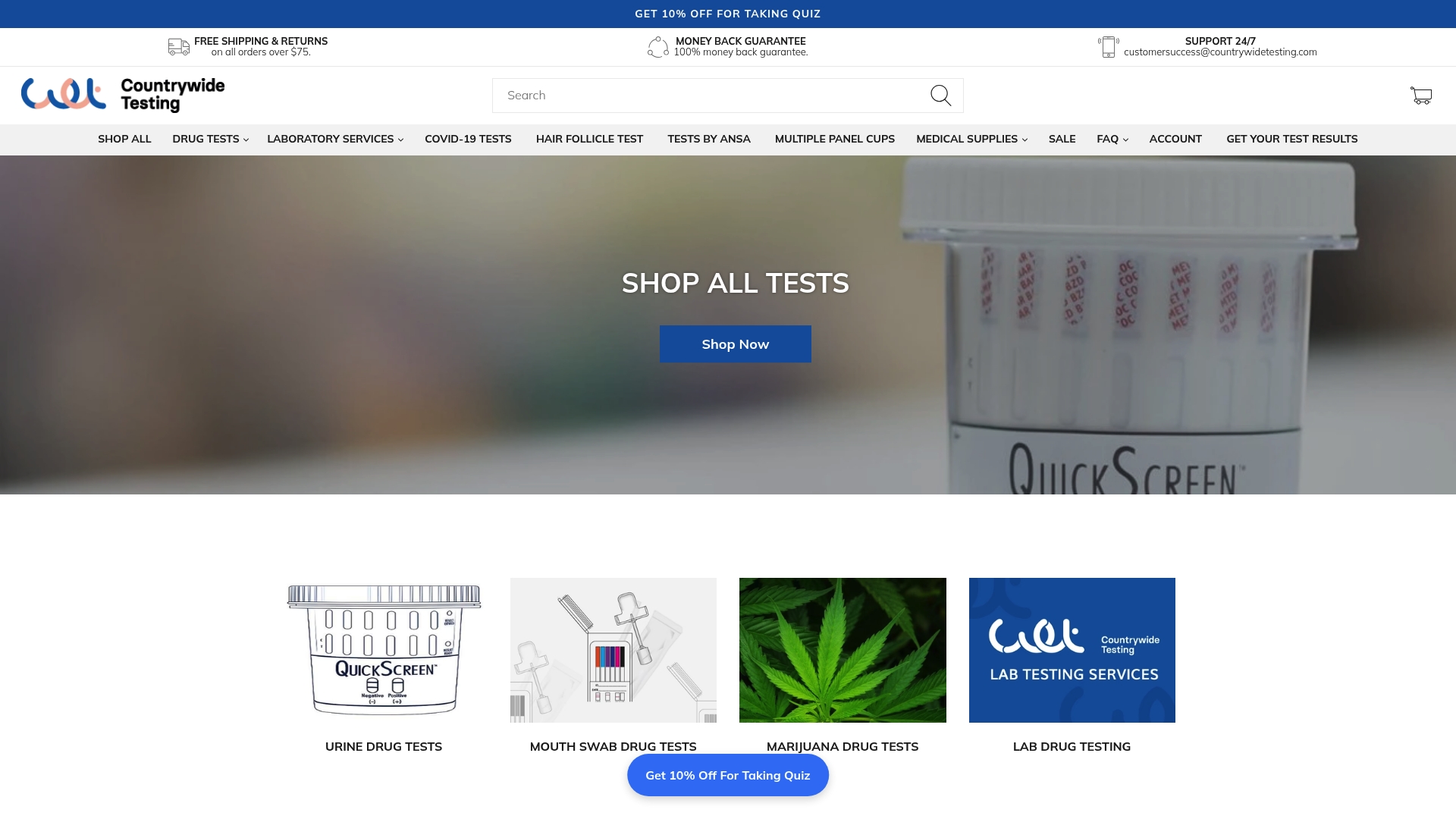
For organizations that also need flexible at-location or at-home screening options alongside lab confirmation, the 12-panel drug test cup provides an efficient first-step screening tool. Pair it with certified lab confirmation and you have a two-stage program that balances speed with legal defensibility. Start building your compliant testing program today.
Frequently asked questions
Do all workplace drug tests have to use SAMHSA-certified labs?
DOT-regulated tests must use SAMHSA-certified labs under 49 CFR Part 40. Non-DOT employers are not legally required to use them but are strongly advised to do so for legal defensibility.
What happens if an employee’s specimen is adulterated or substituted?
The MRO will conduct a donor interview, and if no legitimate medical explanation exists, the specimen is reported as a refusal, which carries the same consequences as a positive result under federal rules.
Are random drug testing policies allowed in every state?
No. State laws vary widely, with some permitting broad random testing and others restricting when and how it can be applied. Always verify your state’s current rules before implementing a random testing program.
What is chain-of-custody and why is it important?
Chain-of-custody is a documented record of every step in specimen handling from collection through reporting. SAMHSA labs maintain strict chain-of-custody controls because without them, results can be legally challenged and dismissed.
How can employers prevent cheating in drug tests?
Observed collections, temperature checks, validity testing for creatinine and pH levels, and electronic CCF systems all work together to reduce tampering and strengthen specimen integrity.