
How to set up DOT drug testing: employer guide for 2026
Setting up DOT drug testing compliance can feel overwhelming for employers managing safety-sensitive transportation employees. Federal regulations require strict protocols, from policy creation to random testing execution, yet many HR professionals struggle to navigate the complex requirements without clear guidance. This step-by-step guide breaks down exactly how to establish a compliant DOT drug testing program, covering everything from determining coverage and selecting service agents to executing the six mandatory test types and maintaining records. You’ll gain practical frameworks to implement testing protocols confidently while avoiding common compliance pitfalls that lead to violations.
Table of Contents
- Key takeaways
- Understanding DOT drug testing requirements and coverage
- Preparing your DOT drug testing program: policy, roles, and service agents
- Executing DOT drug testing: required test types and random testing protocols
- Managing records, reporting, and ongoing compliance monitoring
- Ensure reliable DOT drug testing with Countrywide Testing
- Frequently asked questions
Key Takeaways
| Point | Details |
|---|---|
| DOT coverage determination | Use the Am I Covered tool to confirm which roles and vehicles trigger DOT drug testing requirements. |
| Policy and roles | Develop a written drug and alcohol policy, designate a DER, and select service agents to support compliant testing. |
| Six test types | Implement the six mandated DOT drug and alcohol test types across the program. |
| Recordkeeping and reporting | Retain DOT testing records for five years and file required annual reports. |
Understanding DOT drug testing requirements and coverage
Determining whether your organization falls under DOT drug testing regulations is the essential first step. Employers must implement drug and alcohol testing if they have safety-sensitive employees under DOT agencies like FMCSA for commercial motor vehicle operators requiring a CDL. Safety-sensitive positions include drivers operating vehicles requiring a CDL, pipeline workers performing operations and maintenance duties, aviation personnel like pilots and mechanics, railroad engineers and conductors, and maritime crew members.
The DOT provides an online tool called “Am I Covered?” that helps employers determine if their workforce falls under these regulations. This assessment considers your industry sector, employee roles, and vehicle classifications. If you employ drivers operating commercial vehicles over 26,001 pounds, transporting hazardous materials requiring placards, or carrying 16 or more passengers including the driver, you’re likely covered under FMCSA regulations.
Prohibited substances under DOT testing include marijuana, cocaine, opioids, amphetamines, and phencyclidine. A critical compliance point: marijuana remains federally prohibited for safety-sensitive employees even in states where recreational or medical use is legal. DOT regulations supersede state laws, meaning positive marijuana tests result in violations regardless of state legislation. This federal-state conflict creates confusion, but employers must enforce DOT standards without exception.
Understanding drug testing policies requirements helps you build compliant frameworks from the start. Key coverage considerations include:
- Identify all positions meeting safety-sensitive criteria under your applicable DOT agency
- Verify vehicle classifications and operational thresholds triggering compliance
- Document coverage determinations for audit purposes
- Communicate DOT requirements clearly to affected employees during onboarding
- Review coverage annually as your workforce and operations evolve
Non-compliance carries serious consequences beyond regulatory penalties. Safety incidents involving untested or improperly tested employees expose your organization to liability claims, insurance complications, and potential loss of operating authority. Establishing clear coverage parameters protects both your workforce and your business operations.
Preparing your DOT drug testing program: policy, roles, and service agents
Building a compliant DOT drug testing program requires careful preparation across policy development, internal role assignments, and external partnerships. Key steps to set up include determining coverage, developing a written policy, designating a DER, selecting service agents, registering with the FMCSA Clearinghouse, and conducting training. Each component plays a distinct role in creating a functional compliance framework.
Your written drug and alcohol policy must address all DOT requirements while communicating expectations clearly to employees. The policy should specify which positions are covered, explain all six test types, outline consequences for policy violations, describe the testing process, and provide information about substance abuse resources. Distribute this policy to all covered employees and obtain signed acknowledgment forms for your records.

The Designated Employer Representative serves as your compliance point person. This individual manages day-to-day testing operations, receives test results from the Medical Review Officer, makes decisions about employee fitness for duty, and maintains required records. Choose someone with strong organizational skills and discretion, as they’ll handle sensitive employee information. Many employers designate an HR manager or safety director for this role, though you can also outsource DER functions to a third-party administrator.
Selecting qualified service agents is critical for compliant testing execution. You’ll need partnerships with:
- Collection sites with trained collectors who follow DOT procedures for specimen collection
- SAMHSA-certified laboratories that analyze specimens using approved methods
- A Medical Review Officer who reviews and verifies test results, interviews employees about legitimate medical explanations
- Optionally, a Consortium/Third-Party Administrator who manages your entire testing program
Pro Tip: Vet service agents carefully by verifying certifications, checking references from similar-sized employers, and confirming they understand your specific DOT agency requirements. Not all testing providers have DOT expertise, and using non-compliant agents puts your entire program at risk.
Registering with the FMCSA Clearinghouse is mandatory for motor carrier employers. This database tracks CDL driver drug and alcohol violations, ensuring drivers can’t hide positive tests by switching employers. You’ll need to register your company, designate authorized users, and query the Clearinghouse before hiring drivers and annually for current employees. Understanding the drug screening workflow helps you integrate Clearinghouse queries into your hiring and compliance processes seamlessly.
Training requirements apply to multiple stakeholders. Supervisors who make reasonable suspicion determinations need at least 60 minutes of training on drug signs and 60 minutes on alcohol signs. Your DER should understand Part 40 regulations thoroughly. Employees need education about policy requirements, testing procedures, and consequences. Document all training with attendance records and training materials for compliance verification.
Executing DOT drug testing: required test types and random testing protocols
DOT regulations mandate six test types that employers must implement: pre-employment, random, post-accident, reasonable suspicion, return-to-duty, and follow-up testing. Each serves a specific compliance purpose and follows distinct protocols. Understanding when and how to conduct each test type ensures you meet regulatory obligations while maintaining fair, consistent practices.
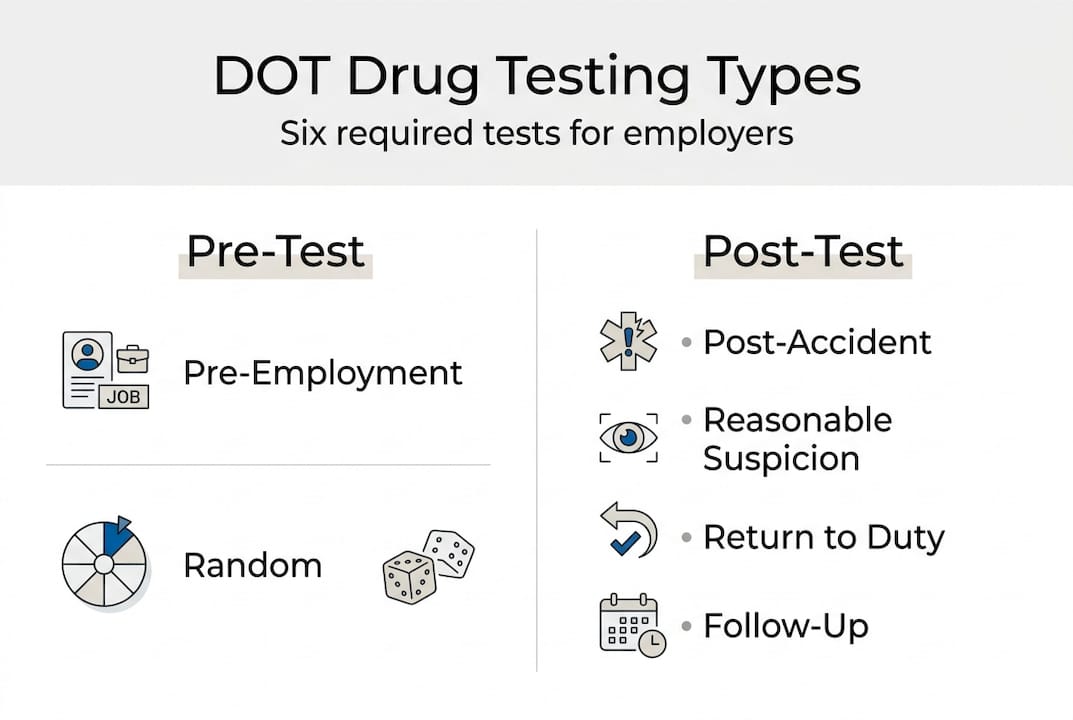
Pre-employment testing occurs before an employee first performs safety-sensitive functions. You must receive a negative result before allowing the employee to work. Random testing provides ongoing deterrence by selecting employees using a scientifically valid random method throughout the year. Random testing rates for FMCSA in 2026 remain at 50% of the average annual driver count for drugs and 10% for alcohol, unchanged since 2020. Post-accident testing applies after accidents meeting specific DOT criteria, typically involving fatalities, injuries requiring immediate medical treatment, or disabling vehicle damage.
Reasonable suspicion testing occurs when trained supervisors observe behavior or appearance indicating possible substance use. Document observations specifically, focusing on objective signs like slurred speech, coordination problems, or alcohol odor. Return-to-duty testing happens before an employee who violated DOT drug and alcohol regulations returns to safety-sensitive duties, following evaluation by a Substance Abuse Professional. Follow-up testing involves unannounced tests for employees returning after violations, with a minimum of six tests in the first 12 months as directed by the SAP.
| Test Type | When Required | Key Compliance Points |
|---|---|---|
| Pre-Employment | Before first safety-sensitive duty | Must receive negative result before work begins |
| Random | Ongoing throughout year | 50% drug rate, 10% alcohol rate for FMCSA in 2026 |
| Post-Accident | After qualifying accidents | Test within specific timeframes per accident type |
| Reasonable Suspicion | When trained supervisor observes signs | Document specific observations immediately |
| Return-to-Duty | Before returning after violation | Requires SAP evaluation and recommendation |
| Follow-Up | After return from violation | Minimum 6 tests in 12 months, up to 60 months |
Specimen collection options have expanded with oral fluid testing now allowed alongside traditional urine testing under DOT guidelines. Oral fluid collection offers advantages including observed collection without privacy concerns, shorter detection windows for recent use, and reduced specimen adulteration opportunities. However, urine testing remains the most common method due to established laboratory infrastructure and longer detection periods for most substances.
Implementing a compliant random testing program requires specific protocols:
- Use a scientifically valid random selection method, typically provided by your C/TPA
- Conduct selections throughout the year, not concentrated in specific periods
- Test selected employees immediately upon notification with no advance warning
- Maintain confidentiality about who was selected and when
- Document the selection process and testing completion dates
- Ensure your annual testing reaches the minimum percentage rates
Pro Tip: Many employers exceed minimum random testing rates to strengthen deterrence. Consider testing 60-75% annually for drugs if your budget allows, as higher rates demonstrate commitment to safety and may reduce insurance premiums.
Understanding different types of drug tests helps you choose appropriate methods for various scenarios. For post-accident drug testing, timing is critical. Test as soon as possible after the accident, ideally within 2 hours for alcohol and 32 hours for drugs. If you can’t test within these windows, document reasons why testing wasn’t completed.
Managing records, reporting, and ongoing compliance monitoring
Maintaining accurate records and filing required reports represents the final compliance pillar. Employers must keep records for 5 years minimum and file annual Management Information System reports, with ultimate compliance responsibility remaining with the employer even when using service agents. This accountability means you can’t simply outsource compliance and forget about it. Regular monitoring ensures your program operates correctly.
Record retention requirements vary by document type. Keep these records for five years: alcohol test results showing 0.02 or higher, verified positive drug test results, refusals to test, SAP reports, and follow-up testing schedules. Maintain these for two years: negative and canceled drug test results, alcohol test results below 0.02. Keep one year: random selection records. Store all records securely with restricted access to protect employee privacy while ensuring availability for DOT audits.
The annual MIS report summarizes your testing program activity for the previous calendar year. Submit this report by March 15 to your relevant DOT agency. The report includes total employees in your random testing pool, number of tests conducted by type, positive results, refusals, and other program statistics. Even if you use a C/TPA to compile data, verify accuracy before submission since you bear responsibility for report contents.
Understanding chain of custody drug testing procedures protects the integrity of your testing program. Every specimen must have complete documentation from collection through laboratory analysis and result reporting. Breaks in chain of custody can invalidate test results and create compliance gaps.
Statistics underscore the importance of rigorous compliance monitoring. Clearinghouse reports show over 300,000 violations with approximately 81% representing positive drug results, emphasizing why ongoing monitoring matters. These violations affect driver employability and carrier compliance ratings. Regular program audits help you identify and correct issues before they become serious problems.
Practical compliance monitoring strategies include:
- Quarterly reviews of testing completion rates against required minimums
- Annual audits of service agent certifications and performance
- Regular training refreshers for supervisors and the DER
- Periodic policy reviews to incorporate regulatory updates
- Documentation spot checks to verify complete records
- Employee communication to reinforce policy awareness
Pro Tip: Create a compliance calendar with key deadlines for random testing quarters, MIS report submission, annual Clearinghouse queries, and policy distribution. Set reminders 30 days in advance to avoid last-minute scrambling.
Common compliance pitfalls to avoid include failing to test the minimum random percentages, missing post-accident testing windows, inadequate supervisor training for reasonable suspicion determinations, incomplete record retention, and delayed Clearinghouse reporting. Each creates audit risk and potential penalties. When drug testing your employees, consistency and documentation prove your commitment to regulatory compliance.
Employers remain ultimately responsible for program compliance regardless of service agent involvement. If your C/TPA fails to conduct required random tests or your MRO misses a positive result, DOT holds you accountable. This responsibility requires active oversight, not passive reliance on vendors. Review service agent reports monthly, verify testing completion, and maintain direct communication about any compliance concerns.
Ensure reliable DOT drug testing with Countrywide Testing
Implementing a compliant DOT drug testing program requires reliable partners who understand federal regulations and deliver consistent results. Countrywide Testing provides comprehensive solutions for employers navigating DOT compliance requirements. Our laboratory drug testing services connect you with SAMHSA-certified labs that meet all DOT standards for specimen analysis and result reporting.
We offer nationwide coverage supporting collection sites, laboratory analysis, and result verification across all DOT testing scenarios. Whether you need pre-employment screening, random testing coordination, or post-accident testing support, our network ensures you can test employees promptly regardless of location. The QuickScreen 10 panel saliva drug test provides an efficient DOT-acceptable specimen collection option, ideal for reasonable suspicion and post-accident scenarios requiring immediate testing.
Our team understands the complexities employers face when establishing testing programs. We help you navigate service agent selection, understand specimen collection procedures, and maintain compliance with evolving regulations. Countrywide Testing partners with you to build a testing program that protects your workforce while meeting all federal requirements. Contact us to discuss your DOT drug testing needs and discover how we simplify compliance.
Frequently asked questions
How do I know if my employees must undergo DOT drug testing?
Employees in safety-sensitive roles regulated by DOT agencies like FMCSA typically require testing. This includes CDL drivers operating commercial vehicles over 26,001 pounds, transporting hazardous materials, or carrying 16+ passengers. Use the DOT “Am I Covered?” online tool to confirm your specific coverage based on industry sector and employee duties.
What are the six types of DOT drug tests employers must implement?
Employers must conduct pre-employment, random, post-accident, reasonable suspicion, return-to-duty, and follow-up testing. Random test rates for FMCSA-regulated drivers in 2026 are 50% for drugs and 10% for alcohol annually. Each test type serves a distinct compliance purpose with specific triggering events and procedural requirements.
Can I use oral fluid testing for DOT drug tests?
Yes, oral fluid testing is now authorized alongside urine testing under DOT regulations. This expansion provides employers with more specimen collection options while maintaining compliance. Oral fluid offers advantages like observed collection without privacy concerns, though urine remains the most established testing method with broader laboratory infrastructure.
How long must DOT drug testing records be kept?
Employers must retain all DOT drug testing records for a minimum of 5 years. This includes positive results, refusals, SAP reports, and follow-up schedules. Negative drug results and alcohol tests below 0.02 require 2-year retention. You must also file annual MIS reports with DOT by March 15 summarizing previous year testing activity.
Does state marijuana legalization affect DOT drug testing requirements?
No, marijuana remains federally prohibited for DOT-covered safety-sensitive employees regardless of state laws. Positive marijuana tests result in DOT violations even in states where recreational or medical use is legal. Federal DOT regulations supersede state legislation, requiring employers to enforce prohibition consistently across all locations.