
HIPAA compliance in drug testing: what employers must know
TL;DR:
- Most employer drug testing records are not protected by HIPAA laws.
- Employers should follow ADA, 42 CFR Part 2, and state laws for privacy compliance.
- Building a culture of confidentiality and vetting third-party vendors reduce legal risks.
Many employers assume HIPAA automatically governs every aspect of their workplace drug testing program. That assumption is wrong, and acting on it can create gaps that leave your organization exposed to real legal risk. Most U.S. employers are not HIPAA covered entities for employment-related drug testing, which means the rules protecting employee privacy in this space come from a patchwork of overlapping laws, not a single clean framework. This guide breaks down exactly when HIPAA applies, when it does not, which other laws fill the gaps, and what practical steps you can take right now to protect your employees and your company.
Table of Contents
- Understanding HIPAA’s role in workplace drug testing
- Key legal intersect: ADA, 42 CFR Part 2, and related privacy laws
- Employer best practices for HIPAA-aligned drug testing
- Common compliance pitfalls and costly consequences
- Where most employers go wrong—and the real key to HIPAA compliance
- Ensure compliant drug testing with trusted solutions
- Frequently asked questions
Key Takeaways
| Point | Details |
|---|---|
| HIPAA’s limits | HIPAA usually covers laboratories or health plans processing drug tests, not employers holding results. |
| ADA and other laws | Workplace drug testing is often more affected by ADA and 42 CFR Part 2 than HIPAA itself. |
| Consent is critical | Employers should always obtain explicit written consent for drug testing and sharing results. |
| Proper handling avoids risk | Restrict access, store test results apart from personnel files, and train staff on confidentiality. |
Understanding HIPAA’s role in workplace drug testing
HIPAA, the Health Insurance Portability and Accountability Act, protects what is called Protected Health Information, or PHI. PHI is health data created, received, or maintained by a covered entity, which is typically a healthcare provider, health plan, or healthcare clearinghouse. The critical word here is “entity.” Most employers, as employers, are not covered entities under HIPAA.
So where does drug testing fit? The lab that processes your employee’s urine sample is almost certainly a covered entity. The Medical Review Officer (MRO) who interprets the results may also qualify. But once those results land in your HR department’s hands, the record generally stops being PHI under HIPAA. Employment records held by employers are explicitly excluded from the PHI definition, even when those records contain health-related information like drug test results.
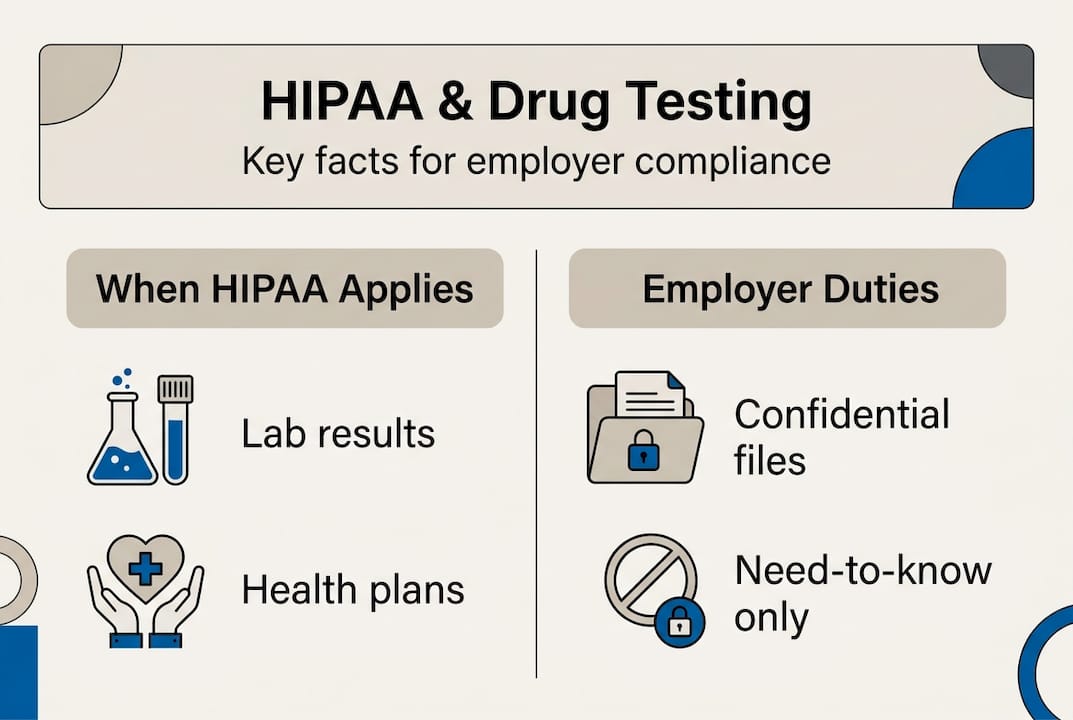
This distinction matters enormously in practice. Here is a quick breakdown of who holds the record and which law applies:
| Scenario | Record holder | Applicable law |
|---|---|---|
| Lab processes urine sample | Certified lab (covered entity) | HIPAA applies |
| MRO reviews and reports result | MRO (covered entity) | HIPAA applies |
| HR receives final result | Employer (not a covered entity) | ADA, state law, policy |
| Self-insured employer health plan | Employer acting as plan | HIPAA may apply |
| EAP referral records | Treatment provider | 42 CFR Part 2 |
One important exception: if your company operates a self-insured health plan, that plan function is a covered entity. Drug test results flowing through that plan could be PHI. This is a frequently overlooked edge case that trips up mid-size and large employers.
For a practical breakdown of how these rules affect your day-to-day operations, the employer compliance guide at CountryWideTesting.com walks through the most common scenarios step by step.
Key takeaways for understanding HIPAA’s actual scope:
- HIPAA covers labs and MROs handling test results, not employers receiving them
- Employer-held drug test records are excluded from PHI by definition
- Self-insured health plans are the main exception where HIPAA reaches employers directly
- State privacy laws may impose additional obligations regardless of HIPAA status
- Confidentiality obligations still exist for employers, they just come from other sources
Key legal intersect: ADA, 42 CFR Part 2, and related privacy laws
Just because HIPAA may not apply directly to your HR file does not mean you have a free pass on privacy. Two other legal frameworks impose strict obligations that many employers underestimate.

The Americans with Disabilities Act (ADA) is the first major layer. Substance use disorders can qualify as disabilities under the ADA, which means employees in recovery may be entitled to confidentiality protections and reasonable accommodations. ADA violations account for roughly half of all drug-free workplace lawsuits. That is a striking number, and it reflects how often employers focus on the test itself while ignoring the legal obligations that follow a positive result.
The second layer is 42 CFR Part 2, a federal regulation that governs records from substance use disorder treatment programs, including many Employee Assistance Programs (EAPs). 42 CFR Part 2 requires specific written authorization before any treatment-related records can be shared, even with other parts of your own organization. This is stricter than HIPAA in several ways.
Here is how these laws interact in real drug testing situations:
| Law | Applies to | Key requirement | Penalty risk | |—|—|—| | HIPAA | Labs, MROs, health plans | Protect PHI, limit disclosure | Fines up to $2.19M/year | | ADA | All employers with 15+ employees | Confidentiality, accommodations | Lawsuits, EEOC complaints | | 42 CFR Part 2 | EAP and treatment records | Specific written authorization | Federal enforcement | | State law | Varies by state | Often stricter than federal | State penalties |
Here is a numbered list of the most critical intersections to manage:
- An employee tests positive and discloses they are in treatment. ADA and 42 CFR Part 2 both activate.
- Your EAP refers an employee for counseling. Those records are now under 42 CFR Part 2, not just your internal policy.
- A supervisor asks HR about a test result. ADA requires you to limit that disclosure strictly.
- An employee is taking a prescribed medication that affects results. The interactive process under ADA requires you to engage before taking action.
- Your MRO flags a result. The role of MROs in filtering and interpreting results is your first compliance checkpoint.
Pro Tip: Always treat any record that touches an EAP or treatment program as doubly sensitive. Apply both ADA confidentiality rules and 42 CFR Part 2 authorization requirements, even if you are not sure which one technically governs. Err on the side of more protection, not less.
For a step-by-step look at how to structure your process from start to finish, the screening workflow for HR resource lays out each decision point clearly.
Employer best practices for HIPAA-aligned drug testing
Even when HIPAA does not directly apply to your employer records, building your process around HIPAA-aligned standards is smart risk management. It signals good faith, reduces exposure under ADA and state law, and creates a defensible paper trail if you ever face a complaint.
Employers must obtain written consent, limit access to results, and store records securely. These three requirements are the foundation of any compliant drug testing program. Here is how to put them into practice:
- Written consent forms should specify what is being tested, who will see the results, how long records are kept, and under what circumstances results may be shared. Vague consent forms are a common vulnerability.
- Access control means only HR personnel, the MRO, and supervisors with a direct operational need should ever see a test result. Document who accessed what and when.
- Secure storage requires drug test records to be kept in a file separate from the general personnel file. This is both a best practice and an ADA requirement.
- Staff training is non-negotiable. Supervisors who do not understand confidentiality rules are your biggest liability. Train them on what they can and cannot say, ask, or share.
- Third-party vendors should be vetted for compliance. Ask for documentation of their certifications and chain-of-custody procedures before you sign a contract.
Pro Tip: Use SAMHSA-certified labs and require clear chain-of-custody documentation for every sample. This protects you legally and ensures the result itself is defensible if challenged.
For more detail on structuring your internal process, the workplace compliance process guide and HR policy tips resource both offer concrete frameworks you can adapt to your organization’s size and industry.
Common compliance pitfalls and costly consequences
Knowing the rules is one thing. Seeing what happens when employers ignore them is another. The consequences of mishandling drug test results are not hypothetical.
Non-compliance risks include lawsuits for improper disclosure, ADA failures, and HIPAA fines where applicable. Real enforcement actions have resulted in significant financial and reputational damage for organizations that thought their processes were fine.
“The most expensive compliance mistake is assuming your current process is good enough without ever verifying it against current law.”
Here are the most common pitfalls, in order of how often we see them:
- Sharing results too broadly. A supervisor mentions a positive result to a colleague. That single conversation can trigger an ADA lawsuit.
- Missing or incomplete consent. Employees who were not properly informed before testing have successfully challenged adverse employment actions.
- Improper storage. Drug test records filed in the general personnel file create ADA violations and discovery problems in litigation.
- Ignoring the interactive process. When a positive result involves a disclosed disability or prescription, failing to engage the ADA interactive process is a separate legal exposure.
- Outdated vendor contracts. If your testing vendor’s practices do not meet current standards, you share liability for their failures.
The financial stakes are real. Concentra paid $112,500 to settle an OCR enforcement action related to access delays, and HIPAA fines can reach $2.19 million per violation category per year. EEOC cases under ADA have resulted in damages exceeding $400,000 in individual cases.
For a clear picture of what federal enforcement looks like and why it matters for your program, the federal compliance consequences resource is worth reviewing before your next policy audit.
Where most employers go wrong—and the real key to HIPAA compliance
Here is the uncomfortable truth we have seen play out repeatedly: employers spend significant energy getting the paperwork right and almost none getting the culture right. They collect signed consent forms, file them correctly, and then a supervisor casually mentions a test result in a team meeting. The form did not protect anyone.
Compliance is not a document. It is a behavior. The organizations that avoid costly violations are the ones where every person who touches a drug test result, from the HR coordinator to the department manager, understands exactly what they can and cannot do with that information.
Third-party partners are another overlooked risk. Even with the right contracts in place, a vendor who does not follow chain-of-custody protocols or who stores results insecurely creates exposure for your organization. Vetting your partners is not a one-time checkbox. It is an ongoing obligation.
The streamlined compliance workflow we recommend starts with process mapping: identify every person who touches a result, every system where it is stored, and every scenario where it might be shared. Once you can see the full picture, gaps become obvious. Most employers are surprised by what they find.
Ensure compliant drug testing with trusted solutions
Building a compliant drug testing program is significantly easier when you work with a vendor who already understands the regulatory landscape. CountryWideTesting.com partners with SAMHSA, ISO, CLIA, and CAP certified laboratories, which means every sample your employees provide is handled by a lab that meets the highest federal and industry standards.
Whether you need lab testing services for a specific program or want to build out a complete employer screening solution, our platform gives you access to certified testing, clear chain-of-custody documentation, and MRO support. Explore nationwide drug testing options designed specifically for employers who need reliable, defensible results and a process that holds up under scrutiny.
Frequently asked questions
Does HIPAA always apply to drug testing in the workplace?
No. HIPAA does not cover employer-held drug testing records. It applies when results are handled by covered entities like labs, MROs, or health plans, not when stored solely by the employer.
What are the penalties for mishandling drug test results under HIPAA?
When HIPAA applies, fines range from $145 to $2.19 million per violation category per year, depending on the level of negligence or intent.
Can employers share drug test results with supervisors or other staff?
Only personnel with a legitimate need-to-know, such as HR or an MRO, should access results. Only authorized personnel should access drug testing records, and written consent is best practice before any disclosure.
How does ADA affect workplace drug testing confidentiality?
The ADA requires confidentiality for medical information, including drug test results, and may require accommodations for employees with substance use disorders that qualify as disabilities.