
Why Comply With Federal Drug Testing: Key Employer Impacts
Managing drug testing in a safety-sensitive workplace can feel like a constant high-stakes balancing act for American HR managers. Federal requirements, including the Omnibus Transportation Employee Testing Act of 1991 and FMCSA rules, demand precise testing programs covering every crucial moment from pre-employment to post-incident. This guide clarifies the essential regulations, outlines the key drug testing scenarios, and highlights actionable steps for building a reliable and compliant drug-free workplace policy.
Table of Contents
- Federal Drug Testing Requirements Explained
- Key Testing Types and Processes for Employers
- Legal Framework and Compliance Obligations
- Risks of Non-Compliance and Common Pitfalls
- Benefits for Workplace Safety and Reputation
Key Takeaways
| Point | Details |
|---|---|
| Federal Regulations | Employers must adhere to federal drug testing requirements to ensure safety and compliance in the workplace. |
| Testing Types | Key drug testing scenarios include pre-employment screenings, random testing, and post-accident investigations. |
| Legal Obligations | Organizations must implement standardized testing procedures and protect employee privacy to avoid legal repercussions. |
| Impact on Safety | Robust drug testing programs enhance workplace safety, reduce accidents, and foster a culture of accountability among employees. |
Federal Drug Testing Requirements Explained
Employers operating in safety-sensitive industries must understand the complex landscape of federal drug testing regulations. The Department of Transportation drug testing procedures establish comprehensive guidelines that mandate specific testing protocols for organizations across multiple sectors.
Federal regulations require employers to implement rigorous drug testing programs that cover several critical testing scenarios:
- Pre-employment screening
- Random testing intervals
- Post-accident investigations
- Reasonable suspicion evaluations
- Return-to-duty assessments
- Follow-up compliance checks
The Federal Motor Carrier Safety Administration regulations specifically target commercial transportation industries, mandating strict testing requirements for commercial driver’s license (CDL) holders. These rules ensure that safety-sensitive positions maintain high standards of workplace safety and individual accountability.
Employers must follow precise administrative procedures when conducting drug tests, including:
- Utilizing certified laboratory testing facilities
- Maintaining confidential testing records
- Following standardized collection and analysis protocols
- Implementing clear communication about testing expectations
- Ensuring consistent application of testing policies
Drug testing is not just a compliance requirement – it’s a critical safety measure protecting both employees and organizations from potential risks.
Pro tip: Develop a comprehensive drug testing policy that clearly communicates expectations, procedures, and potential consequences to all employees.
Key Testing Types and Processes for Employers
Employers must navigate a complex landscape of drug testing methodologies to ensure workplace safety and regulatory compliance. Federal drug testing protocols outline specific requirements for detecting substance use across various safety-sensitive industries.
The primary drug testing types mandated by federal regulations include:
- Pre-employment screening
- Random testing
- Post-accident investigations
- Reasonable suspicion evaluations
- Return-to-duty assessments
- Follow-up compliance testing
Workplace drug screening can utilize multiple detection methods, with each testing approach offering unique advantages for identifying potential substance use:
Here’s a comparison of common federal drug detection methods and their workplace impact:
| Testing Method | Detection Window | Advantages | Considerations |
|---|---|---|---|
| Urine | 1-3 days | Cost-effective and broad | May miss very recent use |
| Blood | Hours to 1 day | Accurate for impairment | Invasive and costly |
| Oral Fluid | Up to 24 hours | Quick, hard to tamper | Limited window |
| Hair Follicle | Up to 90 days | Shows long-term use | Not for recent use |
-
Urine Testing
- Most common and cost-effective method
- Detects recent drug use
- Covers wide range of substances
-
Blood Testing
- Most accurate for current impairment
- Provides precise substance concentration
- More invasive and expensive
-
Oral Fluid Testing
- Quick and non-invasive
- Detects very recent drug use
- Difficult to manipulate
-
Hair Follicle Testing
- Longest detection window
- Reveals historical drug use patterns
- Less effective for recent consumption
Comprehensive drug testing goes beyond compliance – it’s a critical strategy for maintaining workplace safety and productivity.
Pro tip: Develop a standardized drug testing policy that clearly outlines all testing procedures, consequences, and employee rights to ensure transparency and fair implementation.
Legal Framework and Compliance Obligations
Employers must navigate a complex legal landscape of drug testing regulations that extend far beyond simple workplace policies. Federal transportation testing regulations establish comprehensive requirements for maintaining workplace safety and ensuring consistent compliance across industries.
Key legal obligations for employers include:
- Implementing standardized testing procedures
- Maintaining employee privacy protections
- Documenting testing protocols
- Reporting test results accurately
- Establishing clear consequences for violations
- Protecting employee rights during testing
The regulatory framework governing workplace drug testing is primarily established through several critical federal statutes:
-
Omnibus Transportation Employee Testing Act of 1991
- Mandates drug and alcohol testing in transportation sectors
- Establishes minimum testing standards
- Defines employer responsibilities
-
49 CFR Part 40 Regulations
- Details specific testing procedures
- Outlines laboratory certification requirements
- Defines consequences for non-compliance
-
Department of Transportation Guidelines
- Provides comprehensive testing protocols
- Specifies substances to be tested
- Establishes employee screening requirements
Compliance is not optional – it’s a legal mandate that protects both employers and employees from potential risks and liability.
Pro tip: Consult with legal counsel to develop a comprehensive drug testing policy that meets all federal and state regulatory requirements, ensuring both legal compliance and employee fairness.
Risks of Non-Compliance and Common Pitfalls
Employers face significant legal and financial consequences when failing to implement robust drug testing protocols. Non-compliance risks can devastate organizations, potentially resulting in severe penalties that extend far beyond simple regulatory infractions.
The most critical non-compliance risks include:
- Substantial financial penalties
- Loss of professional licensing
- Potential civil and criminal legal actions
- Reputational damage
- Increased workplace safety liability
- Potential federal funding disqualification
Common pitfalls that trigger non-compliance stem from several key operational failures:
-
Inadequate Testing Protocols
- Inconsistent specimen collection methods
- Poor documentation practices
- Lack of standardized testing procedures
-
Training and Oversight Failures
- Insufficient staff training on testing requirements
- Weak internal compliance monitoring
- Unclear communication of testing expectations
-
Privacy and Legal Violations
- Improper handling of employee test results
- Failure to protect employee confidentiality
- Inconsistent application of testing policies
One compliance mistake can trigger a cascade of legal and financial consequences that could potentially destroy an organization’s credibility and operational capacity.
Pro tip: Develop a comprehensive internal audit system that regularly reviews drug testing procedures, ensuring ongoing compliance and identifying potential vulnerabilities before they become critical issues.
Benefits for Workplace Safety and Reputation
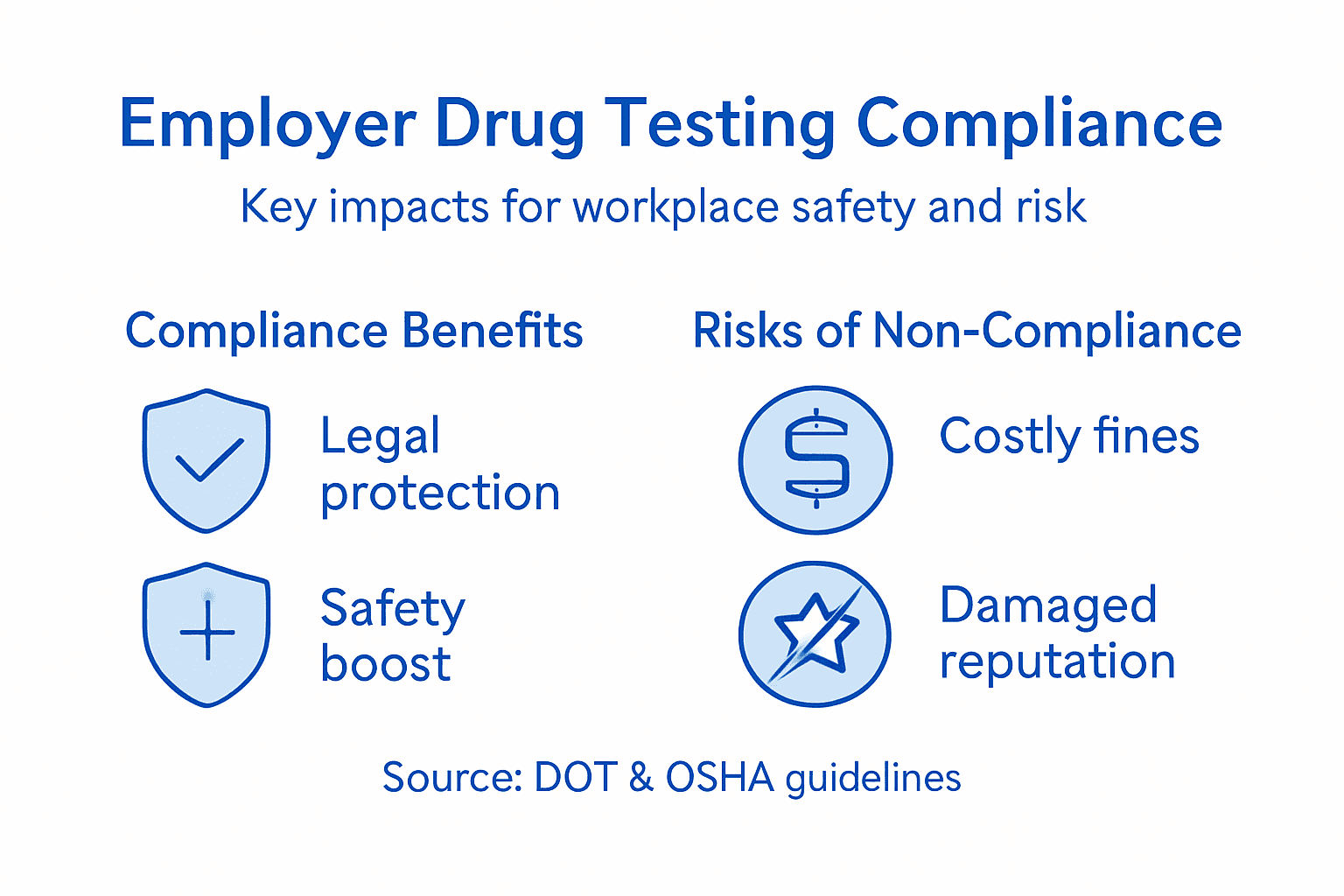
Companies that prioritize drug testing demonstrate a profound commitment to workplace safety and organizational integrity. Drug testing programs significantly enhance workplace protection, creating environments where employee performance and public safety are paramount.
Key benefits of comprehensive drug testing include:
- Reduced workplace accidents
- Enhanced employee productivity
- Lower insurance and liability costs
- Improved organizational reputation
- Stronger employee trust
- Proactive risk management
The most significant advantages of robust drug testing programs emerge across multiple operational dimensions:
This table summarizes how compliant drug testing programs protect organizational interests:
| Area of Impact | Benefit Provided | Business Outcome |
|---|---|---|
| Workplace Safety | Prevents impaired work | Fewer accidents and downtime |
| Legal Risk | Meets regulations | Reduces lawsuits and penalties |
| Employee Trust | Promotes fair policies | Stronger morale and retention |
| Reputation | Public safety commitment | Improved client and partner trust |
-
Safety Impact
- Identifies potentially impaired workers
- Prevents dangerous workplace scenarios
- Protects employees and public safety
-
Legal and Financial Protection
- Demonstrates regulatory compliance
- Reduces potential litigation risks
- Lowers workers’ compensation expenses
-
Organizational Culture
- Signals commitment to employee wellness
- Establishes clear performance expectations
- Promotes a responsible work environment
Drug testing is more than a procedure – it’s a strategic investment in your organization’s most valuable asset: its people.
Pro tip: Communicate drug testing policies transparently, framing them as a mutual commitment to safety and professional excellence rather than as punitive measures.

Simplify Federal Drug Testing Compliance with Trusted Solutions
Navigating federal drug testing requirements can feel overwhelming for employers committed to workplace safety and legal compliance. From adhering to strict Department of Transportation drug testing procedures to managing varied testing scenarios like random and post-accident screenings, every step demands precision and reliability. Common challenges such as ensuring proper specimen collection, maintaining confidentiality, and partnering with certified labs heighten the need for a dependable testing provider.
At CountryWideTesting.com, we understand the high stakes involved in maintaining compliant drug testing programs. We offer a wide array of SAMHSA and CLIA certified drug and alcohol testing products including urine and mouth swab kits. Our partnership with licensed laboratories meeting ISO and CAP standards guarantees trustworthy processing and reporting. Whether you need comprehensive employer solutions or customized lab testing, our platform delivers secure, efficient, and compliant services designed to protect your organization and employees.
Take control of your drug testing program today by choosing a partner that prioritizes accuracy and regulatory compliance. Visit CountryWideTesting.com now to explore tailored testing options that align with federal mandates and safeguard your workplace integrity.
Frequently Asked Questions
What are the main federal drug testing requirements for employers?
Employers must implement drug testing programs that include pre-employment screening, random testing, post-accident investigations, reasonable suspicion evaluations, return-to-duty assessments, and follow-up compliance checks.
Why is it important for employers to comply with federal drug testing regulations?
Compliance protects both employers and employees from legal risks, enhances workplace safety, reduces liabilities, and ensures a safe working environment in safety-sensitive industries.
What are the main types of drug testing methods used in federal programs?
The common drug testing methods include urine testing, blood testing, oral fluid testing, and hair follicle testing, each with its unique detection windows and advantages.
What are the potential consequences of non-compliance with drug testing regulations?
Non-compliance can result in significant financial penalties, loss of professional licenses, civil and criminal legal actions, reputational damage, and increased workplace safety liabilities.