
How drug testing shapes HR policies for safer workplaces
Drug testing in the workplace often carries a misleading assumption: that positive results directly indicate impairment on the job. In reality, most tests detect metabolites that linger long after effects wear off, creating compliance puzzles for HR professionals navigating safety mandates, privacy laws, and evolving cannabis regulations. You need clarity on how testing fits into modern HR strategy, balancing accident prevention with legal protections for employees. This guide cuts through misconceptions to reveal drug testing’s actual role in policy design, compliance frameworks, and workplace safety outcomes.
Table of Contents
- Key takeaways
- Why drug testing is vital in HR policies
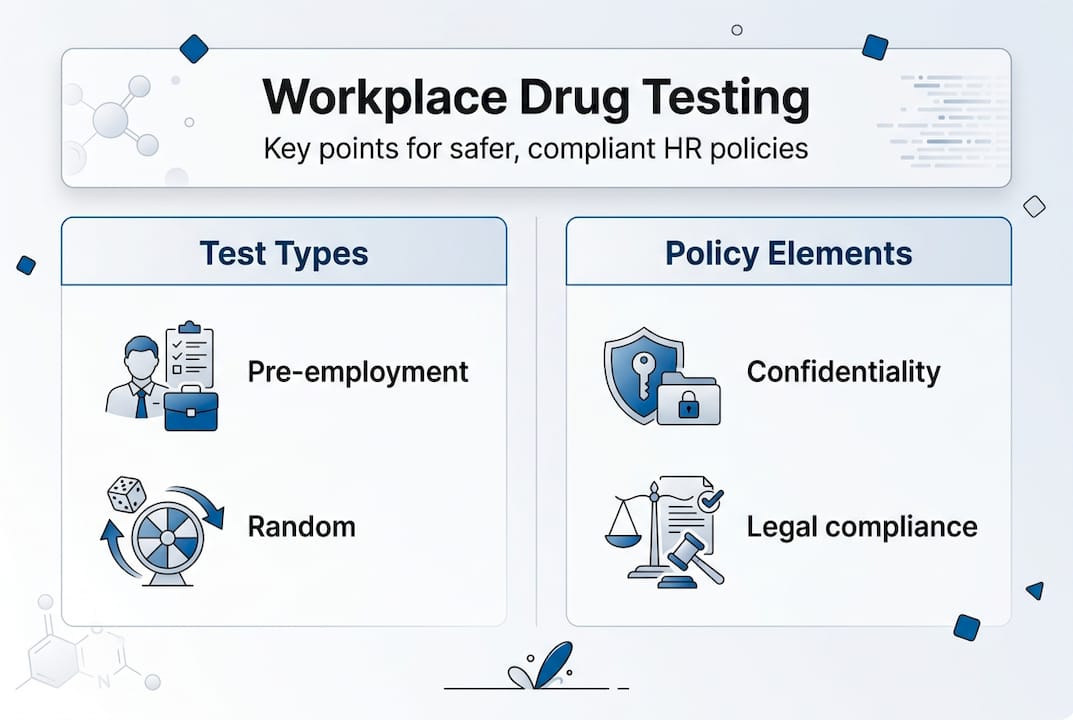
- Types of drug tests and their application in HR policies
- Navigating legal and ethical considerations in drug testing
- Emerging trends and best practices in HR drug testing policies
- Explore comprehensive drug testing solutions
- Frequently asked questions about drug testing in HR
Key Takeaways
| Point | Details |
|---|---|
| Impairment detection gap | Most tests detect metabolites that linger after impairment ends, making it hard to assess current on the job safety. |
| Legal alignment with laws | Policies should align with federal and state requirements including the ADA and cannabis regulations. |
| Test types vary | Categories include pre employment, random, reasonable suspicion, and post accident testing. |
| Fentanyl focus | Fentanyl positivity is seven times higher in random tests than in pre employment tests. |
| Policy as safety program cornerstone | Effective programs couple testing with supervisor training, incident reporting, and employee support resources. |
Why drug testing is vital in HR policies
Drug testing serves three core functions in HR strategy: preventing workplace accidents, meeting regulatory obligations, and reducing organizational liability. Safety-sensitive industries see the clearest benefits. Organizations implementing comprehensive testing programs report accident reductions of up to 50%, with parallel drops in absenteeism and workers’ compensation claims. These outcomes matter most in transportation, construction, and manufacturing, where impaired judgment creates immediate hazards.
Federal law mandates testing for DOT-regulated roles, covering commercial drivers, pilots, and pipeline operators. The DOT employer guidelines specify pre-employment, random, reasonable suspicion, post-accident, return-to-duty, and follow-up testing protocols. For federal contractors, the Drug-Free Workplace Act requires written policies and employee awareness programs, though actual testing remains optional for most.
Pro Tip: Non-regulated private employers face no universal federal testing mandate, giving you flexibility to design programs matching your specific risk profile and state law requirements.
Beyond compliance, testing functions as a deterrent. Employees aware of random screening protocols show lower substance use rates. This preventive effect extends beyond detection, shaping workplace culture around safety expectations. However, testing alone cannot guarantee a drug-free environment. Effective drug screening supports broader workplace safety initiatives including supervisor training, incident reporting systems, and employee assistance resources.
“Drug testing programs reduce workplace accidents by creating accountability and early intervention opportunities, but they work best as part of comprehensive safety management rather than standalone solutions.”
The liability protection aspect cannot be overstated. Employers demonstrating reasonable safety measures, including drug testing where appropriate, strengthen their legal position in negligence claims following workplace incidents. Documentation of testing policies and consistent application provides evidence of due diligence in maintaining safe working conditions.
Types of drug tests and their application in HR policies
Each testing category serves distinct HR objectives, requiring clear policy definitions for lawful, effective implementation.
-
Pre-employment testing screens candidates before job offers become final, establishing baseline expectations. Most common in safety-sensitive roles, this approach filters applicants with recent substance use. However, cannabis legalization complicates pre-employment screening as some states prohibit adverse actions based solely on positive cannabis results for off-duty use.
-
Random testing operates as an ongoing deterrent, selecting employees unpredictably throughout employment. This method proves most effective for detecting harder drugs. Fentanyl positivity rates are seven times higher in random versus pre-employment tests, revealing substance issues that emerge after hiring. Random protocols require truly random selection methods, documented procedures, and immediate notification to maintain legal defensibility.
-
Reasonable suspicion testing responds to observable signs of impairment or policy violations. This category demands the most careful documentation. Supervisors must record specific behaviors such as slurred speech, coordination problems, erratic conduct, or safety violations before ordering tests. Documented observable signs are legally required to justify reasonable suspicion testing and withstand potential discrimination challenges.
-
Post-accident testing investigates whether substance use contributed to workplace incidents. Policies should specify triggering events, such as injuries requiring medical treatment, property damage above set thresholds, or near-miss incidents with serious potential consequences. Timing matters critically, as delays allow substances to metabolize, reducing detection accuracy.
Pro Tip: Train multiple supervisors in reasonable suspicion recognition to ensure coverage across shifts and prevent single-person bias in testing decisions. Use standardized observation checklists to improve consistency.
Your policy must explicitly define which test types apply to which employee categories, the substances screened, collection procedures, and confidentiality safeguards. Ambiguous policies create legal vulnerabilities and employee distrust. A well-structured drug screening workflow ensures consistent application across all testing scenarios, protecting both organizational interests and employee rights.
Navigating legal and ethical considerations in drug testing
Federal and state laws create a complex compliance landscape for drug testing policies. No universal federal mandate requires private employers to test, but specific regulations govern contractors and safety-sensitive industries. The Americans with Disabilities Act prohibits discrimination against employees with past substance use disorders or those participating in rehabilitation programs. ADA protections extend to recovering individuals, meaning you cannot refuse employment solely based on treatment history, though current illegal drug use receives no protection.

Family and Medical Leave Act provisions allow employees to take leave for substance abuse treatment without jeopardizing job security. The National Labor Relations Act adds another layer, as union employees may challenge testing policies through collective bargaining. These federal frameworks establish baseline protections you must honor regardless of state location.
State laws introduce significant variation, particularly around cannabis. Over 20 states now prohibit employment actions based on off-duty cannabis use detected through testing. California AB2188 bans discrimination for positive cannabis tests detecting non-psychoactive metabolites, pushing employers toward impairment-focused alternatives. New York, Nevada, and New Jersey impose similar restrictions, with some requiring advance notice of testing policies and limiting reasonable suspicion testing to trained supervisors.
| Legal Framework | Key Requirements | HR Policy Impact |
|---|---|---|
| Federal (ADA, FMLA) | Protect past users, rehab participants | Cannot discriminate based on treatment history |
| DOT Regulations | Mandatory testing for covered roles | Must follow specific protocols, cutoff levels |
| State Cannabis Laws | Vary by jurisdiction | May prohibit off-duty use discipline, require impairment focus |
| State Privacy Laws | Notice, consent, confidentiality | Must inform employees, secure results |
The metabolite detection problem creates ethical dilemmas. Standard urine tests identify THC metabolites remaining up to 30 days after use, providing no insight into current impairment. An employee testing positive may have consumed cannabis legally weeks earlier while off-duty, raising fairness questions. Some jurisdictions respond by requiring employers to demonstrate actual impairment rather than mere presence of metabolites.
Pro Tip: Multistate employers need location-specific policy versions addressing each state’s unique requirements. Centralizing policy management while allowing regional adaptations prevents compliance gaps.
Privacy considerations extend beyond legal minimums. Employees expect confidentiality in testing processes and results. Medical Review Officers should evaluate positive results, contacting employees privately to discuss legitimate medication use or other explanations before reporting to employers. Understanding drug testing policy requirements helps you build trust while maintaining safety standards. Even in healthcare, where safety concerns run high, marijuana testing for nurses must balance patient safety with evolving legal protections for off-duty use.
Emerging trends and best practices in HR drug testing policies
Workplace drug testing data reveals shifting substance use patterns demanding policy updates. Overall positivity rates hover around 4.4% across all testing types, but fentanyl detection in random tests shows alarming increases. This synthetic opioid’s potency and prevalence create unique workplace risks, as even small amounts cause severe impairment. Random testing catches fentanyl use that pre-employment screening misses, highlighting the value of ongoing monitoring in high-risk environments.
| Substance Category | Pre-Employment Positivity | Random Testing Positivity | Key Trend |
|---|---|---|---|
| Cannabis | 3.9% | 5.3% | Complicated by legalization, metabolite persistence |
| Cocaine | 0.5% | 0.7% | Stable rates, regional variation |
| Opiates | 0.6% | 0.9% | Includes prescription and illicit use |
| Fentanyl | 0.2% | 1.4% | Dramatic increase in random testing |
The cannabis impairment challenge drives innovation in testing methods. Traditional urine tests detect non-psychoactive metabolites lingering long after effects end, creating false positives for workplace impairment. Behavioral observation and oral fluid testing offer better alternatives for detecting recent use and actual impairment. Saliva tests identify THC itself rather than metabolites, providing a shorter detection window aligned with intoxication periods.
Best practices for modern drug testing policies include:
- Impairment-focused approaches: Train supervisors to recognize behavioral signs of impairment rather than relying solely on metabolite detection. Document specific observations like coordination problems, judgment lapses, or safety violations.
- Medical Review Officer integration: Require MRO review of all positive results before employment actions. MROs distinguish legitimate medication use from illicit substances, reducing wrongful termination risks.
- Employee Assistance Program connections: Link positive results to confidential counseling and treatment resources rather than automatic termination. This approach supports recovery while maintaining safety standards.
- Regular policy audits: Review testing protocols annually to incorporate new state laws, emerging substances, and evolving best practices. Synthetic drugs and changing cannabis regulations demand ongoing attention.
- Transparent communication: Clearly explain testing rationale, procedures, and consequences to all employees. Transparency builds trust and improves compliance with safety expectations.
Pro Tip: Consider adopting oral fluid testing for reasonable suspicion and post-accident scenarios where recent use matters most, while reserving urine testing for pre-employment and random screening where broader detection windows serve deterrent purposes.
Your testing strategy should reflect your specific industry risks and workforce composition. Workplace safety drug screening programs work best when tailored to operational realities rather than copied from generic templates. Manufacturing environments with heavy equipment need different approaches than office settings with minimal safety risks. Understanding how to interpret lab test results accurately ensures appropriate responses to positive findings, distinguishing true safety concerns from legal off-duty conduct.
Explore comprehensive drug testing solutions
Implementing effective drug testing policies requires reliable laboratory partnerships and testing infrastructure. Professional lab testing services provide the certified analysis, Medical Review Officer support, and compliance documentation necessary for defensible HR programs. SAMHSA, ISO, CLIA, and CAP accreditations ensure results meet legal and scientific standards for employment decisions.
Multistate operations benefit from nationwide drug testing networks offering consistent protocols across locations while adapting to state-specific legal requirements. These partnerships simplify compliance management, provide employee access to convenient collection sites, and deliver rapid turnaround times for time-sensitive testing scenarios. Whether you need pre-employment screening, random testing programs, or reasonable suspicion protocols, professional testing services align laboratory capabilities with your HR policy objectives.
Frequently asked questions about drug testing in HR
What types of drug tests should HR include in policies?
Include pre-employment, random, reasonable suspicion, and post-accident testing with clear definitions of when each applies. Specify tested substances, collection methods, and cutoff levels to ensure consistent application and legal defensibility.
How do federal and state laws affect drug testing rules?
Federal laws mandate testing for DOT-covered roles and protect employees in recovery programs, while state laws vary significantly on cannabis testing and off-duty use protections. Review drug testing policy requirements for your specific jurisdictions to ensure compliance.
What are best practices for reasonable suspicion testing?
Train multiple supervisors to recognize impairment signs, document specific observable behaviors before ordering tests, and use standardized checklists. Never rely on hunches or single observations; reasonable suspicion requires concrete, documented evidence of policy violations or safety concerns.
How should I handle positive test results compliantly?
Require Medical Review Officer evaluation before taking employment action, allow employees to explain legitimate medication use, and consider rehabilitation options through Employee Assistance Programs. Document all steps and apply policies consistently across similar situations.
What recent drug trends should HR monitor for policy updates?
Fentanyl positivity rates in random testing have increased dramatically, while cannabis legalization continues expanding with varying workplace protections. Monitor synthetic drug emergence, state law changes, and shifts toward impairment-focused testing methods to keep policies current and effective.