
Transit authority drug testing compliance workflow guide
TL;DR:
- Effective compliance starts with documented programs, safety-sensitive role designations, and qualified vendors.
- Key testing includes pre-employment, random, post-accident, and return-to-duty, each with specific procedures.
- Ongoing oversight, training, and data management are essential for audit readiness and safety culture.
Transit authorities carry a unique burden: one compliance failure can ground operations, expose the agency to federal enforcement, and put thousands of riders at risk before anyone realizes there’s a problem. Drug testing requirements for FTA-covered employers fall under 49 CFR Part 655, which sets precise rules for pre-employment screening, random testing rates, post-accident procedures, and ongoing reporting. This guide walks compliance officers and transit managers through the full workflow, from program setup and vendor coordination to managing positive results and surviving an FTA audit without findings.
Table of Contents
- Essential tools and prerequisites for drug testing compliance
- Step-by-step workflow: From pre-employment through random testing
- Handling reasonable suspicion cases and positive test results
- Verification: Oversight, reporting, and common compliance pitfalls
- Lessons learned: Why compliance is more than checking regulatory boxes
- Take your compliance workflow further with expert support
- Frequently asked questions
Key Takeaways
| Point | Details |
|---|---|
| Understand regulatory triggers | Clear written policies and job role identification are foundational to compliance. |
| Follow stepwise workflow | Each test type has unique requirements; use a structured workflow to avoid mistakes. |
| Document reasonable suspicion | Supervisors must document exact observations to justify reasonable suspicion testing. |
| Meet FTA minimum rates | In 2026, random drug testing is set at 50% and random alcohol at 10% for FTA compliance. |
| Verify and report | Regular internal reviews and proper MIS reporting secure audit readiness and continuous compliance. |
Essential tools and prerequisites for drug testing compliance
Before a single test is ordered, the organizational foundation has to be solid. Agencies that skip foundational setup steps often discover the gaps only when an auditor or a serious incident forces the issue, and that is the worst possible moment for discovery.
Understanding drug testing in transportation goes beyond knowing which panels to order. Effective compliance starts with three concrete prerequisites: a written drug and alcohol testing program, correctly identified safety-sensitive positions, and a formal contract with a qualified Third-Party Administrator (TPA) or testing vendor.
The FTA’s reasonable suspicion training resources make this explicit: the core workflow requires establishing written program policies, coordinating with a drug and alcohol testing vendor or TPA, and ensuring that covered positions and safety-sensitive roles are correctly identified before any testing begins. These are not optional starting points. They are the legal foundation every subsequent test rests on.
The table below summarizes the essential requirements compliance officers should verify before initiating or improving a program:
| Requirement | Details | Who is responsible |
|---|---|---|
| Written program policy | Must align with 49 CFR Part 655 | HR/Legal/Compliance officer |
| Safety-sensitive role designation | All covered positions formally documented | Operations manager |
| TPA or vendor contract | Signed agreement with licensed collector network | Compliance officer |
| Supervisor training | Reasonable suspicion training completed and logged | Training department |
| MRO arrangement | Medical Review Officer retained for result verification | Program administrator |
| Employee notification | Written notice of testing policy distributed to all covered staff | HR department |
For a detailed walkthrough of how to structure the program from day one, the DOT drug testing setup guide offers practical employer-focused steps that apply directly to transit settings.
Key prerequisites before launching or auditing your program:
- Confirm all safety-sensitive job descriptions are current and formally approved
- Verify your TPA is registered and uses SAMHSA-certified laboratories
- Ensure supervisors have completed DOT-approved reasonable suspicion training within the required timeframe
- Check that your written policy has been reviewed and updated within the last 12 months
- Confirm your MRO is DOT-qualified and has a current certification on file
Pro Tip: Maintain a policy version log with effective dates and distribution records. When an auditor asks whether a specific employee was notified of the program under the current policy version, you want a dated signature or electronic acknowledgment ready, not a verbal assurance.
Step-by-step workflow: From pre-employment through random testing
Once all compliance tools and policies are in place, here’s how to execute the workflow step by step.
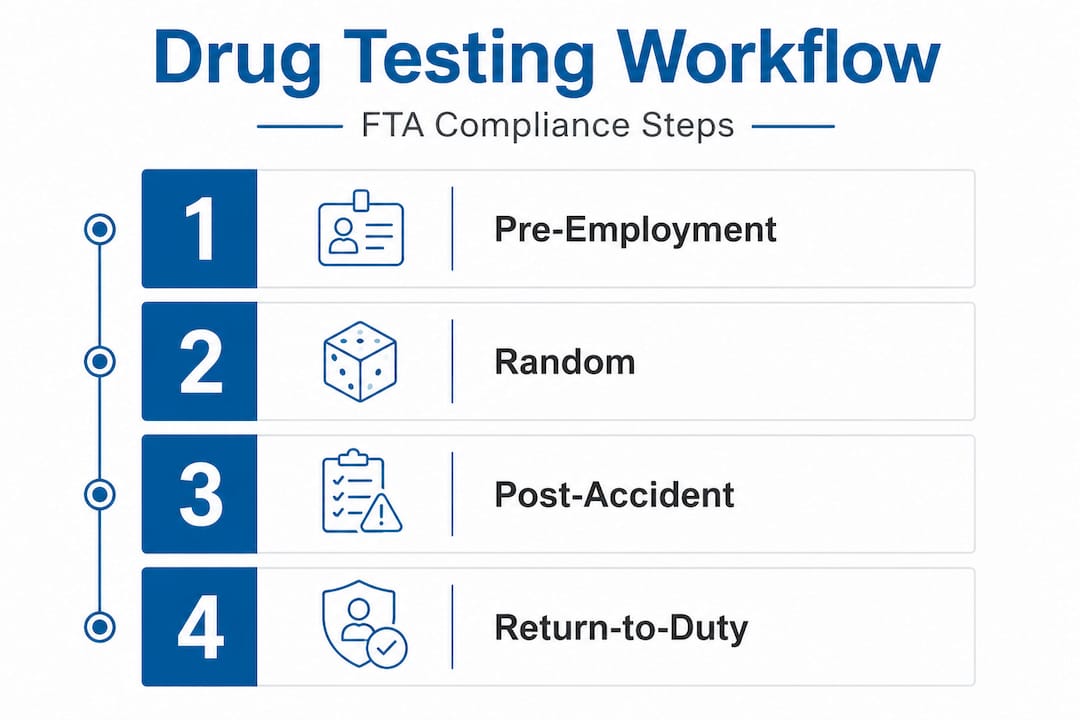
The four core testing categories in FTA-regulated programs are pre-employment, random, post-accident, and return-to-duty or follow-up testing. Each has distinct triggers, documentation requirements, and timelines. Treating them as interchangeable is a common and costly mistake.
Pre-employment testing
Under 49 CFR 655.41, an employer must ensure that a covered employee or applicant receives a pre-employment drug test and receives a verified negative result before that individual performs any safety-sensitive function for the first time. No exceptions. No provisional start dates pending results.
Step-by-step pre-employment process:
- Identify the position as safety-sensitive and document that designation in the personnel file
- Issue the testing order through your TPA or collection site network before the start date
- Confirm the specimen reaches a SAMHSA-certified lab within the required chain of custody timelines
- Wait for the MRO to verify and transmit the negative result in writing
- Document the verified negative result in the employee’s drug testing file
- Authorize the employee to perform safety-sensitive duties only after step 5 is complete
Random testing
Random testing is where many transit agencies develop compliance vulnerabilities. The selection process must be truly random, meaning every covered employee in the pool has an equal chance of selection each time a draw occurs. Using a scientifically valid random number generator through your TPA is the standard approach.
For calendar year 2026, the FTA minimum random testing rates are set at 50% for drug testing and 10% for alcohol testing among covered employees. These rates apply to your total covered employee pool and must be met by December 31, 2026.
Understanding the types of transportation drug testing and how each fits into your calendar is essential for planning. A well-managed random drug testing workflow distributes selections evenly across quarters rather than front-loading or back-loading them into a single period.
| Testing type | Trigger | Key documentation required | 2026 rate or timeframe |
|---|---|---|---|
| Pre-employment | Before first safety-sensitive duty | Negative result before start | Required every new hire |
| Random drug | Computer-generated selection | Selection record, chain of custody | 50% of covered pool |
| Random alcohol | Computer-generated selection | Selection record, BAT results | 10% of covered pool |
| Post-accident | Qualifying accident threshold met | Accident report, testing timeline log | Within 32 hours (drugs), 8 hours (alcohol) |
| Return-to-duty | After verified positive + SAP clearance | SAP evaluation, negative test result | Before resuming safety-sensitive duties |
Pro Tip: Stagger random test draws across all four quarters rather than running a single annual draw. Evenly distributed quarterly selections reduce the statistical chance of clustering and give auditors evidence of a systematic, ongoing program rather than a one-time administrative event.
Handling reasonable suspicion cases and positive test results
With the main workflow operational, transit authorities must prepare for special cases such as reasonable suspicion and verified positives.
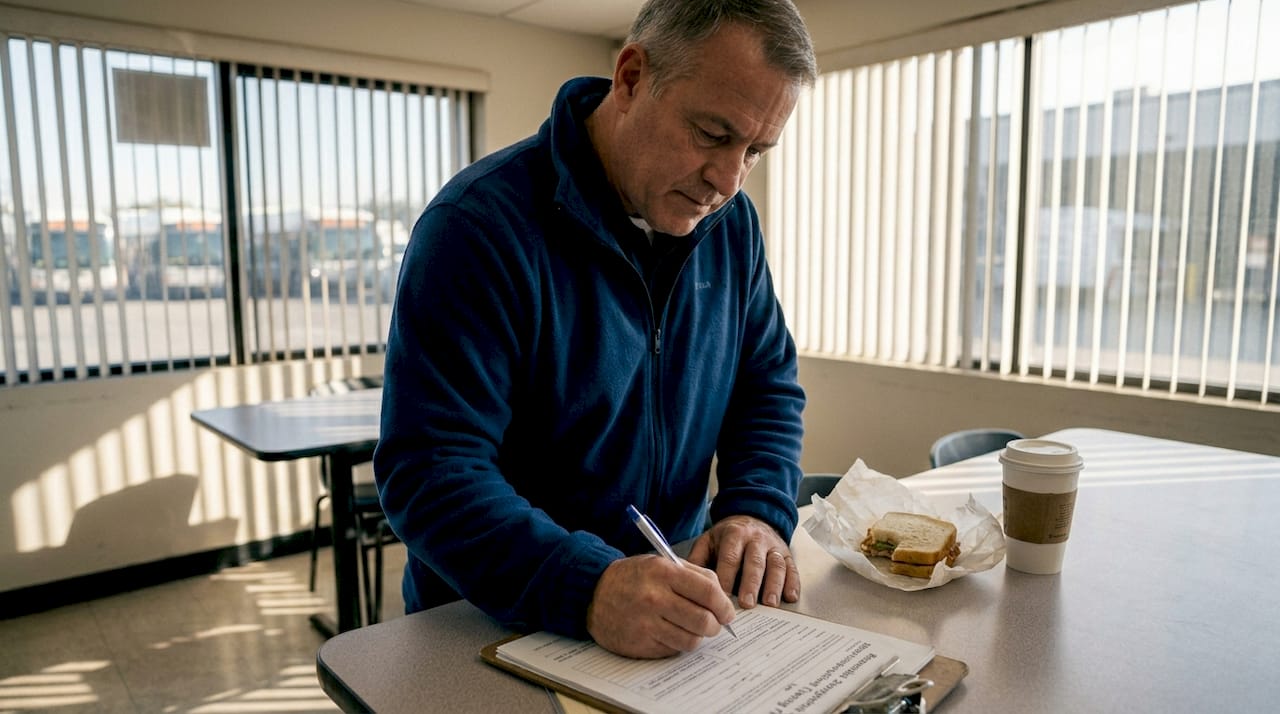
Reasonable suspicion testing is the category that most often generates compliance findings during FTA audits, and the reason is almost always documentation failure rather than intent. Supervisors who observe concerning behavior but fail to write it down contemporaneously, or who delay initiating the test while seeking a second opinion, create legal exposure that a clean testing record cannot fix.
Observable signs that may justify reasonable suspicion testing include:
- Slurred speech or incoherent communication during a shift
- Noticeable odor of alcohol or marijuana during pre-trip or mid-route check
- Erratic or unsafe vehicle operation witnessed directly by a supervisor
- Unusual physical symptoms such as glassy eyes, unsteady gait, or tremors
- Behavioral patterns such as aggression, disorientation, or extreme mood swings not consistent with prior conduct
Required documentation steps when initiating a reasonable suspicion test:
- Record specific observations in writing immediately, including exact time, date, location, and what was seen or heard
- Have a second trained supervisor co-document when possible, though this is not always required
- Initiate the drug or alcohol test as soon as safely practicable after documenting
- Remove the employee from safety-sensitive duty immediately pending the result
- Store all documentation in a secure, access-restricted file
The DOT employer guidelines are direct on this point:
“A practical compliance workflow for transit reasonable suspicion starts with trained supervisors and officers documenting specific, contemporaneous observations and initiating the drug or alcohol test based on probable use or misuse, not hunches or complaints.”
For a broader look at conducting drug testing for compliance in regulated settings, the documentation discipline described above applies across all testing categories, not just reasonable suspicion.
After a verified positive result, compliance does not end at notification. The post-positive process involves several mandatory steps. The employee must be immediately removed from safety-sensitive duties. They have the right to request a split specimen test, and that request must be honored within 72 hours of notification. A Substance Abuse Professional (SAP) evaluation must be completed before any return-to-duty determination is made. According to DOT return-to-duty procedures, return-to-duty and follow-up testing requirements, including the SAP evaluation process, must be fully completed before an employee can resume performing safety-sensitive functions.
Verification: Oversight, reporting, and common compliance pitfalls
Completing drug tests is not the end. Ongoing verification, oversight, and reporting cement your compliance standing.
The Management Information System (MIS) report is the primary annual reporting vehicle for FTA-covered employers. It documents all testing activity from the prior calendar year and must be submitted by March 15 of the following year. This report is not optional, and errors or missing data are common audit triggers.
For 2026, the FTA random testing minimums remain at 50% for drug testing and 10% for alcohol testing. These rates are not static policy decisions by individual agencies. They are set annually based on verified industry violation rates gathered through FTA’s own MIS reporting process. That means the rates can change year over year, and compliance teams should treat random rate management as a data-driven, auditable control rather than a setting configured once and forgotten.
A step-by-step drug screening workflow that incorporates quarterly rate tracking helps managers confirm they are on pace before the December 31 deadline rather than scrambling in Q4 to meet annual minimums.
Common compliance pitfalls and how to avoid them:
- Failing to test before the first safety-sensitive duty: Build a hard stop in your onboarding checklist that requires MRO-verified negative result documentation before the system allows a safety-sensitive assignment
- Supervisors initiating reasonable suspicion tests without contemporaneous written documentation: Require supervisors to submit a completed observation form before the test order is placed in your TPA portal
- Running random draws with predictable patterns: Use your TPA’s automated random selection system and audit the draw methodology annually
- Letting MRO or TPA contracts lapse: Set calendar reminders 90 days before contract renewals and confirm SAMHSA certification currency at each renewal
- Missing MIS submission deadlines: Assign a specific compliance officer as the MIS data owner with a Q4 data reconciliation checklist
- Inadequate record retention: Federal regulations require drug testing records to be retained for specific periods, ranging from one year for negative results to five years for verified positives and refusals
Pro Tip: Schedule a quarterly internal compliance review, not just an annual one. A 30-minute review of your random selection counts, documentation files, and TPA reporting against your program benchmarks catches drift early and keeps your team audit-ready throughout the year.
Lessons learned: Why compliance is more than checking regulatory boxes
Transit managers who have lived through an FTA audit will tell you the same thing: the programs that survive scrutiny are the ones where compliance is treated as a living practice, not a binder that gets pulled out once a year.
That distinction matters more than most agencies realize until it’s too late. Consider reasonable suspicion testing. DOT guidance is clear that this category depends entirely on contemporaneous, articulable, first-hand supervisor observations. Documentation discipline and training currency are not administrative niceties. They are what determines whether your reasonable suspicion test holds up under review or becomes an agency liability.
The agencies that do this well share a common trait: they invest in their supervisors as compliance assets. That means annual refresher training, not just one-time certification. It means practicing documentation scenarios in advance, not just reading a policy. It means building a culture where a supervisor feels supported, not second-guessed, when they initiate a reasonable suspicion test with solid documentation.
Data management is the other underrated investment. An agency that tracks testing rates in a spreadsheet updated monthly is better positioned than one relying on year-end TPA summaries to figure out whether they’ve met the 50% drug testing minimum. Proactive data management turns compliance from a reactive exercise into a forward-looking safety strategy.
This same mindset applies to other high-stakes sectors. For example, reviewing drug testing protocols for private schools illustrates how institutions outside transit have built documentation-first cultures that translate directly into audit resilience. The principles are transferable.
Compliance, at its best, is a safety culture strategy. The paperwork is evidence of the culture, not a substitute for it.
Take your compliance workflow further with expert support
Managing FTA drug testing compliance internally is achievable, but it requires the right infrastructure, the right partners, and ongoing attention to rate management and documentation. Many transit agencies find that a combination of a qualified TPA and access to rapid, certified lab services makes the difference between a reactive program and a genuinely audit-ready one.
CountryWideTesting.com provides access to lab testing services backed by SAMHSA-certified, ISO, CLIA, and CAP-accredited laboratories, giving transit compliance officers confidence that results will meet federal standards and hold up under MRO and auditor review. For agencies looking to build or reinforce their testing supply chain, 12-panel drug test cups and customizable screening options are available for workplace programs that need reliable, fast preliminary results before confirmation lab testing. Whether you are setting up a new program or closing compliance gaps in an existing one, the right testing partner simplifies every step of the workflow.
Frequently asked questions
What are the minimum FTA drug and alcohol testing rates for 2026?
For 2026, the FTA minimum random testing rate is 50% for drug testing and 10% for alcohol testing across all covered transit employees.
When must a transit employee complete a pre-employment drug test?
A verified negative result is required before the employee performs any safety-sensitive function, as mandated by 49 CFR 655.41, with no exceptions for provisional assignments.
How should a supervisor initiate drug testing based on reasonable suspicion?
Supervisors must document specific, contemporaneous observations in writing before initiating a test, because DOT guidelines require testing to be based on direct observation, not secondhand reports or general suspicion.
What happens after a verified positive drug test?
The employee must be removed from safety-sensitive duties immediately, and return-to-duty steps including a Substance Abuse Professional evaluation must be fully completed before the employee can resume covered functions.