
Build a Compliant Drug Testing Workflow for Schools
TL;DR:
- Schools must establish clear, documented drug testing policies including consent, procedures, and confidentiality.
- A consistent, chain-of-custody process and trained staff are essential for compliant testing and valid results.
- Effective programs focus on community dialogue and student support, not just punitive measures.
Private schools are under more scrutiny than ever when it comes to student substance use. Administrators who lack a documented, step-by-step drug testing workflow risk inconsistent enforcement, family disputes, and potential legal exposure. A well-designed process protects students, supports staff, and keeps your school aligned with both state law and community expectations. This guide walks you through everything: from building a legally sound policy foundation, to executing tests, responding to results, and continuously improving your program so it earns lasting trust from families and faculty alike.
Table of Contents
- Laying the foundation: Key requirements and policy essentials
- Step-by-step workflow: Implementing compliant drug testing
- Addressing results: Response protocols and student support
- Verifying impact: Monitoring, audits, and continuous improvement
- Why the “one size fits all” approach misses the mark
- Get expert help setting up your school’s drug testing workflow
- Frequently asked questions
Key Takeaways
| Point | Details |
|---|---|
| Policy groundwork | A clear, legally compliant drug testing policy lays the foundation for effective workflows. |
| Stepwise workflow | Following clear steps ensures fair, transparent, and consistent handling of student drug testing. |
| Support over punishment | Modern best practices prioritize student assessment and counseling over instant discipline. |
| Continuous improvement | Feedback-driven review and adaptation make drug testing policies safer and more effective. |
Laying the foundation: Key requirements and policy essentials
Before a single test is administered, your school needs a clear, documented policy. This is not optional paperwork. It is the legal and ethical backbone of everything that follows. Without it, even well-intentioned testing can result in challenges from families, accusations of bias, or regulatory problems.
Private schools have more flexibility than public schools in shaping their drug testing programs, but that flexibility comes with responsibility. You still need to understand your state’s privacy laws, student rights statutes, and any accreditation requirements. Consult with legal counsel before finalizing any policy language, and review your school’s charter or mission statement to ensure the program aligns with your stated values.
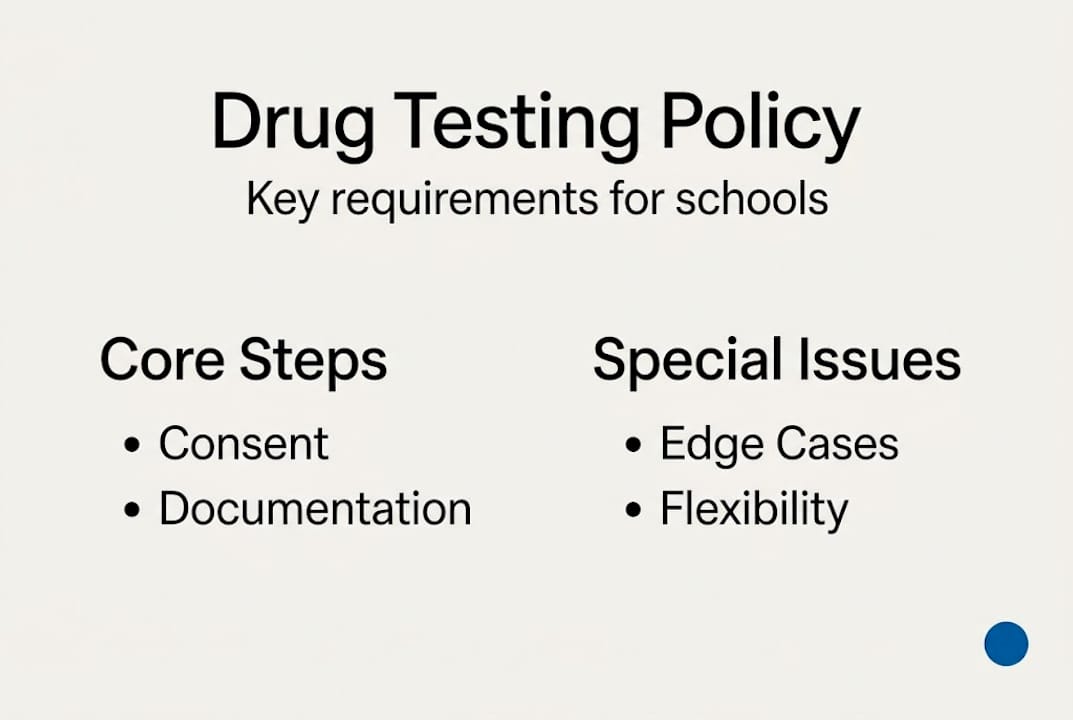
Consent and communication are non-negotiable. Families must be clearly informed that drug testing is part of enrollment conditions. Consent forms should be written in plain language, explain what substances are tested, describe the process, and outline how results will be handled. Some schools include this language directly in enrollment contracts, which makes refusal grounds for reconsideration of enrollment status.
Your policy documentation should cover the following key areas:
- Purpose and scope: Why testing is conducted and which students are subject to it (random, for-cause, or both)
- Substances tested: List every panel on the test, including alcohol and any emerging substances
- Consent procedures: Signed acknowledgment by parent or guardian at enrollment
- Notification timelines: How and when families are informed of testing events
- Confidentiality protections: Who has access to results and how records are stored
- Appeals and grievance procedures: How families can dispute a result
Refer to a proven drug testing checklist when building your documentation structure to ensure nothing is missed.
Edge cases are where policies often fall apart. The Overlake School Substance Policy outlines clear guidance on self-reporting and refusals, including how students disclosing prescription medications before testing are treated differently than those who do not. Refusals should be treated as equivalent to a positive result in most frameworks, and your policy must state this explicitly.
Pro Tip: Always include a section in your parent and student handbook that explains what happens before a test is scheduled. Surprises breed distrust. Transparency builds cooperation.
| Policy element | Recommended action |
|---|---|
| Consent form | Collected at enrollment, renewed annually |
| Substance panel | Disclosed in writing to families |
| Prescription disclosure | Required before test day |
| Refusal protocol | Treated as presumptive positive |
| Grievance process | Documented, with timeline for resolution |
Researchers studying student drug testing programs have noted contrasting views on effectiveness, which is why having strong procedural safeguards matters as much as the testing itself.
Step-by-step workflow: Implementing compliant drug testing
With policy in place, execution is where most schools stumble. A poorly run collection process, a missed chain-of-custody step, or an untrained staff member can invalidate results and expose your school to legal risk. Structure and consistency are everything here.
Review the full step-by-step student drug testing process before running your first test cycle. Here is a practical workflow that covers each phase:
- Pre-notification: Inform families of an upcoming random or for-cause test according to your policy timeline. For random tests, keep the notification window short to prevent preparation.
- Student selection: Use a documented random selection method (such as a third-party randomizer) to eliminate bias. For cause-based testing, document the observable behaviors that triggered the decision.
- Collection setup: Designate a private, supervised collection area. Staff conducting collection must be trained on specimen handling and privacy protocols.
- Sample collection: Use a standardized testing product. Mouth swab tests reduce privacy concerns during collection; urine tests offer broader detection windows. Learn the differences with a full types of drug tests for students guide.
- Chain-of-custody documentation: Every sample must be labeled, sealed, and logged immediately. Any break in this chain can render a result inadmissible in a disciplinary hearing.
- Lab submission: Ship samples to your certified lab partner. Ensure your lab holds SAMHSA, CLIA, or CAP certification for defensible results.
- Result receipt: Negative results are typically released within 24 to 48 hours. Positive or inconclusive results may require confirmatory testing via GC-MS analysis.
- Notification: Notify the appropriate administrator and, per policy, the family. Never share results with non-essential staff.
| Result type | Immediate action | Next step |
|---|---|---|
| Negative | File securely, no further action | Continue monitoring per schedule |
| Positive (initial) | Confirm with lab, notify administrator | Begin support protocol, notify family |
| Inconclusive | Retest with new sample | Hold disciplinary action pending retest |
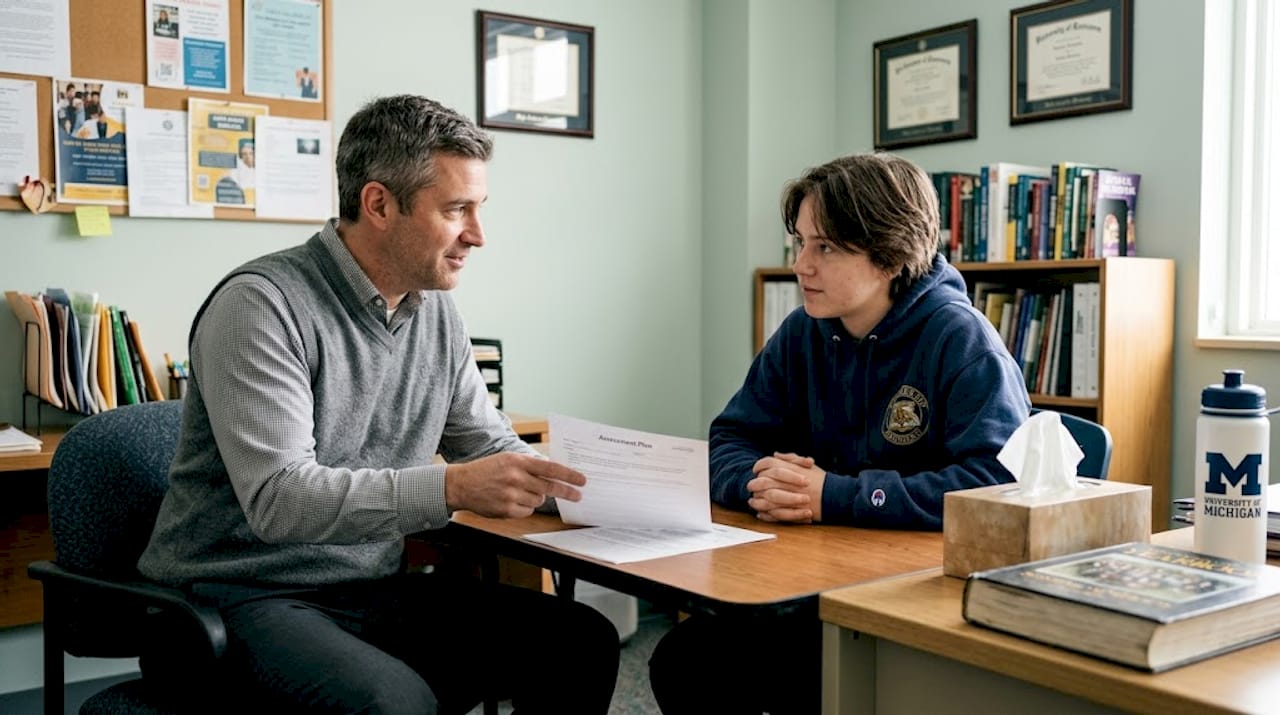
As outlined in the Overlake School Substance Policy, first offense consequences emphasize assessment and counseling rather than immediate punitive action. Modeling this approach signals to families that your school prioritizes student well-being over punishment.
For a deeper look at compliance across different school types, the implement drug testing in schools guide covers regulatory nuances worth reviewing.
Addressing results: Response protocols and student support
How your school handles results is the true test of your program’s integrity. A technically sound testing process means nothing if the response is inconsistent, punitive without support, or poorly communicated to families.
“The response to a positive test should always begin with a question: what does this student need, and how do we help them get it?”
For negative results, document the outcome, store it confidentially, and close the file. No further action is required unless retesting is scheduled.
For positive results, follow these steps:
- Confirm the result with your certified lab using GC-MS confirmation before taking any disciplinary step
- Notify the student’s parent or guardian privately, following your policy’s communication protocol
- Schedule a mandatory assessment with a licensed counselor or substance use professional
- Place the student in a support plan, which may include regular check-ins, educational sessions, or outpatient counseling
- Document every step with timestamps and staff signatures
The Overlake School Substance Policy specifies that counseling is mandatory on first offense, with repeat offenses escalating to suspension or expulsion, and that families are responsible for covering the cost of required services. Having this spelled out in advance prevents conflict when it matters most.
Pro Tip: Build a vetted referral list of local counselors and substance use professionals before you ever run a test. Scrambling for resources after a positive result adds unnecessary pressure on staff and families.
For disputed results, activate your grievance process immediately. Give families a written explanation of the result, the confirmatory method used, and the specific steps to file a formal appeal. This protects your school and demonstrates procedural fairness.
Note that certain medications can affect test outcomes. Administrators should understand how ADHD medication and drug tests interact to avoid misinterpreting a legitimate prescription as a violation. Require prescription disclosure in advance and flag these cases before results are reviewed.
For context on the broader debate around testing-based approaches versus behavioral interventions, reviewing criticisms and alternatives helps administrators build a more balanced response framework. Understanding can schools drug test students also clarifies the legal context specific to private school settings.
Verifying impact: Monitoring, audits, and continuous improvement
Running a drug testing program without measuring its outcomes is like driving without a dashboard. You might be headed in the right direction, but you have no idea how fast, how safely, or when to correct course.
Start by defining what success looks like for your school. It is rarely zero positive tests. More meaningful metrics include reduction in reported incidents, family satisfaction scores, and student participation in voluntary wellness programs.
| Metric | Measurement method | Review frequency |
|---|---|---|
| Incident reports | Disciplinary record tracking | Quarterly |
| Family satisfaction | Anonymous survey | Twice yearly |
| Policy compliance | Internal audit against checklist | Annually |
| Lab turnaround time | Vendor report | Per test cycle |
| Appeals filed | Grievance log | Quarterly |
Schedule a formal annual audit of your entire program. This should include a review of collection procedures, chain-of-custody documentation, lab partner certifications, and staff training records. Consider bringing in an external compliance reviewer every two to three years.
Collect anonymous feedback from students and parents using short digital surveys. Ask specific questions: Did you understand the policy? Did you feel the process was fair? What would you change? This kind of input often surfaces blind spots your internal team misses.
It is also worth noting that critics cite limited evidence that drug testing alone reduces substance use among students, which means your program must be paired with strong prevention and education efforts to show real results.
Update your substance panel regularly. Fentanyl analogs, synthetic cannabinoids, and kratom are increasingly relevant in 2026 and may not appear on standard panels. Review your tested substances annually and revise based on local trends. Watching for signs of drug use in students outside of testing cycles adds another layer of early intervention. A regularly reviewed compliant workflow for schools ensures your process keeps pace with evolving requirements.
Audit checklist highlights:
- Consent forms collected and stored for all enrolled students
- Staff training records current for collection and confidentiality
- Lab certifications verified and on file
- Grievance log reviewed for patterns
- Policy language updated to reflect current substance trends
Why the “one size fits all” approach misses the mark
Most drug testing consultants hand schools a template and call it a workflow. In practice, we have seen these cookie-cutter programs create more friction than they resolve. A boarding school with 200 students, a tight-knit community, and a wellness-first culture needs a fundamentally different approach than a large day school focused on athletic programs and competitive academics.
The schools that get this right do one thing differently: they treat the testing program as a living part of their community culture, not a compliance checkbox. They revisit policies with faculty and parent advisory groups. They survey students anonymously. They adjust substance panels when local data changes.
The most effective programs we have seen are built around dialogue, not just documentation. When families understand the why behind a program and trust the how, cooperation increases and disputes decrease. The goal of conducting student drug testing should never be to catch students. It should be to create a structure that deters use and supports recovery when needed. That reframe changes everything about how you design, communicate, and evolve your workflow.
Get expert help setting up your school’s drug testing workflow
Building a compliant, effective drug testing program from scratch takes more than good intentions. It takes the right tools, certified lab partners, and a process that can hold up under scrutiny.
At CountryWideTesting.com, we work with private schools across the country to provide reliable, certified testing solutions. Whether you need lab testing services for confirmatory analysis or a convenient 12 panel at-home drug test for initial screening, we have options designed to fit your policy structure. Our lab partners meet SAMHSA, CLIA, and CAP standards, so your results are defensible when it matters. Reach out today to explore testing packages built for school environments and get guidance on building a workflow your community can trust.
Frequently asked questions
What should a private school drug testing policy include?
It must cover consent, communication, and clear procedures for administering and responding to results. Edge cases including refusals and prescription disclosure must also be explicitly addressed.
Are there alternative methods to drug testing for reducing substance use?
Yes. Critics suggest skills training and prevention-focused programs as potentially more effective, given limited evidence that testing alone reduces student substance use.
How are prescription medications handled in student drug testing?
Students must disclose prescriptions before testing since certain medications affect results. Per the Overlake prescription disclosure protocol, undisclosed medications may be treated as a positive result.
What are the consequences for positive drug tests in private schools?
Initial positives typically require assessment and counseling before any punitive action. As noted in the Overlake repeat offense policy, violations escalate to suspension or expulsion only after initial support steps are exhausted.
Do families have to pay for counseling or treatment after a positive test?
In most cases, yes. The Overlake family cost policy specifies that families are responsible for covering the cost of any required counseling or assessment services.