
Build a compliant random drug testing workflow for fleets
TL;DR:
- FMCSA mandates fleets test 50% of safety-sensitive drivers for drugs annually in 2026.
- Proper workflow includes policy development, supervisor training, and documented random selection.
- Digital tools and regular audits ensure compliance and help reduce preventable transportation accidents.
Running a commercial fleet without a tight random drug testing workflow is not just a safety risk. It is a regulatory liability that can cost your company its operating authority. Over 326,000 violations have been reported to the Federal Motor carrier Safety Administration (fmcsa) clearinghouse since 2020, with positive drug tests accounting for roughly 81% of those and marijuana alone representing about 60%. For fleet managers and HR professionals, those numbers signal one thing: your workflow needs to be airtight. This guide walks you through understanding the rules, preparing your program, executing tests correctly, and verifying compliance, step by step.
Table of Contents
- understand fmcsa requirements for random drug testing
- prepare: essential policies, tools, and steps before testing
- execute: step-by-step workflow for random drug testing
- verify: monitoring, reporting, and avoiding common mistakes
- What most fleet managers overlook about random drug testing workflows
- streamline random drug testing with professional lab services
- frequently asked questions
Key Takeaways
| Point | Details |
|---|---|
| FMCSA testing rates | Fleet managers must test at least 50% of safety-sensitive positions for drugs and 10% for alcohol annually in 2026. |
| Written policy and training | A clear written policy and trained supervisors are crucial to maintaining compliance and preventing violations. |
| Digital tools for compliance | Using digital selection tools and automated recordkeeping minimizes errors and streamlines FMCSA compliance. |
| Active monitoring reduces risk | Regular audits and ongoing monitoring dramatically reduce the risk of accidents and regulatory violations. |
| Professional testing solutions | Lab-based and at-home drug test services help fleets meet FMCSA requirements quickly and reliably. |
understand fmcsa requirements for random drug testing
Before you can build a compliant workflow, you need to know exactly what the rules require. The fmcsa sets mandatory minimum rates that every fleet must meet, and in 2026, those numbers are firm.
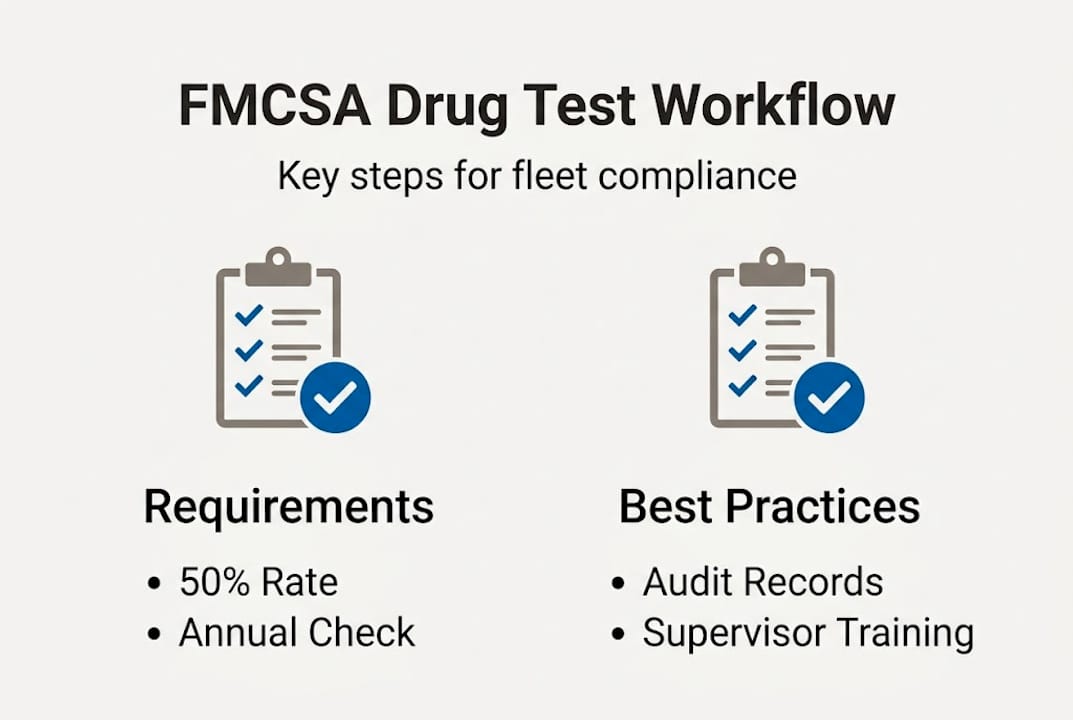
Random drug testing compliance requires fleets to test at least 50% of the average number of safety-sensitive driver positions for drugs annually. For alcohol, the minimum rate is 10%. These are not targets. They are floors. The required testing rates are triggered when the industry-wide positive rate stays at or above 1.0%, which it has consistently done.
2026 random testing rate summary
| Testing type | Required annual rate | Panel substances | reporting mechanism |
|---|---|---|---|
| Drug testing | 50% of avg. safety-sensitive positions | THC, cocaine, opioids, amphetamines, PCP, fentanyl (proposed) | fmcsa clearinghouse |
| alcohol testing | 10% of avg. safety-sensitive positions | Blood alcohol content only | fmcsa clearinghouse |
The substance panel is also expanding. fentanyl and norfentanyl are proposed for addition in 2026, reflecting the ongoing opioid crisis and its documented presence among commercial drivers. Understanding why testing matters goes beyond the legal checklist. It is about reducing preventable crashes on public roads.
Key compliance thresholds to know:
- Selection pool: All safety-sensitive employees must be in the random pool at all times, even those currently on leave
- Testing frequency: Testing must be spread reasonably throughout the calendar year, not clustered into one quarter
- Third-party administrators (TPAs): You can use a TPA to manage the pool and selection, but you remain legally responsible
- Record retention: Drug test results must be kept for five years; alcohol results for two years
Pro tip: If your fleet operates across multiple states, verify that your testing policy satisfies both fmcsa federal rules and any stricter state requirements. Federal law is the minimum, not the ceiling.
prepare: essential policies, tools, and steps before testing
Knowing the regulations is step one. Building the infrastructure to follow them is step two, and this is where many fleets stumble.
A written drug and alcohol policy is not optional. It is required by fmcsa and must clearly state testing types, consequences, return-to-duty procedures, and employee rights. Fleet drug testing HR policies should be reviewed annually and signed by every employee covered under the program.
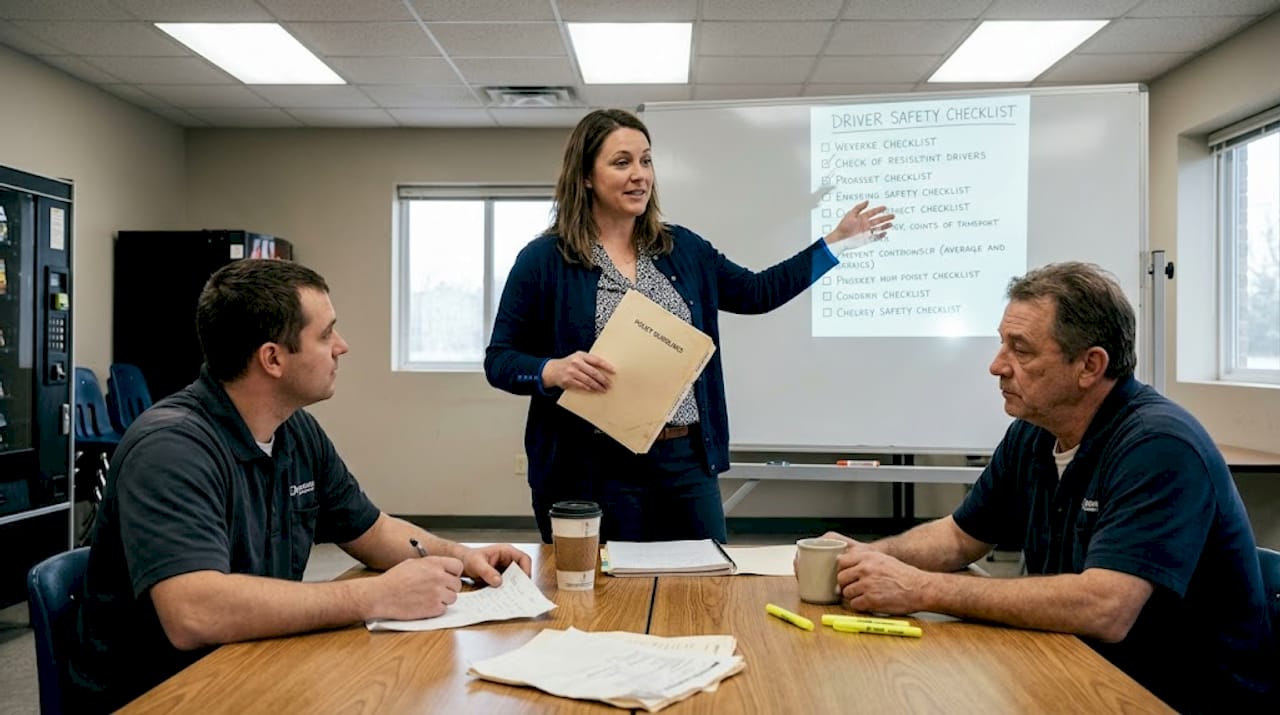
Supervisor training is equally mandatory. Fleet employers must train supervisors for 60 minutes on drug recognition and 60 minutes on alcohol misuse. This is not a one-time task. New supervisors need training before they make any reasonable-suspicion decisions, which carry serious legal weight if contested.
Test selection comparison
| test type | turnaround | compliance status | best use case |
|---|---|---|---|
| Laboratory urine test | 24 to 72 hours | fully dot compliant | standard random and pre-employment |
| oral fluid (lab-based) | 24 to 72 hours | authorized, pending HHS lab cert | supplemental or post-accident |
| rapid (instant) urine | minutes | not dot compliant alone | internal screening only |
Choosing the right test matters. For DOT drug testing setup, only federally certified laboratory tests count toward your compliance numbers. rapid tests can be useful for internal purposes, but they will not satisfy fmcsa reporting requirements.
Before your first test runs, confirm:
- Written policy is distributed and signed by all covered employees
- A certified medical review officer (mro) is contracted
- A clearinghouse account is registered and active
- Collection sites are vetted and chain-of-custody forms are stocked
- A random selection method is documented and defensible
Pro tip: conduct an internal program audit before your first test cycle and every year after. This surfaces gaps in paperwork, expired collector certifications, or missing clearinghouse queries before a dot audit does.
execute: step-by-step workflow for random drug testing
With your policies and tools in place, execution is where compliance becomes real. A flawed process at this stage can invalidate results and expose your fleet to penalties.
Here is the precise workflow for fully compliant random drug testing:
- Generate a random selection. Use a scientifically valid method, typically a random number generator through a TPA or software. Document the method and selection output. A spreadsheet with manually chosen names does not qualify.
- notify the selected employee. The employee must be told on the same day as the test with no advance warning. Do not tell coworkers or supervisors outside the need-to-know chain.
- Direct the employee immediately to the collection site. The driver goes directly, with no stops, and the collection happens the same day. Any delay without a documented reason can be treated as a refusal.
- Collection and chain of custody. The certified collector follows HHS-approved procedures. A federal custody and control form (ccf) is completed. Both the collector and employee sign it. The specimen is sealed in the employee’s presence.
- Laboratory analysis. The specimen goes to a samhsa-certified laboratory. Results are reported to the mro, not directly to you.
- mro review. The mro verifies positive results, contacts the employee for any legitimate medical explanation, and issues a final verified result to the employer.
- Report to clearinghouse. If the result is a verified positive, refusal, or other violation, it must be reported to the fmcsa clearinghouse within two business days.
- Document and retain. Store all ccfs, results, and related records per retention requirements.
One critical update for 2026: fentanyl and norfentanyl are proposed for addition to standard panels, and oral fluid testing is now authorized but remains pending HHS laboratory certification. Keep your collection sites informed of panel changes as they are finalized. Review your drug testing checklist to confirm every step is tracked.
Important: oral fluid testing requires hhs-certified laboratories to be fully dot-authorized. As of 2026, that certification process is ongoing. Do not substitute oral fluid for urine testing unless you have confirmed the lab meets current hhs standards.
Pro tip: use digital selection and recordkeeping software integrated with your TPA. It timestamps every action, creates an audit trail, and removes human error from the randomization process. Paper-based systems are legal but create unnecessary risk around workplace accident stats and liability exposure.
verify: monitoring, reporting, and avoiding common mistakes
Execution without verification is how compliant programs become non-compliant ones. The final layer of your workflow is the ongoing monitoring and review cycle.
Requirements for ongoing monitoring include:
- Annual rate verification: confirm you have tested the required percentage of your pool before year end
- clearinghouse queries: run full queries on all new hires and limited annual queries on existing drivers
- mro relationship maintenance: ensure your mro is current and accessible
- policy updates: reflect any regulatory changes (like fentanyl panel additions) in your written policy promptly
- supervisor retraining: document refresher sessions as new substances or procedures are added
The numbers reinforce why this monitoring matters. Over 326,000 violations reported since 2020 show that industry positive rates have consistently stayed above 1.0%, which is exactly why the 50% drug testing rate remains in effect. Without internal tracking, you may hit december and discover you are short of your annual quota.
Common mistakes that lead to violations:
- incomplete clearinghouse reporting: every verified positive and refusal must be entered, not just the ones that lead to termination
- poor randomization documentation: if you cannot prove the selection was random, a dot auditor can challenge every result from that cycle
- missed annual testing rate: testing 45% when the rule requires 50% is a direct violation, even if accidental
- expired collector credentials: a test conducted by an uncertified collector may be considered invalid
- delayed notification after selection: if a driver is selected but not notified for several days, that test may not be legally defensible
Knowing the post-accident drug testing rules is also essential, since those requirements overlap with your random program records and employer post-accident obligations must be documented separately.
Pro tip: schedule quarterly internal audits, not just an annual review. A quarterly check lets you catch a shortfall in testing numbers, an expired contract, or a training gap with enough time to fix it before it becomes a federal finding.
What most fleet managers overlook about random drug testing workflows
Most fleets treat random drug testing as a box to check. Meet the percentage. File the paperwork. Move on. That approach is not wrong, but it leaves real safety value on the table.
The fleets that genuinely reduce accidents are the ones treating the workflow as a live safety system. Digital tools do not just save time. They make randomization legally unassailable and audit trails automatic. When a dot auditor walks in, your records should be immediately accessible and complete.
Frequent audits reveal something most annual reviews miss: creeping errors. A collector whose certification quietly expired. A clearinghouse account with stale employee records. These are not dramatic failures. They are quiet ones, and they accumulate.
The clearinghouse is also underused as a proactive tool. Most employers run the minimum required queries. The ones with the cleanest records run them more often and use the data to inform training and safety culture decisions.
For real accident reduction insights, the data consistently shows that active programs outperform reactive ones. Testing because the rule says to is compliance. Testing because you actually want safer roads is a safety culture. The difference shows up in your incident logs.
streamline random drug testing with professional lab services
Building a compliant workflow is straightforward when you have the right testing infrastructure behind you.
CountryWideTesting.com connects fleet managers and HR teams with lab testing services that meet samhsa, clia, cap, and iso standards, ensuring every result holds up to fmcsa scrutiny. Whether you need to outfit a large fleet or supplement your existing program, our nationwide drug testing network makes it easy to find certified collection sites and lab-processed results you can report with confidence. For teams that need rapid internal screening alongside formal compliance testing, the 12-panel at-home cup test is a practical addition. Let us help you build a program that passes audits and, more importantly, keeps your drivers safe.
frequently asked questions
what is the fmcsa random drug testing rate for fleets in 2026?
FMCSA requires fleets to test at least 50% of safety-sensitive positions for drugs and 10% for alcohol on an annual basis in 2026.
what substances are being added to random drug testing panels in 2026?
fentanyl and norfentanyl are proposed for inclusion in the standard panel in 2026, while oral fluid testing is authorized but awaiting final HHS lab certification before it is fully dot-compliant.
how can fleets avoid common mistakes in random drug testing workflows?
Document every step of the selection and collection process, train supervisors properly, and use digital recordkeeping to maintain timely and complete clearinghouse reporting.
why is random drug testing so important for fleet safety?
Random drug testing reduces preventable crashes and keeps fleets fmcsa-compliant. Drug testing cuts workplace accidents significantly, protecting both drivers and the public they share roads with.