
Random drug testing in trucking: compliance and safety
TL;DR:
- Over 190,000 commercial drivers are currently banned from operating due to drug and alcohol violations.
- Random drug testing is federally required to deter substance misuse and improve trucking safety.
- Emerging substances like fentanyl are prompting updates in drug testing protocols for 2026.
Over 190,000 commercial drivers are currently prohibited from operating because of drug and alcohol violations. That number is not a rounding error. It represents a significant slice of the workforce that keeps American freight moving. For trucking company owners and HR managers, that reality should reframe how you think about random drug testing. This guide breaks down why random testing is federally required, how it deters substance misuse, what a strong program looks like, and what new threats like fentanyl mean for your testing protocols going forward.
Table of Contents
- How drug and alcohol use impacts the trucking industry
- The role of random drug testing: Compliance and deterrence
- Building an effective random drug testing program
- Emerging substances and testing trends in 2026
- Why random testing’s impact in trucking goes deeper than compliance
- Take the next step: Reliable random testing solutions for your fleet
- Frequently asked questions
Key Takeaways
| Point | Details |
|---|---|
| High violation rates persist | More than 190,000 truck drivers are currently barred from driving due to drug and alcohol violations. |
| Random testing is essential | Federal law requires random drug testing to deter use and bolster road safety. |
| Compliance protects your business | Noncompliance can mean severe penalties, lost reputation, and revoked operating authority. |
| Testing evolves with modern risks | DOT testing panels are adapting to new threats like fentanyl for more effective detection. |
| Strategic testing improves culture | A proactive approach to random drug testing fosters a safer, more responsible company environment. |
How drug and alcohol use impacts the trucking industry
Substance misuse in trucking is not a fringe problem. It is persistent, measurable, and directly tied to road safety outcomes. The data from the FMCSA Clearinghouse makes that impossible to ignore.
Since 2020, over 300,000 drug and alcohol violations have been recorded, with marijuana accounting for roughly 60% of all positive tests.
That figure spans just a few years. It tells you that this is not a problem that self-corrects. Drivers under the influence of marijuana or other substances are making decisions behind the wheel of vehicles that can weigh up to 80,000 pounds. The consequences of impaired judgment at highway speeds are catastrophic.
Here is what the data consistently shows about substance misuse in commercial trucking:
- Marijuana is the leading substance detected, making up the majority of positive results
- Opioids and stimulants account for a significant share of remaining violations
- Alcohol violations, while less common than drug violations, still represent thousands of incidents annually
- Repeat violations occur when drivers are not removed from safety-sensitive functions promptly
The connection between drug testing and trucking safety is direct. Impaired drivers are more likely to miss hazards, misjudge stopping distances, and react slowly in emergencies. Every mile driven impaired is a liability exposure for your company and a threat to everyone on the road.
For HR managers, the business case is just as clear. Workers’ compensation claims, litigation costs, and insurance premiums all climb when substance misuse goes undetected. Programs focused on reducing workplace accidents through testing are not just safety investments. They are financial ones.
Random drug testing addresses this problem at the source. When drivers know they can be tested at any time, the calculus around substance use changes. That deterrence effect is the foundation of why federal rules require it.
Now that the scale of drug and alcohol misuse is clear, let’s examine what random drug testing involves.
The role of random drug testing: Compliance and deterrence
Random drug testing is not optional for most trucking companies. If you operate commercial motor vehicles under FMCSA jurisdiction, federal law requires you to have a compliant random testing program in place. There is no workaround.
The deterrence logic is straightforward. Predictable testing is easy to game. A driver who knows testing happens only during pre-employment or after accidents can time substance use around those windows. Random testing removes that predictability entirely. When any workday could be a testing day, the incentive to stay clean is constant.
Robust programs deter use, prevent crashes, and reduce liability, while noncompliance risks fines, an unsatisfactory safety rating, and even loss of operating authority. That last consequence can end a business.
Here is a comparison of compliant versus noncompliant programs:
| Factor | Compliant program | Noncompliant program |
|---|---|---|
| Selection method | Statistically random, documented | Informal or predictable |
| Testing rate | Meets or exceeds FMCSA minimums | Below required thresholds |
| Record keeping | Complete and audit-ready | Incomplete or missing |
| Consequences | Protected from liability | Fines, rating loss, authority revoked |
| Driver behavior | Deterred by unpredictability | Able to anticipate testing windows |
To build a program that actually works, follow these core steps:
- Register with a DOT-compliant consortium or third-party administrator
- Establish a random selection pool that includes all safety-sensitive employees
- Use a scientifically valid random selection method, such as a computer-generated draw
- Conduct testing without advance notice on the selected date
- Document every selection, notification, and result thoroughly
- Follow return-to-duty and follow-up testing protocols for any positive results
Pro Tip: Never let managers hand-pick who gets tested. Even with good intentions, that practice creates legal exposure and undermines the program’s deterrence value. The selection process must be genuinely random and defensible.
Understanding random drug testing and safety at a program level helps you see why every procedural detail matters. Reviewing truck driver compliance rules specific to 2026 will keep your policies current.
Understanding compliance and deterrence, the next question is: What does an effective random testing program look like?
Building an effective random drug testing program
Knowing you need a program and actually running one well are two different things. Many companies have policies on paper that would not survive an audit. The gap is almost always in execution.

The FMCSA sets minimum testing rates based on industry-wide positive test data. Positive rates above 1% require at least 50% of covered drivers to be randomly tested each year. That threshold is currently in effect, which means your program must be active and well-documented.
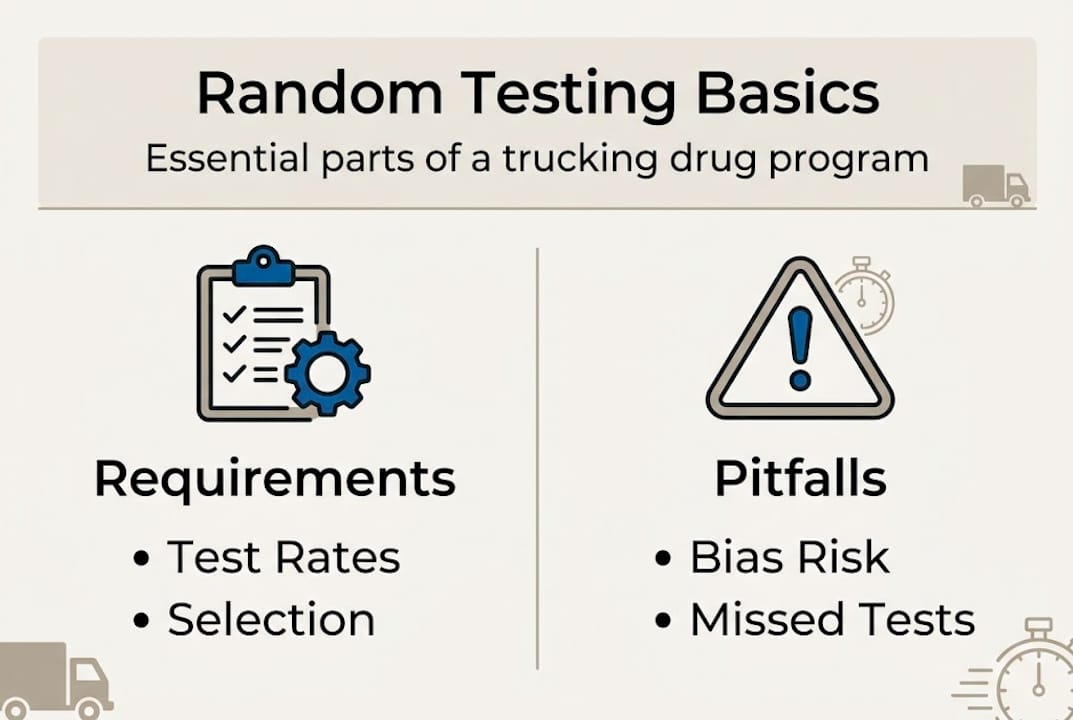
Here is a breakdown of the key elements every program needs:
| Program element | What it requires | Common pitfall |
|---|---|---|
| Selection process | Truly random, documented draw | Managers choosing who gets tested |
| Testing frequency | At least 50% of drivers annually | Testing too few or bunching tests |
| Specimen collection | Trained collector, proper chain of custody | Unqualified collectors, broken chain |
| Lab processing | SAMHSA-certified laboratory | Using uncertified or unaccredited labs |
| Result management | MRO review before action is taken | Acting on unconfirmed positives |
| Record retention | Minimum 5 years for most records | Gaps, lost files, incomplete logs |
Choosing the right testing provider matters more than most companies realize. A provider that uses types of drug testing suited to DOT requirements, including urine testing processed through SAMHSA-certified labs, gives you results that hold up legally and operationally.
Key features to look for in a testing provider:
- SAMHSA-certified lab processing for all specimens
- Medical Review Officer (MRO) services included
- Secure, audit-ready record keeping
- Fast turnaround on results to minimize operational disruption
- Clear chain-of-custody documentation
Understanding random testing workplace impact helps you communicate the program’s value to your team, not just enforce it.
Pro Tip: Schedule testing throughout the year rather than clustering it in one quarter. Spread-out testing is harder to anticipate and strengthens the deterrence effect significantly.
With the program’s structure established, staying up to date with testing trends is essential.
Emerging substances and testing trends in 2026
The drug landscape does not stay still. What was a reliable test panel five years ago may miss substances that are now showing up in driver populations. Fentanyl is the clearest example of this shift.
The DOT has proposed adding fentanyl and norfentanyl to mandatory federal drug test panels, with detection covering recent opioid use spanning 2 to 13 days.
This is a significant change. Fentanyl is extraordinarily potent and has become widespread in the illicit drug supply. A driver using fentanyl would not be caught under current standard panels unless the employer specifically adds it. The proposed rule change closes that gap.
Here is what trucking companies need to watch in 2026:
- Fentanyl and norfentanyl are expected to be added to federal panels, requiring updated test kits and lab agreements
- Synthetic opioids beyond fentanyl continue to evolve, and expanded panels may follow
- Marijuana legalization in multiple states creates confusion, but federal DOT rules still prohibit any detectable THC for covered drivers
- Oral fluid testing has been approved as an alternative to urine for DOT testing, giving employers a new collection option
- Clearinghouse query requirements remain mandatory for pre-employment and annual checks
For HR managers, staying ahead of these changes means reviewing your testing panel annually. If your current provider does not offer fentanyl dipstick tests or updated panels, now is the time to ask. Waiting until a rule is finalized to update your program puts you behind the compliance curve.
The broader takeaway is that substance threats evolve faster than regulations do. Companies that only test for what is currently required will always be one step behind. Proactive testing that anticipates where the rules are heading protects your fleet and your liability exposure.
Finally, let’s look at the broader impact and lessons learned from these efforts.
Why random testing’s impact in trucking goes deeper than compliance
Most conversations about random drug testing start and end with the rules. That framing misses the larger point.
The companies that see the most benefit from their testing programs are not the ones doing the minimum to pass an audit. They are the ones that treat testing as a signal of organizational values. When you build a program that is consistent, fair, and transparent, you are telling your drivers that safety is not negotiable. That message shapes culture in ways that a policy document never can.
We have seen that firms taking drug testing for transportation safety seriously tend to report lower turnover and higher morale. That is not a coincidence. Drivers who work in a safety-first environment feel more protected. They know their coworkers are held to the same standard. That trust is hard to build and easy to lose.
The uncomfortable truth is that many companies treat random testing as a checkbox. They do the minimum rate, use the cheapest provider, and file the paperwork. That approach creates the appearance of compliance without the substance of it. When an incident happens, that gap becomes very expensive very fast.
Framing random testing as an investment in your people changes how you implement it. Better providers, clearer communication, and consistent follow-through are not overhead costs. They are the foundation of a fleet you can actually trust.
Take the next step: Reliable random testing solutions for your fleet
If your random drug testing program needs a stronger foundation, or if you are building one from scratch, having the right testing partner makes all the difference.
At CountryWideTesting.com, we offer lab testing services processed through SAMHSA, CLIA, and CAP-certified laboratories, giving you results that meet DOT and FMCSA standards. For on-site or rapid screening needs, our 12-panel at-home test covers the most common substances in a single collection. Whether you manage a small fleet or a large operation, our nationwide drug testing solutions are built to support compliant, consistent programs that protect your drivers, your business, and the public.
Frequently asked questions
Why is random drug testing required in trucking?
Random testing is federally mandated for FMCSA-regulated drivers to deter substance use, prevent accidents, and maintain compliance with DOT regulations.
What happens if a trucking company fails to comply with random drug testing rules?
Noncompliance risks fines, an unsatisfactory safety rating, and potential loss of operating authority, any of which can severely disrupt or end your business.
How often must drivers be randomly tested?
Currently, at least 50% of FMCSA-regulated drivers must be randomly tested each year because industry-wide positive test rates remain above the 1% threshold.
Are new drugs being added to trucking drug tests?
Yes, the DOT has proposed adding fentanyl and norfentanyl to federal drug test panels, reflecting the growing presence of synthetic opioids in the driver population.
Does random testing actually reduce accidents?
Yes, consistent random drug testing programs have been shown to directly decrease workplace accidents and injury rates across transportation industries.