
Why Drug Testing Is Essential for Trucking Safety
TL;DR:
- Federal law mandates comprehensive drug testing for all safety-sensitive trucking drivers, regardless of state laws.
- Combining urine and hair testing enhances detection of recent and past drug use, improving safety.
- Implementing and regularly reviewing a proactive drug testing program reduces accidents, improves safety scores, and safeguards business reputation.
Drug testing in trucking is often dismissed as bureaucratic red tape, but that framing misses the point entirely. Fleets that treat compliance as a checkbox exercise expose themselves to catastrophic liability, higher insurance costs, and preventable tragedies on the road. With 5,472 large truck fatalities recorded in 2023, the stakes for every fleet manager are real and measurable. This guide walks you through what federal law actually requires, how the testing science works, and why a proactive drug testing program is one of the smartest operational investments you can make for your business.
Table of Contents
- The regulatory backbone: Why drug testing is required
- How testing works: Types, triggers, and the science
- How compliance protects your business and reputation
- Overcoming challenges: Legalization, detection gaps, and industry trends
- A practical perspective: Real priorities for fleet managers
- Next steps: Make drug testing simple and effective
- Frequently asked questions
Key Takeaways
| Point | Details |
|---|---|
| Legal requirements | DOT and FMCSA require drug testing for trucking to ensure fleet safety and compliance with federal law. |
| Comprehensive testing | A mix of urine, oral fluid, and sometimes hair tests help detect substance abuse and keep the roads safe. |
| Business impact | Proper drug testing policies lower accidents, protect your reputation, and prevent costly fines or audits. |
| Stay proactive | Going beyond minimum standards and adapting to industry changes gives fleets a real competitive edge. |
The regulatory backbone: Why drug testing is required
Federal law does not give trucking companies a choice when it comes to drug and alcohol testing. The Department of Transportation (DOT) and the Federal Motor Carrier Safety Administration (FMCSA) mandate testing for all commercial motor vehicle (CMV) drivers who hold a commercial driver’s license (CDL) and operate in safety-sensitive functions. The legal foundation sits in DOT Part 40 Regulations, which define six required test types with specific triggers and methodologies that every covered employer must follow.
The six mandatory test scenarios are:
- Pre-employment: Before a driver operates a CMV
- Random: Unannounced, at federally set annual rates
- Post-accident: After qualifying crashes
- Reasonable suspicion: When trained supervisors observe specific signs
- Return-to-duty: After a violation and treatment
- Follow-up: Ongoing testing after return-to-duty
| Test type | When it applies | Primary purpose |
|---|---|---|
| Pre-employment | Before first safety-sensitive duty | Screen new hires |
| Random | Unannounced throughout the year | Ongoing deterrence |
| Post-accident | After qualifying crashes | Determine impairment role |
| Reasonable suspicion | Observable signs of impairment | Address immediate risk |
| Return-to-duty | After violation resolution | Confirm fitness |
| Follow-up | After return-to-duty | Sustained monitoring |
One area that trips up many fleet managers is the relationship between state marijuana laws and federal requirements. Even if your state has legalized recreational or medical marijuana, federal DOT rules apply to CDL holders in safety-sensitive roles. State law does not override federal authority here. A driver who tests positive for THC in a state where marijuana is legal still faces the same consequences as any other DOT violation.
“Compliance with federal drug and alcohol testing regulations is not optional for covered employers. Violations carry serious consequences including fines, loss of operating authority, and civil liability.” — DOT employer guidelines
For a full breakdown of what these rules mean for your operation in 2026, the 2026 compliance guide is a solid starting point. You can also review the types of drug testing used across transportation sectors to understand how trucking fits into the broader regulatory picture.
How testing works: Types, triggers, and the science
Knowing that testing is required is one thing. Understanding what actually happens during a test helps you manage your program with confidence and explain the process clearly to your drivers.
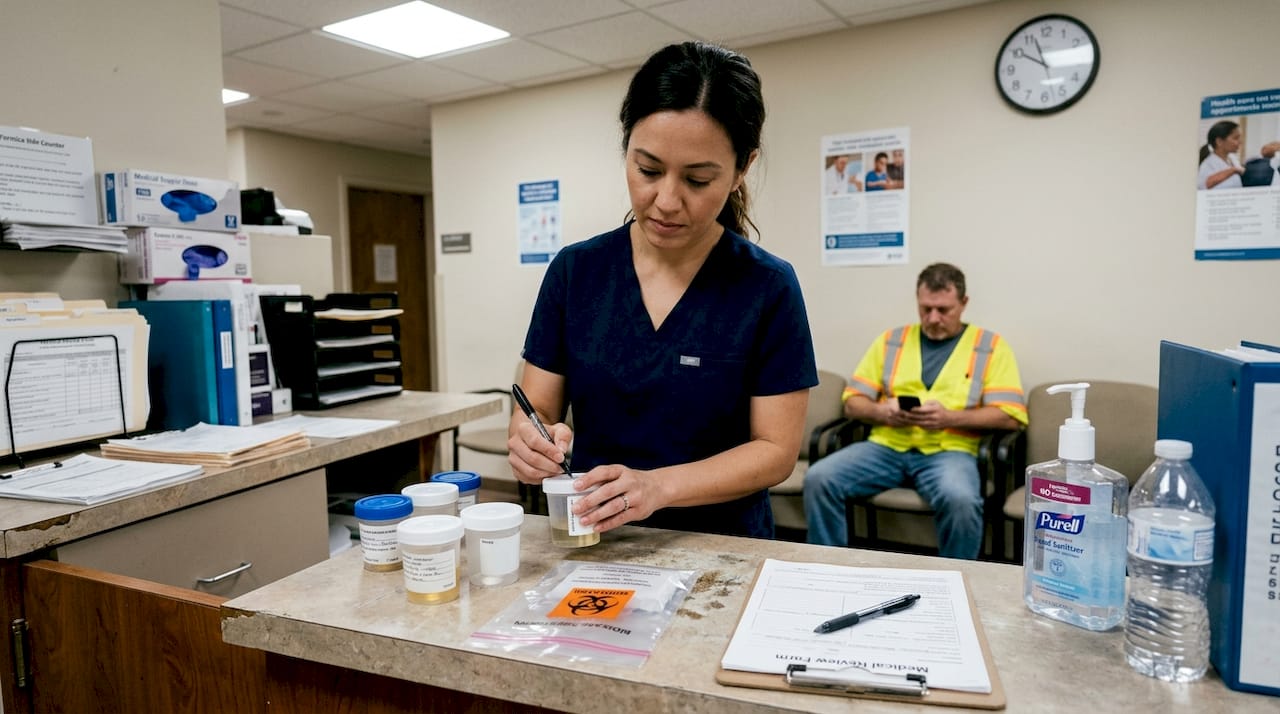
The DOT mandates a 5-panel urine or oral fluid test that screens for five substance categories: THC (marijuana), cocaine, amphetamines, opioids, and PCP. Urine has been the standard specimen for decades. Oral fluid (mouth swab) testing became a federally approved option more recently, giving employers more flexibility in collection settings.
Here is how the six test triggers apply in practice:
- Pre-employment: Conducted before a driver performs any safety-sensitive function
- Random: Selected by a scientifically valid random process; in 2026, FMCSA rates are 50% of drivers for drugs and 10% for alcohol annually
- Post-accident: Required when a fatality occurs, or when a driver receives a citation after a crash with injury or disabling damage
- Reasonable suspicion: Ordered by a trained supervisor based on specific, observable behavior
- Return-to-duty: A one-time test after a substance abuse professional clears the driver
- Follow-up: A minimum of six unannounced tests in the first 12 months after return-to-duty
Specimen type matters more than many fleet managers realize. Each option has trade-offs:
| Specimen type | Detection window (THC example) | DOT-approved | Notes |
|---|---|---|---|
| Urine | 3 to 30 days (chronic use) | Yes | Most established method |
| Oral fluid | 4 to 48 hours | Yes (2023 onward) | Better for recent use |
| Hair | Up to 90 days | No (internal use only) | Longest detection window |
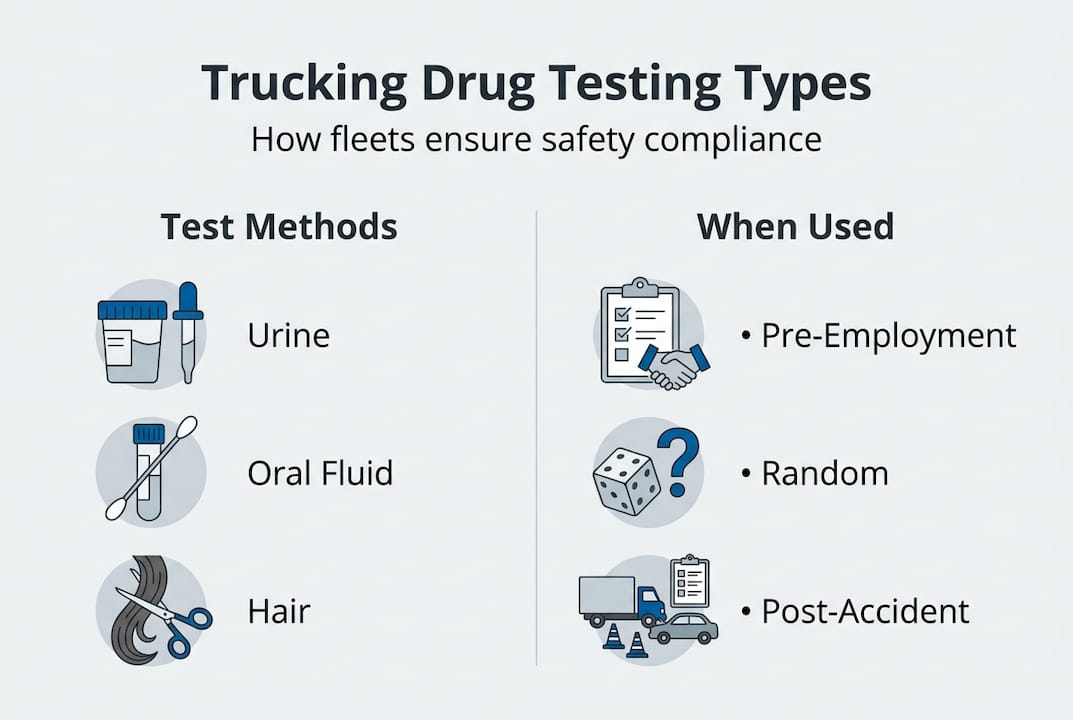
Oral fluid testing does come with challenges around detection accuracy, particularly for chronic or past use. Hair testing, while not DOT-mandated, is increasingly used by safety-conscious fleets as a supplemental tool because of its 90-day detection window.
Pro Tip: Pair urine testing for DOT compliance with hair testing for internal screening during pre-employment. This combination catches recent and historical use that a single method might miss.
Once a specimen is collected, a medical review officer (MRO) reviews all lab results before they reach you as the employer. This step protects both the driver and your company from errors. For a plain-language breakdown of the full process, the DOT drug test explained resource covers each stage in detail.
How compliance protects your business and reputation
The business case for rigorous drug testing goes well beyond avoiding fines. Non-compliance creates a chain reaction that touches your insurance rates, your Compliance, Safety, Accountability (CSA) score, and your ability to win contracts with shippers who audit carrier safety records.
According to DOT employer guidelines, fleet managers should implement written policies, use a Consortium/Third-Party Administrator (C/TPA) if managing a small fleet, and automate Clearinghouse tracking to avoid audits and fines. Drug testing violations consistently rank among the top FMCSA enforcement findings, and a single audit that uncovers gaps can result in out-of-service orders.
Here is what a well-run testing program actually delivers:
- Lower accident rates: Workplace drug testing programs cut workplace accidents by 45% in safety-sensitive industries
- Better CSA scores: Fewer violations mean fewer points, which directly affects your safety rating
- Reduced insurance premiums: Insurers reward fleets with documented, consistent testing programs
- Stronger hiring standards: Pre-employment testing filters out high-risk candidates before they get behind the wheel
- Clearinghouse compliance: Querying the FMCSA Drug and Alcohol Clearinghouse before hiring protects you from unknowingly employing a driver with an unresolved violation
- Audit readiness: Organized records and a written policy make DOT audits far less stressful
Pro Tip: Automate your Clearinghouse queries using your C/TPA’s system. Manual tracking is the single biggest source of missed violations for small and mid-size fleets.
For a step-by-step approach to building your program, the employer guide to DOT drug testing walks through policy creation, collection site setup, and recordkeeping. The driver screening compliance resource adds practical detail on screening workflows that hold up under scrutiny.
Overcoming challenges: Legalization, detection gaps, and industry trends
Even with a solid compliance program in place, fleet managers face ongoing challenges that regulations alone do not fully address. The landscape is shifting, and staying ahead of it requires more than just following the minimum requirements.
The marijuana legalization issue is perhaps the most confusing for drivers and managers alike. As of 2026, marijuana remains a Schedule I controlled substance under federal law. Federal law overrides state marijuana legalization for CDL holders in safety-sensitive roles, full stop. Drivers who believe their state card or recreational use protects them from DOT consequences are wrong, and that misunderstanding creates real risk for your fleet.
Oral fluid testing, while a welcome addition to the DOT toolkit, has its own limitations. Its shorter detection window means a driver who used marijuana several days ago may test negative. Hair testing is increasingly recommended to close that gap, though it requires a separate internal policy and cannot substitute for DOT-required testing.
Common compliance pitfalls and how to address them:
- Missed random selections: Use a C/TPA with automated scheduling to ensure correct annual rates are met
- Incomplete post-accident documentation: Train supervisors on exactly which crashes trigger testing requirements
- Outdated written policies: Review your policy annually, especially as oral fluid rules and Clearinghouse requirements evolve
- Ignoring the Clearinghouse: Failing to query before hire is a direct violation, not just an oversight
- Supervisor training gaps: Reasonable suspicion testing is only valid when the supervisor who orders it has completed DOT-required training
“As testing technology evolves and state laws shift, fleets that rely solely on minimum compliance will find themselves increasingly exposed. Proactive programs that layer multiple testing methods are the new standard for safety-conscious carriers.”
For a deeper look at how testing connects to broader safety outcomes, the role of drug testing in safety and accident reduction impacts resources offer data-backed context.
A practical perspective: Real priorities for fleet managers
Here is something most compliance guides will not tell you: meeting the minimum federal requirements is the floor, not the ceiling. Fleets that treat drug testing as a purely legal obligation miss the cultural dimension entirely. Drivers notice when a company runs a serious, consistent program. It signals that leadership takes safety personally, and that reputation attracts better candidates and retains experienced drivers.
The fleets we see struggle most with compliance are not the ones who ignored the rules outright. They are the ones who set up a program once and never revisited it. Regulations change. Detection science improves. State laws create confusion. An annual policy review is not optional if you want to stay protected.
Investing in supervisor training for reasonable suspicion testing is one of the highest-return moves a fleet manager can make. A single documented, well-handled reasonable suspicion case can prevent a catastrophic accident and demonstrate to insurers and auditors that your safety culture is real.
Do not try to manage this alone. Lean on your MRO and C/TPA. That is what they are there for. The driver screening best practices resource is a good reference for building a program that runs smoothly without requiring constant manual oversight.
Pro Tip: Schedule a quarterly internal audit of your testing records, not just an annual one. Catching gaps early is far less costly than discovering them during a DOT review.
Next steps: Make drug testing simple and effective
A strong drug testing program does not have to be complicated or expensive to manage. The right tools and partners make it straightforward to stay compliant, protect your drivers, and keep your safety ratings where they need to be.
Countrywide Testing offers SAMHSA-certified lab testing, DOT-compliant urine and oral fluid options, and fleet-ready solutions built for trucking companies of every size. Whether you need lab testing services for your full driver roster or want to explore a 12-panel at-home test for internal screening, the platform connects you to certified labs and compliance support without the complexity. Reach out to explore a testing program tailored to your fleet’s specific needs.
Frequently asked questions
What drugs are included in DOT trucking drug tests?
DOT-regulated drug tests for trucking screen for THC, cocaine, amphetamines, opioids, and PCP using a 5-panel process. These five categories cover the substances most associated with impaired driving in safety-sensitive roles.
Are marijuana laws in my state relevant to DOT drug testing requirements?
Federal DOT regulations prohibit marijuana use for truck drivers regardless of state law, and a positive result is a violation. Federal law overrides state marijuana legalization for all CDL holders in safety-sensitive functions.
How often do trucking companies need to conduct random drug and alcohol tests?
In 2026, FMCSA requires fleets to test a minimum of 50% of drivers for drugs and 10% for alcohol on an annual basis through a scientifically valid random selection process.
What happens if a driver fails a DOT drug test?
The driver must be immediately removed from safety-sensitive duties and complete a return-to-duty process that includes evaluation by a substance abuse professional and follow-up testing before returning to work.
Can trucking companies use hair testing for DOT compliance?
Hair testing is not DOT-mandated, so it cannot replace urine or oral fluid for official compliance. However, hair testing is recommended as a supplemental internal tool because of its 90-day detection window for substances like THC.
Recommended
- Drug Testing in Transportation – Ensuring Global Safety
- Drug tests for truck drivers: 2026 compliance guide
- FMCSA Post-Accident Drug Testing Rules Every Trucking Company Should K
- 7 Key Types of Drug Testing for Transportation Compliance
- Så ökar utbildning för truckförare säkerheten och effektiviteten