
Driver Drug Screening: 95% Accurate Compliance Guide
Drug screening for commercial drivers is one of the most heavily regulated HR functions in logistics and transportation. A single procedural error can trigger DOT audits, legal liability, or safety incidents. Yet many companies still stumble with consent forms, chain of custody protocols, and lab selection. This guide walks you through every step of compliant driver drug screening, from preparation to result interpretation, so you can avoid costly mistakes and maintain a safe workforce.
Table of Contents
- Prerequisites And Preparation For Driver Drug Screening
- Step By Step Testing Procedure For Drivers
- Common Errors And Troubleshooting In Driver Drug Screening
- Expected Timelines And Costs Of Driver Drug Screening
- Alternative Testing Methods And Their Tradeoffs
- Streamline Your Driver Drug Screening With Countrywide Testing
- Frequently Asked Questions About Driver Drug Screening
Key Takeaways
| Point | Details |
|---|---|
| Legal compliance | DOT and SAMHSA regulations are mandatory for driver drug screening to avoid penalties. |
| Observed collection | Use certified labs with proper chain of custody protocols to ensure 95% accuracy. |
| Common errors | Sample contamination and documentation breaches occur in 15% of tests. |
| Turnaround and cost | Results typically arrive in 24 to 72 hours, costing $30 to $50 per test. |
| Alternative methods | Oral fluid tests offer faster results but have shorter detection windows and less DOT acceptance. |
Prerequisites and Preparation for Driver Drug Screening
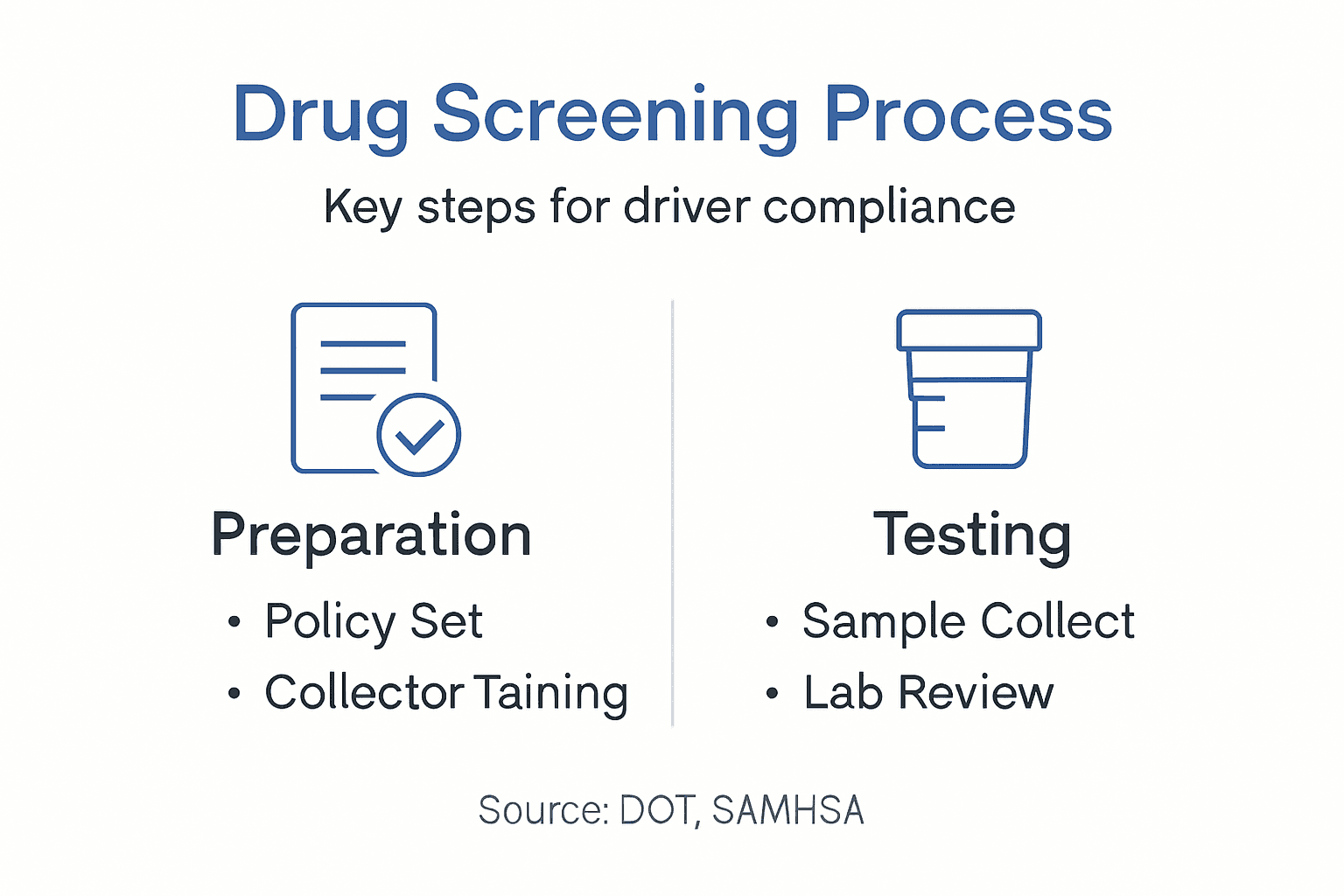
Before you collect a single sample, you need a compliance foundation. Drug screening for commercial drivers falls under strict federal oversight. Employers must ensure driver drug screening complies with federal regulations such as the Department of Transportation (DOT) and SAMHSA guidelines to avoid legal penalties and maintain safety standards. Without proper preparation, even a perfect collection procedure can fail during an audit.
Start with a written drug testing policy. This document should outline when testing occurs (pre employment, random, post accident, reasonable suspicion), which substances you screen for, and consequences for positive results. Your policy must align with DOT drug testing regulations and state laws. Distribute this policy to all drivers and require signed acknowledgment.
Next, secure your testing infrastructure:
- Obtain signed consent forms from every driver before conducting tests. These forms protect you legally and clarify employee rights.
- Partner with SAMHSA certified collection sites or mobile collectors trained in DOT procedures. Unqualified collectors introduce errors that invalidate results.
- Verify your laboratory holds SAMHSA, ISO 17025, and CAP accreditations. These certifications ensure accurate processing and defensible results.
- Set up a chain of custody system with tamper evident seals, tracking forms, and secure storage. Every sample movement must be documented.
- Train supervisors on reasonable suspicion indicators and documentation requirements. Inconsistent application of your policy creates legal risk.
Understanding the full drug screening process overview helps you identify gaps in your current procedures. Many companies rush implementation and pay for it later when auditors find policy violations or documentation holes. Invest time upfront to build a system that withstands scrutiny.
Step by Step Testing Procedure for Drivers
With preparation complete, you can execute compliant drug screening. Follow these steps in order every time:
-
Notify the driver immediately. For random testing, provide notice just before collection to prevent sample tampering. For pre employment or scheduled tests, give reasonable advance notice. Document the notification time and method.
-
Verify identity and obtain consent. Check a government issued photo ID against your records. Have the driver sign the consent form and chain of custody document. No exceptions, even for longtime employees.
-
Proceed to the collection site. Use a SAMHSA certified facility or qualified mobile collector. The collection must occur under direct observation per DOT requirements. This prevents substitution and ensures sample integrity.
-
Collect the urine sample. Urine drug tests are the most widely used driver drug screening method due to high accuracy and regulatory acceptance, with detection sensitivity of 95% for common substances. The collector will provide a sterile cup, verify temperature (90 to 100 degrees Fahrenheit within four minutes), check for adulteration, and split the sample into primary and backup containers.
-
Complete chain of custody documentation. Both collector and driver sign forms confirming sample details, seal integrity, and transfer time. Place tamper evident seals on containers immediately. Any gap in documentation can invalidate results.
-
Transport samples to the laboratory. Use approved couriers with temperature controlled packaging. Samples must reach the lab within 24 hours. Delays or temperature exposure degrade specimens and produce false negatives.
-
Receive and interpret results. Labs typically return findings in 24 to 72 hours. Negative results clear the driver for duty. Non negative results trigger Medical Review Officer (MRO) review to rule out legitimate prescriptions before confirming a violation.
A well designed drug screening workflow for HR managers keeps this process moving efficiently. Many HR teams struggle with step five because collectors rush documentation or drivers refuse to sign. Train your team to handle these situations calmly while maintaining compliance. Review the detailed guidance on how to conduct drug testing for workplace compliance and apply the step by step drug testing guide principles to your driver program.
Common Errors and Troubleshooting in Driver Drug Screening
Even experienced HR teams make mistakes that compromise test validity. Approximately 15% of driver drug tests fail due to sample contamination or chain of custody breaches, increasing employer legal risks. Understanding where errors occur helps you build prevention strategies.
The most frequent problems include:
-
Sample contamination or adulteration. Drivers sometimes add water, bleach, or commercial adulterants to urine samples. Proper observation during collection prevents this. Temperature checks and lab validity testing catch most attempts.
-
Chain of custody gaps. Missing signatures, incorrect dates, or unclear sample identification invalidate results. Use pre printed forms with clear instructions. Double check every field before the driver leaves.
-
Unobserved collections. DOT regulations require direct observation for all driver testing. Shy bladder protocols exist for drivers who cannot produce samples under observation, but standard collections must be observed. Never compromise on this requirement.
-
Delayed transportation. Samples left in hot vehicles or delayed in transit degrade rapidly. Coordinate pickup schedules with your courier. If delays occur, refrigerate samples and document the gap.
-
Inadequate documentation. Vague reasonable suspicion notes or missing supervisor signatures create legal vulnerabilities. Train supervisors to document specific behaviors (slurred speech, odor of alcohol, erratic driving) with times and witnesses.
Implement these troubleshooting strategies:
- Audit your chain of custody forms quarterly. Look for patterns in incomplete sections.
- Use only trained, certified collectors. Require annual recertification.
- Maintain temperature controlled storage at collection sites.
- Create checklists for supervisors documenting reasonable suspicion.
- Partner with labs that provide real time sample tracking.
Pro Tip: Schedule mock collections twice yearly where you walk through the entire process with new collectors. Catch documentation errors in training rather than during actual tests. Review drug screening workflow tips and apply drug screening troubleshooting advice to strengthen your procedures.
Expected Timelines and Costs of Driver Drug Screening
Budget planning requires realistic expectations for drug screening expenses and turnaround times. Lab results usually return within 24 to 72 hours after collection, depending on the testing panel and lab workload. Simple five panel screens (marijuana, cocaine, amphetamines, opiates, PCP) process faster than extended panels.
Average costs range from $30 to $50 per urine drug test for standard DOT panels. This price typically includes collection, laboratory analysis, and MRO review. Costs increase for expanded panels, observed collections at remote sites, or expedited processing. Mobile collection services add $50 to $150 per visit but save time for fleets with multiple drivers.
| Cost Factor | Standard Range | Notes |
|---|---|---|
| Basic urine test | $30 to $50 | Five panel DOT screen |
| Extended panel | $60 to $100 | Includes synthetic opioids, benzodiazepines |
| Mobile collection | $50 to $150 | Per site visit, multiple drivers reduce per test cost |
| Expedited processing | $75 to $125 | Results in 24 hours or less |
| MRO review | Included | Typically bundled with lab fee |
Oral fluid tests provide faster results (within 24 hours) but have tradeoffs in regulatory acceptance and detection windows. If your drivers operate under DOT authority, urine testing remains mandatory. For non DOT drivers, oral fluid offers convenience at similar or slightly higher cost ($40 to $60 per test).
Pro Tip: Negotiate annual contracts with labs if you conduct high volumes of tests. Many labs offer 10% to 20% discounts for guaranteed minimum volumes. Calculate your annual testing needs (new hires, randoms, post accident) and request volume pricing. Understanding drug screening timeline and costs helps you compare vendor proposals accurately.
Alternative Testing Methods and Their Tradeoffs
Urine testing dominates driver drug screening, but alternatives exist for specific situations. Understanding each method’s strengths and limitations helps you choose appropriately.
Oral fluid tests offer rapid results (24 hour turnaround) and easier collection. A collector swabs the inside of the driver’s mouth for saliva, eliminating privacy concerns and observation requirements. Detection windows are shorter (24 to 48 hours for most drugs), making oral fluid ideal for detecting very recent use. However, DOT regulations currently require urine testing for commercial drivers, limiting oral fluid to non regulated employees.
Urine tests have longer detection windows (3 to 4 days for most substances, up to 30 days for heavy marijuana use) and stronger DOT regulatory acceptance. The 95% sensitivity rate and decades of legal precedent make urine the gold standard for safety sensitive positions. Collection requires more privacy management and carries higher risk of tampering, but proper procedures mitigate these concerns.
| Factor | Urine Testing | Oral Fluid Testing |
|---|---|---|
| Detection window | 3 to 4 days (most drugs) | 24 to 48 hours |
| DOT acceptance | Required for commercial drivers | Not DOT approved |
| Collection complexity | Requires observation, privacy management | Simple, non invasive |
| Accuracy | 95% sensitivity | 85% to 90% sensitivity |
| Cost | $30 to $50 | $40 to $60 |
| Turnaround | 24 to 72 hours | 24 hours |
For DOT regulated commercial drivers, urine testing remains the gold standard and legal requirement. Consider oral fluid only for warehouse staff, mechanics, or other non driving employees where detection of very recent use matters more than extended windows. Some companies use oral fluid for reasonable suspicion testing when immediate results help with termination decisions, then confirm with urine tests for legal defensibility.
Explore the detailed breakdown of types of drug tests overview to understand which method fits each role in your organization. Selecting the right method depends on compliance needs, turnaround time urgency, and convenience balanced against regulatory requirements.
Streamline Your Driver Drug Screening with Countrywide Testing
Compliant driver drug screening protects your company from liability while keeping roads safe. Countrywide Testing offers certified, compliant drug screening services designed specifically for transportation and logistics companies. Our partnerships with SAMHSA certified labs and nationwide collection sites ensure quick turnaround times and defensible results every time.
We handle the complexity of DOT compliance so you can focus on running your fleet. Our platform guides you through each step, from consent documentation to result interpretation. Learn how drug tests work at the molecular level and stay updated on latest drug testing trends affecting your industry. Explore our comprehensive laboratory drug testing services to find the right solution for your fleet size and testing volume.
Frequently Asked Questions About Driver Drug Screening
How often must I conduct random drug tests on commercial drivers?
DOT requires random testing at a minimum annual rate of 50% of your average driver count for drugs and 10% for alcohol. You must use a truly random selection process and conduct tests throughout the year, not just in one quarter.
What happens if a driver tests positive?
Remove the driver from safety sensitive duties immediately. An MRO will contact the driver to discuss potential legitimate medical explanations. If the MRO confirms a violation, the driver must complete a return to duty process with a substance abuse professional before returning to work.
Can drivers refuse a drug test?
Refusal to test (including failing to provide sufficient sample, adulterating specimens, or leaving the collection site) counts as a positive test under DOT rules. Document the refusal and follow the same procedures as a confirmed positive result.
How long do I need to keep drug testing records?
Maintain records for at least five years. This includes negative results, chain of custody forms, and policy acknowledgments. Positive tests and refusals require longer retention. Check your state laws for additional requirements.
What is the difference between a lab test and an instant test?
Instant tests provide preliminary results in minutes but require lab confirmation for any non negative findings. DOT regulations require all specimens go to SAMHSA certified labs for analysis, making instant tests unsuitable for commercial driver screening. For additional guidance, review drug screening workflow FAQs.