
Drug screening workflow: Complete employer guide 2026
TL;DR:
- Most employers lack a clear, legally compliant workplace drug testing workflow.
- Consistent implementation and training are crucial for legal protection and effective deterrence.
- Regularly updating panels and monitoring results improve safety and compliance.
Over 65% of U.S. employers conduct some form of workplace drug testing, yet many operate without a clearly defined, legally sound workflow. That gap creates serious exposure: discrimination lawsuits, regulatory fines, and workplace safety failures that could have been prevented. Building a drug screening workflow from scratch sounds complicated, but it doesn’t have to be. This guide breaks the process into three actionable phases, covering policy preparation, operational rollout, and continuous improvement, so your organization can screen confidently, consistently, and in full compliance with federal and state requirements.
Table of Contents
- Understanding drug screening in the workplace
- Step 1: Prepare your drug screening policy and tools
- Step 2: Implement the workflow and ensure compliance
- Step 3: Monitor results, address challenges, and refine
- What most guides skip: The real drivers of drug screening success
- Take the next step: Simplify drug screening with proven solutions
- Frequently asked questions
Key Takeaways
| Point | Details |
|---|---|
| Legal compliance is crucial | Applying uniform drug screening policies and robust documentation protects your business from lawsuits. |
| Preparation boosts effectiveness | Well-defined policies, proper tools, and certified labs form the backbone of a defensible workflow. |
| Random testing works best | Frequent random drug tests reveal more violations and deter ongoing substance use. |
| Update panels annually | Review and adjust which substances you test for every year to keep pace with trends and legal changes. |
| Culture drives success | Consistent training and team buy-in make compliance last beyond simple policy documents. |
Understanding drug screening in the workplace
A drug screening workflow is the documented, repeatable process your organization follows every time it tests an employee or applicant. It’s not just about buying a test kit. It covers who gets tested, when, how specimens are collected, where they’re analyzed, and what happens with the results. Without that structure, you’re exposed.
Common testing types and their purpose
Testing types used by U.S. employers include:
- Pre-employment: Screens candidates before a job offer is finalized or before starting work.
- Random: Unannounced testing of a randomly selected pool, the strongest ongoing deterrent.
- Reasonable suspicion: Triggered by observable behavioral or physical signs of impairment.
- Post-accident: Required after workplace incidents to determine whether substance use was a factor.
- Return-to-duty and follow-up: Used after a violation to monitor employees returning to safety-sensitive roles.
Each type serves a distinct compliance and safety function. Skipping one category entirely can leave a gap that regulators or plaintiffs will find.
Federal vs. voluntary programs
Not all employers are subject to the same rules. DOT-regulated industries (transportation, aviation, pipeline) must follow mandatory federal testing programs. Other employers operate voluntary programs but still benefit from following SAMHSA guidelines as a best-practice standard.
| Framework | Who it applies to | Key requirement |
|---|---|---|
| DOT/FMCSA | Transportation, CDL drivers | Mandatory random, pre-employment, post-accident |
| SAMHSA guidelines | Federal contractors, voluntary programs | HHS-certified labs, 5-panel minimum |
| State drug-free workplace laws | Varies by state | May affect workers’ comp rates |
Legal complications you can’t ignore
State cannabis laws, ADA accommodations, and NLRA considerations introduce important edge cases that can derail an otherwise solid workflow. Some states restrict testing for off-duty marijuana use. The ADA requires you to evaluate whether a positive result reflects a disability-related prescription. And collective bargaining agreements may limit how and when you test unionized employees.
“A workflow that isn’t applied uniformly across all employees in similar roles is one of the fastest paths to a discrimination claim.”
Review your drug testing compliance guide before finalizing any policy. Consistency isn’t just good practice. It’s your legal shield.
Step 1: Prepare your drug screening policy and tools
With the key concepts defined, it’s time to lay your workflow’s foundation. This phase is where most employers cut corners, and it’s where the most costly mistakes originate.
Build a policy that holds up
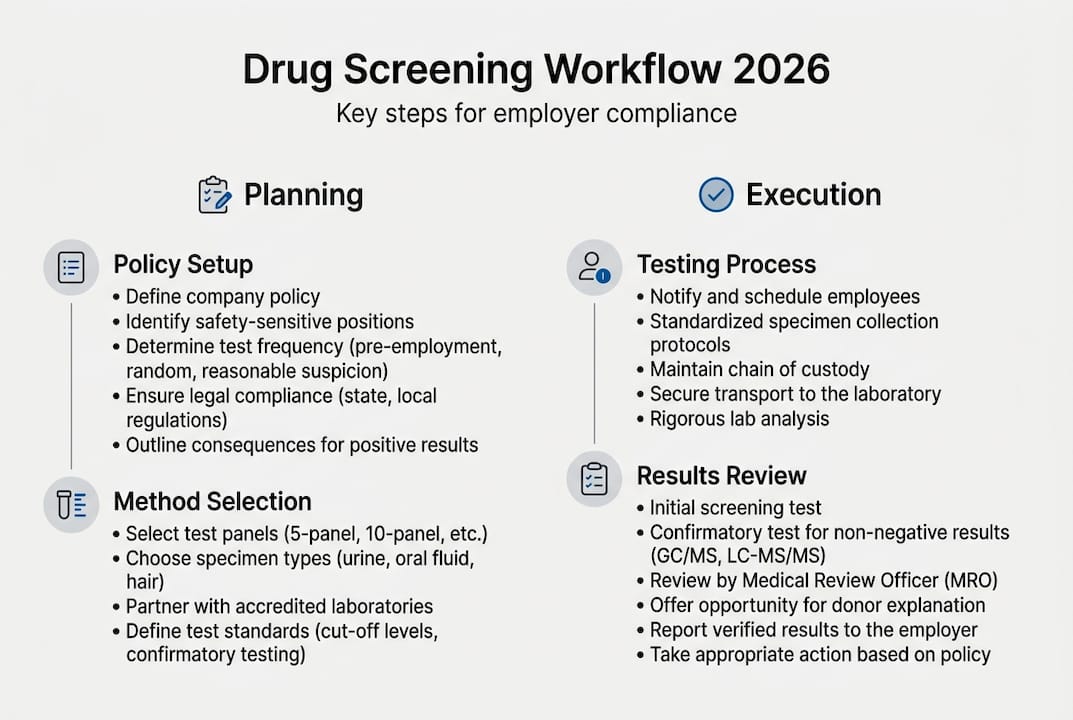
Your written policy is the backbone of everything that follows. It needs to clearly define:
- Scope: Which positions are subject to testing and under what circumstances.
- Timing: When testing occurs (pre-employment, random, post-accident, etc.).
- Confidentiality: How results are stored, who can access them, and for how long.
- Consequences: What happens after a positive result, including any rehabilitation options.
- Legal review: Have employment counsel review the policy before you distribute it.
A policy that’s vague about consequences or doesn’t address state-specific marijuana rules will create problems the moment you try to enforce it.
Choose the right specimen and testing method
Federal guidelines require HHS-certified labs, split specimens, and a core 5-panel configuration, now updated in 2026 to include fentanyl and norfentanyl. Here’s how your specimen options compare:
| Specimen type | Detection window | Best use case |
|---|---|---|
| Urine | 1 to 7 days (most substances) | Pre-employment, random, post-accident |
| Oral fluid (saliva) | 24 to 48 hours | Reasonable suspicion, on-site rapid testing |
| Hair | Up to 90 days | Pre-employment, return-to-duty |
For a detailed breakdown of each stage, the step-by-step drug screening workflow resource covers specimen handling, panel selection, and lab requirements in full.
Assign clear responsibilities
Every role in the process needs an owner. HR manages policy communication and record-keeping. Supervisors handle reasonable suspicion documentation. A Medical Review Officer (MRO) reviews all lab-confirmed positives before results are released. Understanding the role of the medical review officer is essential because an MRO can legitimately overturn a positive result if a valid prescription explains the finding.

Pro Tip: Review your test panels at least once a year. Substance abuse trends shift, and regulatory updates (like the 2026 fentanyl addition) can make your current panel incomplete overnight.
Step 2: Implement the workflow and ensure compliance
Once you have your tools and policy ready, you’re equipped to roll out and enforce your workflow. Implementation is where theory meets reality, and where gaps in planning become visible fast.
Communicate before you test
Employees must receive written notice of your drug testing policy before any testing begins. New hires should sign an acknowledgment during onboarding. For existing employees, distribute updates and collect signatures. This protects you against retaliation claims and sets clear expectations.
The operational sequence
Follow this sequence for every test event:
- Notify the employee according to your policy (immediately for random or post-accident; in advance for return-to-duty).
- Document the reason for testing, especially for reasonable suspicion cases.
- Direct the employee to an approved collection site or administer an on-site collection per protocol.
- Ensure proper specimen collection with chain-of-custody forms completed at the point of collection.
- Send to a certified lab for analysis, or use a validated point-of-collection test for rapid screening.
- MRO reviews all non-negative results before any action is taken.
- Release results to the designated HR contact only, maintaining confidentiality.
Chain of custody and MRO review are critical to defend against lawsuits. A broken chain of custody can invalidate a result entirely, leaving you unable to act on a confirmed positive.
“Inconsistent protocols, such as testing some employees but not others in the same role, are among the most common triggers for regulatory action and civil litigation.”
Pro Tip: Uniform application is not optional. Your random pool, your post-accident protocol, and your reasonable suspicion criteria must apply equally to all employees in covered roles, from entry-level workers to senior managers.
For practical guidance on conducting drug testing on-site or through a collection network, review your options before you schedule your first test event. Solid documentation also supports workplace safety with drug testing goals by creating an auditable record of every action taken.
Step 3: Monitor results, address challenges, and refine
Executing the workflow is only the beginning. Maintaining its effectiveness requires ongoing attention to what the data is telling you and how your process holds up under real-world pressure.
Track positivity rates as a health indicator
Your positivity rate (the percentage of tests returning non-negative results) is a signal, not just a number. A sudden spike in post-accident positives may indicate a safety culture problem. A rate that’s consistently zero across a large workforce might suggest your collection process isn’t being taken seriously. Benchmark against industry data and watch for trends over time.
Handle challenging outcomes correctly
Not every positive result is straightforward. Here’s what to watch for:
- Prescription medications: The MRO will contact the employee to verify. Do not take action until the MRO releases the final result.
- Disputed results: Employees have the right to request a split specimen retest. Honor it.
- ADA accommodation requests: If an employee discloses a disability or treatment program, consult legal counsel before making any employment decision.
- Refusals to test: Treat refusals as positive results under your policy, and document everything.
Update your panels to match current threats
Random testing detects seven times more fentanyl than pre-employment screening alone. That statistic should reshape how you think about your testing calendar. If your random testing rate is low or your panel doesn’t include fentanyl, you’re missing the most dangerous substance in today’s workforce.
Review HR policies and drug testing practices annually to align your panel with current substance trends and any new regulatory requirements.
Pro Tip: Ongoing random testing is your most effective deterrent. Employees who know they could be tested at any time are far less likely to use substances that impair their performance or judgment.
Refine your workflow every 12 months. Review your policy language, your panel configuration, your lab relationships, and your internal training to make sure everything still fits your organization’s size, risk profile, and regulatory obligations.
What most guides skip: The real drivers of drug screening success
Most drug screening guides focus on the mechanics: which forms to use, which labs to call, which panels to order. Those details matter. But in our experience, the workflows that actually protect employers aren’t the ones with the most sophisticated technology. They’re the ones with the most consistent execution.
The real failure mode isn’t a missing compliance checkbox. It’s a supervisor who doesn’t know how to document reasonable suspicion, or an HR team that applies the policy differently depending on who’s being tested. Those inconsistencies are where lawsuits are born.
Organizations that embed drug screening into their culture, not just their policy manual, see measurably better outcomes. When employees understand the “why” behind testing, and when managers are trained to apply the policy fairly and confidently, trust actually increases. Compliance becomes a shared value rather than a threat.
Make drug screening part of onboarding education, annual training, and manager accountability reviews. If you’re exploring how at-home drug screening compliance fits into a broader program, that’s worth evaluating too. The technical framework is the floor, not the ceiling.
Take the next step: Simplify drug screening with proven solutions
Ready to put your policy into action? The right partners and supplies make all the difference between a workflow that holds up under scrutiny and one that creates more problems than it solves.
At CountryWideTesting.com, we work with employers at every stage of workflow setup, from selecting the right test format to connecting with certified lab partners. Our lab testing services are backed by SAMHSA, CLIA, and CAP-certified laboratories, so your results are defensible and compliant. For fast, on-site screening needs, our saliva drug test kits deliver rapid results across 10 panels with no lab wait time. Whether you’re building a new program or tightening an existing one, we have the tools and expertise to support your compliance goals.
Frequently asked questions
What are the legal risks of poor drug screening workflows?
Improper or inconsistent screening can expose employers to discrimination lawsuits, privacy violations, and regulatory fines. Without chain of custody documentation and MRO review, even a legitimate positive result can be challenged successfully in court.
Which drug tests are required for DOT-regulated employers?
DOT-regulated employers must conduct pre-employment, random (at a 50% annual pool rate for most modes), post-accident, and return-to-duty testing, along with FMCSA Clearinghouse queries for commercial drivers.
How often should employers update their drug testing panels?
Review and update panels at least annually to reflect current substance trends, regulatory changes, and any new mandated analytes such as fentanyl and norfentanyl added in recent federal updates.
Can state cannabis laws affect workplace drug testing?
Yes. Some states limit THC testing or restrict disciplinary action for off-duty use, so employers must review local statutes alongside federal requirements before finalizing their testing policy.
Why is random testing considered more effective than just pre-employment screening?
Random testing detects fentanyl at seven times the rate of pre-employment screening alone, making it a far stronger deterrent for ongoing substance use in safety-sensitive roles.
Recommended
- Step by Step Drug Screening Workflow for HR Managers
- Top 8 Laboratory Drug Screening Tools in 2026 for Employers Ensuring W
- Drug testing compliance guide for employers in 2026
- Drug Screening Workflow for Clinics: Ensure Compliance Easily
- GeneMatrix LIMS - Laboratory Information Management System | AI-Powered Lab Software