
How to build a compliant drug test workflow for universities
TL;DR:
- Effective university drug testing requires understanding layered regulations, clear workflows, and designated accountability. Proper procedures for selection, notification, collection, and result management protect institutions from compliance failures and legal liabilities. Building a culture of support alongside strict protocols enhances safety and reduces repeat violations.
Managing drug testing at a university is nothing like running a corporate HR program. When a compliance audit uncovers missing chain-of-custody forms, notification gaps, or an NCAA athlete who was tested without a doping control officer present, the fallout is immediate and expensive. Legal liability, NCAA eligibility disputes, and reputational damage are all on the table. Universities implement drug testing primarily for employees in safety-sensitive positions and student-athletes, and each group demands its own structured, defensible workflow. This guide walks you through every stage of that workflow, from policy setup to continuous improvement.
Table of Contents
- Understanding drug testing requirements for universities
- Key roles, technologies, and required resources
- Step-by-step drug test management workflow
- Troubleshooting, compliance checks, and continuous improvement
- A smarter approach: Why your culture matters more than your workflow
- Simplify compliance with turnkey drug testing solutions
- Frequently asked questions
Key Takeaways
| Point | Details |
|---|---|
| Define clear roles | Assign a coordinator and use certified labs and tools for compliance. |
| Follow structured steps | Use detailed workflows for selection, collection, and result management. |
| Document every exception | Keep meticulous records for audits and handle edge cases with clear protocols. |
| Balance discipline with support | Combine enforcement with education for better long-term student outcomes. |
Understanding drug testing requirements for universities
Before you can build a workflow, you need to know exactly who you’re testing, why, and under what legal framework. The regulatory landscape for universities is layered. Federal mandates, NCAA bylaws, state employment law, and your institution’s own policies all intersect, and a gap in any one of them creates audit exposure.
Who gets tested and why?
Universities typically test three groups. First, employees in safety-sensitive positions such as transportation staff, facilities workers handling hazardous materials, and campus police are subject to Department of Transportation (DOT) rules or Drug-Free Workplace Act obligations. Second, student-athletes participating in NCAA competition face one of the most rigorous testing frameworks in higher education. Third, non-athlete students may be tested when a policy violation triggers a sanction-based test.
The testing triggers for employees include:
- Pre-employment: Before a safety-sensitive hire begins work
- Random: Unannounced, computer-generated selection throughout the year
- Reasonable suspicion: When a trained supervisor observes behavioral or physical indicators
- Post-accident: Following a workplace incident meeting defined criteria
- Return-to-duty: Before an employee resumes a safety-sensitive role after a violation
- Follow-up: Ongoing unannounced tests after return-to-duty clearance
Each trigger carries its own documentation requirements and timelines. Missing a step in any one of these scenarios is a compliance event.
The numbers that should concern you
Approximately 30% of US colleges have active drug testing programs, yet roughly 20% of college students report marijuana use in the past 30 days. That gap between prevalence and testing coverage means many institutions are operating without the data they need to make informed policy decisions. For student-athletes, NCAA compliance is particularly high-stakes because a failed or invalidated test can cost an athlete their eligibility.
“A compliant drug test workflow is not just a HR obligation. It is a liability management tool that protects the institution, its employees, and its students equally.”
Athletic drug screening requirements differ substantially from employee testing, which is why your workflow must branch clearly between these populations from the moment a test is triggered. Understanding those distinctions upfront saves enormous time during execution.
Key roles, technologies, and required resources
With a solid understanding of what’s required, here’s how to assemble the people and tools that power your workflow.
Who does what
Designating a Drug Test Coordinator (DTC) or Designated Employer Representative (DER) is the single most important structural decision you will make. This person owns the process. They interface with the lab, receive results, communicate with the Medical Review Officer (MRO), and coordinate follow-up actions. Without a named DER, accountability evaporates the moment something goes wrong.
Beyond the DER, your team needs:
- Trained supervisors who can identify and document reasonable suspicion triggers
- Collection site staff or a contracted collection partner for specimen handling
- A SAMHSA-certified laboratory for federally mandated testing
- A Medical Review Officer (MRO) who reviews and verifies lab results
- IT support to manage random selection software and record-keeping systems
Resource and technology overview
| Resource | Purpose | Key requirement |
|---|---|---|
| SAMHSA-certified lab | Processes urine specimens | Must meet federal standards |
| MRO (Medical Review Officer) | Reviews and interprets results | Licensed physician |
| OEHR random selection software | Generates unbiased random pools | Auditable selection records |
| Chain-of-custody forms | Documents specimen from collection to lab | No alterations permitted |
| Notification templates | Standardizes employee/athlete communication | Timestamps and receipts required |
| Vendor service contracts | Lab, collection, MRO relationships | SLAs and compliance clauses |
Choosing the right drug testing kit selection matters more than most administrators realize. A kit that doesn’t meet specimen integrity standards will generate results the MRO cannot defend, leaving you exposed in a grievance or appeal.
For random testing pools specifically, OEHR (Occupational Electronic Health Record) platforms allow you to manage pool composition, generate randomized selections, document notification dates, and store test results in one auditable location. Integration between your OEHR platform and your SAMHSA lab certification process reduces manual data entry errors, which remain a leading cause of compliance failures.
Pro Tip: Never rely on a single staff member to understand the entire workflow. Cross-train at least two people for every critical role. If your DER is out during a post-accident testing window, you need a fully trained backup ready to act within hours, not days.
Step-by-step drug test management workflow
Here’s exactly how your team can execute each stage, step by step, from start to finish.
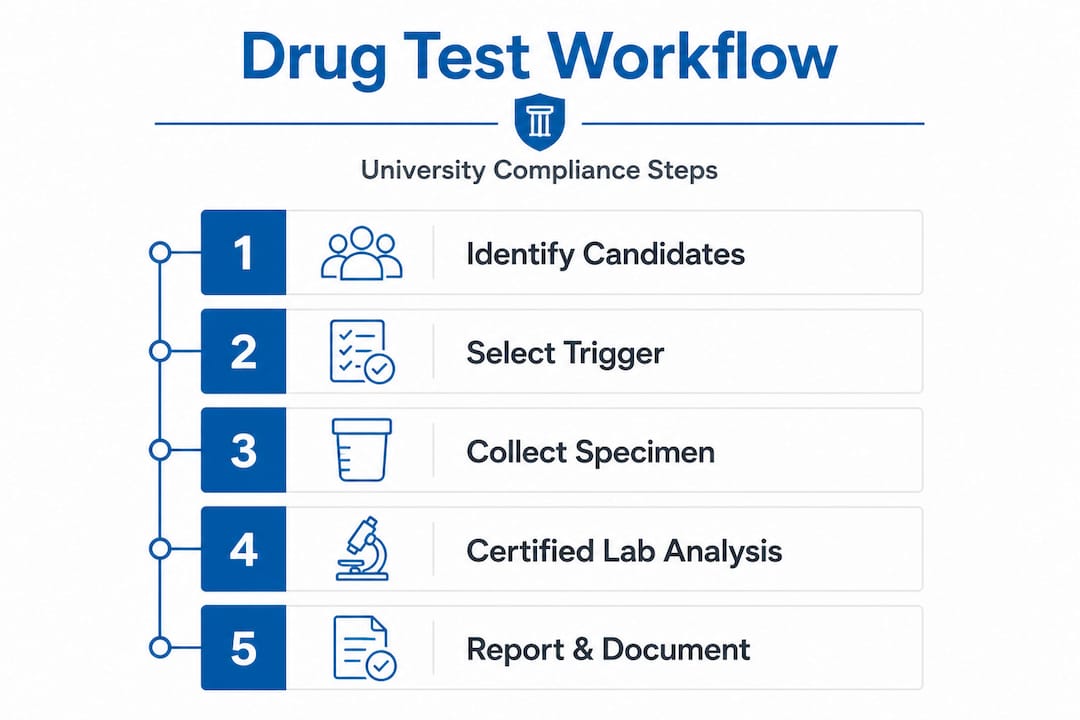
The core workflow sequence
- Selection: Use OEHR software or a verified random number process to select individuals from the eligible pool. Document the selection date, method, and personnel involved.
- Notification: Deliver notification directly and privately. For employees, this should happen on the same day as selection. For NCAA athletes, notification comes from a doping control officer. Log timestamps and obtain a signature or acknowledgment.
- Collection: Escort the individual to the collection site immediately after notification. Delays are a compliance risk. Collection staff verify identity, maintain direct observation protocols where required, and complete chain-of-custody forms on the spot.
- Lab processing: Specimens are transported under sealed, documented chain-of-custody to a SAMHSA-certified lab. The lab screens the specimen and, if reactive, sends it for confirmatory GC/MS testing.
- MRO review: The Medical Review Officer contacts the donor before reporting a non-negative result to the DER. This step protects both the institution and the individual from errors caused by legitimate medical use.
- Result reporting: The MRO reports verified results to the DER. Negative results are logged. Non-negative results trigger the next action based on policy, which may include removal from safety-sensitive duty, referral to a Substance Abuse Professional (SAP), or in student cases, a disciplinary referral.
- Follow-up: For employees returning to duty, a follow-up plan requires unannounced testing per a schedule set by the SAP.
NCAA athletes versus standard employee workflow
| Stage | NCAA athlete | Employee (safety-sensitive) |
|---|---|---|
| Selection | NCAA-directed or institution-directed random | OEHR random pool or trigger-based |
| Notification | Doping control officer, in-person | DER or trained supervisor |
| Collection | Directly observed, specific gravity checked | Monitored, chain-of-custody form |
| Medical exceptions | Pre-approved therapeutic use exemption | MRO review post-collection |
| Result impact | Eligibility loss, suspension | Removal from duty, SAP referral |
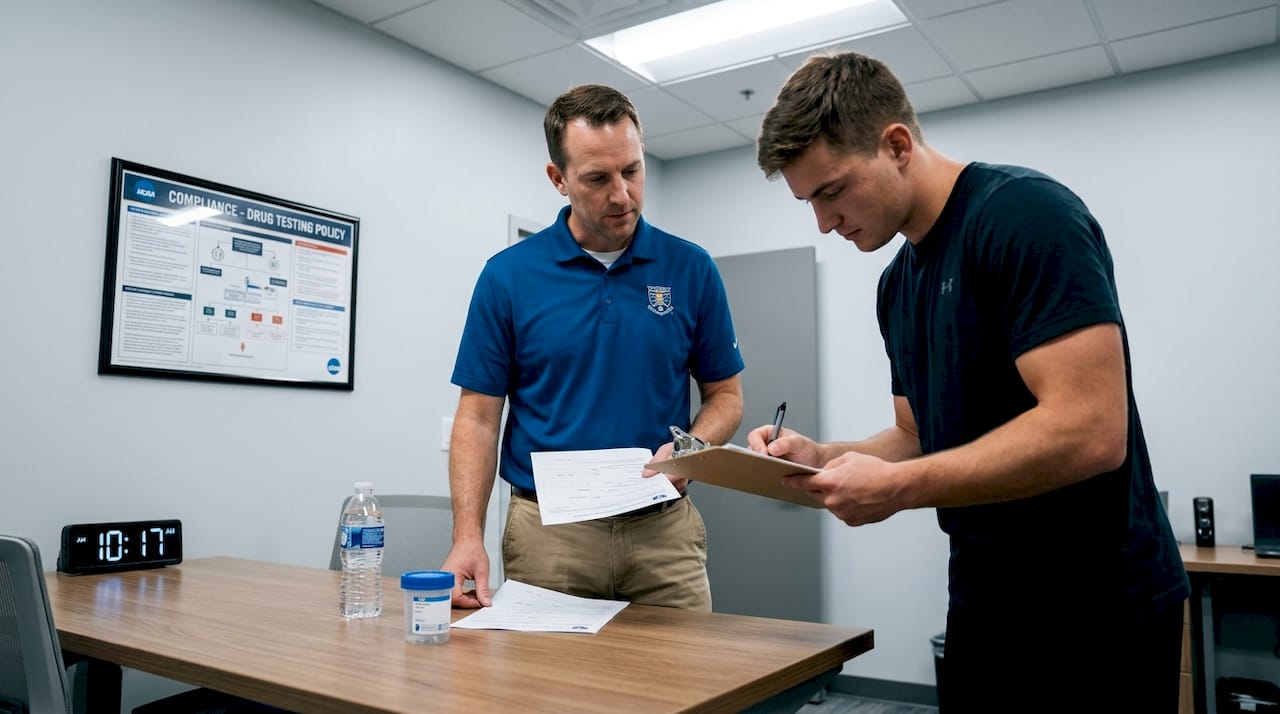
NCAA athletes face direct observation collection, specific gravity verification to detect dilution, and a pre-approval process for any medications on the banned substance list. These requirements are far more restrictive than standard employee testing, and confusing the two workflows creates serious problems.
Handling special cases
Universities follow specific protocols for dilute specimens, which require a retest. A specimen with creatinine below 2 mg/dL is reported as substituted and treated as a refusal. A specimen with creatinine between 2 and 20 mg/dL is reported as dilute, and many policies mandate an immediate second collection under direct observation. Refusals, whether the individual refuses to provide a specimen or leaves the site before collection completes, are treated as positive results and carry the same sanctions.
For a detailed workflow example that maps each decision point, including what to do when a collection site is unavailable or an employee claims a medical condition mid-collection, having documented procedures is non-negotiable.
Pro Tip: Chain-of-custody documentation is the number one area where compliance failures occur during audits. Treat every form as a legal document because it is. Any correction requires a single line through the error, the corrector’s initials, and the date. White-out or full erasure voids the form.
The chain-of-custody procedures for employer compliance apply directly to higher education settings, with the added complexity of managing dual populations under different regulatory frameworks.
Troubleshooting, compliance checks, and continuous improvement
To finish, let’s address how to avoid costly missteps and keep your workflow bulletproof.
Common errors that create audit exposure
- Providing advance notice of a random test, even inadvertently through scheduling patterns
- Failing to document reasonable suspicion observations in writing within 24 hours
- Allowing a gap in chain-of-custody where specimen custody is unclear
- Using an expired or uncertified collection kit
- Not obtaining a signed acknowledgment of notification
- Skipping MRO review before reporting a non-negative result to HR
Each of these errors has been used to successfully challenge test results in grievance hearings and legal proceedings. The documentation trail is what makes your results defensible.
Troubleshooting specific scenarios
Edge cases require clear written procedures covering travel deferrals, where an employee is selected during approved leave, handling dilute specimens requiring retest, managing refusals, and transporting individuals after a reasonable suspicion determination. When an employee is away on travel during a random selection window, your policy needs to specify whether the selection carries over to their return or is voided for that cycle. Inconsistent treatment across employees is an equal employment liability.
Follow-up testing after return-to-duty can continue for up to 60 months, and the schedule must be unpredictable. Following a pattern (such as always testing on the first Monday of the month) defeats the deterrence purpose and may itself constitute a compliance failure under DOT rules.
Testing deters use but can also burden management, which is why policies must balance compliance requirements with employee support mechanisms and stay current with evolving state marijuana laws and Good Samaritan protections.
Building a culture of continuous improvement
Use a compliance checklist for quarterly self-audits. Review every non-negative case annually to identify process gaps. Monitor state law changes, particularly around marijuana legalization, because a substance that is now legal in your state may still be a federal disqualifier for safety-sensitive roles. Bring your legal counsel into annual policy reviews. And update your MRO and lab contracts every time regulatory guidance changes.
Pro Tip: Create a dedicated exception log where staff record every deviation from standard procedure, including the reason and resolution. This log becomes your first line of defense in any audit or legal challenge, and it demonstrates good-faith compliance efforts even when mistakes occurred.
A smarter approach: Why your culture matters more than your workflow
Here is the perspective that rarely makes it into compliance guides. A perfectly documented workflow can still produce terrible outcomes if it exists in isolation from the broader campus culture. Institutions that treat drug testing purely as a disciplinary tool consistently underperform compared to those that integrate testing with education and support services.
The data tells a stark story. Only 9% of students with alcohol use disorder receive treatment, even on campuses with active testing programs. That number should be alarming. It means that enforcement is reaching a small fraction of the students who actually need intervention, while the majority either go undetected or go unsupported after detection.
Progressive sanction models, which use a three-strike framework combined with mandatory counseling referrals, consistently outperform zero-tolerance approaches in reducing repeat violations. Students who understand that a positive test leads to support first and suspension as a last resort are more likely to self-report and engage with treatment. That reduces your institution’s liability while improving student outcomes.
The same logic applies to employees. Return-to-duty programs that pair testing requirements with Employee Assistance Program (EAP) referrals produce lower recidivism than punitive-only approaches. Building those referral pathways directly into your workflow, not as an afterthought but as a mandatory step after any non-negative result, signals that the program’s goal is safety and wellbeing, not punishment.
Reviewing school culture and compliance examples from peer institutions reveals that the programs with the fewest legal challenges and the best long-term outcomes are invariably the ones where testing is one component of a larger health and safety strategy. Workflow perfection without cultural alignment is a costly way to generate paperwork.
Simplify compliance with turnkey drug testing solutions
Running a compliant university drug testing program requires reliable products and certified lab partners, not just good procedures. The operational burden on your student health and HR teams drops significantly when your testing supplies and lab services are standardized, audit-ready, and sourced from a single trusted provider.
CountryWideTesting.com offers nationwide lab testing services through SAMHSA, CAP, and CLIA-certified laboratories, giving your institution the regulatory standing required for both employee and NCAA-adjacent testing programs. For institutions that need confirmatory testing with a fully documented chain-of-custody, the SAMHSA mail-in confirmation kit provides a straightforward, audit-defensible solution that integrates directly with your existing workflow. Whether you’re managing a random pool of 50 safety-sensitive employees or building out a broader student health screening program, purpose-built tools reduce your audit risk and free your team to focus on what matters most.
Frequently asked questions
Who is subject to drug testing at universities?
Employees in safety-sensitive roles and student-athletes per federal rules are the primary groups; non-athlete students are typically only tested following a documented policy violation or sanction.
What happens if a student refuses a drug test?
A refusal is treated as a positive result under most university and federal policies, triggering the same sanctions as a confirmed non-negative outcome, including potential follow-up testing requirements.
How long are individuals subject to follow-up tests after returning to duty?
Follow-up testing can extend up to 60 months post-return-to-duty, depending on the severity of the infraction and the Substance Abuse Professional’s recommendation.
Are there legal protections for students who seek help for drug or alcohol issues?
Yes, several states have 911 Good Samaritan protections for students seeking medical help; review your state’s specific statutes and incorporate those protections explicitly into your campus policy language.
What technology helps streamline university drug test management?
OEHR software automates random selection, tracks notification timelines, and stores compliance documentation, making it the most practical technology investment for institutions managing multiple testing pools.