
NCAA drug testing: protocols, banned substances & compliance
Most athletic directors assume NCAA drug testing is primarily about catching athletes on steroids. That assumption leaves programs dangerously underprepared. The NCAA’s drug testing framework covers stimulants, recreational drugs, masking agents, and a broad category of “related substances” that can ensnare athletes who never touched a performance-enhancing drug. According to the NCAA banned substances policy, banned classes include stimulants, anabolic agents, beta-blockers, diuretics, and narcotics, with no exhaustive list provided. Understanding the full scope of this system is not optional for compliance staff. It is a core administrative responsibility.
Table of Contents
- What is NCAA drug testing?
- How the NCAA drug testing process works
- Which substances are banned by the NCAA?
- Medical exceptions and recent rule changes
- Recent trends and empirical benchmarks in NCAA drug testing
- How to ensure compliance and support athlete well-being
- Frequently asked questions
Key Takeaways
| Point | Details |
|---|---|
| Wide scope of banned substances | NCAA drug testing covers both performance-enhancing and recreational drugs. |
| Clear medical exception process | Athletes must follow strict procedures to get exceptions for legitimate medications. |
| Regular trends review is critical | Monitoring drug testing trends helps institutions reduce compliance risks. |
| Testing tools support compliance | Access to lab and at-home testing solutions helps administrators streamline NCAA checks. |
What is NCAA drug testing?
NCAA drug testing serves three distinct purposes: preserving fair competition, protecting athlete health, and holding institutions accountable for the conduct of their programs. It is not simply a deterrent. It is a structured regulatory system with real consequences for athletes and schools that fail to follow it.
The program covers both performance-enhancing substances and recreational drugs. That means a student-athlete testing positive for a stimulant found in a common pre-workout supplement faces the same eligibility consequences as one caught using anabolic steroids. The scope is deliberately broad.
“The NCAA does not publish a complete list of banned substances. Any substance chemically related to a banned class may also be prohibited, even if not explicitly named.”
Testing responsibilities are split between the NCAA at the national level and individual member institutions at the campus level. The NCAA conducts testing at championship events and through year-round random selection. Schools are expected to run their own college athletic drug screening programs independently. Both layers must function correctly for a program to stay compliant.
A common misconception is that only high-profile athletes get tested. In reality, any rostered student-athlete in any sport can be selected at any time. Administrators who treat drug testing as a formality rather than a compliance system are the ones who get caught off guard.
How the NCAA drug testing process works
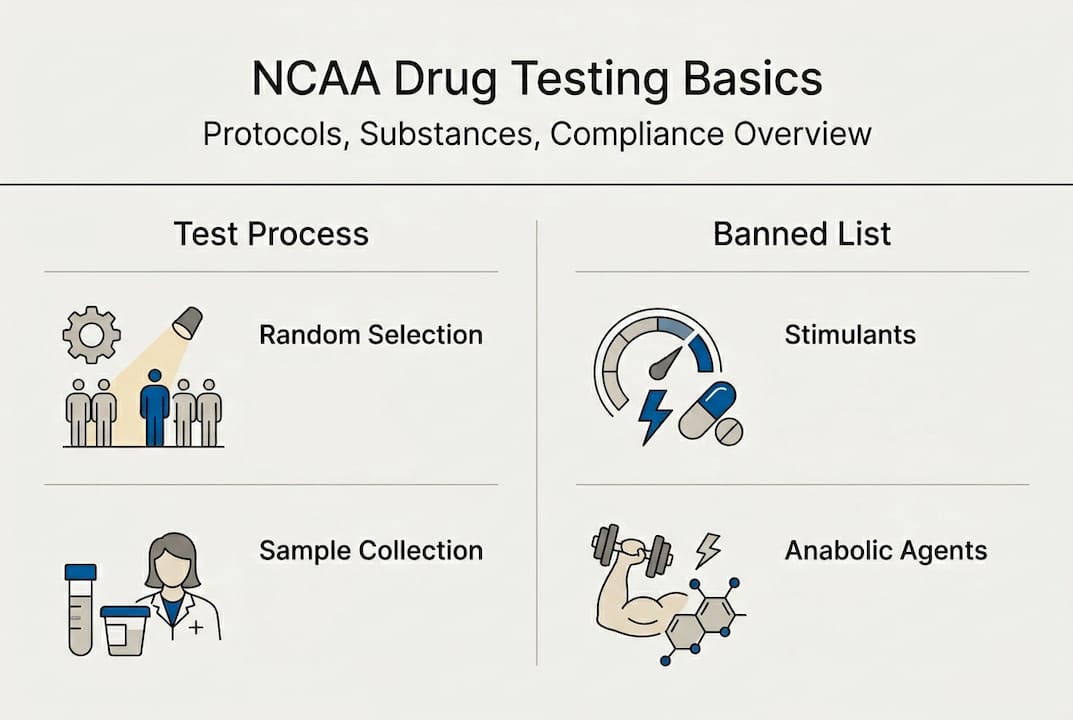
The NCAA uses two selection methods: random selection throughout the academic year and event-based selection at championships and bowl games. Both follow a strict chain-of-custody protocol that protects the integrity of results and the rights of athletes.
Here is how the process unfolds from notification to result:
- Notification: The athlete receives written notice, typically with little advance warning, requiring them to report to the collection site within a specified window.
- Check-in: The athlete presents valid identification and confirms their identity with the collection crew.
- Witnessed collection: A same-gender collector directly observes the urine sample to prevent tampering or substitution.
- Sample security: The sample is split into an A and B specimen, sealed, and logged with a unique identifier.
- Lab analysis: Samples go to an NCAA-certified laboratory where they are screened using immunoassay and confirmed by gas chromatography or mass spectrometry.
- Result review: Positive A specimens trigger a review process. The athlete may request B specimen testing before any sanction is imposed.
A dilute or atypical sample may require a retest, which can extend the timeline and create additional administrative burden for your compliance office.
Understanding the types of drug tests for athletes used in collegiate settings helps your staff anticipate what athletes will face. Your student drug testing guide protocols should mirror NCAA chain-of-custody standards so athletes are not caught off guard by institutional testing either.
Pro Tip: Brief your athletes on supplement risks before every season. Many positive tests involve substances that athletes did not know were in their supplements. The NCAA does not accept “I didn’t know” as a defense.
Which substances are banned by the NCAA?
The complete list of NCAA banned substances is organized into classes rather than individual compounds. This structure means that a newly developed stimulant analog can be banned even before it is explicitly named. Administrators need to understand the classes, not just memorize a list.
Major banned substance classes:
- Stimulants: Amphetamines, ephedrine, and related compounds. Common in weight-loss supplements and pre-workout products.
- Anabolic agents: Testosterone, SARMs (selective androgen receptor modulators), and related steroids.
- Beta-blockers: Banned in archery and rifle sports only, where they reduce hand tremor and heart rate.
- Diuretics and masking agents: Substances that dilute urine or interfere with detection of other banned drugs.
- Narcotics: Opioids including morphine and oxycodone.
- Peptide hormones and growth factors: HGH, EPO, and similar compounds.
- Anti-estrogens: Often used post-steroid cycle; banned regardless of context.
- Beta-2 agonists: Certain asthma medications fall here unless a medical exception is approved.
| Substance class | Common sources | Exception available? |
|---|---|---|
| Stimulants | Supplements, ADHD meds | Yes, with documentation |
| Anabolic agents | Steroids, SARMs | No |
| Beta-blockers | Heart/anxiety meds | Archery/rifle only |
| Diuretics | Weight-loss products | Rarely |
| Narcotics | Prescription painkillers | Limited |
| Beta-2 agonists | Asthma inhalers | Yes, with documentation |
The gray area that trips up most programs is the “related substances” clause. A supplement labeled as a natural product may contain a compound structurally similar to a banned stimulant. Staying current with drug testing trends helps compliance staff anticipate which new compounds are entering the supplement market.
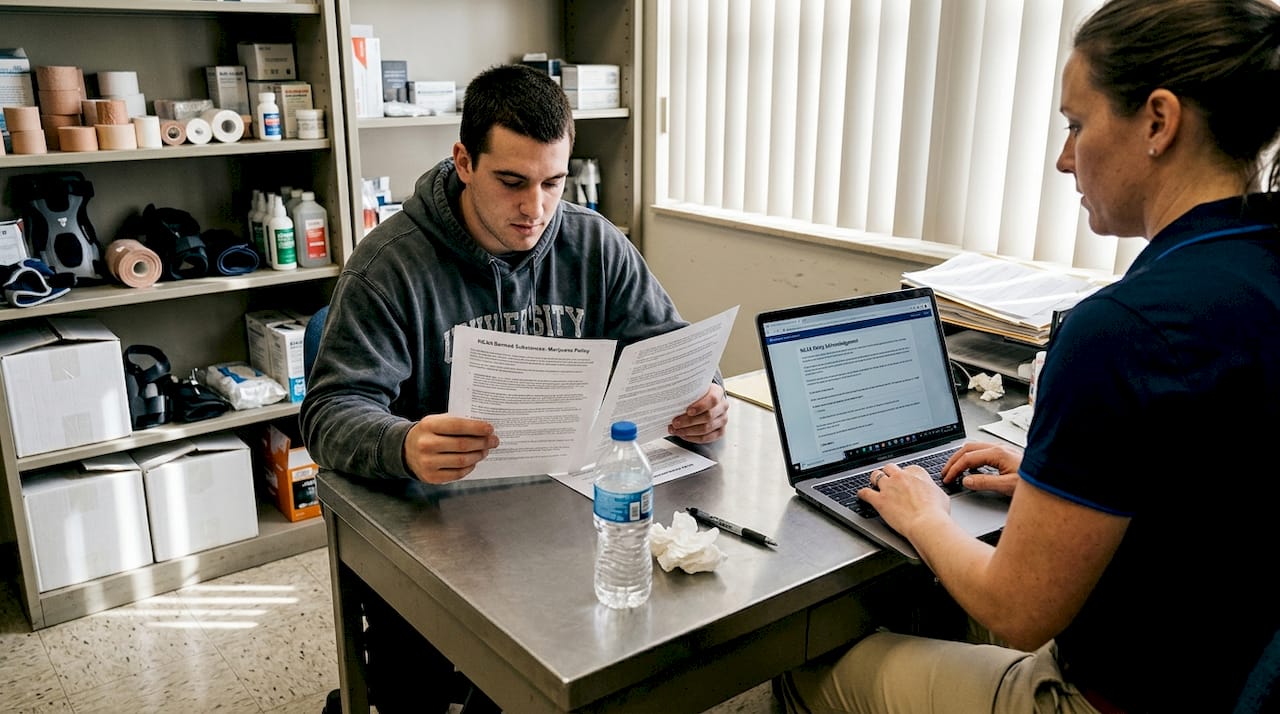
Marijuana occupies a separate category. The NCAA has adjusted its marijuana drug testing policies over recent years, raising the threshold for a positive THC result. However, it remains a banned substance, and state legalization does not create an exemption under NCAA rules.
Medical exceptions and recent rule changes
Athletes with legitimate medical needs are not automatically disqualified from competition. The NCAA has a formal medical exception pathway, but it requires proactive documentation and advance approval. Waiting until after a positive test to raise a medical defense rarely works.
The process works like this: the athlete’s physician submits an NCAA medical exception form, which is reviewed by the Committee on Competitive Safeguards and Medical Aspects of Sports (CSMAS). CSMAS evaluates whether the medical need is genuine and whether a non-banned alternative exists. Approval is not guaranteed.
| Medication type | Exception possible? | Notes |
|---|---|---|
| ADHD stimulants (Adderall, Ritalin) | Yes | Requires full documentation |
| Asthma inhalers (beta-2 agonists) | Yes | Specific formulations only |
| Testosterone replacement | Rarely | Scrutinized heavily |
| Cannabis/THC | No | No exceptions under any circumstance |
| Diuretics for medical conditions | Rarely | Alternative drugs preferred |
Recent medical exception updates have tightened requirements for ADHD medications in particular. CSMAS now expects more thorough neuropsychological documentation before approving stimulant use. Programs that relied on a simple physician letter in prior years may find that standard no longer sufficient.
For asthma medications, specific inhaled beta-2 agonists are permitted with documentation, but oral or injectable forms of the same drugs are not. The delivery method matters.
Pro Tip: Build a prescription tracking system into your compliance workflow at the start of each academic year. Every athlete on a medication that touches a banned class should have their exception paperwork filed before the season begins, not after a positive test triggers a crisis.
Administrators should also review school drug testing for students policies to ensure institutional testing programs align with NCAA standards and do not create conflicting obligations for athletes.
Recent trends and empirical benchmarks in NCAA drug testing
Data from 2023 shows that roughly 2.3% of Division I athletes test positive for stimulants annually, with over 90 confirmed positive cases at the D1 level. That number sounds small until you realize what it means for your institution’s risk exposure.
A single positive test triggers eligibility suspension, potential scholarship review, and reputational consequences for the program. At competitive programs where roster depth is thin, one suspension can affect season outcomes. Compliance is not just an ethical obligation. It is a competitive one.
Recent shifts in substance use patterns show a rise in stimulant positives relative to anabolic agent positives. This reflects broader trends in supplement culture, where stimulant-heavy pre-workout products have become standard in many athletic training environments. Coaches who normalize supplement use without oversight are inadvertently increasing their program’s risk.
Cannabis-related positives have declined since the NCAA raised its detection threshold, but stimulant and peptide hormone cases have increased. Staying current with drug testing trends in 2026 helps compliance teams anticipate where the next wave of violations is likely to come from.
Actions to reduce positive rates on your campus:
- Implement a mandatory supplement review process using Drug Free Sport AXIS before any product is approved for team use.
- Conduct pre-season education sessions that specifically address stimulant risks in common supplements.
- Establish a confidential reporting channel so athletes can disclose prescription medications without fear of stigma.
- Run institutional testing throughout the year, not just before championships, to identify problems early.
- Partner with a certified testing provider to ensure your institutional program meets chain-of-custody standards.
- Review your compliance protocols annually against the most current NCAA banned substance guidance.
How to ensure compliance and support athlete well-being
Building a reliable NCAA drug testing compliance program requires more than reading the rulebook once a year. It requires consistent institutional testing, certified laboratory partnerships, and tools that reduce the administrative burden on your staff.
CountryWideTesting.com offers lab testing services processed through SAMHSA, ISO, CLIA, and CAP certified laboratories, giving your institution the documentation quality that holds up under NCAA scrutiny. For programs that need rapid screening options, the steroid abuse urine test kit provides a practical first-line tool for institutional monitoring. Whether you need bulk testing solutions for a full roster or targeted screening for specific athletes, CountryWideTesting.com provides the infrastructure to keep your compliance program running efficiently and defensibly year-round.
Frequently asked questions
Who is responsible for NCAA drug testing at a member institution?
Both the NCAA and individual member schools share responsibility. The NCAA handles championship and random year-round testing, while institutions are expected to run independent drug testing programs for their student-athletes.
What should athletes do if they need prescription medication that appears on the banned list?
Athletes must submit an NCAA exception form reviewed by CSMAS before competing. Waiting until after a positive test to disclose a prescription is not an accepted defense.
Are supplements safe for athletes under NCAA drug testing rules?
Not automatically. Supplements carry real risk because they may contain compounds related to banned classes. Athletes should always verify products through Drug Free Sport AXIS before use.
What is the consequence for a positive NCAA drug test?
A confirmed positive typically results in immediate suspension from competition and loss of eligibility for a defined period, which varies by substance class and whether it is a first or repeat offense.
How common are positive NCAA drug tests?
Roughly 2.3% of D1 athletes test positive for stimulants each year, based on 2023 estimates, with over 90 confirmed cases at the Division I level alone.