
Consortium drug testing: compliance & safety for employers
TL;DR:
- Consortium drug testing pools multiple employers’ safety-sensitive employees managed by a third-party to ensure valid randomness.
- Federal regulations mandate consortium membership for owner-operators and small DOT-regulated fleets to meet testing requirements.
- Employers must actively engage in oversight; reliance solely on third-party management can lead to compliance failures.
Many employers running DOT-regulated operations assume they understand their random drug testing obligations, until an audit reveals a critical gap. Consortium drug testing is one of the most misunderstood compliance tools in workplace safety, yet it is legally required for a large segment of the workforce. A wrong assumption about how your testing pool is structured can mean a failed inspection, a suspended operating authority, or worse, a preventable accident. This guide breaks down exactly what consortium drug testing is, who needs it, how it works, and what employers consistently get wrong about it.
Table of Contents
- What is consortium drug testing?
- When and why consortium drug testing is required
- How consortium drug testing works
- Benefits, challenges, and frequently misunderstood aspects
- Our perspective: What most employers get wrong about consortium drug testing
- Streamline compliance with trusted drug testing solutions
- Frequently asked questions
Key Takeaways
| Point | Details |
|---|---|
| Consortium definition | A consortium program pools employees from multiple companies for random drug testing, managed by a C/TPA. |
| Who must join | DOT-regulated owner-operators and small fleets are required by law to participate in consortium testing pools. |
| Compliance advantages | Consortiums streamline legal compliance, recordkeeping, and effective detection of ongoing substance use. |
| Nuances matter | State laws can impact testing rules, and proper administration—including MRO review—is crucial to avoid errors. |
| Practical next steps | Employers should use compliant providers and stay involved to ensure testing programs work as intended. |
What is consortium drug testing?
At its core, consortium drug testing is a shared testing arrangement. Multiple employers pool their safety-sensitive employees into one combined random selection pool, managed by a Consortium/Third-Party Administrator, known as a C/TPA. This structure is especially critical for small fleets and owner-operators in DOT-regulated industries, where a single employer may not have enough employees to run a statistically valid random testing program on their own.
Think of it like a lottery. If only one person buys tickets, the draw is meaningless. Random selection only works when the pool is large enough to make selection genuinely unpredictable. That is the fundamental logic behind consortium testing.
The industries most affected include:
- Trucking and motor carriers (regulated by FMCSA)
- Public transit agencies (FTA)
- Aviation (FAA)
- Railroads (FRA)
- Pipeline operators (PHMSA)
- Maritime (USCG)
Each of these industries has DOT-mandated minimum random testing rates. In 2026, FMCSA requires that at least 50% of a fleet’s average number of drivers be tested for drugs annually, and 10% for alcohol. Keeping up with these rates, maintaining records, and ensuring proper chain of custody is where many small operators fall short.
Here is a quick comparison of solo testing versus consortium testing:
| Feature | Solo employer testing | Consortium testing |
|---|---|---|
| Pool size | Limited to your own staff | Shared across many employers |
| Random validity | Questionable with small teams | Statistically sound |
| Admin burden | Entirely on you | Managed by C/TPA |
| Regulatory risk | High for small fleets | Significantly reduced |
| Recordkeeping | Internal | Maintained by C/TPA |
“A consortium drug testing program is a service where multiple employers, particularly small fleets and owner-operators in DOT-regulated industries like FMCSA trucking, pool their safety-sensitive employees into a shared random testing pool managed by a Consortium/Third-Party Administrator (C/TPA).” — DOT’s employer guidelines
Understanding random drug testing importance is the first step toward building a program that actually holds up under scrutiny.
When and why consortium drug testing is required
Not every employer has a choice here. For owner-operators and small fleets in DOT-regulated industries, joining a consortium is a federal requirement. You simply cannot self-administer a random testing program when you are the only driver. A pool of one is not a pool at all.
Larger fleets technically have the option to run their own internal random testing programs, but many choose consortium membership anyway. The administrative relief alone is worth it. Coordinating random draws, maintaining compliant records, and staying current on regulatory changes is a full-time job that most safety managers did not sign up for.
Here is a breakdown of who must use a consortium versus who may benefit from one:
| Employer type | Requirement |
|---|---|
| Owner-operators (DOT) | Mandatory consortium enrollment |
| Small fleets (1-5 drivers) | Mandatory consortium enrollment |
| Mid to large fleets | Optional, but operationally advantageous |
| Non-DOT employers | Not federally required, but widely used |
Beyond the federal layer, some states add their own rules. Iowa, for example, has specific requirements about which employees can be included in a random pool, and those rules do not always align neatly with federal flexibility. Ignoring state-level nuances is a common and costly mistake.
Here is what consortium membership typically handles for you:
- Maintaining the random selection pool with accurate employee records
- Conducting randomized draws at federally required rates
- Notifying employers of selected employees in time for testing
- Keeping official records for compliance audits
- Coordinating with collection sites and certified labs
Pro Tip: Even if you are a larger fleet and consortium membership is optional, enrolling still provides a legal paper trail that protects you in disputes. Documentation managed by a neutral third party carries more weight than internal records alone.
Understanding compliance in drug screening and the broader impact on drug screening workplace safety helps employers see why this is not just a checkbox exercise.
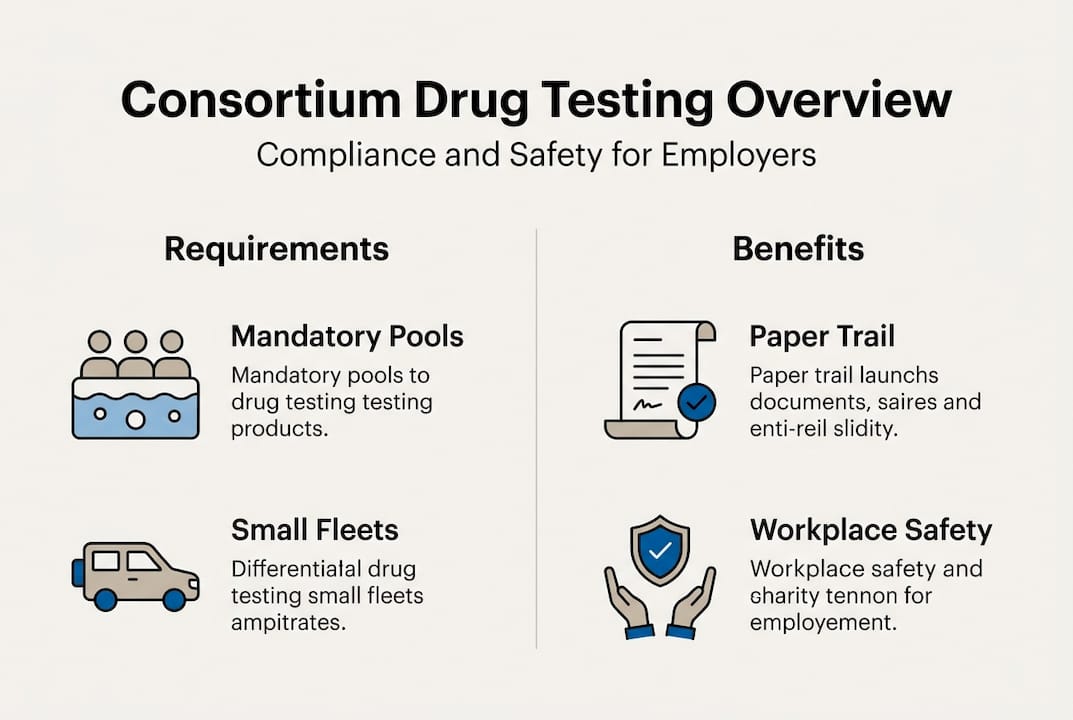
The DOT requirements are clear: mandatory for owner-operators and small fleets who cannot self-randomize, and beneficial for larger fleets looking to outsource the administrative load.
How consortium drug testing works
Knowing you need a consortium is one thing. Understanding how it actually operates day to day is another. Here is the standard process most C/TPAs follow:
- Enrollment: Your safety-sensitive employees are added to the consortium’s shared random pool.
- Random selection: The C/TPA uses a scientifically valid method to select employees at the required rate.
- Notification: The employer receives notice, typically with a short window for the employee to report for testing.
- Testing: The employee visits an approved collection site for a urine specimen, which goes to a SAMHSA-certified lab.
- MRO review: A Medical Review Officer reviews all non-negative results before they are reported to the employer.
- Recordkeeping: The C/TPA logs results and maintains documentation for regulatory audits.
The role of the MRO is often underestimated. Before a positive result reaches your desk, a licensed physician reviews it to rule out legitimate medical explanations. This step protects both the employer and the employee from acting on a false positive.
A critical point that many employers miss: if a selected employee is not tested within the required window, that absence is treated as a refusal to test. A refusal carries the same consequences as a confirmed positive result, including removal from safety-sensitive duties.

As state law random pools analysis points out, owner-operators must join a consortium because a pool of one is invalid, and missing a test equals a refusal. State laws may also add procedural nuances that affect how your C/TPA manages the pool.
Pro Tip: Ask your C/TPA how they handle notification windows and what their process is when an employee is unavailable. A vague answer is a red flag. You need a C/TPA with a documented, defensible notification protocol.
Familiarizing yourself with workplace drug test procedures ensures you know what your obligations are once a selection is made, not just what the C/TPA handles.
Benefits, challenges, and frequently misunderstood aspects
Consortium drug testing delivers real advantages, but it also comes with complications that employers need to understand before assuming everything is handled.
Key benefits include:
- Legally valid random selection that holds up in audits
- Reduced administrative burden on internal HR and safety teams
- Access to certified collection sites and SAMHSA-approved labs
- MRO review that filters out false positives before they cause harm
- Centralized recordkeeping that simplifies compliance reporting
One of the most compelling arguments for consortium testing is what it catches. Fentanyl positivity rates are more than seven times higher in random testing compared to pre-employment screening, according to the 2025 Quest Diagnostics Drug Testing Index. Pre-employment tests catch people who know they are being watched. Random testing catches people who thought they were safe.
That statistic should change how you think about your testing program. A pre-employment screen alone is not a safety program. It is a starting point.
“Random testing via consortiums detects ongoing use better than pre-employment, which is critical for safety in high-risk industries amid rising fentanyl and synthetic drug use.”
Common challenges include:
- Navigating differences between DOT and non-DOT testing rules
- State laws that impose stricter pool composition requirements
- ADA and privacy concerns around how results are handled and disclosed
- Employers misunderstanding what a positive result actually means before MRO review
One of the most frequently misunderstood concepts is the “pool of one.” Some owner-operators genuinely believe they can run their own random program. They cannot. A single-person pool produces no randomness. It is also worth noting that DOT rules and non-DOT rules are not interchangeable. Using a non-DOT test for a DOT-required position is a compliance failure, even if the test itself is accurate.
SAMHSA employer resources acknowledge both sides: consortiums are essential for compliance and safety, but employers must also be aware of false positive risks, state law variations, and privacy obligations.
Understanding the impact of drug testing on overall workplace safety gives employers the bigger picture behind why these programs exist.
Our perspective: What most employers get wrong about consortium drug testing
Here is the uncomfortable truth: most employers treat consortium enrollment as a one-time task. They sign up, pay the annual fee, and assume compliance is handled. It is not.
A C/TPA manages the mechanics, but the employer remains legally responsible. If your C/TPA makes an error in pool composition, misses a notification, or fails to follow state-specific rules, the regulatory penalty lands on you. That is not a hypothetical. It happens.
The employers who avoid compliance failures are the ones who stay engaged. They review their annual testing records, ask their C/TPA for documentation, and consult with their MRO when a result feels unclear. They also invest in understanding confirmatory testing insights so they know exactly what happens between a non-negative screen and a verified positive result.
Over-reliance on third parties is the single biggest risk we see. Consortiums are a tool, not a substitute for employer accountability. The most compliant programs combine a reliable C/TPA with an employer who actually understands what they are paying for.
Streamline compliance with trusted drug testing solutions
If this guide has clarified what consortium drug testing actually demands from you as an employer, the next step is making sure your testing infrastructure can support those demands reliably.
At CountryWideTesting.com, we connect employers with lab testing services backed by SAMHSA, CLIA, and CAP-certified laboratories, so every result you receive meets the evidentiary standard regulators expect. Whether you are setting up a new program or auditing an existing one, our nationwide drug testing network makes it straightforward to stay compliant without the administrative chaos. Talk to us about your current setup and we will help you identify any gaps before an auditor does.
Frequently asked questions
Who is legally required to join a consortium drug testing pool?
Owner-operators and small fleets in DOT-regulated industries must join a consortium pool, as self-administration of a random testing program is not permitted for these groups.
What is the role of a C/TPA in consortium drug testing?
A C/TPA manages the random pool and records, notifies employers when employees are selected, and maintains all documentation needed for compliance audits.
How is a ‘pool of one’ treated in consortium drug testing?
A single employee cannot form a valid random pool, so owner-operators must enroll in a multi-employer consortium to satisfy federal random testing requirements.
Does consortium drug testing apply to non-DOT employers?
Some non-DOT employers use consortium-style programs for random testing, but federal mandates only apply to employers in DOT-regulated industries with safety-sensitive positions.
How do state laws affect consortium drug testing requirements?
Certain states like Iowa impose additional pool rules on testing composition and procedures that can be stricter than what federal DOT regulations require.