
Drug Testing Panels: Ensuring Workplace Safety and Compliance
Many HR managers struggle with the confusion and pushback that surround drug testing in the workplace. Ensuring employee compliance and workplace safety is harder when misconceptions cloud the real purpose and limits of drug testing panels. This guide helps HR leaders cut through the noise by explaining what each panel truly detects, how different sample methods work, and why understanding the nuances matters for staying legally compliant in every American state.
Table of Contents
- Drug Testing Panels Explained: Definition And Misconceptions
- Types Of Drug Testing Panels And Sample Methods
- Key Substances Screened In Workplace Panels
- Legal Requirements And Regulatory Compliance Standards
- Employer Obligations, Risks, And Alternative Solutions
Key Takeaways
| Point | Details |
|---|---|
| Understanding Drug Testing Panels | Drug testing panels efficiently screen for multiple substances using a single sample, with common types including 5-panel and 10-panel tests tailored to specific workplace needs. |
| Addressing Misconceptions | Many assume a positive drug test indicates current impairment; however, tests detect metabolites that may linger long after use has stopped. |
| Compliance with Regulations | Employers must navigate a complex framework of federal and state laws governing drug testing practices, ensuring their policies are compliant and justifiable. |
| Comprehensive Approach to Substance Use | Integrating Employee Assistance Programs alongside drug testing fosters a supportive environment, addressing underlying issues while maintaining workplace safety. |
Drug testing panels explained: definition and misconceptions
A drug testing panel is a standardized collection of tests designed to detect multiple drugs or their metabolites from a single sample. When you hear “5-panel” or “10-panel,” that number refers to how many different substances the test screens for in one analysis. Rather than running separate tests for cocaine, marijuana, amphetamines, and so on, a panel bundles these into a single, efficient process that saves your company time and money. A toxicology screen uses biological specimens like urine, saliva, or hair to identify the presence or absence of specified drugs. For most workplace settings, urine-based panels remain the standard because they’re cost-effective, non-invasive, and provide reliable results within your testing timeline.
Here’s where misconceptions start causing real problems in HR departments. Many managers assume that a positive drug test result automatically means an employee is currently impaired or unable to perform their job safely. That’s simply not how these tests work. A panel detects the presence of drug metabolites, which can remain in someone’s system long after the substance has stopped affecting them. For example, THC can be detected in urine for weeks after use, even if the person is completely sober at work. Similarly, some people mistakenly believe that drug tests measure how frequently someone uses drugs or how much they used. They don’t. Panels provide a binary result: the substance was either detected or it wasn’t. This distinction matters when you’re making employment decisions, especially in states where cannabis use laws have shifted. Another widespread misconception is that all panels are created equal. They’re not. Different industries, regulations, and risk profiles call for different screening levels. What works for a warehouse operation might differ from what suits a transportation company or healthcare facility. Understanding these variations helps you select the right testing strategy for your specific workplace environment.
The ethical dimension deserves your attention too. While employers have legitimate interests in maintaining a safe workplace and protecting productivity, there’s an ongoing debate about employee privacy rights and whether drug testing truly achieves its intended safety goals. Some substances show up on panels long after they could affect job performance, while others might not appear at all despite recent use. This gap between detection capability and actual impairment is something to consider when designing your testing protocols. The key is establishing a clear, defensible testing policy that aligns with both your company’s needs and applicable employment laws in your state.
Pro tip: Before selecting a testing panel for your company, review what common drug panels look like for HR managers in your industry to ensure you’re screening for the substances that matter most to your specific workplace safety concerns.
Types of drug testing panels and sample methods
Drug testing panels come in various configurations, each designed to screen for different numbers and combinations of substances. The most common workplace panels are the 5-panel, 10-panel, and 12-panel options, though your company’s specific needs will determine which makes the most sense. A 5-panel test typically screens for marijuana, cocaine, amphetamines, opioids, and phencyclidine (PCP). A 10-panel expands this to include barbiturates, benzodiazepines, methadone, propoxyphene, and additional opioid variants. A 12-panel goes even further by adding stimulants like methylenedioxy-amphetamine (MDMA). The differences between these panel types matter because they reflect different risk profiles and industry standards. A manufacturing facility with heavy machinery might opt for a 10-panel to catch a broader range of substances, while an office environment might find a 5-panel sufficient. When comparing your options, understanding how 5-panel and 12-panel tests differ helps you select the right screening level for your workforce.
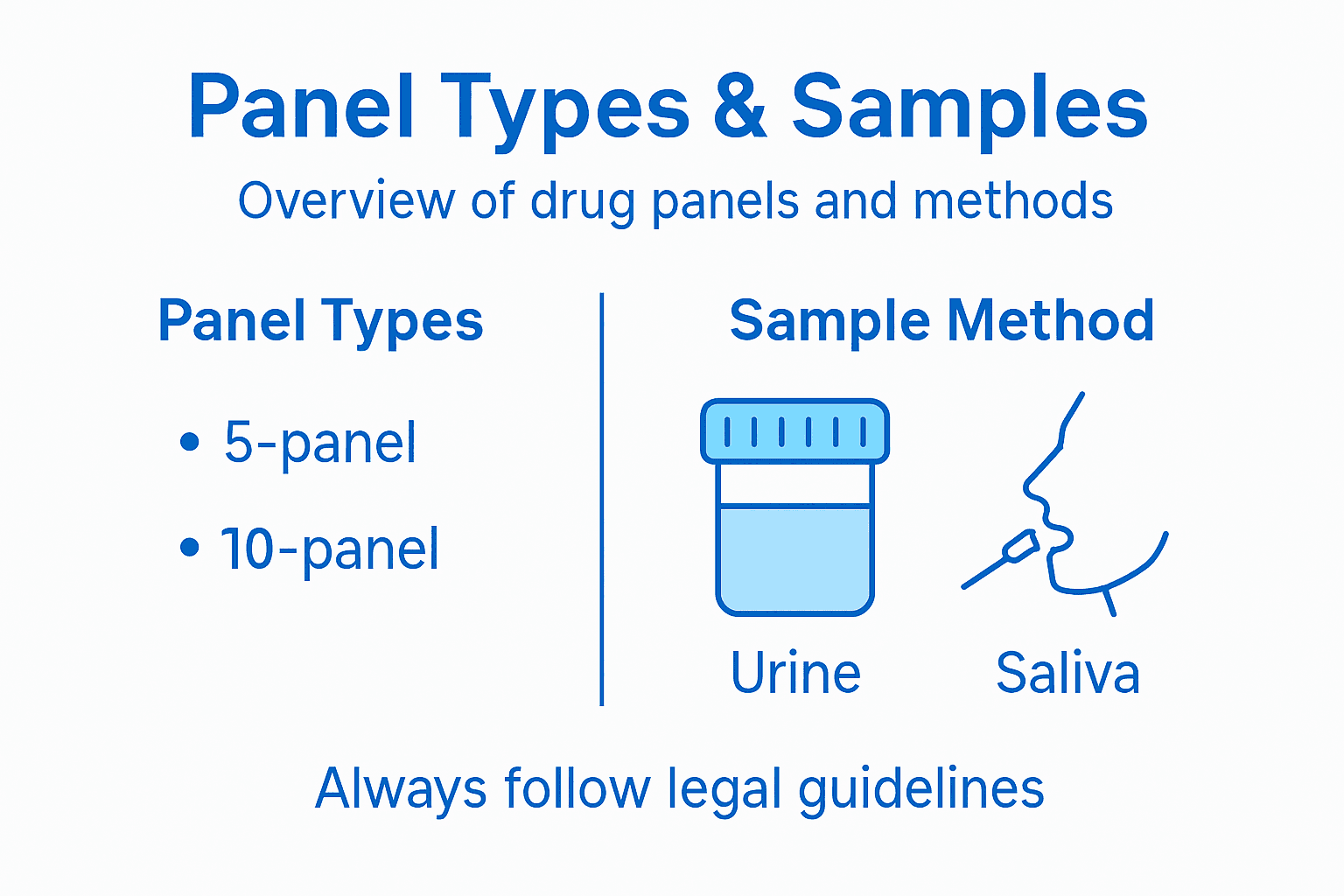
The method you choose for collecting samples affects both the reliability of results and employee experience. Multiple testing procedures exist for different sample types, and each has distinct advantages depending on your situation. Urine testing remains the workplace standard because it’s affordable, non-invasive, and detects drug use within the past few days to a few weeks. Saliva tests offer a quick turnaround and can detect recent use and impairment, making them valuable for post-accident testing or reasonable suspicion situations. Hair testing provides the longest detection window, sometimes revealing drug use going back three months or more, though it’s more expensive and slower to process. Blood tests give the most definitive results but are invasive and primarily used when you need to establish current impairment or in legal situations. Sweat patches represent a specialized approach typically used in parole or rehabilitation monitoring rather than standard workplace screening.
Understanding the detection windows and accuracy levels of each method prevents costly mistakes. Presumptive tests like colorimetric reagent tests are quick and inexpensive but less specific, so they often require confirmatory testing through methods like gas chromatography-mass spectrometry to provide definitive identification. This two-step process ensures you have reliable, defensible results if your decision affects employment. For most HR departments, a urine-based panel with laboratory confirmation strikes the right balance between cost, speed, and accuracy. However, safety-sensitive positions like transportation or healthcare might justify the additional expense of hair testing for its longer detection window, or saliva tests for their impairment detection capability. The key is matching your testing method to both your industry’s regulatory requirements and your company’s actual safety concerns. Don’t over-test or under-test based on assumptions. Your choice should reflect genuine occupational hazards and applicable state laws.
Here’s a comparison of workplace drug testing sample methods and their practical implications:
| Sample Method | Detection Window | Cost & Convenience | Best Use Scenario |
|---|---|---|---|
| Urine Testing | Few days to weeks | Affordable, non-invasive | Routine workplace screening |
| Saliva Testing | Hours to 2 days | Fast, easy collection | Post-accident, impairment checks |
| Hair Testing | Up to 3 months | Expensive, slow results | Safety-sensitive, long-term review |
| Blood Testing | Hours, current use | Highly invasive, costly | Legal cases, impairment proof |
| Sweat Patch | Several weeks | Requires ongoing wear | Parole, rehab monitoring |
Pro tip: Select your panel type and sample method based on your specific industry standards and state regulations, then stay consistent with that approach across all testing to avoid legal challenges and ensure fair treatment of all employees.
Key substances screened in workplace panels
Workplace drug testing panels target specific substances based on their abuse potential and impact on job safety and performance. The foundational substances appear across nearly all panels because they represent the most common drugs of abuse in American workplaces. Marijuana (cannabinoids) remains the most frequently detected substance in workplace testing, partly because it’s legal in some states but still prohibited by many employers under federal guidelines. Cocaine is a powerful stimulant that impairs judgment and increases heart rate, making it particularly dangerous in safety-sensitive roles. Amphetamines and methamphetamine stimulate the central nervous system and affect alertness and decision-making. Opiates and opioids are pain medications that can cause drowsiness and impaired coordination. PCP (phencyclidine) is a hallucinogen that produces unpredictable behavioral effects. These five substances form the core of a basic panel because they address the drugs most likely to show up in your workforce and the ones with the clearest safety implications. Many employers expand beyond this foundation to include benzodiazepines (anti-anxiety medications), barbiturates (sedatives), and other prescription medications that can impair work performance when misused.
Standardized testing frameworks help ensure consistency and legal defensibility. Testing guidelines cover drugs of abuse and therapeutic substances across multiple specimen types, which means your testing approach should align with established clinical standards. A 10-panel test typically includes the core five substances plus benzodiazepines, barbiturates, methadone, and propoxyphene. This expanded approach catches more prescription drug misuse, which is increasingly common in American workplaces. An employee legally prescribed Xanax might test positive on a 10-panel but not a 5-panel. The choice between panel sizes depends on your industry and risk profile. A construction company with heavy equipment needs might prioritize the broader 10-panel screening, while a small professional services firm might rely on the more economical 5-panel. What matters is that you understand what each substance actually does and why it matters for your specific workplace. Marijuana shows up in nearly every panel now, even in states where it’s legal recreationally, because employers maintain the right to enforce drug-free workplace policies. Opioids have become increasingly important to screen for given the addiction crisis affecting American workplaces across all industries.
Alcohol deserves special attention because it’s often tested separately or as part of extended panels. Many employers conduct breath alcohol tests separately from drug panels, particularly for roles involving driving or machinery operation. Alcohol is legal but can be catastrophic in safety-sensitive positions. Some companies add testing for synthetic cannabinoids (K2, spice) or synthetic cathinones (bath salts) to their standard panels because these designer drugs bypass traditional detection methods and pose serious safety risks. When you’re designing your testing program, work with your testing provider to understand which substances are most relevant to your specific business. A healthcare facility might prioritize opioid detection more heavily than a retail environment. A transportation company must focus on substances affecting alertness and coordination. The substances you choose to screen for send a message about what safety concerns matter most in your organization, so make intentional choices rather than defaulting to whatever your competitor uses.
Pro tip: Start with your industry’s standard panel size and add substances based on actual safety concerns in your workplace, then document why you chose each substance to defend your testing policy if an employee challenges it.
Legal requirements and regulatory compliance standards
Your company’s drug testing program doesn’t operate in a vacuum. Federal law, state regulations, and industry standards create a complex framework that determines what you can and cannot do. If your company is a federal contractor or grantee, you face mandatory requirements under the Drug-Free Workplace Act of 1988. This isn’t optional. Federal contractors must establish drug-free workplace policies as a condition of receiving federal funding. The requirements are specific: you must publish a clear policy statement, provide drug awareness programs to employees, notify workers of their obligations, and take documented action when an employee is convicted of a workplace drug violation. If you fail to comply, you risk suspension or termination of your federal contracts or grants. This applies to companies doing business with the Department of Defense, Department of Transportation, Department of Health and Human Services, and numerous other federal agencies. Even if you’re not a federal contractor, understanding these standards helps you build a defensible program.
Beyond federal requirements, your testing practices must comply with state laws, which vary dramatically across the country. Some states impose strict limitations on when you can test, what you can test for, and how you must handle results. California, for example, has significantly restricted pre-employment testing in recent years. New York requires specific notice before testing. Connecticut limits testing to safety-sensitive positions. Other states like Texas and Florida provide employers broader latitude. The critical point is that state laws often override federal law when they’re more protective of employees. You cannot simply implement a national policy and assume it works everywhere. A 10-panel test legal in Texas might violate privacy protections in Massachusetts. An at-will termination for a positive test in one state could trigger wrongful termination liability in another. Work with an employment attorney in your state to ensure your testing policy complies with local requirements. This investment upfront prevents expensive litigation later.
Beyond legal requirements, industry standards and accreditation matter significantly. If you’re using a laboratory, verify that it meets standards from SAMHSA (Substance Abuse and Mental Health Services Administration), CLIA (Clinical Laboratory Improvement Amendments), CAP (College of American Pathologists), or ISO (International Organization for Standardization). These certifications don’t just ensure accuracy. They demonstrate to regulators, employees, and courts that you’re using reputable, scientifically sound testing methods. Many states require SAMHSA-certified labs for workplace testing, and federal contractors definitely need them. When selecting a testing provider, ask for proof of certification. Don’t assume that any lab can handle workplace testing. A hospital lab certified for clinical diagnostics isn’t necessarily qualified for workplace screening. Safety-sensitive industries like transportation have additional regulatory frameworks. Department of Transportation (DOT) rules specify exactly which substances to test for, how to conduct testing, and how to document results. If you have drivers, mechanics, or safety personnel subject to DOT rules, you must follow those protocols precisely or face federal penalties.
Compliance also means maintaining detailed documentation of your entire testing program. Keep records of policy development, employee notifications, test results with proper chain-of-custody documentation, and any disciplinary actions taken. This documentation protects your company if an employee claims discrimination or privacy violations. It also demonstrates good faith compliance if regulators investigate. Many HR managers make the mistake of thinking that “no positive results means we’re doing fine.” That’s not how compliance works. Regulators examine whether your process was sound, not just whether you found violations. Store records securely and maintain them for the timeframes required by your state and any applicable federal regulations. Most states require at least three to five years of retention. Consult with your legal team about your specific obligations.
Pro tip: Review your state’s specific drug testing laws with an employment attorney before implementing or modifying your testing program, and verify that your testing laboratory holds current certifications from SAMHSA, CLIA, CAP, or ISO to ensure regulatory compliance and defensibility.
Employer obligations, risks, and alternative solutions
Your legal obligations as an employer extend beyond simply testing for drugs. Employers must provide a safe workplace free from serious recognized hazards, which includes addressing substance use that affects safety. This is an OSHA requirement, not optional. You need to maintain safety protocols, provide training in languages your workforce understands, and ensure safe equipment and procedures. But here’s the critical part: you must also comply with drug testing laws and maintain non-discriminatory practices throughout the process. These obligations aren’t separate from each other. A poorly designed testing program that violates state law or discriminates against protected groups exposes you to litigation even if your safety intentions are sound. The risk isn’t just from the drug use itself. It’s from implementing a testing program that creates legal liability.
The risks employers face from substance use in the workplace have shifted dramatically in recent years. Workplace overdose deaths have surged, with opioids being the leading cause. This isn’t a theoretical concern. Your employees are struggling with addiction at rates you may not realize. Beyond overdose deaths, substance use creates cascading problems: increased absenteeism, accidents from impaired judgment, reduced productivity, higher workers’ compensation claims, and damaged team morale. A single accident involving an impaired employee can cost your company hundreds of thousands in liability, settlements, and regulatory fines. Insurance premiums skyrocket after incidents. Your reputation suffers. But here’s what many HR managers miss: punitive drug testing alone doesn’t solve the underlying problem. Testing catches current or recent use, but it doesn’t address why employees are using drugs. It doesn’t prevent addiction. For opioids especially, many employees started using prescription painkillers legally before developing addiction. Testing them after they’ve become addicted doesn’t help them recover.
This is where alternative solutions become genuinely valuable. Employee Assistance Programs (EAPs) provide confidential counseling and treatment referrals for substance use issues. These programs help employees before they become liabilities. Prevention and education initiatives teach employees about substance abuse risks and available resources. Wellness programs that address stress, pain management, and mental health reduce the drivers of substance use. These alternatives work alongside testing, not instead of it. The combination is more effective than testing alone. Companies that pair drug testing with robust EAP support report better safety outcomes, lower turnover, and improved morale. Employees feel supported rather than just surveilled. Recovery and return-to-work programs help employees who struggle with addiction stay employed while getting treatment. This approach acknowledges that addiction is a health issue, not purely a character flaw.
The practical approach integrates all three elements. First, maintain your drug testing program to catch current impairment issues and demonstrate your commitment to workplace safety. Second, implement a strong EAP that covers substance abuse treatment with minimal out-of-pocket costs for employees. Many EAPs are bundled with health insurance and cost far less than the expenses created by untreated addiction. Third, build a culture that encourages employees to use these resources without fear of automatic termination. Some forward-thinking companies implement last-chance agreements where employees who voluntarily enter treatment avoid immediate termination, though they face consequences if they fail to comply with treatment plans. This approach recovers some of your investment in employees while addressing the underlying problem. Fourth, provide supervisor training so managers can recognize signs of substance use and direct employees toward help rather than only toward discipline. A supervisor who notices declining performance can offer EAP referral as a supportive option, not just a punitive one. The combination of testing, treatment access, and supportive management creates genuine workplace safety improvements.
Risk mitigation also means documenting everything. Keep records of your testing policy, supervisor training completion, EAP promotion, and any employee utilization of assistance programs. This documentation demonstrates that you implemented a comprehensive approach to substance use, not just punitive testing. If litigation occurs, showing that you offered treatment options alongside testing strengthens your legal position. It also demonstrates good faith efforts to support employees, which can reduce the severity of any claims against you.
This summary shows how Employee Assistance Programs (EAPs) and prevention initiatives complement drug testing:
| Initiative Type | Core Benefit | Impact on Workplace | Example Approach |
|---|---|---|---|
| Drug Testing | Detects current/impaired use | Reduces accidents | Regular random screening |
| EAPs | Offers confidential help | Supports recovery | Counseling and treatment referral |
| Education/Prevention | Reduces risk factors | Improves morale | Substance abuse workshops |
| Wellness Programs | Addresses underlying issues | Lowers addiction rates | Stress management campaigns |
Pro tip: Pair your drug testing program with a robust Employee Assistance Program covering substance abuse treatment, then train supervisors to recognize struggling employees and refer them to help rather than defaulting to discipline, creating a safety culture that actually reduces substance use instead of just catching it.
Strengthen Your Workplace Safety with Expert Drug Testing Solutions
Navigating the complexities of drug testing panels and regulatory compliance can feel overwhelming. This article highlights common challenges like selecting the right drug panel, understanding various testing methods, and ensuring your program meets federal and state laws. If your goal is to maintain a safe, legally defensible workplace while supporting employee well-being, precise, reliable testing is essential.
At CountryWideTesting.com, we specialize in offering trusted drug and alcohol testing products and services tailored to your specific workplace needs. Partnering with licensed laboratories certified under SAMHSA, ISO, CLIA, and CAP means you receive accurate results you can depend on. Whether you require urine drug test panels, mouth swab screenings, or lab-based confirmation testing, our platform provides convenient access to solutions that align with your industry standards and state regulations.
Take control of your workplace safety today by choosing comprehensive testing options that fit your company’s unique risk profile. Explore how our expert testing services and educational resources can help you build a compliant program that protects your employees and your business. Visit CountryWideTesting.com now to find the right testing panel and method for your needs and ensure your drug testing program is both effective and legally compliant.
Frequently Asked Questions
What is a drug testing panel?
A drug testing panel is a standardized collection of tests used to detect multiple drugs or their metabolites from a single sample, like urine or saliva. The numbers refer to how many substances are screened, such as a 5-panel or 10-panel test.
How long do substances stay detectable in urine during drug tests?
Substances can remain detectable in urine for days or even weeks after use, depending on the specific drug. For example, THC can be detected for weeks, while other drugs might only appear for a few days.
What substances are typically included in a 10-panel drug test?
A 10-panel drug test typically includes the core substances like marijuana, cocaine, amphetamines, opioids, and PCP, along with additional substances such as barbiturates, benzodiazepines, and methadone.
Are all drug testing panels the same?
No, drug testing panels vary widely based on industry standards and company needs. Different panels screen for different substances, and the choice should be based on the specific safety concerns of your workplace.