
Why Biometrics in Drug Testing: An Employer's Guide
TL;DR:
- Biometric drug testing offers faster, noninvasive screening with improved identification, but it must be confirmed by certified labs. Employers should treat biometrics as a preliminary step and only act after confirmatory lab results meet legal standards. Proper legal, privacy, and operational protocols are essential for effective and compliant implementation.
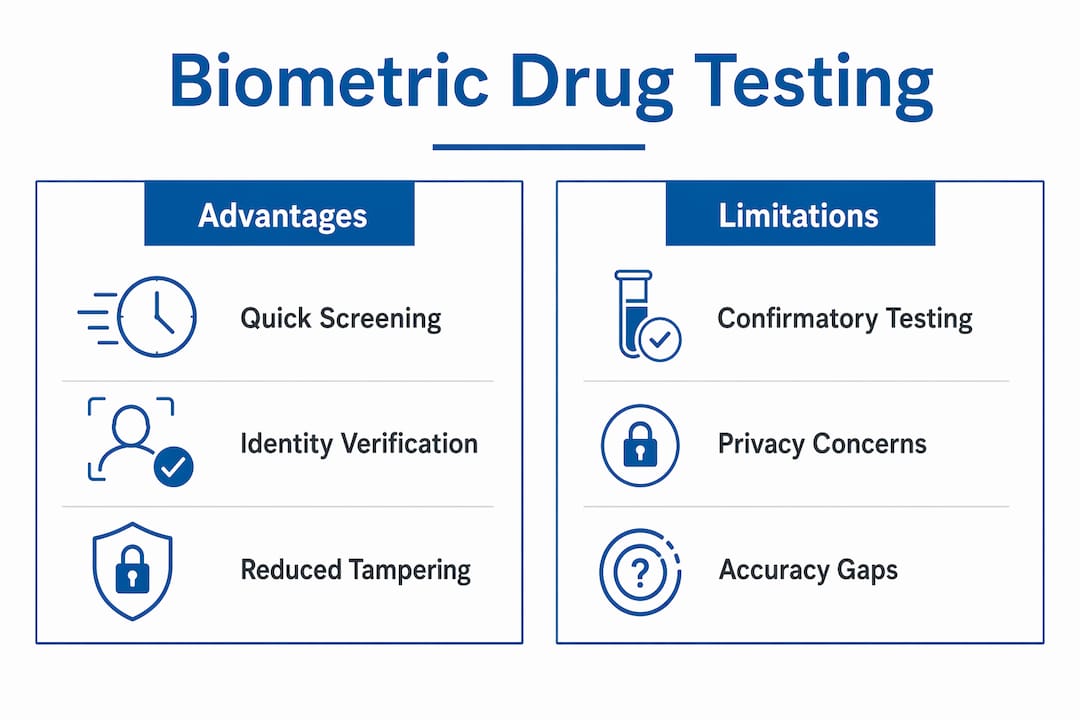
Biometric drug testing is worth adopting in safety-sensitive workplaces, with one firm condition: every positive screen must be confirmed by a certified laboratory before any HR action follows. The core case for biometrics rests on three practical advantages: faster on-site screening, stronger donor identity verification, and reduced sample substitution risk. The principal cautions are equally clear.
- Benefits: Rapid results (fingerprint sweat screening in about ten minutes; iris-based impairment screening very quickly), noninvasive collection, tamper resistance, and improved chain-of-custody integrity.
- Cautions: Biometric screens are triage tools, not proof. Independent peer-reviewed validation is limited for many methods, state biometric privacy laws (Illinois BIPA and similar statutes) create real legal exposure, and confirmatory testing through SAMHSA-approved, CLIA- and CAP-certified labs remains the legal and clinical standard before any disciplinary action.
Table of Contents
- Which biometric methods are actually used in drug screening?
- What employers actually gain by adding biometrics to a testing program
- What biometrics cannot do, and where accuracy gaps appear
- U.S. legal and privacy risks every employer must evaluate
- How to integrate biometrics into a compliant testing workflow
- Pre-rollout checklist for HR and safety officers
- What to expect for turnaround times and costs
- How Countrywidetesting supports employers adopting biometric-capable workflows
- Key Takeaways
- The part of this conversation most employers skip
- Ready to build a compliant biometric-capable testing program?
- Useful sources and further reading
Which biometric methods are actually used in drug screening?
Three distinct approaches exist, and HR teams need to understand what each one measures before evaluating vendors.
- Fingerprint sweat-metabolite screening: Detects drug metabolites present in trace sweat on a fingertip. The Intelligent Fingerprinting DSR-Plus system uses cartridges to analyze sweat and can detect recent drug use within about one day for many substances, with vendors claiming rapid results in approximately ten minutes. This method measures what was consumed, not current impairment.
- Iris and pupillometry-based impairment screening: Analyzes pupil and iris responses to light stimuli as indicators of potential impairment. Vendors market these as screening tools capable of flagging impairment signals in seconds. They measure functional state, not metabolite presence, so they address a different question than urine or sweat tests.
- Biometric identity verification: Uses fingerprint, facial recognition, or iris scans solely to confirm that the person providing a sample is the registered donor. This approach does not detect substances at all; it closes the sample-substitution loophole that undermines conventional urine collection.
The mental model that matters: identity verification and substance detection are separate functions. A program can use biometrics for one, the other, or both, and the legal and operational implications differ for each.
What employers actually gain by adding biometrics to a testing program
The operational case is strongest for safety-sensitive industries where downtime after an incident is costly and urine collection logistics are cumbersome.
- Speed: On-site fingerprint screening can return results quickly, compared to waiting for a collection site appointment and a one to two day lab turnaround for a standard urine test.
- Noninvasive collection and reduced biohazard handling: Fingerprint screening eliminates observed collection, biohazard containers, and temperature-check protocols, simplifying logistics for field-based reasonable-cause testing.
- Tamper resistance: Because the donor’s identity is verified biometrically at the point of collection, substituted or adulterated samples become far harder to pass off.
- Impairment detection before task assignment: Iris-based tools can flag potential impairment at a gate or job-site entry point, giving supervisors an objective data point before a worker operates heavy equipment.
Pro Tip: Pair every biometric positive with an immediate standard specimen collection for confirmatory lab testing. Running both simultaneously reduces the window between screening and enforceable results and can cut operational costs.
What biometrics cannot do, and where accuracy gaps appear
The limitations here are not minor footnotes; they shape how a compliant program must be structured.
- Screening vs. confirmation: Biometric tools measure markers or impairment signals. Certified laboratory tests measure quantitative metabolite concentrations against established cutoff levels. Only certified lab confirmation meets the evidentiary standard required for termination or DOT-regulated enforcement.
- Limited independent validation: Many biometric screening approaches, including pupillometry, voice analysis, and gait analysis, remain at an R&D stage with sparse peer-reviewed validation. Vendor accuracy claims are often proprietary and based on internal datasets.
- False positive and false negative drivers: Environmental factors (lighting, temperature, contact lenses), medical conditions (certain eye disorders, skin conditions affecting fingerprint quality), and demographic variability in algorithmic training data all affect accuracy. Algorithmic bias is a documented concern across biometric systems generally.
- Vendor claims need scrutiny: Product pages describe machine-learning models that improve detection accuracy as they process more data, but those vendor accuracy claims require independent verification before you rely on them for policy decisions.
Fingerprint sweat testing has shown reasonable screening-level accuracy in some studies when cross-validated against other specimen types, but even strong screening performance does not eliminate the need for lab-based confirmation before HR action.
U.S. legal and privacy risks every employer must evaluate
The legal exposure from biometric drug testing is real and state-specific. Getting this wrong can expose your organization to class-action liability independent of any drug-testing outcome.
- State biometric privacy laws: Illinois’ Biometric Information Privacy Act (BIPA) and similar statutes in Texas, Washington, and other states impose written consent, disclosure, and data-retention requirements before any biometric data is collected. Map your workforce locations before deploying any biometric tool.
- HIPAA, GINA, and ADA intersections: Biometric test outputs that reveal health conditions may trigger HIPAA protections. Genetic information embedded in some biometric templates could implicate GINA. ADA concerns arise if impairment screening flags a medical condition rather than substance use. Counsel review is not optional.
- Consent and data minimization: Employees must receive clear written notice of what data is collected, how long it is retained, who can access it, and how it is deleted. HIPAA compliance in drug testing principles apply to the handling of any health-adjacent data your program generates.
- Union and collective-bargaining obligations: In unionized workplaces, introducing biometric screening likely triggers a duty to bargain. Skipping that step can result in unfair labor practice charges regardless of the program’s merits.
Pro Tip: Require vendors to include data-deletion schedules, breach notification timelines (72 hours or less), and audit-log access in the contract before signing. These clauses are far easier to negotiate before deployment than after an incident.
How to integrate biometrics into a compliant testing workflow
The compliance architecture here is not complicated, but the sequence matters.
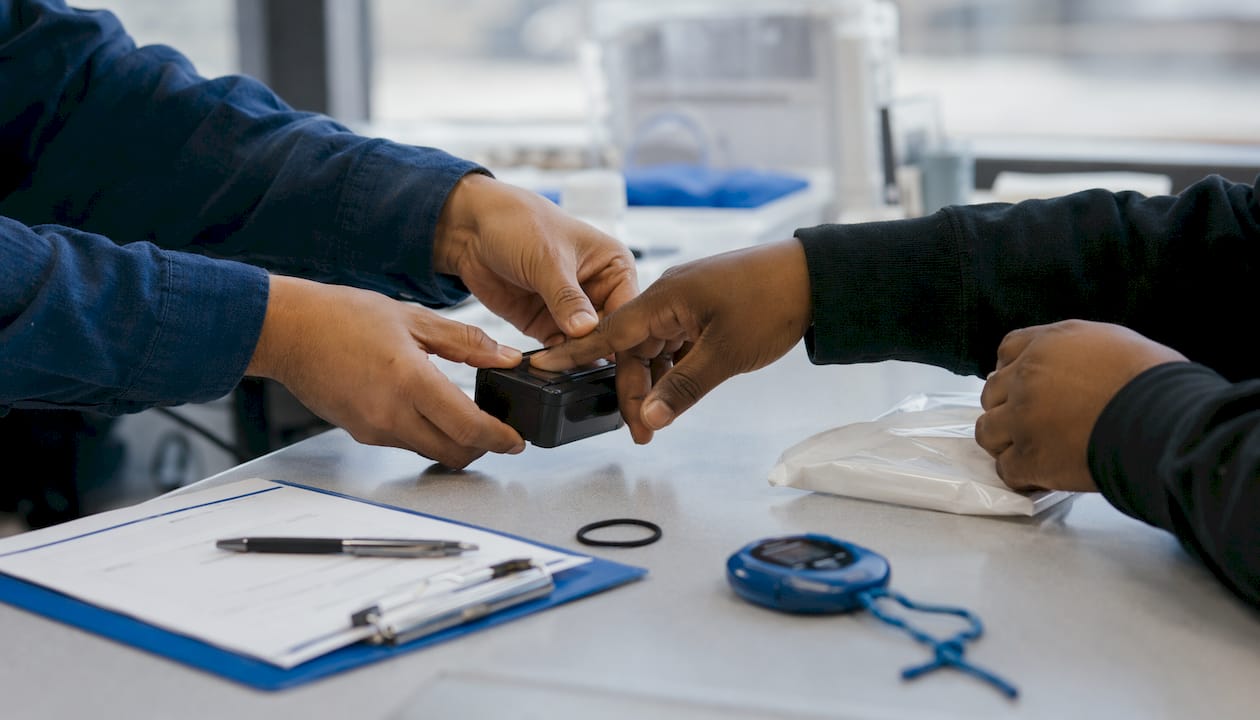
Use biometrics as a preliminary filter only. A positive biometric screen triggers standard specimen collection for confirmatory testing; it does not, by itself, trigger HR action.
Operational flow:
- On-site biometric screen — fingerprint sweat cartridge or iris impairment scan at the point of entry or post-incident.
- Biometric identity verification — confirm the donor’s identity against the registered record before any specimen is collected.
- Immediate confirmatory specimen collection — collect urine or oral fluid under standard chain-of-custody protocols at the same location or a designated collection site.
- Lab routing — send the sealed specimen to a SAMHSA-approved, CAP-certified lab with full chain-of-custody documentation.
- HR adjudication — act only on confirmed lab results, following your written drug-free workplace policy.
Where DOT or other federal regulations govern your workforce, SAMHSA/DOT rules control the confirmatory process entirely. Biometric screening can sit upstream of that process as an operational triage layer, but it cannot substitute for any federally mandated step.
Pre-rollout checklist for HR and safety officers
- Update your drug-free workplace policy to define biometric screening as a preliminary triage step, state its purpose, and document retention and deletion schedules for biometric data.
- Complete state law mapping — identify every state where employees will be screened and confirm BIPA-style consent and notice requirements for each.
- Get legal and union counsel sign-off before piloting, including EEOC and ADA review of your impairment-screening criteria.
- Conduct vendor due diligence — request independent validation studies, data security certifications, integration documentation with CLIA/CAP labs, and liability clauses covering false positives.
- Define pilot parameters — select a safety-sensitive subset, specify the confirmatory lab action for every positive screen, and set a false-positive rate threshold that would pause the pilot.
- Train managers and collect informed consent — managers need to understand what a biometric positive means (a trigger for confirmation, not a finding), and employees need signed consent forms before any data is collected.
Pro Tip: Track three metrics during your pilot: time-to-confirmed-result, the rate at which biometric positives are confirmed by the lab, and the number of employee complaints or opt-out requests. Those three numbers tell you whether the program is operationally sound and legally defensible.
What to expect for turnaround times and costs
Speed is one of the clearest advantages biometrics offer. Fingerprint sweat screening returns results in about ten minutes on-site. Iris-based impairment tools are marketed as capable of flagging potential impairment signals very quickly, though those figures reflect vendor claims for screening, not confirmed metabolite detection.
Speed note: The 5–20 second iris screening figure comes from vendor marketing materials and reflects impairment signal detection, not laboratory-grade metabolite confirmation. Treat it as an operational triage benchmark, not a forensic result.
Confirmatory lab turnaround through a CLIA/CAP-certified lab typically runs 24–48 hours for standard panels, with expedited options available for urgent post-incident cases at higher per-test cost.
Cost drivers to budget for:
- Device purchase or lease and per-cartridge consumable costs for fingerprint systems.
- Per-test licensing or software fees for iris-based platforms with connectivity modules.
- Integration and administrator training costs.
- Confirmatory lab fees for every biometric positive, which can add up quickly during a pilot if false-positive rates are higher than expected.
How Countrywidetesting supports employers adopting biometric-capable workflows
Countrywidetesting partners with labs certified to SAMHSA, CLIA, CAP, and ISO standards, which means the confirmatory testing step your biometric program depends on is covered by a single, compliant vendor relationship.
- Certified lab confirmation routing: Positive biometric screens can be routed directly into Countrywidetesting’s lab testing services pipeline, with full chain-of-custody documentation.
- On-site and at-home test kits: Multi-panel urine and oral fluid kits are available for immediate confirmatory collection after a biometric screen triggers further testing.
- HR policy resources: Countrywidetesting’s resource library covers current drug testing trends, HIPAA compliance, and 2026 screening standards to support policy drafting.
- Pilot logistics support: Ordering kits, rapid lab routing, and documentation guidance are available for employers building a biometric-capable pilot program.
Key Takeaways
Biometric drug screening adds real value for employers in safety-sensitive roles, but only when paired with certified lab confirmation and a legally sound consent framework.
| Point | Details |
|---|---|
| Biometrics are triage, not proof | A positive biometric screen triggers confirmatory lab testing; it never justifies HR action on its own. |
| Speed advantage is real | Fingerprint sweat screening returns results in roughly 10 minutes; iris tools claim 5–20 seconds for impairment signals. |
| State law exposure is significant | BIPA-style statutes in Illinois and other states require written consent and retention limits before any biometric data is collected. |
| Independent validation is sparse | Require third-party validation data from vendors before piloting; do not rely solely on vendor accuracy claims. |
| Countrywidetesting covers the confirmation step | Countrywidetesting routes positive screens to SAMHSA-approved, CLIA/CAP-certified labs with full chain-of-custody documentation. |
The part of this conversation most employers skip
The promise of a 10-minute fingerprint screen or a 20-second iris scan is genuinely appealing when you’re managing a safety-sensitive workforce. The problem is that most employers evaluate biometric drug testing as if speed and accuracy are the whole story. They are not even half of it.
The legal architecture around biometric data in the United States is moving faster than most HR teams realize. Illinois BIPA litigation has produced nine-figure settlements against companies that collected biometric data without proper consent. The same legal theory applies to a fingerprint drug screen. If your vendor collects a biometric template and your policy does not specify retention limits and deletion schedules, you have created liability that has nothing to do with whether the employee was impaired.
The second thing employers underestimate is the confirmatory gap. A biometric positive that is not confirmed by a CLIA/CAP-certified lab is not a finding. Acting on it anyway is the fastest route to a wrongful termination claim. The right frame is not “biometrics vs. traditional testing.” It’s “biometrics as the first gate, certified lab as the decision point.” Build the program in that sequence and the operational benefits are real. Reverse it and you’ve created risk on both ends.
Ready to build a compliant biometric-capable testing program?
Countrywidetesting gives employers a direct path from biometric screening to certified lab confirmation, without the complexity of managing multiple vendor relationships. When a biometric screen flags a potential positive, Countrywidetesting’s laboratory testing services route the confirmatory specimen to a SAMHSA-approved, CLIA/CAP-certified lab with full chain-of-custody documentation. Multi-panel collection kits are available for immediate on-site confirmatory collection, and HR-facing policy resources cover consent, HIPAA compliance, and 2026 screening standards.
Contact Countrywidetesting to discuss pilot planning, certified lab routing, and the right kit configuration for your workforce.
Useful sources and further reading
- NDWA — Intelligent Fingerprinting summary: Covers fingerprint sweat-metabolite detection, vendor speed claims, and the recommendation to treat biometric screens as triage requiring lab confirmation.
- The Recovery Village — Fingerprint drug testing overview: Describes operational advantages (noninvasive sampling, portability, reduced biohazard waste) and confirms the need for confirmatory testing.
- Empocorp — Biometric screening and privacy concerns: Independent summary of accuracy limitations, demographic bias risks, and legal/privacy obligations — not a vendor source.
- EyecoolTech — Iris Drug Tester ECX108: Vendor product page describing iris-based impairment screening features and speed claims (vendor statement, not independent validation).
- Countrywidetesting — Lab testing services: SAMHSA/CLIA/CAP-certified confirmatory lab routing for employers.
- Countrywidetesting — Current drug testing trends: HR-facing resource covering biometric screening developments and 2026 standards.