
2026 Drug Screening Standards: 90% Labs CAP Certified
Many HR managers believe all drug tests detect substances equally well, but this misconception can lead to serious compliance failures. The reality is far more complex. Federal agencies have updated workplace drug screening standards for 2026, introducing new scientific validation requirements and technological protocols that demand your immediate attention. Understanding these changes is crucial for maintaining legally defensible testing programs that protect your organization while ensuring workplace safety.
Table of Contents
- Introduction To 2026 Drug Screening Standards
- Regulatory Foundations And Updates
- Drug Testing Methods And Advances
- Laboratory Standards And Accreditation
- Implementation Best Practices And Compliance
- Legal Compliance And Risk Mitigation
- Technological Enhancements In Drug Screening
- Explore Trusted Drug Testing Solutions For 2026
Key Takeaways
| Point | Details |
|---|---|
| Laboratory Accreditation | Over 90% of federally certified labs hold CAP or ISO accreditation in 2026, ensuring test result integrity. |
| Federal Gold Standard | Urine testing remains the preferred method for workplace screening due to its broad detection window and regulatory acceptance. |
| Oral Fluid Advancement | Mouth swab testing offers faster, less invasive detection for recent drug use with growing regulatory support. |
| AI Detection Boost | Artificial intelligence analytics improve detection accuracy by 10-15%, significantly reducing false positive rates. |
| Complex Compliance | Employers must balance federal mandatory guidelines with varying state laws, particularly around marijuana legalization. |
Introduction to 2026 Drug Screening Standards
Federal oversight of workplace drug testing has evolved significantly. SAMHSA and HHS updated federal drug testing guidelines for 2026, prioritizing scientific validation and technological adoption across all testing programs. These updates affect every organization conducting workplace screening, from small businesses to federal contractors.
The regulatory changes emphasize three core principles. First, laboratories must demonstrate scientific validity through rigorous certification processes. Second, testing methods must align with current pharmacological research on drug metabolism and detection. Third, employers must implement digital documentation systems that create tamper-proof audit trails.
For HR managers and compliance officers, these standards represent both challenge and opportunity. You need to understand how regulatory requirements translate into practical policies that protect your organization from legal exposure. The workplace safety impact of employer drug screening extends beyond simple pass/fail results to comprehensive risk management strategies.
Key areas requiring immediate attention include:
- Laboratory certification verification for all testing partners
- Method selection based on detection needs and legal requirements
- Policy documentation that addresses both federal and state compliance
- Employee communication protocols that ensure transparency and fairness
- Regular audits to maintain alignment with evolving standards
The complexity of modern drug screening demands proactive engagement. Waiting until a compliance issue arises puts your organization at unnecessary risk. Understanding the foundation of these standards enables you to build programs that withstand legal scrutiny while supporting genuine workplace safety objectives.
Regulatory Foundations and Updates
Navigating the intersection of federal and state drug testing laws requires careful attention to detail. Federal mandatory guidelines updated in 2026 reflect changes in drug screening policies that accommodate new scientific understanding while maintaining safety standards. However, these federal requirements represent only part of your compliance picture.
State marijuana legalization creates particularly complex challenges. Workplace drug testing after legalization impacts your policies differently depending on your location and industry. Some states prohibit discrimination against off-duty marijuana use, while federal contractors must maintain zero-tolerance policies regardless of state law.
You must balance these competing requirements strategically. Federal law still classifies marijuana as a Schedule I substance, meaning DOT-regulated positions and federal contractors cannot accommodate positive tests. Meanwhile, states with legal recreational or medical marijuana programs may restrict your ability to discipline employees for off-duty use.
Understanding key drug testing policy requirements helps you structure programs that satisfy multiple jurisdictions. Your policy documentation should explicitly address:
- Which positions fall under federal testing mandates
- How state protections for legal marijuana use apply to your workforce
- Clear safety-sensitive position definitions where zero-tolerance remains justified
- Reasonable accommodation processes for medical marijuana users in non-safety roles
- Documentation requirements that support defensible employment decisions
The federal drug testing requirements for government positions provide a baseline, but you likely need more comprehensive policies. Private employers operating in multiple states face the most complex compliance scenarios, requiring careful policy customization by location.
Regular legal reviews ensure your program adapts as courts interpret these laws. Employment litigation related to drug testing has increased significantly as marijuana laws evolve, making proactive compliance essential rather than optional.
Drug Testing Methods and Advances
Selecting appropriate testing methods directly impacts your program’s effectiveness and defensibility. Urine testing remains the federal gold standard due to its broad detection window and sensitivity, detecting most substances for 1-5 days after use. This method provides comprehensive screening across multiple drug classes with well-established cutoff levels and confirmation procedures.
Oral fluid testing offers faster results and less invasive collection but has a shorter detection window, typically identifying substances used within 24-48 hours. This method excels at detecting recent impairment, making it valuable for post-accident testing or reasonable suspicion scenarios where current intoxication is the primary concern.
Comparing these methods helps you match testing strategy to your specific needs:
| Factor | Urine Testing | Oral Fluid Testing |
|---|---|---|
| Detection Window | 1-5 days (longer for some substances) | 24-48 hours |
| Collection Process | Requires privacy, more invasive | Observed collection, less invasive |
| Tampering Risk | Higher without proper protocols | Lower due to observed collection |
| Federal Acceptance | Fully approved for all programs | Growing acceptance, some restrictions |
| Cost per Test | Generally lower | Slightly higher |
| Result Timing | 24-72 hours for confirmation | 24-48 hours for confirmation |
Understanding different types of drug tests enables strategic program design. You might use urine testing for pre-employment screening to capture longer detection windows while implementing oral fluid testing for reasonable suspicion situations requiring rapid results.
Pro Tip: Match your testing method to specific safety risks and operational needs rather than defaulting to one approach for all situations. Post-accident testing benefits from oral fluid’s ability to detect recent use, while pre-employment screening often requires urine testing’s broader detection window.
Emerging technologies continue advancing both methods. Instant oral fluid devices now provide preliminary results within minutes, though confirmation testing remains necessary. Point-of-collection testing devices have improved reliability while reducing laboratory turnaround times for initial screening results.
Your method selection should also consider employee acceptance and program participation rates. Less invasive collection methods typically receive better employee reception, potentially reducing program resistance and improving overall compliance with testing protocols.
Laboratory Standards and Accreditation
Laboratory certification directly determines whether your test results withstand legal challenges. Over 90% of federally certified labs hold CAP or ISO accreditations as of 2026, reflecting the industry’s commitment to quality assurance and standardized procedures. These certifications are not interchangeable or purely administrative; they represent fundamentally different quality management approaches.

CLIA (Clinical Laboratory Improvement Amendments) certification establishes baseline requirements for laboratories performing testing on human specimens. This federal program ensures minimum quality standards but represents the starting point rather than the gold standard for workplace drug testing laboratories.
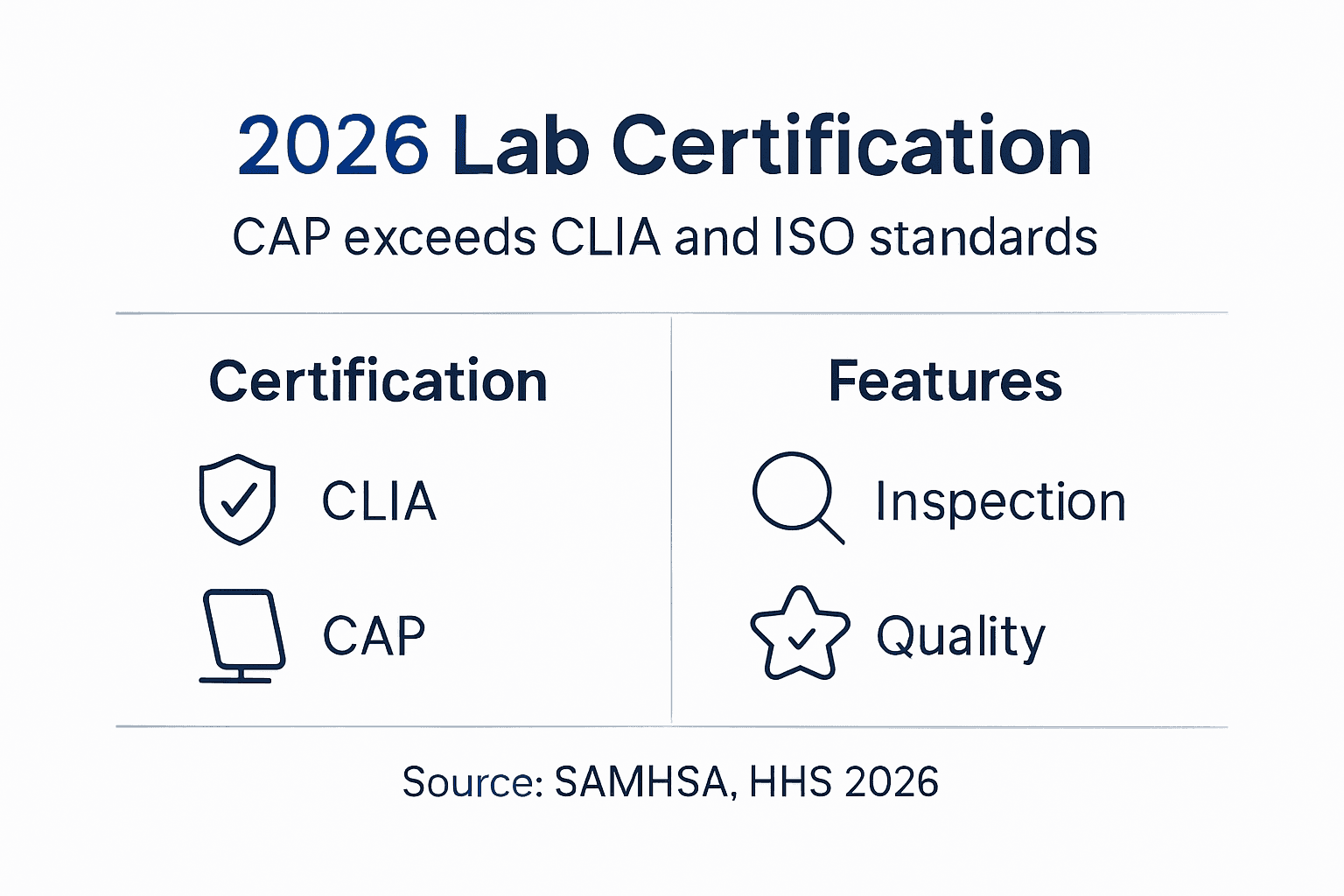
CAP (College of American Pathologists) accreditation exceeds CLIA requirements through rigorous inspection protocols and proficiency testing. CAP-accredited laboratories undergo peer review by practicing pathologists, maintaining quality management systems that emphasize continuous improvement. This accreditation has become the preferred standard for employment-related testing.
ISO/IEC 17025 certification focuses specifically on testing and calibration laboratory competence. Laboratories meeting this international standard demonstrate technical proficiency and management system effectiveness. The 2026 updates to ISO 17025 incorporate risk-based thinking and emphasize measurement uncertainty calculations.
When you conduct drug testing for compliance, laboratory selection significantly impacts result defensibility. Working with accredited drug testing labs provides several critical advantages:
- Chain of custody procedures that create legally defensible documentation
- Standardized confirmation testing using GC-MS or LC-MS/MS technology
- Medical review officer (MRO) services that evaluate positive results appropriately
- Proficiency testing participation demonstrating ongoing accuracy
- Quality control protocols that identify and correct potential errors
Verifying your laboratory partner’s credentials requires more than checking websites. Request current accreditation certificates and scope documents showing which testing services fall under accreditation. CLIA laboratory accreditation requirements provide baseline standards, but employment testing demands higher certification levels.
The legal implications of using non-accredited laboratories are severe. Courts may exclude test results from improperly certified laboratories, potentially exposing your organization to wrongful termination claims or discrimination lawsuits. The modest cost savings from using uncertified laboratories create disproportionate legal risk.
Implementation Best Practices and Compliance
Building a compliant drug screening program requires systematic planning and execution. Start by assessing which regulations apply to your specific situation. Federal contractors face different requirements than private employers, and safety-sensitive positions may trigger additional testing obligations under DOT rules.
Follow this implementation sequence for optimal results:
- Conduct a comprehensive regulatory audit identifying all applicable federal and state requirements for your industry and locations.
- Select testing methods and laboratory partners based on your specific detection needs and budget constraints while ensuring proper accreditation.
- Develop written policies documenting your program’s purpose, covered positions, testing circumstances, and consequences for positive results.
- Implement employee communication and training programs explaining testing procedures, rights, and responsibilities before program launch.
- Establish digital documentation systems for chain of custody tracking and result management that maintain confidentiality and create audit trails.
- Schedule regular policy reviews and updates to maintain alignment with evolving federal and state legal requirements.
Digital chain of custody systems have transformed program integrity. Digital chain of custody tracking reduces sample tampering and errors by over 40%, creating tamper-proof documentation from collection through final disposition. These systems eliminate handwriting interpretation issues while providing real-time visibility into sample status.
Employee communication significantly impacts program success. Clearly explain why testing occurs, which positions are covered, and what substances are screened. Transparency reduces anxiety and builds trust in the program’s fairness. Provide written materials in languages your workforce understands, and offer opportunities for questions before implementing testing.
The drug screening workflow for HR should integrate smoothly with existing employment processes. Pre-employment testing fits naturally into onboarding, while random testing requires careful scheduling to maintain true randomness. Post-accident testing demands immediate response protocols that balance safety investigation needs with employee rights.
Pro Tip: Review and update your drug testing policies at least annually, or whenever significant legal changes occur in jurisdictions where you operate. Outdated policies create liability even when your testing procedures follow current best practices.
Documentation quality determines whether your program withstands legal challenges. Maintain detailed records showing policy distribution, employee acknowledgments, testing authorization, chain of custody, and result notifications. These records demonstrate procedural consistency and good faith compliance efforts.
Legal Compliance and Risk Mitigation
Legal risks associated with workplace drug testing extend beyond test accuracy to encompass discrimination claims, privacy violations, and wrongful termination lawsuits. Certified labs reduce litigation risk related to drug testing practices by ensuring scientifically defensible results that courts will accept as reliable evidence.
State law variations create the most complex compliance challenges. Your organization may operate in jurisdictions with completely different approaches to marijuana, prescription medication accommodations, and testing circumstances. California restricts pre-employment marijuana testing for most positions, while Wyoming permits comprehensive zero-tolerance policies. Understanding these variations prevents expensive legal mistakes.
Employers must document legitimate business justifications for testing programs. Safety-sensitive positions clearly warrant comprehensive screening, but testing office workers may face higher scrutiny in some jurisdictions. Your policy should articulate specific safety concerns or regulatory requirements driving testing decisions for each covered position.
Using drug screening to reduce legal risks requires balancing employer rights with employee protections. Key risk mitigation strategies include:
- Consistent policy application across all similarly situated employees
- Clear definitions of safety-sensitive positions based on actual job duties
- Reasonable accommodation processes for prescription medications and disabilities
- Confidentiality protocols protecting test results and medical information
- Regular training for supervisors on reasonable suspicion indicators and documentation
Discrimination claims often arise when testing policies disproportionately impact protected classes or appear selectively enforced. Document objective criteria for reasonable suspicion testing and maintain records showing consistent application across your workforce. Random testing programs must use truly random selection methods, not supervisor discretion disguised as randomness.
Medical marijuana patients present unique challenges requiring careful legal analysis. While federal law provides no accommodation requirements, state laws increasingly recognize medical marijuana as a legitimate treatment. Employers should focus on actual impairment rather than positive tests for past marijuana use when legally permissible.
Prescription medication use requires nuanced evaluation. Employees taking prescribed opioids or benzodiazepines may test positive without violating drug-free workplace policies. Medical review officers evaluate positive results in context of legitimate prescriptions, but you still need policies addressing impairment from prescription medications.
Technological Enhancements in Drug Screening
Technology continues reshaping drug screening accuracy, efficiency, and security. Digital documentation systems eliminate paper-based chain of custody forms that were vulnerable to loss or alteration. Electronic records provide real-time tracking from collection site through laboratory analysis, creating comprehensive audit trails that satisfy regulatory requirements while improving operational efficiency.
AI-driven analytics improve detection accuracy by 10-15%, reducing false positives through sophisticated pattern recognition that identifies potential adulterants or specimen integrity issues. Machine learning algorithms analyze thousands of test characteristics simultaneously, detecting anomalies that might escape human review.
“Artificial intelligence in drug screening represents the most significant accuracy advancement in decades, combining speed with precision that transforms how laboratories validate results and identify potential testing errors before reporting.”
Emerging technologies improving workplace drug screening include:
- Blockchain-based chain of custody systems providing immutable documentation records
- Mobile collection applications enabling remote testing with real-time result transmission
- Advanced confirmation testing methods detecting designer drugs and synthetic compounds
- Integrated laboratory information systems streamlining result reporting and MRO review
- Biometric donor identification preventing sample substitution or donor misidentification
Staying current with current drug testing technology trends helps you evaluate which innovations provide genuine value versus marketing hype. Not every technological advancement justifies immediate adoption, but understanding capabilities enables strategic planning.
Point-of-collection testing devices have improved significantly, offering preliminary results within minutes. These devices work well for initial screening but cannot replace laboratory confirmation testing for employment decisions. Use instant tests to guide immediate safety decisions while awaiting confirmatory laboratory analysis.
Data security becomes increasingly important as programs digitize. Electronic systems must comply with HIPAA requirements protecting medical information confidentiality. Implement robust access controls ensuring only authorized personnel view test results, and maintain secure storage preventing unauthorized disclosure.
Explore Trusted Drug Testing Solutions for 2026
Implementing compliant drug screening programs demands expertise and reliable laboratory partnerships. Understanding how drug tests work provides foundational knowledge, but executing effective programs requires experienced partners.
Countrywide Testing offers comprehensive laboratory drug testing services through partnerships with SAMHSA-certified, CAP-accredited laboratories meeting the highest quality standards. From pre-employment screening to random testing programs, we provide the technology and expertise you need for defensible results. Our platform integrates current drug testing trends with proven protocols, ensuring your program stays ahead of regulatory requirements.
Frequently Asked Questions
What is the main difference between urine and oral fluid testing for workplace compliance?
Urine testing detects drug use over 1-5 days with established federal acceptance, while oral fluid testing identifies recent use within 24-48 hours through less invasive collection. Choose based on whether you need broader detection windows or recent impairment identification.
How often should employers update drug testing policies to reflect changing laws?
Review policies at least annually and immediately after significant legal changes in your operating jurisdictions. State marijuana laws evolve rapidly, requiring proactive monitoring rather than reactive updates after problems emerge.
Are non-certified labs legally acceptable for workplace drug testing?
Non-certified laboratories create substantial legal risk because courts may exclude their results as unreliable evidence. Always use CLIA-certified laboratories with CAP or ISO accreditation for employment-related testing.
Can AI technology replace human review in drug screening analysis?
AI enhances accuracy and identifies potential issues but cannot replace medical review officers who evaluate results in clinical context. Technology supports human expertise rather than replacing professional judgment.
What legal risks do employers face if they don’t comply with updated drug screening standards?
Non-compliance risks include wrongful termination lawsuits, discrimination claims, regulatory penalties for federal contractors, and excluded evidence in litigation. Costs typically far exceed investment in proper program implementation.