
Lab Testing Terminology: Essential Guide for Employers
TL;DR:
- Understanding each phase of workplace drug testing helps prevent legal and compliance mistakes.
- Clear alignment of terminology across policies, reports, and procedures is critical for defensibility.
- Proper lab communication, retest rights, and consistent language ensure a compliant testing program.
A single misread lab result can derail an entire workplace compliance program. Imagine an HR manager seeing “dilute” on a drug test report and treating it as a negative, or confusing a “refusal to test” with a missed appointment. These are real mistakes with real legal consequences, and they happen more often than most organizations admit. This guide exists to fix that. We have assembled the core lab testing terminology every employer and HR professional needs, organized by how it actually appears in the testing workflow. You will find definitions, context, and practical guidance so your program stays defensible and your documentation stays clean.
Table of Contents
- The core phases of workplace drug testing and their terminology
- Key specimen validity terms: Dilute, adulterated, substitution, and refusal
- Panels, analytes, and cutoff concentrations: Interpreting lab reports
- Advanced lab methods and oversight: Presumptive, confirmatory, and the split specimen process
- The compliance trap most HR teams overlook
- Easily manage lab testing compliance with expert solutions
- Frequently asked questions
Key Takeaways
| Point | Details |
|---|---|
| Know the testing process | Understanding each phase, from specimen collection to result reporting, ensures effective compliance. |
| Master validity categories | Recognize terms like dilute, adulterated, or refusal to handle results correctly. |
| Use correct report language | Panel, analyte, and cutoff terms should match those in regulatory and lab documents. |
| Apply oversight protocols | Follow DOT and MRO protocols for advanced testing and split specimen procedures. |
The core phases of workplace drug testing and their terminology
Understanding where each term fits in the testing process is the fastest way to prevent confusion. Drug testing terminology is not random. It follows a logical, sequential workflow from collection to final result, and each phase introduces its own vocabulary.
Phase 1: Specimen collection
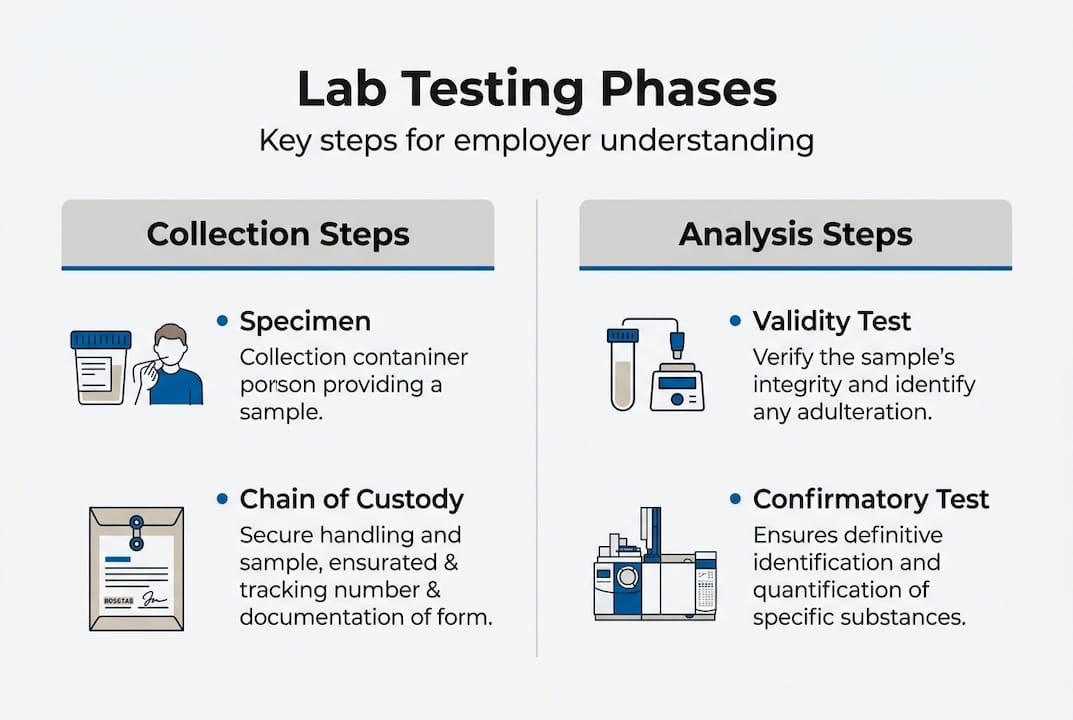
A specimen is the biological sample collected from a donor for analysis. The most common specimens in workplace testing are urine, oral fluid (mouth swab), and hair. Each specimen type has different detection windows, collection protocols, and regulatory requirements. Urine remains the standard for federally mandated programs.
Phase 2: Chain of custody
The chain of custody (COC) is a documented, unbroken record of who handled the specimen from the moment of collection through final lab reporting. A broken COC can invalidate a result in a legal challenge. Every transfer, seal, and signature matters.
Phase 3: Laboratory validity testing
Before a specimen is screened for drugs, the lab runs validity tests to confirm the sample is genuine and suitable for analysis. This step checks creatinine levels, pH, and specific gravity. As SAMHSA identifies, common industry terms in U.S. workplace drug testing include specimen, chain of custody, laboratory validity testing, two-stage testing, and Medical Review Officer result verification.
Phase 4: Screening and confirmatory testing
Initial screening uses immunoassay technology to quickly flag potential positives. Any non-negative result then moves to confirmatory testing, a more precise method (typically gas chromatography-mass spectrometry, or GC-MS) that definitively identifies the substance and its concentration.
Phase 5: Medical Review Officer (MRO) review
The Medical Review Officer is a licensed physician who reviews all non-negative results before they reach the employer. The MRO can contact the donor to explore legitimate medical explanations and has the authority to change a lab-reported positive to a negative if a valid prescription exists.
| Testing phase | Key term | What HR needs to know |
|---|---|---|
| Collection | Specimen | Defines sample type and detection window |
| Documentation | Chain of custody | Legal proof of sample integrity |
| Lab pre-screening | Validity testing | Confirms sample is genuine |
| Initial screen | Immunoassay | Fast but not definitive |
| Final confirmation | GC-MS | Legally defensible result |
| Result review | MRO review | Final authority before employer notification |
For employers who want to align these phases with internal documents, drug testing and HR policies that mirror this sequence will hold up under regulatory scrutiny.
Pro Tip: Always use the same terminology in your company drug testing policy that your lab and MRO use in their reports. Inconsistent language is the number one cause of policy disputes.
Key specimen validity terms: Dilute, adulterated, substitution, and refusal
Knowing the sequence, it is critical to understand the specific validity results that determine next steps and compliance protocols. These categories are where many HR teams stumble because the outcomes are not always intuitive.
Specimen validity definitions fall into four main categories, each carrying distinct compliance implications. SAMHSA’s framework lists validity test categories as dilute, adulterated, substituted, and refusal-to-test.
The four validity categories explained:
- Dilute: The specimen has lower than normal creatinine and specific gravity levels, meaning the donor likely consumed excessive fluids before the test. Not all dilutes are automatic negatives. Some programs require a recollection.
- Adulterated: A foreign substance was added to the specimen to interfere with the test. Bleach and nitrites are common adulterants. This is treated as a serious violation.
- Substituted: The specimen does not meet the biological markers for human urine. Creatinine and specific gravity fall outside the ranges physiologically possible for a live human. This means the sample was replaced, not just diluted.
- Refusal to test: This category covers situations where a donor declines to test, fails to appear, or provides an adulterated or substituted specimen. Under DOT rules, adulterated or substituted findings are treated as test refusals with the same consequences as a verified positive.
| Validity result | What it means | Typical HR action |
|---|---|---|
| Dilute negative | Low concentration, no drugs detected | Optional: recollect under observation |
| Dilute positive | Low concentration, drugs still detected | Treat as positive |
| Adulterated | Foreign substance detected | Treat as refusal |
| Substituted | Sample is not human urine | Treat as refusal |
| Refusal to test | Donor declined or obstructed | Same consequences as positive |
For additional context on how these drug testing outcome categories interact with return-to-duty programs, it helps to map them directly in your written policy.
Pro Tip: Your policy training materials should explicitly define what happens after each validity result. If your staff cannot explain the difference between a dilute negative and a substituted specimen, a legal challenge will expose that gap quickly.
Panels, analytes, and cutoff concentrations: Interpreting lab reports
With validity terms clear, HR teams must also understand how specific lab results are categorized and what those findings mean. Lab reports contain technical language that can look confusing without a reference point.
A panel is a predefined set of drug classes tested in a single specimen. A standard 5-panel test screens for marijuana, cocaine, opiates, amphetamines, and phencyclidine (PCP). An analyte is the specific substance or metabolite the lab is measuring within each drug class. For example, the analyte for marijuana use is THC-COOH, a metabolite the body produces when processing cannabis.
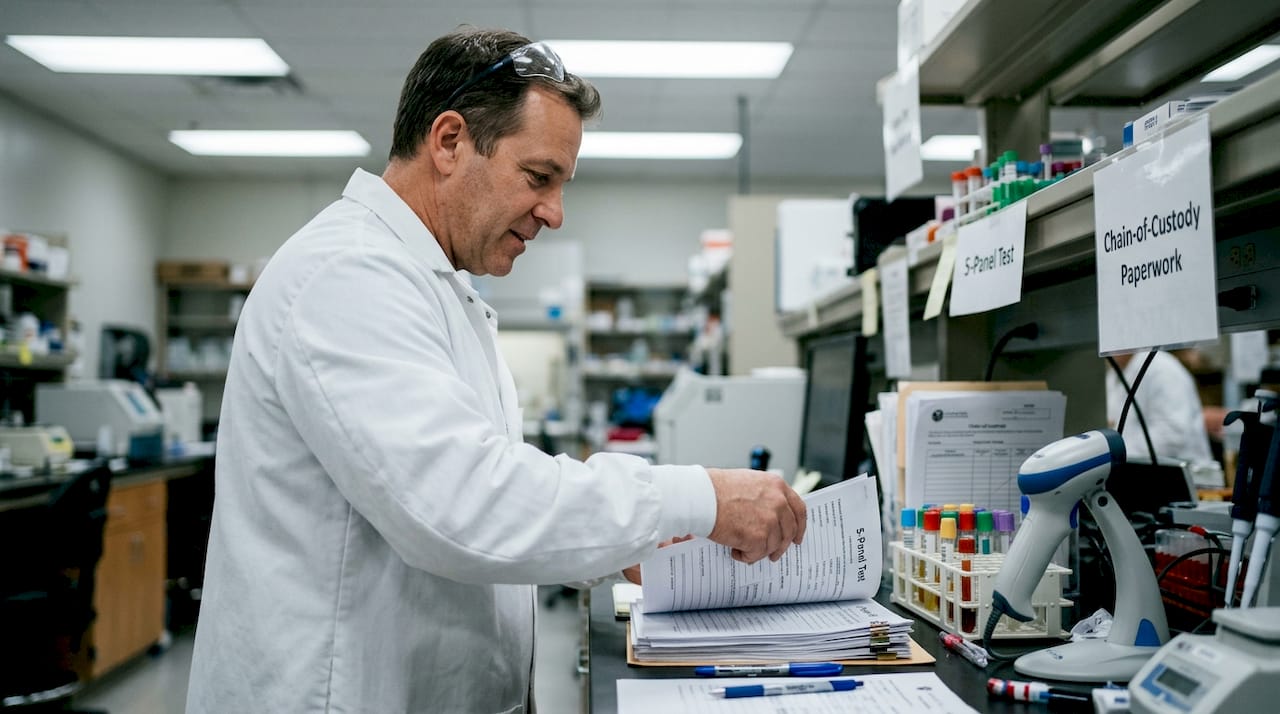
The cutoff concentration is the threshold a substance must reach in the specimen for the lab to report a positive. Federal workplace drug testing panels set specific cutoff concentrations for both initial screening and confirmatory testing.
Here is why two cutoff levels matter. The initial screen uses a higher, more lenient threshold to catch potential positives quickly. The confirmatory test uses a stricter, lower threshold to verify the result. A specimen can pass the initial screen and still have a substance present, just below the screening cutoff. That is not the same as a clean sample.
| Drug class | Example analyte | Initial cutoff (ng/mL) | Confirmatory cutoff (ng/mL) |
|---|---|---|---|
| Marijuana | THC-COOH | 50 | 15 |
| Cocaine | Benzoylecgonine | 150 | 100 |
| Opiates | Morphine | 2000 | 2000 |
| Amphetamines | Amphetamine | 500 | 250 |
| PCP | Phencyclidine | 25 | 25 |
For a broader look at how drug testing panels are structured and selected, your choice of panel should match your industry’s risk profile and any applicable federal mandates.
When communicating test results internally, always use the same panel and analyte names that appear on the lab report. Paraphrasing technical terms in employee communications or policy documents creates discrepancies that can complicate grievance proceedings.
To understand cutoff levels in practical terms, think of the cutoff as the legal speed limit. Being under it means the lab reports negative, even if a trace is present. For HR leaders selecting or reviewing programs, common drug panel examples can help you match your panel to your compliance environment.
Advanced lab methods and oversight: Presumptive, confirmatory, and the split specimen process
Beyond the primary report terms, some programs require specialized procedures and oversight to ensure fairness and reliability. This is where the workflow gets more technical, and where errors in understanding can cost employees and employers significantly.
Presumptive testing, also called screening, is designed for speed and efficiency. It uses immunoassay technology to produce a preliminary result. A presumptive positive does not mean the donor used drugs. It means the specimen needs further evaluation. Confirmatory testing uses advanced instruments such as GC-MS or liquid chromatography-tandem mass spectrometry (LC-MS/MS) to identify substances with precision.
The split specimen protocol:
- When a urine specimen is collected, it is divided into two bottles: Bottle A (the primary specimen) and Bottle B (the split specimen).
- Bottle A is tested first. If it returns a verified positive, adulterated, or substituted result, the donor has the right to request testing of Bottle B.
- The donor or MRO must initiate the Bottle B request within a specific window. Under DOT split specimen rules, the retest request must be made within 72 hours of the donor being notified of the result.
- Bottle B is sent to a second SAMHSA-certified lab for independent analysis.
- If Bottle B does not confirm the Bottle A result, the MRO cancels the test.
The role of MROs in this process is critical. They serve as the quality checkpoint between the lab and the employer, ensuring that results are both scientifically valid and legally sound.
Pro Tip: In DOT and safety-sensitive programs, make sure your donors receive written notice of their Bottle B retest rights at the time of collection. Failing to notify donors is a procedural violation that can void the result.
The compliance trap most HR teams overlook
Most HR professionals assume compliance problems come from not knowing enough terminology. In our experience, that is rarely the full picture. The bigger issue is how terminology gets communicated and applied once it leaves the lab.
Here is a pattern we see repeatedly. An organization invests in proper testing infrastructure, trains the right staff, and builds a policy. But the policy uses informal language while the lab reports use regulated terminology. When a dilute positive comes back, the HR team applies the procedure for a dilute negative because the policy simply says “dilute specimens require recollection” without distinguishing between the two outcomes. That one ambiguity can expose the organization to a wrongful termination claim.
The fix is not more definitions. It is alignment. Every layer of your testing program, from employee handbooks to supervisor training to lab communication protocols, must use the same language. Shaping HR policies around the actual sequence labs and MROs use creates a defensible, consistent program.
Real compliance is not about knowing the terms. It is about ensuring every person who touches the process speaks the same language, from the collection site coordinator to the HR generalist reviewing the final report.
Easily manage lab testing compliance with expert solutions
Applying this terminology in a real workplace program requires more than a glossary. It requires reliable tools, certified lab partnerships, and testing options that fit your specific compliance needs.
At CountryWideTesting.com, we support employers through every stage described in this guide. Our lab testing services connect you with SAMHSA, CLIA, and CAP-certified laboratories that produce legally defensible results with MRO review included. Need a flexible option for team screening or post-incident testing? Our 12-panel at-home test delivers professional-grade detection across the most critical drug classes. We make it straightforward to stay compliant, document properly, and act with confidence at every step.
Frequently asked questions
What is a split specimen in DOT drug testing?
A split specimen is a collected urine sample divided into two bottles so Bottle B can be retested if Bottle A returns a verified positive, adulterated, or substituted result, protecting the donor’s right to an independent retest.
What does ‘cutoff concentration’ mean in lab reports?
Cutoff concentration is the minimum amount of a substance in a specimen that must be reached for the lab to report a positive, with federal guidelines setting specific thresholds for each drug class and testing stage.
What is the difference between presumptive and confirmatory testing?
Presumptive testing is a fast initial immunoassay screen that flags potential positives, while confirmatory testing uses precise instruments like GC-MS to produce a definitive, legally defensible result.
How should HR document drug testing terminology in company policy?
HR should adopt the exact panel names, analyte terms, and validity categories used in lab reports and federal program guidelines so that policy language and test outcomes align without ambiguity.