
Drug Testing Terminology Explained: Compliance Matters
Confusion over drug testing terminology can put even the most experienced Human Resources teams at risk. For American companies facing strict regulatory requirements, understanding the difference between a positive result and a non-negative result, or knowing why a Medical Review Officer review is crucial, directly impacts policy, legal protection, and employee trust. This article breaks down the core concepts and terminology every American HR leader needs to grasp, giving you confidence in your compliance and communication with providers.
Table of Contents
- Drug Testing Terminology And Core Concepts
- Types Of Drug Tests And Key Differences
- Essential Regulatory Standards And Guidelines
- Chain Of Custody, MRO, And Test Results
- HR Compliance Risks And Common Misconceptions
Key Takeaways
| Point | Details |
|---|---|
| Understand Critical Terminology | Familiarize yourself with drug testing terms like positive result, specimen integrity, and MRO to ensure informed decision-making and compliance. |
| Selection of Testing Methods | Choose the appropriate drug testing method based on your workplace needs, budget, and the substances of concern to maintain effective monitoring. |
| Regulatory Compliance | Adhere to federal and state regulations concerning drug testing to avoid legal challenges and ensure proper documentation processes are in place. |
| Document Everything | Maintain thorough documentation of testing processes and results to protect your organization from potential litigation and ensure policy consistency. |
Drug Testing Terminology and Core Concepts
When you’re responsible for your company’s drug testing program, you’ll encounter specific terms that shape how you interpret results, maintain compliance, and protect your organization legally. Understanding these terms isn’t just about using the right vocabulary in meetings. It directly affects how you communicate with your testing provider, interpret results from your laboratory, and defend your testing procedures if they’re ever challenged. The language of drug testing exists for a reason: precision. A positive result doesn’t mean someone used drugs yesterday or last week. A negative result doesn’t guarantee someone isn’t a user. These distinctions matter enormously when you’re making employment decisions.
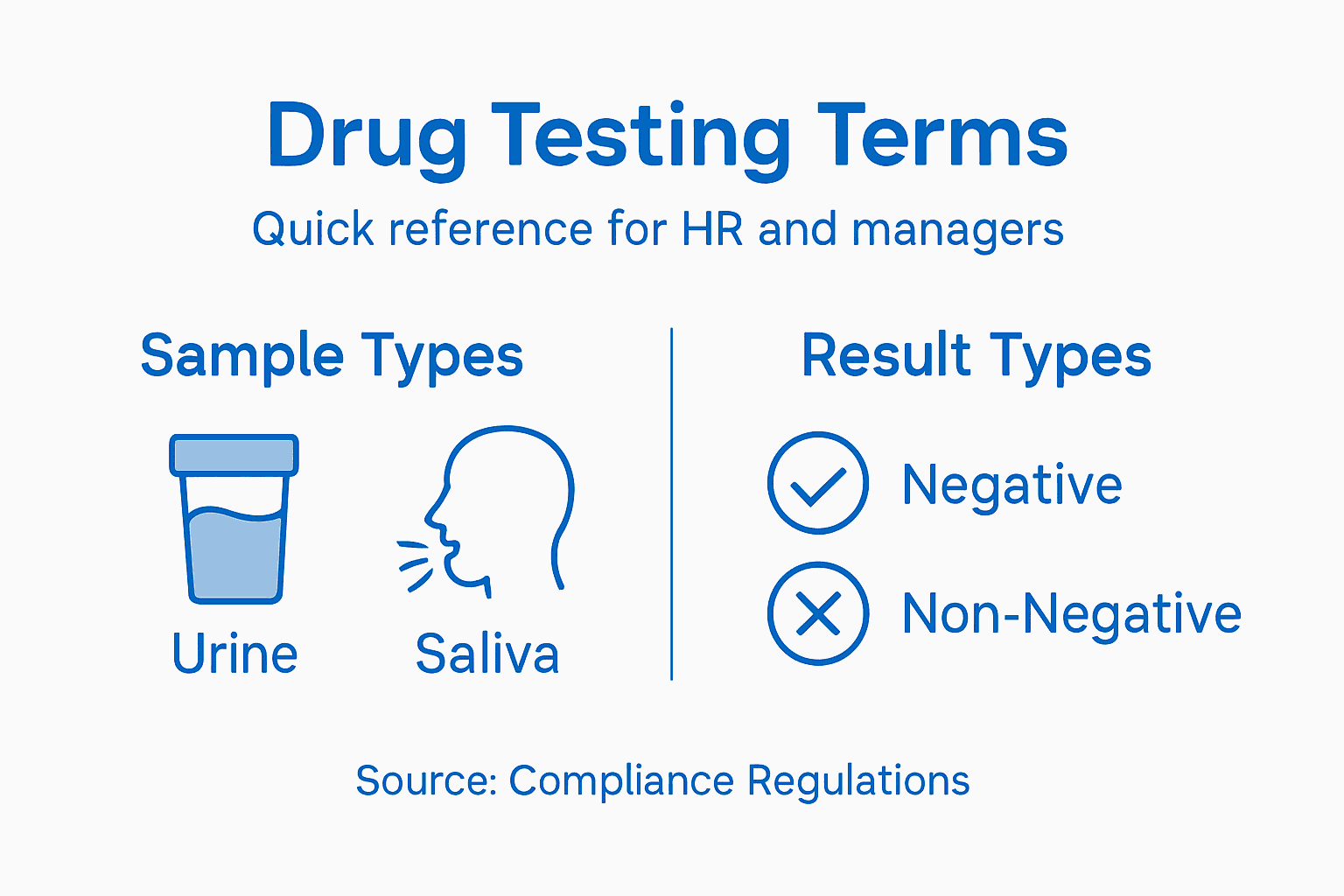
Start with the foundational concepts. A specimen is the biological sample collected from an employee (urine, saliva, hair, or blood). The initial screening is the first test performed on that specimen, designed to identify potential drugs of concern quickly. However, initial screenings can produce false positives due to diet, medications, or laboratory error. That’s why a confirmatory test follows positive initial screens, using more sophisticated methods like gas chromatography or mass spectrometry to verify the presence of drugs. This two-step process protects both the employee and your organization. The Medical Review Officer (MRO) is a licensed physician who reviews positive results before they’re reported to you. The MRO contacts the employee to ask about prescription medications, over-the-counter drugs, or other legitimate explanations for the positive result. Understanding types of drug testing methods helps you choose the right specimen type for your workplace needs.
You’ll also encounter terms related to specimen integrity. An adulterated specimen is one that’s been tampered with (contaminated with chemicals, diluted, or altered to mask drug use). A diluted specimen has excessive water content, suggesting the employee drank large amounts of liquid before testing. A substituted specimen contains urine from someone else entirely. Testing facilities use validity checks to detect these issues before running the actual drug screening. Chain of custody refers to the documented trail of who handled your specimen from collection through testing. This paperwork trail is critical for legal defensibility. If you ever face a legal challenge to your testing results, a broken chain of custody can invalidate an otherwise positive test result.
Other essential terminology includes confirmation, which means a second test has verified the initial positive finding, and reporting limit or threshold, which is the minimum concentration of a substance that will be reported as positive. For workplace drug testing, federal regulations specify particular thresholds for different substances. Non-negative result means the test showed something potentially concerning but hasn’t been confirmed by the MRO yet. Understanding these distinctions helps you avoid making employment decisions based on unconfirmed results. You should also know cutoff levels, the established concentration thresholds set by federal guidelines (and sometimes stricter by state law) that determine whether a specimen tests positive or negative. Different drugs have different cutoff levels, and these may vary based on whether you’re using federal workplace standards or your own company policy.
Pro tip: Create a quick reference document with these key terms and keep it accessible to your HR team and managers who participate in your testing program. When everyone uses consistent terminology with your testing provider, you reduce miscommunication and ensure compliance decisions are based on clear understanding.
Types of Drug Tests and Key Differences
Your company can choose from several drug testing methods, and each one has distinct advantages and limitations. The choice depends on your workplace needs, budget, detection windows, and what substances you’re most concerned about. Understanding the differences helps you make informed decisions about which testing approach aligns with your compliance requirements and organizational culture. Some tests detect recent drug use, while others can identify substances consumed days or even months ago. Some are quick and inexpensive, while others are more thorough but require laboratory processing. You need to understand these trade-offs before implementing your testing program.
The most common workplace test is urine drug testing, which detects metabolites (byproducts of drug use) in the urine. Urine tests are affordable, noninvasive, and have established cutoff levels that align with federal workplace standards. They typically detect drug use from the past two to three days, though marijuana can be detected for longer periods in heavy users. The downside: urine tests can be easily adulterated, and they don’t tell you when someone used the drug or their current impairment level. Saliva (oral fluid) tests are becoming increasingly popular because they’re quick, difficult to cheat, and can detect recent drug use (typically within the past 24 hours). They’re ideal for reasonable suspicion testing or post-accident testing when you need immediate results. However, saliva tests have narrower detection windows than urine tests and may miss older drug use. Hair drug tests detect drug use over a much longer period—typically the past 90 days or longer. They’re excellent for comprehensive background screening before hiring, but they cost more and some people view them as more invasive. Different testing methods have varying sensitivities and specificities depending on the substance being tested.
Blood tests are the gold standard for measuring actual drug concentration in your system, making them useful for determining impairment, but they’re expensive, invasive, and require medical personnel to collect samples. They’re typically reserved for post-accident investigations or situations requiring absolute proof of current drug presence. Some organizations use breath testing for alcohol (which measures impairment directly) but this is less common for controlled substances. When selecting a testing method, consider your budget per employee, how quickly you need results, what substances concern you most, and whether you’re testing for recent use or historical patterns. Federal workplace testing programs follow strict protocols using immunoassay screening followed by confirmatory testing, which combines accuracy with cost-effectiveness. Most companies start with urine testing because it’s affordable and federally established, then add saliva or hair testing for specific situations.
Here’s a quick reference comparing workplace drug testing methods:
| Test Type | Detection Window | Invasiveness | Main Use Case |
|---|---|---|---|
| Urine | 2-3 days (most drugs) | Low | Standard workplace screening |
| Saliva (Oral) | Up to 24 hours | Very Low | Post-incident, suspicion |
| Hair | 90+ days | Moderate | Background checks |
| Blood | Hours to 1-2 days | High | Impairment determination |
| Breath (Alcohol) | Immediate | Very Low | Alcohol impairment checks |
Pro tip: Select your testing method before communicating your drug policy to employees, then document why you chose that specific test in your policy manual—this demonstrates reasoned decision-making if your testing practices are ever challenged legally.
Essential Regulatory Standards and Guidelines
When you establish a drug testing program, you’re not writing your own rules. Federal agencies have created specific regulatory frameworks that govern how testing must be conducted, what substances must be tested for, and how results must be documented. These standards exist to protect employees from false positives, ensure consistent testing practices across industries, and create defensible documentation if your testing decisions are ever legally challenged. The most important thing to understand is that compliance isn’t optional. Violating these standards exposes your organization to lawsuits, regulatory penalties, and damage to your reputation as an employer.
The U.S. Department of Transportation (DOT) established federal drug testing regulations that apply to safety-sensitive positions in transportation and related industries. DOT testing requires specific substances to be screened for, mandates confirmatory testing for all positives, and requires a Medical Review Officer to review results before reporting them to you. The DOT regulations specify exact cutoff levels, specimen validity testing procedures, and documentation requirements. If your company has employees in DOT-regulated positions, you must follow these rules precisely. Beyond DOT, the Substance Abuse and Mental Health Services Administration (SAMHSA) provides guidelines for workplace drug testing, including recommended cutoff levels for initial and confirmatory testing. SAMHSA guidelines aren’t mandatory for all employers, but they’re considered the gold standard for workplace programs. Many states have adopted SAMHSA standards or created stricter standards of their own. Understanding federally mandated testing regulations helps you determine which standards apply to your specific organization and industry.
Your testing laboratory must also meet specific accreditation requirements. CLIA (Clinical Laboratory Improvement Amendments) certification ensures the lab meets minimum quality standards for patient testing. CAP (College of American Pathologists) accreditation provides independent verification that the laboratory follows rigorous quality assurance procedures. ISO 17025 certification indicates the lab meets international standards for competence and reliability. These certifications matter because they demonstrate your lab has been independently verified to produce accurate, legally defensible results. When you contract with a testing provider, confirm they hold appropriate accreditations before signing an agreement. Chain of custody documentation is another critical requirement that appears in every regulatory framework. This means every person who handles a specimen from collection through testing must be documented, and the specimen must be sealed and tracked throughout the process. A broken chain of custody can render even a positive test result inadmissible in legal proceedings. Additionally, quality assurance and proficiency testing ensure laboratories continuously verify their testing accuracy and maintain reliable procedures. Your organization benefits from working with laboratories that participate in proficiency testing programs because it demonstrates they’re committed to consistent accuracy.
Pro tip: Request copies of your testing laboratory’s accreditation certificates (CLIA, CAP, or ISO 17025) and verification that they participate in proficiency testing programs before implementing your testing program; this documentation becomes invaluable if your testing results are ever questioned.
Chain of Custody, MRO, and Test Results
Three elements form the backbone of legally defensible drug testing: maintaining proper chain of custody, having a Medical Review Officer evaluate positive results, and understanding what those results actually mean. These three components work together to protect your organization from liability while ensuring fair treatment of employees. Skip any one of them, and your entire testing program becomes vulnerable to legal challenge. This is where many companies make costly mistakes, so pay close attention to how these processes work together.
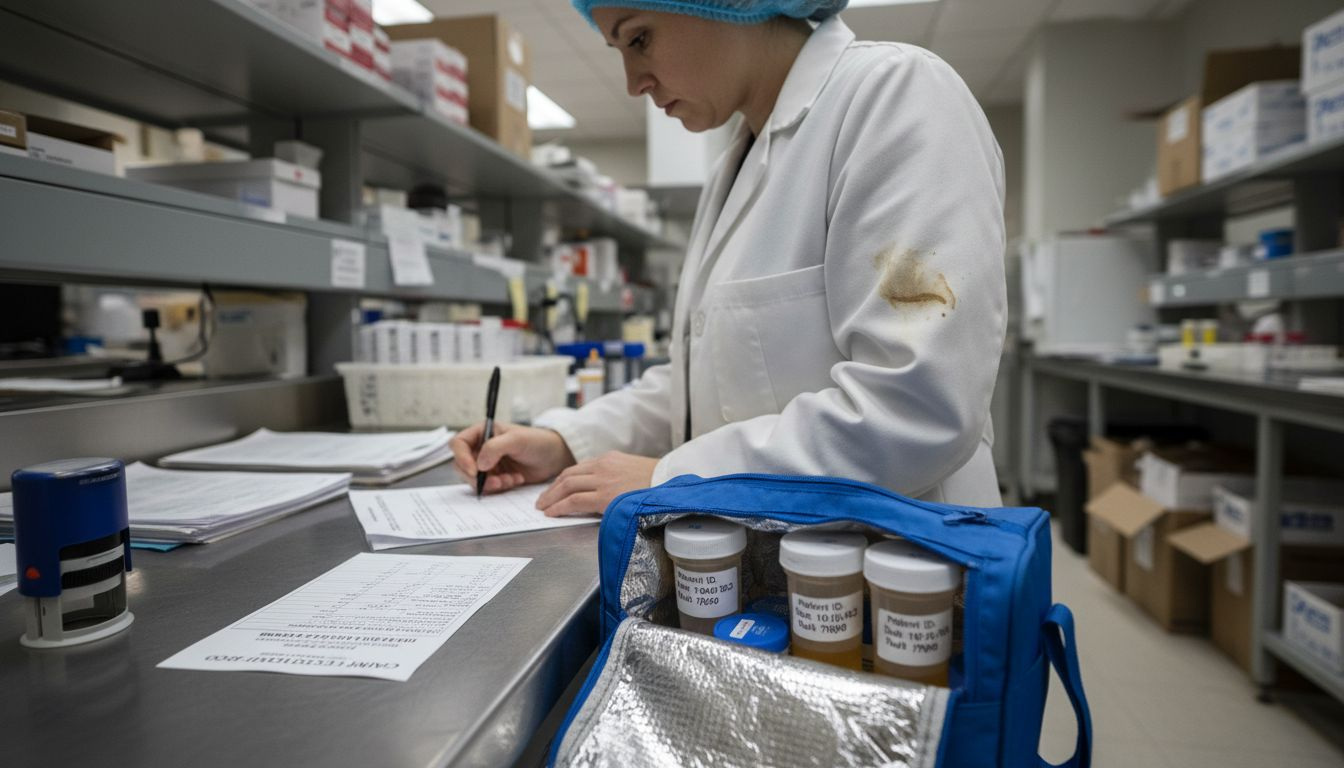
Chain of custody is the documented trail proving that a specimen was properly handled from collection through testing. Every person who touches the specimen must be recorded, including the collector, the transporter, the laboratory technician, and anyone else involved. The specimen must be sealed, labeled with a unique identifier, and stored securely. When chain of custody is broken, a positive result becomes legally worthless because you cannot prove the specimen wasn’t contaminated, switched, or tampered with. Think of it like evidence in a criminal case: even DNA evidence becomes inadmissible if someone can’t account for where it was and who handled it. Proper chain of custody procedures ensure every step is documented in writing, creating an unbreakable trail of accountability. Your testing provider handles much of this, but you need to understand it because you’re responsible for verifying the process was followed correctly.
The Medical Review Officer (MRO) is a licensed physician who serves as an independent reviewer between your testing laboratory and your organization. When a positive result comes back from the lab, it doesn’t automatically mean you fire the employee. The MRO contacts the employee confidentially to ask about prescription medications, over-the-counter drugs, herbal supplements, or dietary factors that could explain the positive result. The employee has an opportunity to provide documentation (like a prescription bottle) before the result is reported to you. If the employee has a legitimate medical explanation, the MRO can change the result to negative. This step protects employees from false positives while protecting your organization from discrimination claims. Understanding the MRO’s role in the testing process helps you recognize why this step is non-negotiable rather than optional.
Finally, you need to understand what your test results actually tell you. A negative result means no drugs were detected above the cutoff level, but it doesn’t prove the person never uses drugs. A positive result that survives confirmatory testing and MRO review means drugs were detected above the federal threshold, but it doesn’t tell you when the drug was used or whether the person is currently impaired. A non-negative result is still pending MRO review. Some labs report dilute specimens, which means the urine was too diluted to be reliable, and you may require retesting. Interpreting lab test results correctly prevents you from misunderstanding what the numbers actually mean. A positive test result is not proof of impairment, guilt, or even recent use; it’s simply a chemical finding that requires proper interpretation in context.
Pro tip: Keep a decision matrix showing what actions you’ll take for different result types (negative, non-negative pending MRO review, positive after MRO confirmation, dilute specimens requiring retest) so managers follow consistent procedures instead of making emotional decisions on the spot.
HR Compliance Risks and Common Misconceptions
Many HR professionals believe their drug testing program is legally sound when it actually contains hidden risks that could explode into litigation or regulatory penalties. These risks often stem from misconceptions about what drug testing can prove, how results should be interpreted, and what protections employees have under law. Understanding these pitfalls now prevents costly mistakes later. The good news: most of these risks are preventable with proper knowledge and documentation.
One dangerous misconception is that a positive drug test proves an employee used drugs illegally or is currently impaired. This is false. A positive test proves only that a drug metabolite was present in the specimen above a certain threshold. It tells you nothing about when the drug was used, how much was used, or whether the employee is impaired. An employee could test positive for marijuana from use three weeks ago on a weekend, yet be perfectly capable of performing their job today. Another risk: assuming all positive results are accurate without confirmatory testing. Initial screening tests produce false positives at rates that vary by substance and test type. Some medications, foods, or supplements can trigger false positives on initial screens. This is why confirmatory testing and MRO review are non-negotiable steps. If you act on an unconfirmed positive result, you expose yourself to wrongful termination lawsuits. Common misunderstandings about drug testing in employment contexts can lead to discrimination claims, privacy violations, and employee mistrust that damages your organization’s reputation.
Another significant risk is inconsistent policy application. If you test some employees for drugs but not others, or if you test employees who report to certain managers but not others, you’re creating discrimination risk. Your policy must be applied uniformly across all employees in the same job classification. Selective enforcement is a red flag for discrimination lawsuits. Additionally, many companies fail to establish clear documentation about why they’re testing. Testing without a documented business reason opens you to privacy invasion claims. You need written policies explaining when you test (pre-employment, reasonable suspicion, post-accident, random, etc.) and why each type of test is necessary for your business. State laws add another layer of complexity. Some states prohibit random testing entirely. Others require advance notice of testing programs. Some states restrict what substances you can test for. A policy that’s compliant federally might violate state law. Many HR professionals assume federal standards apply everywhere, but they don’t. You must research your specific state’s requirements.
Mishandling the MRO process creates substantial risk. Some companies pressure MROs to report positive results without allowing employees adequate opportunity to explain. Others try to bypass MRO review entirely for cost savings. This is like skipping fire insurance to save money. The MRO exists specifically to catch false positives and protect both employees and your organization. Finally, failing to document everything is a compliance disaster waiting to happen. Every testing decision, every policy communication, every result received, and every action taken must be documented. If you’re ever sued, this documentation proves you followed proper procedures. Without documentation, even correct decisions look like you were making things up as you went along.
Below is a summary of key compliance risks and how to mitigate them:
| Compliance Risk | Common Misconception | Effective Mitigation Strategy |
|---|---|---|
| Acting on unconfirmed results | Initial positive means drug use | Require confirmatory testing and MRO |
| Inconsistent policy application | Testing only some employees | Apply policy to all in same job class |
| State vs. federal law conflict | Federal law overrides state laws | Research and follow both sets of laws |
| Incomplete documentation | Verbal decisions are sufficient | Document every test and action taken |
Pro tip: Have your drug testing policy reviewed by an employment law attorney before implementation, especially if you operate in multiple states or have employees in safety-sensitive positions; this preventive cost is tiny compared to defending a discrimination lawsuit.
Ensure Your Drug Testing Program Meets Compliance and Clarity Standards
Navigating drug testing terminology and regulatory requirements can feel overwhelming. You want to avoid costly mistakes like misinterpreting a positive result or breaking the chain of custody. Whether you are managing employee testing programs or seeking reliable testing services, clear understanding and trusted partners are key.
CountryWideTesting.com offers comprehensive solutions tailored to the complexities highlighted in the article. From federally compliant urine and mouth swab drug tests to certified lab processing with SAMHSA, ISO, CLIA, and CAP accreditation, we help you maintain accuracy and legal defensibility. Our testing options support employers, individuals, and organizations looking to comply with DOT regulations and state laws, while navigating critical terms like confirmatory testing and Medical Review Officer reviews.
Take control of your compliance today. Visit CountryWideTesting.com to explore our trusted drug testing solutions and learn how our services simplify the complexities of workplace screening. Empower your HR team with reliable testing methods that uphold the highest standards and protect your organization from liability. Get started now to ensure your drug testing program is both informed and compliant.
Frequently Asked Questions
What is the difference between an initial screening test and a confirmatory test in drug testing?
An initial screening test quickly identifies potential drugs of concern but can produce false positives. A confirmatory test uses more sophisticated methods to verify the presence of drugs, ensuring accurate results before any employment decisions are made.
What does it mean when a test result is labeled as a ‘non-negative’ result?
A non-negative result indicates that the test has shown something potentially concerning but has not yet been confirmed by a Medical Review Officer (MRO). This result requires further investigation.
How does the Medical Review Officer (MRO) protect both employees and the organization in drug testing?
The MRO reviews positive test results and contacts the employee to ask about prescriptions or other factors that could explain the positive result. This protects employees from wrongful assumptions while helping the organization understand the context before making employment decisions.
Why is maintaining the chain of custody important in drug testing?
Chain of custody is critical because it documents who handled the specimen throughout the testing process. A broken chain can undermine the reliability of a test result, making it potentially inadmissible in legal situations, similar to how evidence in a legal case must be properly documented.