
What Is At-Home Health Testing for Employers?
Managing employee drug screening and compliance can feel overwhelming when you need solutions that fit busy schedules and privacy concerns. For HR professionals at mid-sized American companies, traditional lab visits disrupt workflow and lower participation rates. By adopting self-administered kits, you offer convenient screening from home, helping your team maintain confidentiality and stay compliant without leaving the office. This guide explains how at-home health testing empowers your workforce and supports employment decisions with reliable results.
Table of Contents
- What Is At-Home Health Testing?
- Popular Types of At-Home Tests Explained
- How At-Home Testing Kits Work
- Legal Compliance and Reliability Issues
- Comparing At-Home and Lab Testing Options
Key Takeaways
| Point | Details |
|---|---|
| Convenience of At-Home Testing | At-home health testing allows individuals to screen for various health conditions privately and conveniently, without requiring an office visit. |
| Testing Models | Two primary testing models exist: instant-result tests provide immediate feedback, while lab-submission tests offer more accurate results after analysis. |
| Employee Engagement | Offering at-home testing can boost employee participation in wellness programs due to its cost-effectiveness and the comfort of privacy. |
| Compliance and Accuracy | It’s essential to use FDA-authorized tests and follow a two-step testing approach that combines initial at-home screening with lab confirmation for legal defensibility. |
What Is At-Home Health Testing?
At-home health testing gives you the ability to check specific health conditions from your home without scheduling a doctor’s visit. These tests are self-administered kits that let you screen for everything from drug use to infectious diseases, metabolic markers, and genetic risks.
Think of them as a bridge between total autonomy and professional healthcare. You get immediate insight into your health status while maintaining privacy. The convenience factor matters, especially for busy HR professionals managing employee wellness programs.
How At-Home Tests Work
At-home health testing operates in two primary models:
- Instant-result tests: You perform the test and get results within minutes in your home
- Lab-submission tests: You collect a sample at home and mail it to a certified laboratory for analysis
Both approaches detect conditions like infectious diseases and metabolic markers without requiring an office visit. The test kit itself contains everything you need—instructions, collection materials, and sometimes reagents for immediate processing.
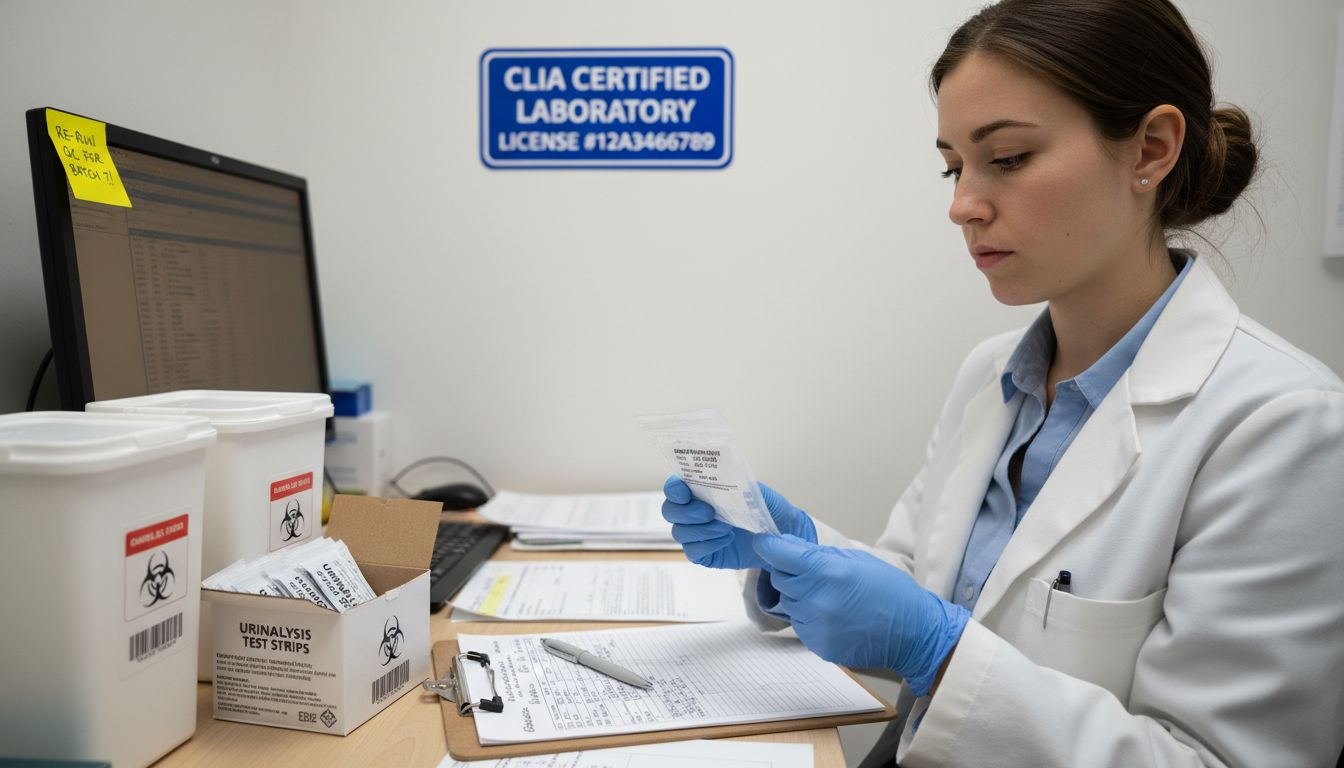
Lab-based home tests offer an advantage for employers: they get processed by SAMHSA-certified, CLIA-compliant laboratories that meet the same regulatory standards as clinical settings. This matters when you need defensible results for employment decisions.
What Can At-Home Tests Detect?
At-home testing capabilities have expanded dramatically. Your organization can screen for:
- Drug and alcohol use (urine, oral fluid, hair)
- Infectious diseases (hepatitis, HIV, sexually transmitted infections)
- Chronic disease markers (glucose levels, cholesterol)
- Pregnancy and women’s health indicators
- Genetic predispositions
At-home tests complement regular healthcare visits but shouldn’t replace them for ongoing medical management.
For employer drug screening specifically, at-home collection kits reduce the friction of traditional lab visits. Employees can collect samples on company time without leaving the building, then submit them to licensed labs for confirmation testing.
Cost and Convenience Benefits
Cost-effective screening happens quickly and confidentially at home, eliminating travel time and waiting room delays. You’re not paying for facility overhead or lab phlebotomists. For mid-sized companies rolling out drug screening programs, this translates to faster implementation and higher employee participation rates.
Confidentiality matters too. Employees appreciate testing from home versus a public testing facility. This psychological comfort often leads to better compliance rates within your workforce.
Quality and Regulatory Standards
The FDA regulates home-use tests for safety and accuracy. Products sold by CountryWideTesting.com come from laboratories meeting SAMHSA, ISO, CLIA, and CAP standards. These certifications mean your results hold up to employment law scrutiny.
Home tests aren’t second-tier screening. They’re legitimate health monitoring tools used by healthcare systems, employers, and individuals for initial screening and disease management.
Pro tip: When implementing at-home testing for your workforce, pair instant-result tests with lab confirmation for drug screening—this balances speed with the legal defensibility HR departments require.
Popular Types of At-Home Tests Explained
At-home tests cover a broad spectrum of health concerns, each designed for specific screening needs. For HR professionals, understanding the different types helps you choose the right testing strategy for your workforce and compliance requirements.
The landscape extends far beyond drug screening. Modern at-home testing addresses infectious diseases, chronic conditions, genetic risks, and more. Your organization might benefit from multiple test types depending on your industry, workforce demographics, and regulatory obligations.
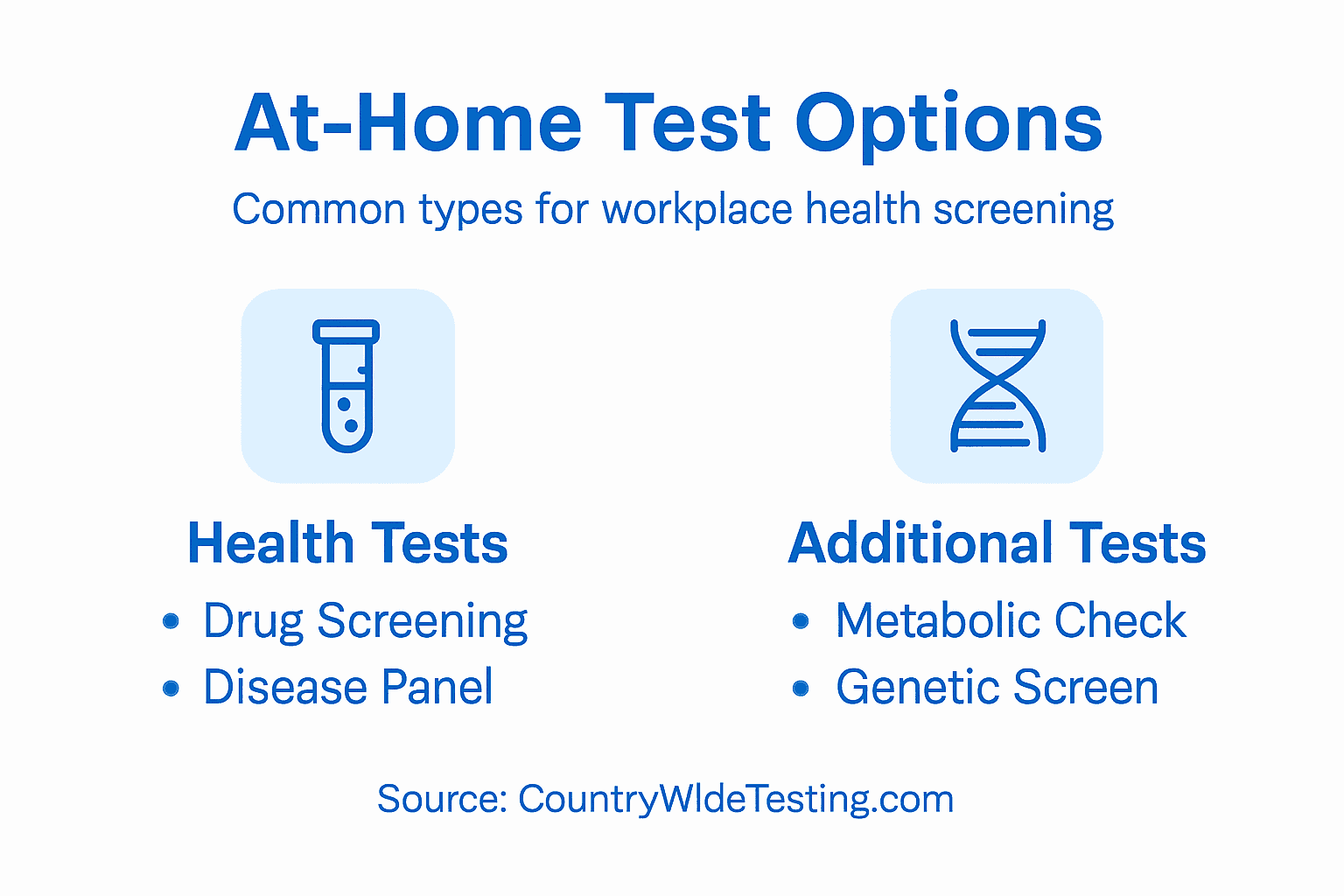
Here’s a quick overview of at-home health test categories and their typical use in workplace wellness:
| Test Category | Common Purpose | Sample Type | Relevance for Employers |
|---|---|---|---|
| Drug Identification | Substance use screening | Urine, saliva, hair | Employment compliance |
| Infectious Disease | Contagion risk management | Blood, nasal swab | Workforce safety protocols |
| Metabolic/Chronic Marker | Chronic condition monitoring | Blood, stool | Wellness and health initiatives |
| Genetic/Women’s Health | Risk prediction, fertility status | Blood, saliva | Broader wellness (optional) |
Drug and Alcohol Testing Kits
Drug screening represents the most common at-home test for employers. These kits detect substance use through:
- Urine tests: Most common, detect drug metabolites for 2-7 days
- Oral fluid tests: Detect more recent use, less invasive collection
- Hair tests: Show longer detection windows (up to 90 days)
Employers often combine at-home drug screening with lab confirmation to balance speed with legal defensibility. Instant-result tests give you quick answers during onboarding; lab confirmation provides documentation courts recognize.
Alcohol testing kits work similarly, though they’re less frequently used for employment screening due to the shorter detection window.
Infectious Disease Tests
Common at-home tests for infectious diseases include:
- Hepatitis screening (hepatitis B and C antibodies)
- HIV antibody detection
- COVID-19 rapid antigen tests
- Sexually transmitted infection screening
Rapid antigen tests for COVID-19 typically deliver results within 10-15 minutes and work anywhere. They’re useful for pre-event screening or post-exposure assessment. For workplace safety protocols, these kits provide immediate insight without lab delays.
Other infectious disease tests require lab submission but offer comprehensive results your occupational health programs can track.
Metabolic and Chronic Disease Tests
Your workforce might benefit from preventive screening through:
- Blood glucose tests: Monitor diabetes risk or manage existing diabetes
- Cholesterol screening: Identify cardiovascular risk factors
- Fecal occult blood tests for colon cancer detection
- Blood pressure monitoring kits
These tests support wellness initiatives beyond compliance. Employees appreciate organizations that help them monitor chronic conditions, and preventive screening reduces long-term healthcare costs.
Genetic and Women’s Health Tests
Genetic testing kits reveal disease predisposition and ancestry information. Women’s health tests include pregnancy detection and hormone monitoring for fertility tracking.
These categories fall outside typical employment screening but align with comprehensive wellness programs some mid-sized companies offer.
Different test types require different collection methods and submission processes—choose based on your specific workforce needs and compliance goals.
Pro tip: When selecting at-home test types for your company, prioritize drug screening with lab confirmation first, then layer in infectious disease screening based on your industry’s specific health and safety requirements.
How At-Home Testing Kits Work
At-home testing kits operate through one of two primary workflows: immediate self-testing or sample collection for lab analysis. Understanding the mechanics helps you implement testing programs that fit your company’s timeline and accuracy requirements.
The process seems simple on the surface, but several factors determine whether results are reliable enough for employment decisions. Kit design, sample collection technique, and proper handling all matter significantly.
The Two Testing Models
At-home testing follows two distinct paths:
- Self-testing: You collect and analyze the sample at home, reading results within minutes
- Self-collection: You collect the sample at home and mail it to a certified laboratory for analysis
The self-testing model offers speed—results arrive before the end of your shift. The self-collection model trades speed for precision, sending samples to SAMHSA-certified laboratories where trained technicians process everything under controlled conditions.
Most employers use self-collection for employment screening because lab results hold up better in legal disputes.
See how instant-result and lab-submitted tests differ for business needs:
| Attribute | Instant-Result Tests | Lab-Submission Tests |
|---|---|---|
| Result Speed | Within minutes | 1-3 days (after shipping) |
| Legal Defensibility | Limited | Strong, meets regulations |
| Employee Disruption | Minimal | Slightly more, requires shipping |
| Typical Use Case | Quick screening | Confirmation for positives |
Self-Testing Process
Immediate-result tests follow a straightforward sequence:
- Collect the sample (urine, saliva, or nasal swab depending on test type)
- Apply sample to the test device according to instructions
- Wait the specified time (typically 5-15 minutes)
- Read the results on the test strip or cassette
Proper sample collection technique and following manufacturer instructions are critical for accurate results. Most test failures occur because users rush the collection or misread results.
For employers, the advantage is immediate feedback. The disadvantage is that positive results typically require confirmation through a lab before taking employment action.
Self-Collection and Lab Submission
When you choose lab-based testing, the process extends but gains defensibility:
- Collect your sample using the kit materials provided
- Seal the sample securely in the provided container
- Ship the sample to the lab using prepaid materials
- The lab analyzes your sample and provides certified results
Sample collection involves gathering urine, blood, or saliva and applying it to the test device, then the kit gets mailed to the laboratory. Results typically arrive within 1-3 business days.
This approach eliminates the need for employees to visit a testing facility while ensuring professional-grade accuracy.
What’s Inside the Kit
Typical at-home test kits include:
- Collection device (swab, cup, lancet for blood)
- Reagent solution or chemical strips
- Test strip, cassette, or analyzer device
- Instructions (detailed and critical)
- Sealing/containment materials
- Prepaid shipping label (for lab-submission tests)
The quality of these components varies dramatically between manufacturers. Kits from CountryWideTesting.com work with certified labs, ensuring components meet regulatory standards.
Kit accuracy depends equally on product quality and how users follow instructions—both matter for reliable results.
Pro tip: When rolling out at-home testing to your workforce, provide detailed at-home drug test instructions to employees beforehand to reduce collection errors and invalid results.
Legal Compliance and Reliability Issues
At-home testing for employment screening sits at the intersection of convenience and legal risk. Your company needs results that hold up in court while maintaining employee trust. This requires understanding both regulatory standards and the practical limitations of home-based testing.
Not all at-home tests are created equal. The difference between FDA-authorized kits and unapproved products can determine whether your testing program survives legal challenge or becomes a liability.
FDA Authorization and Regulatory Compliance
At-home tests must comply with regulatory standards such as FDA authorization to ensure safety and accuracy. This means the kit manufacturer submitted evidence to the FDA demonstrating the test works as claimed. Only use authorized test strips and kits approved for sale.
CountryWideTesting.com partners with laboratories meeting SAMHSA, CLIA, CAP, and ISO standards. These certifications prove the labs process samples according to federal requirements, creating documentation courts recognize.
Unauthorized tests carry serious risks. If you rely on results from non-compliant kits, employees could challenge positive results or sue for wrongful termination based on unreliable evidence.
Accuracy Limitations and False Results
At-home tests have real limitations you must understand before implementation. Rapid antigen tests offer convenience but may have reduced sensitivity compared to lab-based PCR testing, particularly for asymptomatic individuals.
This translates to two problems:
- False negatives: Tests miss actual positive cases, creating safety gaps
- False positives: Tests show positive when someone is actually negative, exposing you to liability
For employment decisions, false positives are the bigger legal exposure. An employee testing positive on an unreliable kit could claim discrimination or wrongful termination based on inaccurate results.
Home Tests as Screening, Not Confirmation
The smartest approach treats at-home tests as initial screening only. Users should understand the strengths and limitations to interpret results properly and follow public health guidelines.
Best practice for employers:
- Use at-home tests for initial screening during onboarding
- Send positive results to a certified lab for confirmation
- Only take employment action based on lab-confirmed results
- Document everything for compliance purposes
This two-step process eliminates the accuracy risk while keeping your timeline relatively short.
Accurate Labeling and Instructions Matter
Compliantly manufactured tests include clear labeling and detailed instructions. Poor instructions lead to collection errors, invalid results, and potential disputes.
When distributing tests to your workforce, provide additional guidance. Many errors occur because employees misunderstand how to collect samples or read results. Written instructions plus verbal walkthrough reduce invalid tests significantly.
At-home testing works best as a screening layer, not as the final determination for employment decisions.
Pro tip: Before rolling out any at-home testing program, consult with your legal team about federal drug testing compliance requirements specific to your industry—some sectors have stricter mandates than others.
Comparing At-Home and Lab Testing Options
Choosing between at-home and lab testing requires balancing speed against accuracy. Both have legitimate roles in employment screening programs, and the right choice depends on your specific workflow and risk tolerance.
Your HR team faces a real trade-off. At-home tests get results fast, but lab tests give you defensible documentation. Understanding the differences helps you build a testing strategy that protects your company.
Speed Versus Accuracy
At-home tests provide quick results and convenience by allowing employees to collect samples without visiting a facility. Results arrive within minutes for instant tests or days for mail-in kits.
Lab tests require professional sample collection and processing, which takes several days but delivers significantly higher accuracy. Lab-based NAATs including PCR tests remain the gold standard for accuracy in detecting infections, while at-home antigen tests offer faster results but lower sensitivity.
For employment screening, this means lab tests confirm what at-home tests suggest. An at-home test showing positive becomes legally defensible only after lab confirmation.
Key Differences at a Glance
| Factor | At-Home Tests | Lab Tests |
|---|---|---|
| Turnaround Time | Minutes to days | 1-3 business days |
| Accuracy | Moderate (antigen) | High (PCR/NAAT) |
| Employee Convenience | Very high | Requires facility visit |
| Documentation | Basic results | Comprehensive records |
| Cost | Lower per test | Higher per test |
| Legal Defensibility | Screening only | Confirmatory |
The cost difference matters for mid-sized companies. Lab tests cost more per sample, but you only run confirmations on positives, keeping total expenses manageable.
When to Use At-Home Testing
At-home testing works best for:
- Initial screening: Quick determination during onboarding or re-screening
- High-volume screening: Testing many employees without facility strain
- Remote workforce: Employees unable to visit testing centers easily
- Rapid decisions: When you need immediate feedback before moving forward
At-home testing enhances accessibility and rapid detection, especially for symptomatic screening or exposure assessment in workplace safety protocols.
When Lab Testing Makes Sense
Lab testing becomes necessary for:
- Employment decisions: Any result that drives termination or hiring rejection
- Compliance documentation: Federal requirements demanding certified results
- High-risk positions: Jobs affecting safety where accuracy is non-negotiable
- Legal protection: Building an audit trail courts recognize
For employment drug screening specifically, never base termination solely on at-home results. Lab confirmation protects you from wrongful termination claims.
The Hybrid Approach
Most HR professionals use a two-tier system: at-home screening followed by lab confirmation for positives. This strategy delivers speed while maintaining legal defensibility.
Implementing this approach:
- Use at-home tests during onboarding for initial screening
- Confirm positive results through certified lab testing
- Only take employment action based on lab results
- Maintain documentation of both tests for compliance
Both testing types have roles in comprehensive screening strategies—at-home testing provides practical speed while labs provide confirmatory accuracy.
Pro tip: When building your testing program, compare at-home versus lab testing accuracy differences to justify the two-tier approach to your CFO based on risk reduction and employee experience.
Simplify Your Workforce Health Screening with Trusted At-Home Testing Solutions
Managing employee wellness programs and ensuring legal compliance can be challenging without reliable testing options. The article highlights key pain points such as balancing speed with legal defensibility, navigating complex regulatory standards like SAMHSA and CLIA, and maintaining employee privacy and convenience during health screening.
At CountryWideTesting.com we understand these challenges and offer a range of certified at-home drug and alcohol testing kits combined with expert lab confirmation services. Our partnership with licensed laboratories meeting SAMHSA, ISO, CLIA, and CAP standards guarantees that your results are not only fast but also legally defensible. Whether you need instant-result kits for quick screening or comprehensive lab-submission tests for employment decisions, we provide solutions tailored to protect your company and support your workforce.
Take control of your employee health screening today by choosing CountryWideTesting.com as your trusted partner. Explore our testing options to implement a compliant, convenient, and confidential program that helps you stay ahead of workforce risks. Visit us now to find the right drug and alcohol testing kits designed for employers who demand accuracy and compliance.
Frequently Asked Questions
What are the benefits of at-home health testing for employers?
At-home health testing offers convenience, privacy, and cost-effectiveness. It allows employees to screen for health conditions without visiting a lab, which can lead to higher participation rates in wellness programs.
How do at-home health tests work?
At-home tests generally operate in two ways: instant-result tests that provide results within minutes and lab-submission tests where employees collect a sample at home and send it to a certified lab for analysis.
What types of conditions can at-home health tests detect?
At-home health tests can detect a wide range of conditions, including drug and alcohol use, infectious diseases, chronic disease markers, and genetic predispositions. Specific tests may include screenings for diabetes, cholesterol levels, and STIs.
What are the legal implications of using at-home health tests in the workplace?
Using at-home health tests requires careful compliance with regulatory standards. FDA authorization and the use of SAMHSA-certified labs for confirmation testing can help ensure results are legally defensible in case of disputes.