
How to conduct probation drug testing: a step-by-step guide
TL;DR:
- Urine analysis is the standard, reliable, and cost-effective method for probation drug testing.
- Effective programs focus on accountability, early intervention, and combining testing with treatment support.
- Proper protocols, documentation, and a supportive approach improve legal defensibility and long-term compliance.
Undetected drug use during probation puts public safety at risk, undermines court orders, and can derail an individual’s path to recovery. For probation officers and program administrators, running a drug testing program that is both legally defensible and genuinely effective is not optional. It is the job. This guide walks you through every stage of the process, from understanding the core principles to handling edge cases and measuring program outcomes, so you can build or refine a program that holds up under scrutiny and actually helps the people in your care.
Table of Contents
- Core principles of probation drug testing
- What you need: Materials, panels, and preparation
- Step-by-step process: From notification to results
- Handling special cases and troubleshooting errors
- Program monitoring, results, and continuous improvement
- Why a therapeutic—not punitive—approach works best
- Streamline your program with the right testing tools
- Frequently asked questions
Key Takeaways
| Point | Details |
|---|---|
| Urine analysis dominates | Urine testing is the most reliable and widely used method for probation drug testing due to its balance of cost, speed, and detection window. |
| Random, supervised testing deters use | Implementing random schedules and observed collections ensures program integrity and better compliance. |
| Documentation is critical | Meticulous recordkeeping—including prescriptions and chain-of-custody—protects against false positives and legal challenges. |
| Positive results require response | Using graduated sanctions and treatment referrals instead of immediate revocation leads to improved outcomes. |
Core principles of probation drug testing
Every solid probation drug testing program is built on a few non-negotiable foundations. Before you can run an effective program, you need to understand why certain methods are used, what they detect, and what the testing is actually trying to accomplish.
Urine analysis is the gold standard for probation testing. Urine analysis is standard due to its cost-effectiveness, reliability, and detection window of 1 to 30 days for most substances. That detection range matters enormously. A single weekend of use can still show up days later, which is a real deterrent for individuals who might otherwise assume they can time their use around testing schedules.
Standard panels screen for the most commonly abused substances:
- THC (marijuana)
- Cocaine
- Amphetamines and methamphetamine
- PCP (phencyclidine)
- Opiates
Expanded 10 and 12-panel tests add benzodiazepines, barbiturates, methadone, oxycodone, and sometimes ethyl glucuronide (EtG) for alcohol monitoring. The right panel for your program depends on the population you supervise and the substances most prevalent in your jurisdiction.
It is also worth stepping back and asking what drug testing is actually for. The answer is threefold: deterrence, compliance monitoring, and rehabilitation support. Testing alone does not fix substance use disorder. Research consistently shows that outcomes improve when testing is paired with treatment referrals and structured support, not just sanctions. Explore effective testing protocols and the role of drug testing in compliance to see how these elements connect.
Key insight: Drug testing is most powerful as a tool for accountability and early intervention, not just as a mechanism for catching violations. Programs that treat a positive result as a signal to engage, rather than only to punish, tend to see better long-term compliance rates.
What you need: Materials, panels, and preparation
Building on those principles, the next step is ensuring you have the right materials and understand what your tests will and won’t screen for.
A compliant collection setup requires more than just a test cup. Here is what every testing station should have on hand:
- Urine collection cups with integrated temperature strips
- Disposable gloves for every collection
- Chain-of-custody forms (one per specimen)
- Tamper-evident seals
- Biohazard bags for specimen transport
- Secure, locked storage for samples awaiting lab pickup
Understanding your panel options is equally important. Standard panels test for 5 to 12 substances, including THC, cocaine, amphetamines, PCP, and opiates. Expanded panels add benzodiazepines, barbiturates, methadone, oxycodone, and EtG for alcohol detection up to 80 hours after consumption. Review the full breakdown of types of drug panels to match the right panel to your supervision needs.
| Panel type | Substances detected | Best use case |
|---|---|---|
| 5-panel | THC, cocaine, amphetamines, PCP, opiates | General supervision |
| 10-panel | Above + benzos, barbiturates, methadone, propoxyphene, methaqualone | Higher-risk populations |
| 12-panel | Above + oxycodone, EtG or buprenorphine | Opioid or alcohol conditions |
One area that trips up many programs is prescription medication. Before testing begins, require individuals to disclose all current prescriptions in writing. A valid prescription for a benzodiazepine or opioid will show up on a panel. Without documentation on file, you may be looking at what appears to be a positive result when it is actually a lawful medication. Getting that paperwork upfront protects both the individual and the integrity of your program.
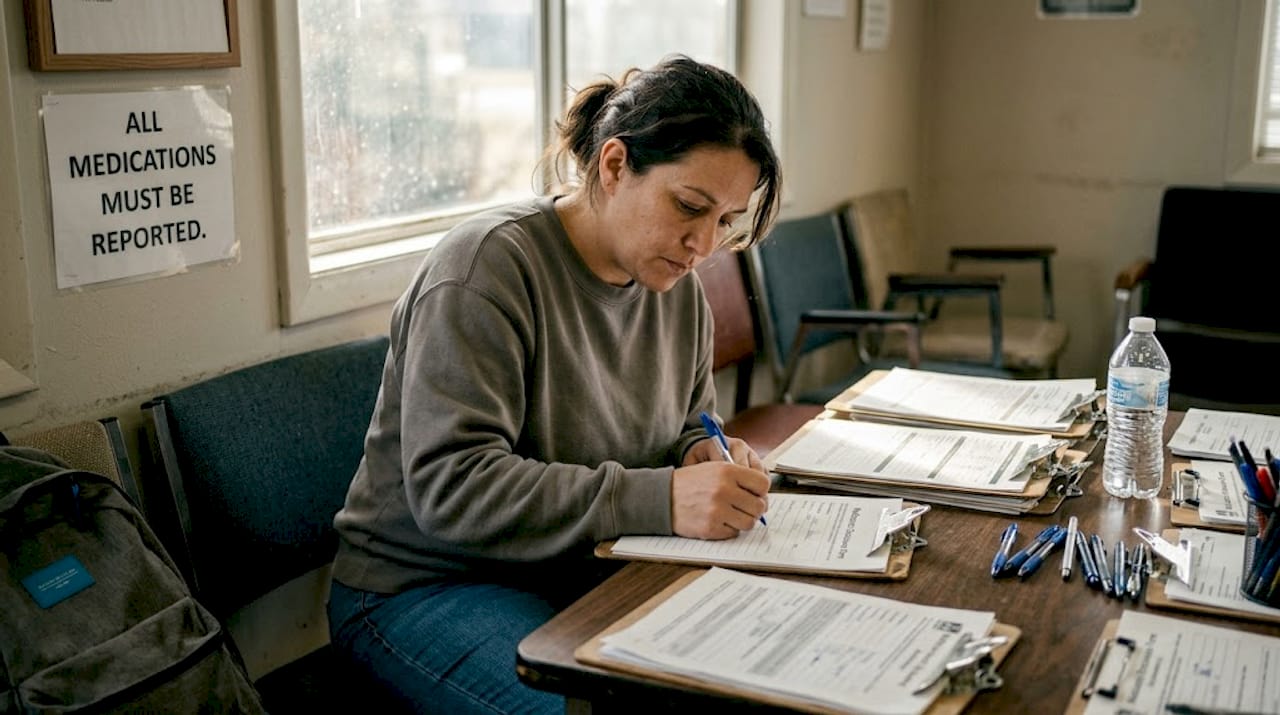
Pro Tip: Build a standardized intake form that captures all current medications, dosages, and prescribing physicians. Review it before every test cycle, not just at intake.
Step-by-step process: From notification to results
Once equipped and informed on what you’re testing for, follow these steps to ensure your process is tight, fair, and meets compliance standards.
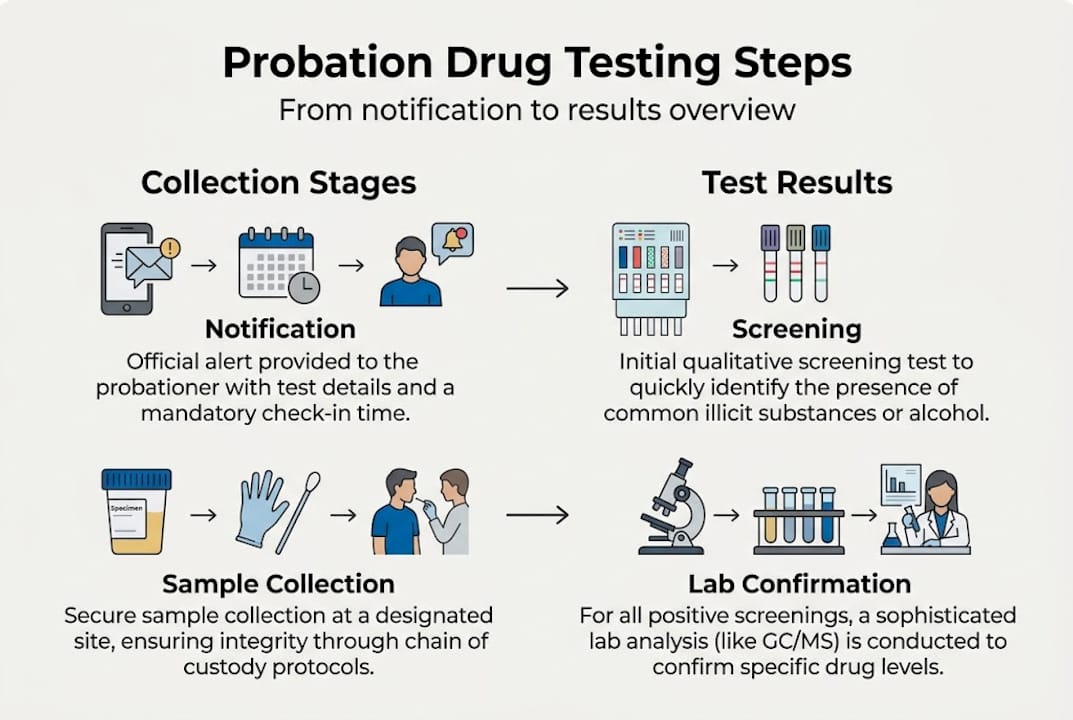
Random selection via color code systems, daily check-ins, supervised collection, validity checks with temperature readings between 90 and 100 degrees Fahrenheit, and chain-of-custody documentation form the backbone of any defensible protocol. Here is how that plays out in practice:
- Random notification: Assign each individual a color code or call-in number. When their code is called, they must report for testing the same day. No advance notice. No exceptions.
- Identity verification: Confirm the individual’s identity with a government-issued photo ID before anything else.
- Supervised collection: A same-gender officer observes the collection to prevent substitution or adulteration. This step is non-negotiable for legal defensibility.
- Validity checks: Immediately check the sample temperature (must be 90 to 100 degrees Fahrenheit), color, and signs of dilution or adulteration.
- On-site immunoassay screen: The initial test delivers results in about five minutes. A preliminary positive is not a confirmed positive.
- GC/MS lab confirmation: Standard procedures require GC/MS confirmation for any positive or disputed result. This step eliminates false positives and holds up in court.
Maintaining a clean chain-of-custody workflow from collection to lab result is what makes your findings legally actionable. Every handoff must be documented. Review the full drug test workflow to ensure your process covers every handoff point.
| Stage | On-site screening | Lab confirmation (GC/MS) |
|---|---|---|
| Time to result | 5 minutes | 24 to 72 hours |
| Accuracy | High (preliminary) | Definitive |
| Legal standing | Presumptive | Admissible in court |
| Cost | Low | Moderate to high |
Pro Tip: Never take action on a preliminary positive alone. Always send disputed or positive samples to a certified lab before initiating any sanction or violation report.
Handling special cases and troubleshooting errors
Even the best preparations and execution can face hiccups. It is vital to know what to do when something unusual happens.
Special situations come up regularly in probation drug testing. How you handle them determines whether your program is fair, legally sound, and effective. Prescription medications require documentation beforehand; refusal or no-show is treated as a positive; dilution and adulteration are detected through validity checks; and EtG testing covers alcohol use up to 80 hours prior.
Here is how to handle the most common edge cases:
- Prescription medications: If an individual tests positive and claims a prescription, check your intake documentation. If the medication was not disclosed in advance, treat it as a potential violation and send for lab confirmation with the prescription information included.
- Refusal to test: A refusal is a positive. Document it immediately, note the time and circumstances, and initiate the appropriate response per your program’s policy.
- No-show: Same rule applies. A missed test without an approved excuse is treated as a positive result.
- Diluted samples: A creatinine level below 20 mg/dL or specific gravity outside the 1.003 to 1.030 range signals dilution. Require an immediate retest under direct observation.
- Adulteration: Unusual pH, temperature outside the valid range, or the presence of oxidizing agents suggests tampering. Document and escalate immediately.
- Alcohol monitoring: EtG testing is the most reliable method for detecting recent alcohol use. It is far more sensitive than a standard breathalyzer and detects use up to 80 hours after consumption.
For any result that may lead to a sanction, follow SAMHSA confirmation guidelines and ensure your lab meets lab certification requirements for defensible results.
Remember: Consistency is your best legal protection. Apply the same rules to every individual, every time. Selective enforcement creates liability and undermines the program’s credibility.
Program monitoring, results, and continuous improvement
Ensuring your program keeps up with best practices and delivers results requires constant measurement and adjustments.
A drug testing program is not a set-it-and-forget-it operation. The data your program generates is one of its most valuable outputs, and using it well separates high-performing programs from ones that just go through the motions.
Random testing deters use, and graduated sanctions for positives including warnings, treatment referrals, and incarceration are the standard response framework. Positive test rates, when tracked over time, serve as a quality indicator for the program as a whole.
Here is how to build a monitoring framework that actually improves outcomes:
- Track positive rates by substance: If opioid positives spike, that signals a need for targeted intervention or panel adjustment.
- Monitor retest compliance: Individuals who consistently miss tests or show diluted samples need closer supervision.
- Review sanction outcomes: Are graduated responses leading to treatment engagement or just cycling people through violations? Adjust accordingly.
- Audit chain-of-custody records quarterly: Documentation gaps are a liability. Regular audits catch problems before they become legal issues.
- Benchmark against program goals: If your program’s goal is reduced recidivism, track whether individuals with consistent negative tests have lower reoffense rates.
Statistic to know: Programs that combine random testing with structured treatment referrals show significantly better completion rates than those relying on sanctions alone. This is not a soft approach. It is an evidence-based one.
For programs managing individuals in recovery, connecting testing data to drug testing and relapse prevention strategies can meaningfully improve long-term outcomes.
Why a therapeutic—not punitive—approach works best
After walking through the technical process and monitoring, it is worth addressing the bigger picture: why you are doing this, and how the framing of drug testing shapes its effectiveness.
Here is what the evidence actually says. SAMHSA and NIDA guidelines emphasize confirmatory testing and precise cutoff levels to avoid false positives from legitimate medications. But beyond the mechanics, both agencies make clear that therapeutic framing, where testing is positioned as part of a supportive structure rather than a punishment mechanism, produces better compliance and better outcomes.
Officers who communicate testing as a tool to help individuals stay accountable to their own recovery goals see higher engagement with treatment and fewer adversarial interactions. That does not mean ignoring violations. It means that the default posture is support, and sanctions are the response to repeated failure, not the first move.
Reducing stigma around positive results, and routing individuals toward treatment rather than immediately toward incarceration, is not leniency. It is strategy. Explore how integrating drug testing with intervention can shift outcomes in your program.
Streamline your program with the right testing tools
If you are ready to strengthen your program or simplify operations, the right testing supplies make a measurable difference in both compliance and efficiency.
At CountryWideTesting.com, we offer a broad menu of products designed for professional use in supervised settings. Whether you need certified lab testing services for GC/MS confirmation or want to stock up on reliable 12-panel at-home tests for flexible program design, we have options that meet SAMHSA, CLIA, and CAP standards. Our supplies are trusted by professionals across the country who need accurate, defensible results every time.
Frequently asked questions
What drugs are included in standard probation drug test panels?
Standard panels typically include marijuana (THC), cocaine, amphetamines, methamphetamines, PCP, and opiates. 10 and 12-panel tests add substances like benzodiazepines, methadone, and oxycodone.
How is random drug testing conducted in a probation setting?
Most programs use a color code or call-in system for random selection. When an individual’s code is called, same-day testing is required with no advance warning.
What happens if an individual refuses or tries to tamper with the drug test?
Refusal or evidence of tampering is treated as a positive test. Refusal equals a positive and typically triggers sanctions or a mandatory treatment referral.
How long can alcohol be detected in a probation drug screening?
EtG testing detects alcohol up to 80 hours after consumption, making it far more sensitive than standard breathalyzer or urine alcohol tests.
Why is confirmation testing important in probation drug monitoring?
Initial immunoassay screens can produce false positives due to medications or other factors. GC/MS confirmation ensures results are accurate and legally defensible before any action is taken.