
Certified labs: critical role in workplace safety
TL;DR:
- Certified laboratories meet strict standards, ensuring legally defensible and accurate workplace drug testing results.
- Instant tests are faster but carry higher false positive risks and are not legally conclusive without lab confirmation.
- Effective drug testing programs combine certified lab results with clear policies, employee support, and ongoing compliance review.
Workplace drug positivity rates across the U.S. hover around 4.4% to 4.6%, and most HR teams are surprised by that number. What surprises them even more is how often their testing programs lack the legal backing to act on those results. Certified laboratories are not just a compliance checkbox. They are the backbone of any workplace drug testing program that can actually hold up to scrutiny, in court, during an audit, or in an employee dispute. This guide breaks down exactly what certified labs do, how they compare to other testing methods, and how you can build a smarter, more defensible testing program.
Table of Contents
- Why certified laboratories matter for workplace drug testing
- Comparing certified laboratories to onsite and instant tests
- Compliance, regulation, and the chain of custody
- Interpreting drug test results: Trends and HR best practices
- The limitations and true impact of certified lab testing
- Comprehensive laboratory testing solutions for your organization
- Frequently asked questions
Key Takeaways
| Point | Details |
|---|---|
| Certified labs ensure compliance | Only certified laboratories offer legally defensible, regulation-compliant drug test results. |
| Instant tests need lab confirmation | Onsite tests are convenient, but confirmation by a certified lab is crucial for HR actions. |
| Trends aid informed policy | Tracking drug positivity rates and substances helps HR tailor effective workplace strategies. |
| Lab tests support, not replace, policy | Certified testing is essential but should complement education, support, and clear communication. |
Why certified laboratories matter for workplace drug testing
A certified laboratory is not simply any facility that runs drug tests. Certification means the lab has met rigorous standards set by recognized regulatory bodies. In the U.S., the most important of these is SAMHSA, the Substance Abuse and Mental Health Services Administration. Other certifications include CLIA (Clinical Laboratory Improvement Amendments), ISO accreditation, and CAP (College of American Pathologists). Each of these standards sets requirements for equipment, personnel, quality control, and result reporting.
SAMHSA certified labs are authorized to conduct federally regulated workplace drug and alcohol testing. That includes federal agencies, Department of Transportation safety-sensitive roles, and any employer required to follow federal drug testing guidelines. As SAMHSA outlines, certified labs conduct regulated testing for federal agencies and DOT positions, ensuring every result meets the Mandatory Guidelines for federal workplace drug testing programs.
Here is what a certified laboratory actually does, step by step:
- Specimen collection oversight: Certified labs work with trained collectors who follow strict protocols to prevent tampering or contamination.
- Chain of custody documentation: Every sample is tracked from collection through analysis, creating a paper trail that can be reviewed legally.
- Initial screening: Samples undergo an immunoassay screen to flag potential positives.
- Confirmation testing: Any presumptive positive goes through a second, more precise test, usually GC-MS (gas chromatography-mass spectrometry), to eliminate false positives.
- Medical Review Officer (MRO) review: A licensed physician reviews all results before they are reported to the employer.
- Secure result reporting: Final results are delivered through a verified, confidential process.
Key insight: Without MRO review and GC-MS confirmation, a positive result from an uncertified test is little more than a starting point. It cannot be used as the sole basis for an employment decision in regulated industries.
The importance for workplace safety goes beyond regulatory compliance. Certified lab results protect you from wrongful termination lawsuits, give employees a fair and scientifically sound process, and create a consistent record that supports fair policy enforcement across your organization.
Comparing certified laboratories to onsite and instant tests
Instant drug tests have genuine appeal. They are fast, affordable, and easy to administer. An onsite test can give you a result in minutes, which seems ideal for post-accident screening or reasonable suspicion testing. But speed comes with tradeoffs that HR professionals cannot afford to ignore.
The core issue is accuracy and legal defensibility. Instant tests carry a higher false positive risk and are not legally defensible without lab confirmation. That means if an employee challenges a termination based on a positive instant test, you may not have the evidence to back your decision.

| Feature | Certified lab test | Instant/onsite test |
|---|---|---|
| Accuracy | Very high (GC-MS confirmed) | Moderate (immunoassay only) |
| Legal defensibility | Yes | No (without confirmation) |
| Turnaround time | 24 to 72 hours | Minutes |
| Cost | Higher | Lower |
| MRO review | Yes | No |
| False positive risk | Minimal | Higher |
| Required for DOT/federal | Yes | No |
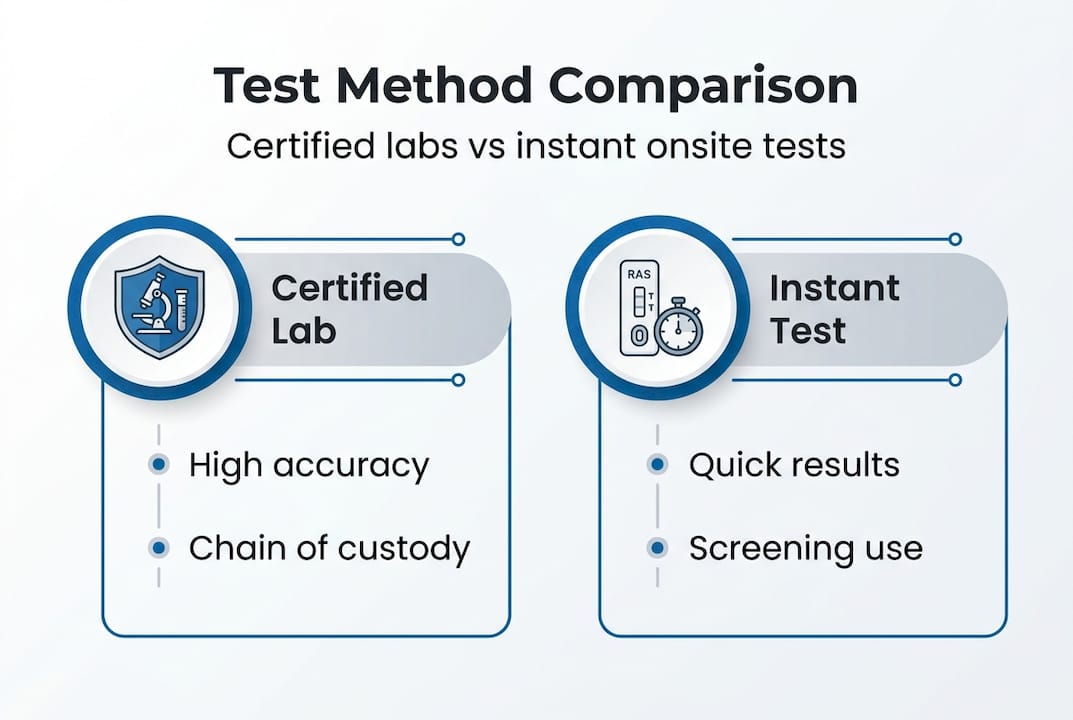
A useful drug test kit comparison shows that even the best instant kits are designed for screening, not confirmation. They are a first filter, not a final answer.
So when does an instant test make sense? Pre-employment screening for non-regulated positions, where you plan to confirm any positive with a lab test, is a reasonable use case. Random screening programs that use instant tests as a first pass before sending flagged samples to a certified lab can also work well. The critical rule: never use an instant test result alone as the basis for a disciplinary action in a regulated environment.
Pro Tip: Build a two-step protocol. Use instant tests for initial speed, then route any non-negative result to a certified lab for confirmation before taking any HR action. This balances cost and compliance without cutting legal corners.
Compliance, regulation, and the chain of custody
The term “chain of custody” gets used a lot in drug testing conversations, but its practical weight is often underestimated. In legal terms, chain of custody is the documented, unbroken sequence of control over a specimen from the moment it is collected to when the result is reported. If any link in that chain is broken or undocumented, the result can be challenged and dismissed.
Certified labs are legally required to maintain detailed chain of custody records. As SAMHSA specifies, certified labs are required for federally regulated workplace drug and alcohol testing, ensuring compliance with the Mandatory Guidelines for both urine and oral fluid testing.
Remember: A broken chain of custody does not just risk a legal loss. It can expose your organization to liability for wrongful action, damage employee trust, and undermine your entire testing program.
Research on drug screening limitations also highlights that procedural integrity is as important as the science itself. For HR professionals, conducting compliant testing means following the full workflow, not shortcuts.
Here is a practical compliance checklist for HR teams:
- Select a SAMHSA-certified or appropriately accredited lab for all regulated testing roles.
- Train your collection staff or use a certified third-party collector network.
- Use official chain of custody forms for every specimen, whether urine or oral fluid.
- Ensure an MRO reviews all results before they reach your HR department.
- Document every step of the testing process, from authorization through result delivery.
- Establish a written drug testing policy that references your lab partner and testing procedures.
- Review your drug screening workflow at least annually to keep pace with regulatory updates.
Compliance is not a one-time setup. Regulations evolve, and your program needs to keep up. Employers who treat compliance as an ongoing process, rather than a one-time implementation, are far better positioned when audits or disputes arise.
Interpreting drug test results: Trends and HR best practices
A positive lab result is a data point, not a verdict. This distinction matters enormously for fair HR practice. A confirmed positive tells you a substance or its metabolite was present in the specimen at a detectable level. It does not tell you when the substance was used, how much was used, or whether the employee was impaired at work. That context is crucial before any disciplinary decision.
Cannabis positivity rates account for more than 40% of all workplace positives, and fentanyl positivity is up to 7 times higher in random testing than in pre-employment screening. These numbers show that your testing timing and type matter, not just the test itself.
| Drug category | Positivity rate (approx.) | Key note |
|---|---|---|
| Cannabis | >40% of positives | Lingers in system; does not prove impairment |
| Amphetamines | ~20% of positives | Includes prescription medications |
| Opioids/fentanyl | Rising; 7x higher in random vs. pre-employment | Serious safety concern in many sectors |
| Cocaine | ~10% of positives | Short detection window |
| Benzodiazepines | Growing trend | Often prescription-related |
The impact on workplace safety is real, but so is the risk of overreacting to a positive result without context. HR teams should follow these best practices after receiving a confirmed positive:
- Pause, do not act immediately. Consult your MRO and legal counsel before taking any employment action.
- Review the employee’s prescription history through the MRO process. Many positives involve legally prescribed medications.
- Apply your written policy consistently. Inconsistent enforcement creates legal exposure.
- Offer support pathways. EAP (Employee Assistance Program) referrals alongside disciplinary steps reflect a balanced approach.
- Document every decision and its rationale in the employee’s file.
Strong HR policies around drug testing go beyond the test itself. The most effective programs treat a positive result as the beginning of a process, not the end of one.
The limitations and true impact of certified lab testing
Here is something most HR compliance guides skip: certified lab testing is essential, but it is not a complete safety strategy on its own. The science is rigorous. The legal protections are real. But the assumption that testing alone makes a workplace safer deserves scrutiny.
Research shows inconclusive links between positives and actual on-the-job accidents or performance problems. A worker who tests positive may have used a substance days ago and be perfectly capable at work. A worker who passes every test may have an alcohol problem that no urine screen will catch in time. Certified labs give you defensible, accurate data. What you do with that data is where policy, judgment, and human understanding come in.
Our view is that wise HR leaders use certified lab rigor as an anchor, not a crutch. Pair the scientific precision of certified testing with clear written policies, regular employee education, and genuine support resources. Build a program where testing is one layer of a broader HR safety strategy, not the entire architecture. That approach protects your organization legally and treats employees with the fairness that actually builds a safer culture.
Comprehensive laboratory testing solutions for your organization
Moving from strategy to action is straightforward when you have the right partner. At Countrywide Testing, we connect employers and HR teams with certified lab testing services backed by SAMHSA, CLIA, ISO, and CAP accredited laboratories.
Whether you need urine drug panels, oral fluid testing, or custom lab solutions for specific compliance requirements, our platform gives you fast, HIPAA-compliant access to a nationwide collection network. Results are typically delivered within 24 to 72 hours, and our team supports you in building a testing workflow that holds up under audit, dispute, or regulatory review. Order online or contact our team to design a program that fits your industry and workforce.
Frequently asked questions
What makes a laboratory ‘certified’ for workplace drug testing?
A certified laboratory meets standards set by regulatory bodies such as SAMHSA and is authorized to perform legally defensible drug tests. Certified labs meet SAMHSA requirements for regulated workplace testing, which is required for federal and many private employers.
How do instant drug tests differ from certified laboratory tests?
Instant tests produce quick results but carry a higher false positive risk and are not legally defensible on their own. Instant tests lack legal defensibility without lab confirmation, making them unsuitable as standalone tools for compliance-driven testing.
Are certified laboratory tests required for DOT or federal workplace drug testing?
Yes. Federal regulations require that certified laboratories be used for all DOT and other federally regulated drug and alcohol testing. Certified labs are required under the Mandatory Guidelines for federal workplace drug testing programs.
Do positive test results always mean an employee is impaired?
No. A positive result confirms a substance was detected, not that the employee was impaired during work. Research shows inconclusive links between positives and actual on-the-job impairment, which is why context and policy are essential before any HR action.
How can HR ensure drug testing programs are both effective and fair?
Combine certified laboratory testing with clear written policies, employee education, and access to support resources like an EAP. Comprehensive programs beyond testing consistently deliver better outcomes for both safety and employee fairness.
Recommended
- Certified lab testing: ensure reliable workplace screening
- Why Lab Drug Testing Matters for Workplace Safety
- Top 8 Laboratory Drug Screening Tools in 2026 for Employers Ensuring W
- Garantiza pruebas laborales: El rol de laboratorios certificados
- Most Dangerous Jobs in California: Hazards and Legal Rights