
Why use third-party labs for workplace drug testing?
TL;DR:
- Third-party accredited labs provide highly accurate, legally defensible drug test results using gold-standard methods.
- In-house testing often lacks accreditation, chain-of-custody control, and confirmation processes, increasing legal risks.
- Effective drug testing programs integrate lab testing with employee education, impairment recognition, and clear policies.
Many employers assume that buying a box of rapid test kits and running results in-house is “good enough” for workplace drug testing. It isn’t. The gap between a convenience-store-level screening and a certified third-party laboratory result is the gap between a defensible, legally sound program and one that exposes your organization to lawsuits, failed audits, and compromised safety. Understanding that difference is not optional for HR professionals managing regulated industries or safety-sensitive roles.
Table of Contents
- What are third-party labs and how do they work?
- Third-party vs. in-house testing: A clear comparison
- Compliance and accreditation: Reducing legal risks
- Limitations and alternatives: What third-party screening can’t do
- Making third-party lab testing work for your organization
- A smarter approach: Why experience shows third-party labs aren’t one-size-fits-all
- Explore reliable third-party lab testing with Countrywide Testing
- Frequently asked questions
Key Takeaways
| Point | Details |
|---|---|
| Legal compliance advantage | Certified third-party labs ensure adherence to federal and state drug testing rules. |
| Greater accuracy and reliability | Specialized equipment and accreditation reduce false results and potential errors. |
| Reduced employer liability | Using certified labs helps protect your organization from legal disputes and challenges. |
| Not a total solution | Even the best third-party labs should be part of a broader workplace safety strategy. |
| Practical, scalable process | Third-party labs handle complex logistics, letting employers focus on people and policy. |
What are third-party labs and how do they work?
A third-party lab is an independent, accredited facility that analyzes biological specimens, such as urine, oral fluid, or hair, outside of your organization. It has no stake in the outcome of any individual test, which is precisely what makes it trustworthy. For workplace drug testing, this independence is not just a nice feature. It is a legal and ethical requirement in many industries.
Here is how the process typically works:
- Collection: A trained collector gathers the specimen at a certified collection site, following strict chain-of-custody protocols to document every hand the sample passes through.
- Sealing and transport: The specimen is sealed, labeled, and shipped to the lab under controlled conditions to prevent tampering or degradation.
- Initial screening: The lab runs an immunoassay screen to flag any substances above established cutoff levels.
- Confirmation testing: Any presumptive positive result is confirmed using gas chromatography-mass spectrometry (GC-MS), the gold standard method for identifying specific substances with precision.
- Medical Review Officer (MRO) review: A licensed physician reviews confirmed positives before results are reported to the employer, filtering out legitimate medical explanations.
- Reporting: Final results are transmitted securely to the employer or designated representative.
The SAMHSA lab certification standard sits at the heart of federal workplace testing. SAMHSA-certified labs are required for federal workplace testing, providing validated accuracy and reducing legal liability for employers. This is not a bureaucratic checkbox. It means the lab has passed rigorous inspections, uses validated methods, and maintains documented quality controls. Understanding the benefits of lab-based testing goes well beyond accuracy alone. It includes defensibility, chain-of-custody integrity, and MRO oversight that in-house kits simply cannot replicate.
The concept of third-party tested quality applies across industries precisely because independent verification removes conflicts of interest and adds a layer of scientific rigor that internal processes rarely match.
Pro Tip: Before signing any contract with a testing provider, request their current accreditation certificates. A legitimate lab will provide documentation of SAMHSA, CAP, or CLIA certification without hesitation. If they hesitate, walk away.
Third-party vs. in-house testing: A clear comparison
Now that you know how third-party labs operate, it’s helpful to measure them directly against the in-house testing approach.
| Criteria | Third-party lab | In-house testing |
|---|---|---|
| Accuracy | GC-MS confirmation, very high | Immunoassay only, prone to false positives |
| Legal defensibility | Strong, MRO-reviewed | Weak, easily challenged |
| Accreditation | SAMHSA, CAP, CLIA certified | Typically none |
| Chain of custody | Documented, auditable | Often informal or incomplete |
| Cost per test | Moderate to higher upfront | Lower upfront, higher hidden costs |
| Compliance for regulated industries | Meets federal requirements | Does not meet federal requirements |
| Staff training required | Minimal (collection only) | Significant ongoing training |
| Turnaround time | 24 to 72 hours | Immediate but unconfirmed |
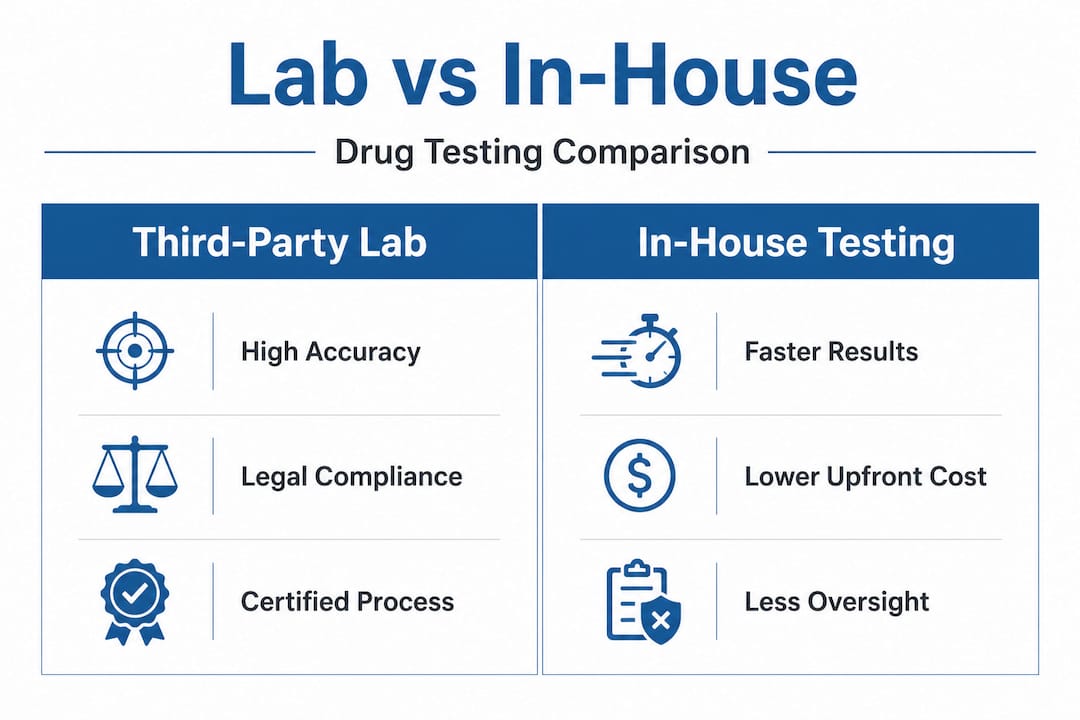
In-house testing risks higher errors, lacks accreditation, and may not be cost-effective for low volumes compared to third-party labs. The hidden costs are where in-house programs bleed money quietly.
Common pitfalls of in-house testing that HR professionals often underestimate:
- False positive liability: Rapid kits can flag legal medications as positives. Without MRO review, you risk wrongful termination claims.
- Training burden: Collectors must be trained and retrained as regulations change. That cost is real and recurring.
- Chain-of-custody gaps: A broken chain of custody can invalidate results entirely in a legal proceeding.
- No confirmation testing: Most in-house kits do not include GC-MS confirmation, meaning any positive result is legally vulnerable.
- Storage and disposal compliance: Biological specimens require proper handling. Non-compliance creates OSHA and HIPAA exposure.
- Audit failure risk: Federal contractors and DOT-regulated employers who rely on in-house testing face serious audit consequences.
Working with certified labs for reliability is not just about getting accurate numbers. It is about building a program that holds up when an employee challenges a result or a regulatory body comes knocking.

Pro Tip: When comparing costs, calculate the cost per confirmed positive, not cost per test. Factor in retest rates, potential litigation costs, and staff time. Third-party labs almost always win that calculation.
Compliance and accreditation: Reducing legal risks
While cost and accuracy are crucial, compliance and accreditation are non-negotiable for many organizations.
Accreditation in drug testing means an independent body has audited the lab’s methods, equipment, personnel, and quality controls against published standards. The three most important accreditation bodies for workplace drug testing are:
- SAMHSA: Required for all federal agency testing and DOT-regulated employers. Covers urine drug testing under the Mandatory Guidelines for Federal Workplace Drug Testing Programs.
- CAP (College of American Pathologists): Covers a broader range of laboratory disciplines and is widely recognized by courts and insurance carriers.
- CLIA (Clinical Laboratory Improvement Amendments): A federal certification required for any lab that performs testing on human specimens, administered by CMS.
“Employers who rely on non-accredited testing face a compounding risk: invalid results that cannot be used in disciplinary proceedings, potential ADA violations when results are mishandled, and exposure to negligent hiring claims if a safety incident follows a failed or missed test.”
SAMHSA-certified labs are required for federal workplace testing, providing validated accuracy and reducing legal liability for employers. That legal liability piece is significant. Courts have consistently held that employers must follow established protocols when taking adverse action based on drug test results.
| Testing scenario | Accredited third-party lab | Non-accredited in-house |
|---|---|---|
| DOT/federal audit | Passes | Automatic failure |
| Employee legal challenge | Results defensible | Results often invalidated |
| Workers’ comp claim | Supports employer position | Weak or inadmissible |
| Insurance premium impact | Neutral to favorable | Potential increase |
| HIPAA data handling | Managed by lab | Employer bears full risk |
The SAMHSA compliance details around specific panels matter too. Using the wrong test panel for your industry can mean missing substances your regulatory body requires you to screen for. And the HIPAA and privacy concerns around drug test data are real. Third-party labs handle specimen data under strict confidentiality protocols. When you run testing in-house, your HR team is directly handling protected health information, which creates its own compliance exposure.
Understanding testing standards explained in broader quality contexts reinforces why independent verification and documented standards are the baseline for any reliable testing program, not just drug testing.
Limitations and alternatives: What third-party screening can’t do
Third-party labs are the gold standard in many areas, but it’s important to recognize where their role ends and what else you can do as an employer.
The most significant limitation is one that surprises many HR professionals: a positive drug test does not prove impairment at the time of the test. Urine testing detects metabolites, the chemical byproducts of drug breakdown, not the active substance itself. Someone can test positive for cannabis metabolites days or weeks after last use, with zero impairment at the time of testing. That creates real complexity in states with legal cannabis and in industries where impairment, not drug use history, is the actual safety concern.
Other important limitations include:
- No real-time impairment detection: Urine and hair tests reflect past use, not current state. Oral fluid testing narrows the window but still does not measure impairment directly.
- Cost per positive can be high: In low-risk workplaces with infrequent positive rates, the cost-per-actionable-result can be difficult to justify.
- Ethical and privacy concerns: Random testing programs, particularly in non-safety-sensitive roles, raise legitimate employee privacy questions that can affect morale and trust.
- Turnaround time: Lab-based testing takes 24 to 72 hours, which is not useful in post-accident scenarios where immediate decisions are needed.
- Limited scope: Standard panels do not detect all substances. Novel synthetic drugs often require specialized panels that must be ordered separately.
Drug screening has limitations like not measuring impairment, high costs per positive, and potential ethical and privacy issues. Alternatives like training are preferred by some organizations, particularly in lower-risk environments.
Practical alternatives and complements to third-party lab testing:
- Impairment detection technology: Tools that assess cognitive and motor function in real time, without biological specimens.
- Supervisor training programs: Teaching managers to recognize behavioral signs of impairment is often more actionable than a lab result.
- Policy-based deterrence: Clear, consistently enforced written policies can reduce use more effectively than testing alone.
- Selective testing protocols: Limiting lab testing to pre-employment, post-accident, and reasonable suspicion scenarios reduces cost without eliminating protection.
- Employee assistance programs (EAPs): Pairing testing with rehabilitation support improves outcomes and reduces turnover.
Keeping up with trends in drug testing is essential because the landscape is shifting fast. Cannabis legalization, new synthetic substances, and evolving state laws are changing what employers can test for and how results can be used. Reviewing drug testing kit alternatives gives you a clearer picture of where rapid screening fits alongside lab-confirmed results in a layered safety strategy.
Making third-party lab testing work for your organization
With benefits, limitations, and compliance considerations clear, the final step is putting a successful third-party lab program into practice.
Here is a practical implementation sequence for HR professionals:
- Assess your regulatory environment: Determine whether you are subject to DOT, federal contractor, or state-specific requirements. This dictates which accreditations your lab must hold.
- Select a certified provider: Verify SAMHSA certification for federal testing. Confirm CAP or CLIA status for broader clinical credibility. Request references from employers in your industry.
- Review your test panels: Match your panel to your industry risk profile and the substances most prevalent in your workforce or region. Do not assume a standard 5-panel covers your needs.
- Train designated collection staff: Even if the lab handles analysis, your collection process must be airtight. Chain-of-custody errors at the collection stage can invalidate perfect lab work.
- Communicate your policy clearly: Employees should know what triggers testing, what substances are screened, what the consequences of a positive result are, and what the MRO review process looks like.
- Monitor and document compliance: Keep records of every test, every result, and every action taken. Audit your process annually against current regulations.
Common mistakes that undermine otherwise solid programs include incomplete chain-of-custody documentation, using collection sites that are not properly trained, failing to update test panels as new substances emerge, and not involving legal counsel in policy drafting. The SAMHSA-certified labs requirement for federal workplace testing is not the finish line. It is the starting point.
Reviewing lab screening tools helps you understand the full range of analytical options available. Studying screening workflow best practices gives you a model for building efficient, compliant collection and reporting processes. And understanding the certified labs for safety role in broader occupational health programs shows you how testing fits into a larger safety culture.
Pro Tip: Set a calendar reminder to review your drug testing policy every 12 months. Regulations change, state cannabis laws shift, and new substances emerge. A policy that was compliant two years ago may not be today.
A smarter approach: Why experience shows third-party labs aren’t one-size-fits-all
We’ve covered the why and how. Now let’s talk about what real-world experience teaches about using third-party labs strategically, because the most common mistake we see is treating lab testing as a program rather than a tool.
Third-party labs excel at two things: legal defensibility and scientific accuracy. They are genuinely irreplaceable for those purposes. But they do not build safety culture, they do not deter impaired behavior in real time, and they do not address the root causes of substance use in your workforce. Organizations that lean entirely on lab testing as their substance use strategy often find themselves with a technically compliant program and a persistent safety problem.
The organizations that get this right customize their approach to their industry’s actual risk profile. A transportation company with DOT obligations has very different needs than a tech firm with a voluntary wellness focus. Applying the same testing frequency, panel, and consequence structure to both is a waste of resources at best and a morale problem at worst.
What experienced HR leaders know is that the value of a certified lab relationship extends beyond the test itself. A good testing partner helps you design policy, advises on panel selection as the substance landscape changes, and flags compliance updates before they become audit findings. That advisory relationship is where the real return on investment lives.
The lab-based testing benefits are real and significant. But they are maximized when lab testing is integrated into a broader program that includes education, supervisor training, EAP access, and a written policy that employees actually understand. The danger of the checkbox mentality is that it creates the appearance of a safe workplace without the substance of one.
Explore reliable third-party lab testing with Countrywide Testing
Understanding third-party lab testing is the first step. Putting it into practice with the right partner is what protects your organization and your workforce.
Countrywide Testing partners with lab testing services backed by SAMHSA-certified, CAP-accredited, and CLIA-certified laboratories nationwide. Whether you need a fully managed employer testing program, a specific panel for post-accident screening, or a convenient multi-drug at-home testing option for remote or field-based employees, Countrywide Testing has a solution built for compliance and reliability. Our team supports HR professionals with policy guidance, panel selection, and seamless ordering so your program stays current, defensible, and easy to manage. Reach out today to build a testing program that actually works.
Frequently asked questions
What does SAMHSA certification mean for workplace drug testing?
SAMHSA certification ensures a lab meets strict federal standards for accuracy and reliability, and it is required for federal workplace testing programs, providing validated accuracy and reducing legal liability for employers.
Is third-party lab testing more accurate than in-house testing?
Yes. Third-party labs use GC-MS confirmation testing and MRO review, while in-house testing risks higher errors, lacks accreditation, and produces results that are far more vulnerable to legal challenge.
Why is accreditation important for drug and alcohol testing labs?
Accreditation means an independent body has audited the lab’s methods and quality controls. SAMHSA-certified labs are required for federal testing, and accreditation protects employers from liability when results are challenged in disciplinary or legal proceedings.
What are alternatives to third-party lab testing?
Alternatives include on-site rapid tests, supervisor impairment training, and behavioral assessment tools. Drug screening has limitations around real-time impairment detection, so many organizations blend lab testing with education and EAP programs for a more complete safety strategy.