
SAMHSA certified labs: ensure compliance and safety
TL;DR:
- Many employers mistakenly believe that any accredited laboratory suffices for workplace drug testing, risking legal and regulatory violations. Only SAMHSA-certified labs meet strict federal standards, ensure compliance, and provide legally defensible results for federally regulated testing programs. Regular verification of certification status and the inclusion of an MRO are critical for maintaining a compliant and reliable drug testing process.
Many employers assume that any accredited laboratory is good enough for workplace drug testing. That assumption is wrong, and it can expose your organization to serious legal and regulatory risk. Federal rules require that federally regulated workplace drug testing use only HHS/SAMHSA-certified laboratories, tied directly to the Mandatory Guidelines for Federal Workplace Drug Testing Programs. This article walks you through exactly what makes SAMHSA-certified labs different, why compliance depends on your lab choice, how to verify certification, and what edge cases to watch for so your program stays defensible.
Table of Contents
- What makes a SAMHSA-certified lab unique?
- Why compliance hinges on HHS-certified labs
- How to find and verify a SAMHSA-certified lab
- Special testing considerations and edge cases
- Why general accreditation isn’t enough: our compliance perspective
- Connect with a trusted lab drug testing partner
- Frequently asked questions
Key Takeaways
| Point | Details |
|---|---|
| Not all labs qualify | Only SAMHSA-certified labs are recognized for federal and regulated workplace drug testing compliance. |
| Certification is ongoing | Labs must maintain quality through continuing performance tests and inspections, not just initial approval. |
| MRO review is essential | A certified Medical Review Officer ensures drug test results are accurate and defensible. |
| Verification protects employers | Employers should always confirm their lab’s SAMHSA certification using the official list before conducting testing. |
| Special cases matter | Certain testing types have additional restrictions—always check requirements for your situation. |
What makes a SAMHSA-certified lab unique?
Not all laboratory credentials are created equal. A lab can hold ISO accreditation, a CLIA certificate, or CAP recognition and still not qualify for federally mandated workplace drug testing. SAMHSA certification, administered through the Department of Health and Human Services (HHS), is a separate, specialized designation that goes far beyond standard lab quality marks.
SAMHSA lab certification requires facilities to meet specific federal performance standards that cover every stage of the testing process: chain of custody handling, specimen validity testing, proficiency testing rounds, and unannounced inspections. Critically, it is not a one-time achievement. Certified labs must continuously demonstrate compliance through recurring external proficiency tests and federal review cycles.
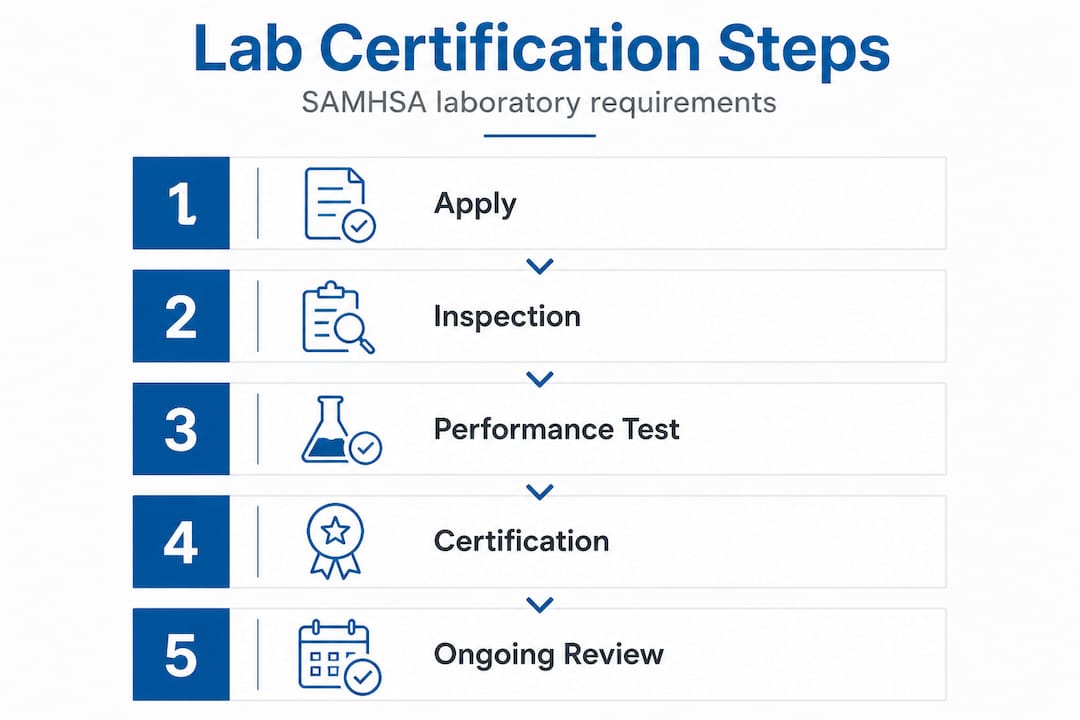
SAMHSA’s certification programs impose ongoing quality and performance requirements that go well beyond having a general lab credential. This means your vendor can lose certification between the time you first vetted them and the time your employee’s specimen arrives. That risk is real, and it matters for every single test you submit.
Here is a side-by-side comparison to make the distinction concrete:
| Feature | SAMHSA-certified lab | Generally accredited lab |
|---|---|---|
| Federal workplace drug testing | Authorized | Not authorized |
| Chain of custody oversight | Mandatory, standardized | Varies by lab |
| Ongoing proficiency testing | Required by HHS | Not required federally |
| Unannounced inspections | Yes, by federal inspectors | Rarely, if ever |
| MRO coordination support | Integral to workflow | Often not included |
| Published on federal list | Yes | No |
The practical risks of using a non-SAMHSA lab when federal compliance is required are significant. Test results may be inadmissible. Employees may successfully challenge terminations. Federal agency audits can result in fines, contract losses, or program decertification. For DOT-regulated employers in transportation, aviation, or pipeline sectors, the consequences extend to safety violations.
Understanding why SAMHSA certification matters is the foundation of a defensible drug testing program. Without it, even a well-intentioned employer can find their entire testing program called into question.
Pro Tip: Even if your current lab vendor has been on your approved vendor list for years, re-validate their certification status before your next testing cycle. Certifications can lapse quietly.
Key benefits of working with a SAMHSA-certified lab include:
- Legally defensible results accepted in federal hearings and employment disputes
- Standardized chain of custody protocols that protect both employer and employee
- Specimen validity testing that detects adulteration or substitution attempts
- Regular federal audits that keep the lab accountable to published performance benchmarks
- Access to an MRO-reviewed workflow that reduces the risk of false positives or reporting errors
Why compliance hinges on HHS-certified labs
Understanding the strict requirements, it’s vital to see exactly how compliance depends on selecting a SAMHSA-certified provider. The Mandatory Guidelines for Federal Workplace Drug Testing Programs are not a suggestion. They are the legal framework that governs drug testing for federal employees, federal contractors, and industries regulated by the Department of Transportation, the Department of Defense, and other agencies.
Using an HHS-certified laboratory plus a Medical Review Officer (MRO) is required for federally regulated, drug-free workplace testing. The MRO is a licensed physician trained to interpret drug test results in the context of prescription medications, medical conditions, and legitimate explanations for non-negative results. Without an MRO, a positive test can go unchallenged, leading to wrongful employment actions. With one, results carry legal weight that holds up under scrutiny.
The role of the MRO is often underestimated by HR teams who treat it as paperwork. It is actually your organization’s most important safeguard against erroneous results and employee lawsuits.
“Certification is also about proper specimen validity and drug testing workflows and governance, including the use of an MRO to interpret results accurately and in compliance with federal guidelines.”
Here is a numbered walkthrough of a fully compliant drug testing process under the Mandatory Guidelines:
- Collection: A trained collector gathers the specimen using a federally approved custody and control form (CCF)
- Shipment: The sealed specimen is shipped directly to a SAMHSA-certified lab with documented chain of custody
- Initial screening: The lab runs an immunoassay test to screen for federally mandated drug panels
- Confirmation testing: Non-negative results are confirmed by GC-MS (gas chromatography-mass spectrometry), the gold standard for accuracy
- Specimen validity review: The lab checks for signs of dilution, adulteration, or substitution
- MRO review: All non-negative confirmed results go to the MRO before the employer receives them
- Final reporting: The MRO reports a verified result to the designated employer representative (DER)
- Recordkeeping: Results are retained per federal recordkeeping requirements, often five years for positive results
Skipping any one of these steps creates vulnerability. Employers who bypass MRO review, for example, may act on lab results that would have been overturned as legitimate medical explanations. Understanding federal drug testing rules in full is not optional for regulated industries.
The numbers make the risk concrete. The DOT alone oversees drug and alcohol testing for more than 12 million safety-sensitive workers. Non-compliance with its testing protocols can result in civil penalties of up to $16,000 per violation per day for employers who fail to follow the required procedures.
How to find and verify a SAMHSA-certified lab
With the compliance framework clear, let’s focus on how you can verify you’re working with a truly certified provider and not risking hidden gaps in your program.
The starting point is the official SAMHSA Certified Laboratory List. SAMHSA’s public list is the employer-facing resource to confirm which HHS-certified labs are currently authorized to conduct federal workplace drug testing. This list is updated monthly and published in the Federal Register. It is the only authoritative source you should use for verification.
Importantly, suspended or revoked labs are removed from the list until their certification is restored. A lab that was certified when you signed your contract may not be certified today.
Use this step-by-step verification checklist when evaluating a testing provider:
- Access the SAMHSA certified list at the official SAMHSA website or Federal Register publication
- Search by lab name and address to confirm the specific facility, not just the parent company
- Confirm the type of authorization: full laboratory versus Instrumented Initial Testing Facility (IITF)
- Ask the lab for their certification number and cross-reference it against the published list
- Verify MRO services are integrated into their testing workflow or separately contracted
- Check the list again quarterly and set a calendar reminder to repeat this process
Here is a comparison table of what to look for when choosing between providers:
| Verification factor | Certified provider | Uncertified/unlisted provider |
|---|---|---|
| Appears on SAMHSA list | Yes, with current date | No |
| Certification type documented | Full lab or IITF noted | Unknown or absent |
| MRO workflow included | Standard offering | Often missing |
| CCF forms used | Required federal forms | Proprietary or inconsistent |
| Specimen validity testing | Performed and reported | Not standardized |
| Federal inspection history | Available on record | Unavailable |
Critical lab compliance means more than choosing the right lab once. It means confirming that choice repeatedly and systematically.
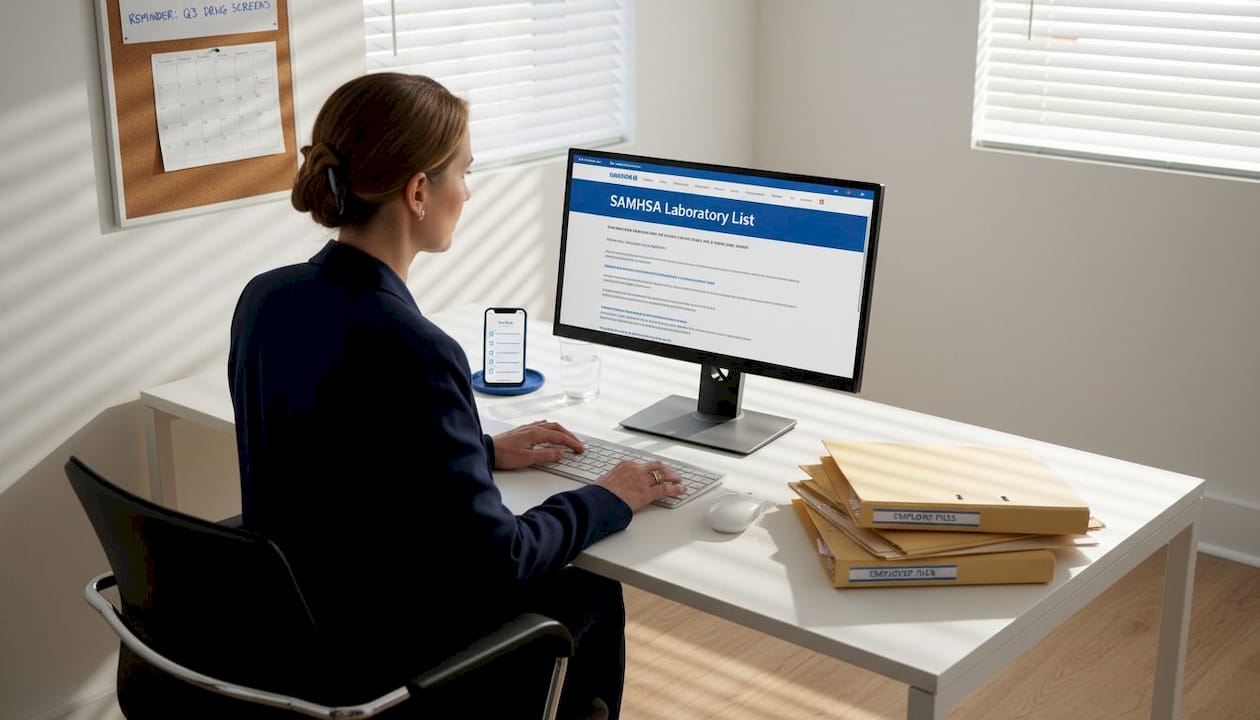
Pro Tip: Set a recurring quarterly calendar reminder for your HR team to check your lab’s certification status. A 15-minute check four times a year is far less costly than defending a non-compliant test result in court.
Special testing considerations and edge cases
Even among certified labs, differences in what services are authorized make it crucial to understand testing nuances before you encounter a problem in a specialized situation.
SAMHSA and HHS restrict certain testing activities to specific facility types. For example, Instrumented Initial Testing Facilities (IITFs) cannot perform oral fluid testing. IITFs are a category of certified facilities that can conduct initial urine specimen screening, but they have limitations that full laboratories do not. If your program uses oral fluid collection for any reason, you must confirm your provider is a full HHS-certified laboratory, not just an IITF.
Understanding reliable workplace testing means accounting for all the situations your program might encounter, not just the standard pre-employment urine screen.
Edge case scenarios that employers in regulated industries need to plan for include:
- Oral fluid testing programs: Only full certified labs, not IITFs, are authorized. DOT has expanded oral fluid testing as an option, so verify your lab specifically
- Federal safety-sensitive roles: Certain roles require expanded panels beyond the standard 5-panel test. Confirm your lab’s panel coverage matches regulatory requirements
- Return-to-duty testing: This post-positive testing category requires strict adherence to MRO-supervised protocols and cannot be handled by a random screening vendor
- Specimen validity failures: If a specimen is flagged as adulterated or substituted, only a certified lab has the legal standing to report it in a way that supports disciplinary action
- Split specimen retesting: An employee’s right to request a split specimen test must be honored through a second certified lab. Your provider needs a formal process for this
- Rapid result programs: On-site instant testing devices are not SAMHSA-certified lab tests. They may serve as a preliminary screen, but any non-negative result must be confirmed by a certified lab before employment action is taken
For DOT-regulated employers specifically, the Federal Motor Carrier Safety Administration (FMCSA), the Federal Aviation Administration (FAA), and the Federal Transit Administration (FTA) each have specific testing protocols that layer on top of the baseline SAMHSA requirements. Oral fluid testing authorization under DOT rules became available in 2023, which means some labs that previously met all your requirements may not have updated their authorizations to include it. Do not assume your current lab has kept pace with regulatory changes.
Stat callout: The 2023 HHS Laboratory Guidelines update that expanded oral fluid testing authorization introduced new requirements for labs seeking that authorization. Not every certified lab opted in, meaning the universe of labs qualified for oral fluid testing is smaller than the total certified lab list.
Why general accreditation isn’t enough: our compliance perspective
We work closely with employers navigating drug testing compliance every day, and the most consistent mistake we see is the conflation of general lab accreditation with SAMHSA certification. ISO certification, CLIA registration, and CAP accreditation are meaningful quality designations. None of them substitute for HHS certification under the Mandatory Guidelines.
This matters practically because employers often rely on procurement teams or third-party vendor portals to select testing providers. Those platforms may filter for “accredited labs” without distinguishing between general accreditation and federal certification. The result is a program that looks compliant on paper but would not survive regulatory scrutiny.
“General accreditation may signal quality, but ‘accreditation’ alone does not meet the specific Mandatory Guidelines expectations for federally regulated workplace drug testing programs.”
The harder truth is that enforcement actions in federal contractor programs and DOT audits rarely give employers a grace period. When an audit finds non-certified lab results in your testing records, you cannot retroactively fix those tests. The violations stand. The consequences follow.
The benefits of lab-based drug testing go beyond passing audits. They include protecting employees from wrongful adverse actions, maintaining the integrity of your safety culture, and building a testing program that functions as a genuine deterrent rather than a checkbox exercise.
Our position is direct: make SAMHSA certification verification a standing item in your HR compliance calendar. Pair it with confirmed MRO usage on every non-negative result. If your current provider cannot document both of these things in writing, it is time to find one that can.
Connect with a trusted lab drug testing partner
Employers who take compliance seriously need a testing partner who takes it equally seriously. At Countrywide Testing, we connect organizations with lab testing services backed by SAMHSA-certified laboratories, ensuring every specimen your program submits is processed under the standards the federal government requires.
Whether you are building a new workplace drug testing program, auditing an existing one, or looking for at-home lab test options for specific needs, Countrywide Testing provides straightforward access to certified, compliant solutions. Our platform is designed for HR professionals and employers who need reliable results, proper chain of custody, and MRO-reviewed reporting without the complexity of navigating federal requirements alone.
Frequently asked questions
What is a SAMHSA-certified lab?
A SAMHSA-certified lab is a testing facility that meets strict federal guidelines for quality, performance, and ongoing oversight, and is the only type of lab authorized for federal workplace drug testing programs.
Why is MRO review required with certified labs?
MRO (Medical Review Officer) review ensures test results are accurately interpreted under federal guidelines, protecting employers from acting on results that have a legitimate medical explanation. MRO involvement is required for all confirmed non-negative results in federal programs.
How can I check if a lab is currently certified?
Use the SAMHSA Certified Laboratory List to verify current status. Any lab not appearing on that list is not authorized for federally regulated workplace testing.
Are non-SAMHSA accredited labs ever suitable for DOT or federal agency testing?
No. Only HHS-certified laboratories meet the official requirements for DOT, federal contractor, and other federally regulated drug testing programs. General accreditation does not substitute.
Do certified labs need to renew or maintain their status?
Yes. Certification is maintained through recurring proficiency testing rounds and federal inspections, which is why employers should check their provider’s status regularly rather than relying on a one-time verification.
Recommended
- Workplace Lab Testing: Critical Role in Compliance
- Certified labs: critical role in workplace safety
- Certified labs for workplace drug testing: Why it matters
- Normas SAMHSA para pruebas de drogas: guía para empresas
- Is Ketamine Therapy FDA Approved? Regulatory Status and Guidelines - Nortex Psychiatry
- Essential Pharmacogenomic Markers: Examples for Safer Drugs