
Certified labs for workplace drug testing: Why it matters
TL;DR:
- Certified labs meet strict regulatory standards, ensuring accurate, defendable testing results.
- Using uncertified labs increases legal, audit, and liability risks for employers.
- Employers should verify lab certification via official SAMHSA or accreditation body lists regularly.
Choosing a lab for your workplace drug and alcohol testing program feels straightforward until you realize that not every lab is built to meet the legal and regulatory standards your industry demands. Many employers assume any accredited facility can process a urine or oral fluid sample and call it a day. That assumption can expose your organization to dismissed test results, failed audits, wrongful termination disputes, and even federal contract penalties. Understanding exactly what separates a certified lab from an uncertified one is the first step toward building a testing program that actually protects your business.
Table of Contents
- What makes a laboratory “certified”?
- Top benefits of using certified labs for workplace testing
- Certified vs. non-certified labs: A direct comparison
- How to ensure your testing program uses certified labs
- Why “good enough” labs aren’t enough: Our take
- Make certified testing simple with our nationwide lab network
- Frequently asked questions
Key Takeaways
| Point | Details |
|---|---|
| Guaranteed compliance | Certified labs ensure your workplace testing meets all federal and industry regulations to keep you audit-ready. |
| Lower legal risk | Choosing certified labs minimizes disputes and liability due to accurate, reliable testing procedures. |
| Faster, reliable results | Certified labs return results quickly with documented chain of custody and consistent accuracy. |
| Easier due diligence | Certification is easy to verify, giving you confidence in your choice and simplifying management oversight. |
| Stronger workplace safety | Using certified labs supports a safer, drug-free workplace and boosts confidence among staff and stakeholders. |
What makes a laboratory “certified”?
Now that we’ve dispelled the myth that any lab will do, let’s look at what sets certified labs apart.
Lab certification is not a marketing label. It is a formal designation granted by recognized regulatory and accreditation bodies that verify a lab meets specific operational, personnel, and quality control standards. The most significant certification body for workplace drug testing in the United States is SAMHSA, the Substance Abuse and Mental Health Services Administration. Labs that earn SAMHSA certification are regularly inspected and must demonstrate proficiency across a strict set of criteria covering equipment calibration, staff training, sample handling, and chain of custody documentation.
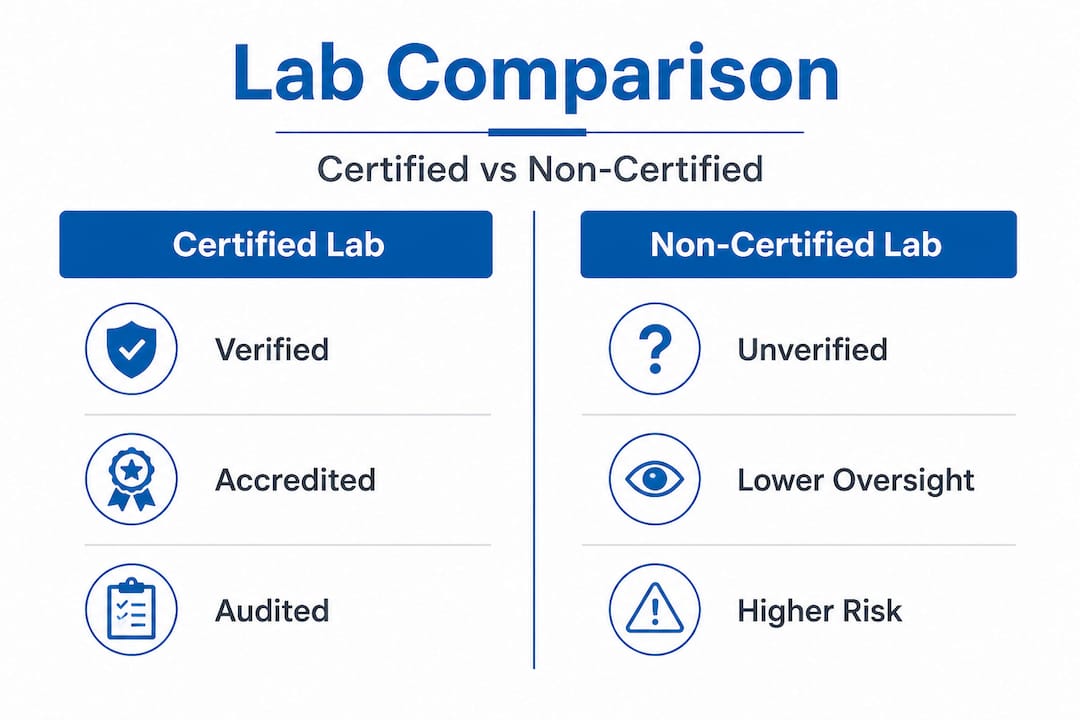
Other important certifications include CAP (College of American Pathologists), CLIA (Clinical Laboratory Improvement Amendments), and various state-specific licensing requirements. Each addresses a different aspect of lab performance. CAP, for example, focuses heavily on laboratory quality systems and peer inspection. CLIA regulates labs that test human specimens for diagnostic purposes. Together, these regulatory standards for labs form a layered framework that ensures testing is done correctly and defensibly.
What does certification actually require? Here are the core elements:
- Trained and credentialed laboratory personnel who follow documented protocols
- Validated, calibrated equipment that is regularly audited for accuracy
- A documented chain of custody from sample collection to final result
- Proficiency testing programs where labs are evaluated using blind samples
- Secure, confidential data handling to protect employee privacy
- Regular on-site inspections by the certifying authority
The Department of Transportation mandates SAMHSA-certified labs for all safety-sensitive positions, including truck drivers, airline pilots, and rail workers. This is not optional guidance. Employers regulated by the DOT face serious penalties if they use a lab that lacks this certification. Beyond DOT, many state and private sector programs adopt the same standard because it represents the gold benchmark for defensible, accurate results.
Understanding SAMHSA drug testing certification also means recognizing what happens without it. Labs without certification are not held to the same proficiency testing requirements, may use less reliable detection methods, and often lack the institutional processes needed to defend results in a legal proceeding. The critical role of certified labs in maintaining workplace safety is not theoretical. It is built into federal regulation for good reason.
Top benefits of using certified labs for workplace testing
With an understanding of what certification means, let’s see how these standards translate into direct employer benefits.
The advantages of using a certified lab go beyond basic accuracy. They touch every layer of your workplace testing program, from legal defensibility to employee trust and operational efficiency.
“Certified labs maintain quality control, trained staff, confidentiality, and timely results, minimizing employer risks from errors or disputes.” Drug-Free Workplace: Drug Testing Resources
Here is what that looks like in practice for employers:
- Legal defensibility: When a positive result leads to a termination dispute or workers’ comp claim, certified lab documentation provides airtight evidence. Chain of custody records show exactly how the sample was handled from collection to analysis.
- Reduced liability from false results: Certified labs use two-stage confirmation testing, typically an initial immunoassay screen followed by GC-MS (gas chromatography-mass spectrometry) confirmation. This dramatically reduces false positives that can expose you to wrongful termination lawsuits.
- Faster, consistent turnarounds: Because certified labs operate under documented quality systems, results are delivered on a predictable schedule. You are not waiting on ad hoc processes.
- Confidentiality protections: Certified facilities are required to handle employee data under strict privacy protocols, reducing your exposure to privacy-related complaints.
- Regulatory audit readiness: If your organization is audited by a federal agency or a state regulatory body, results from a certified lab carry immediate credibility. Non-certified results may be questioned or thrown out entirely.
Pro Tip: When evaluating vendors, ask specifically for their SAMHSA certification number and request their most recent proficiency testing results. A legitimate certified lab will provide both without hesitation.
Using reliable workplace testing services also reduces the burden on your HR team. When you know the lab is handling compliance on their end, your staff spends less time chasing paperwork and more time managing your workforce. Employers who invest in workplace screening reliability through certified partners consistently report fewer disputes, faster resolution, and stronger standing in audits.
Certified vs. non-certified labs: A direct comparison
These advantages become clearer when you compare certified and non-certified labs side by side.
The differences between certified and non-certified labs are not subtle. They affect accuracy, consistency, legal standing, and your organization’s long-term risk profile. One of the most telling data points comes from multi-lab reproducibility research. Confirmatory GC-MS testing in certified labs shows an inter-lab coefficient of variation (CV) below 7%, meaning results are highly consistent across facilities using the same method. In contrast, standard immunoassay screening can show CV rates up to 15%, a significant gap when a single percentage point difference in result interpretation can change an employee’s career.

| Feature | Certified lab | Non-certified lab |
|---|---|---|
| SAMHSA/CAP/CLIA accreditation | Yes, verified and current | None or unverified |
| Confirmatory GC-MS testing | Standard protocol | Often unavailable |
| Chain of custody documentation | Mandatory and auditable | Inconsistent or absent |
| Proficiency testing participation | Required regularly | Not required |
| Legal defensibility of results | Strong, court-accepted | Frequently challenged |
| Staff credentialing | Required by certifying body | No minimum standard |
| Privacy and data security | Regulated and enforceable | Voluntary compliance only |
| Regulatory audit readiness | Built-in by design | Requires ad hoc preparation |
The chain of custody issue deserves extra attention. If your HR team ever faces a legal challenge from a terminated employee, the chain of custody record is the document that proves the sample tested was the one actually collected from that individual. Non-certified labs often lack the rigorous documentation systems to produce this evidence convincingly. One missing signature or gap in handling notes can unravel an otherwise solid case.
Pro Tip: Review the lab quality compliance checklist before onboarding any new testing vendor. It gives you a structured way to evaluate each provider against objective quality benchmarks.
The distinction between certified and uncertified labs is also relevant when evaluating compliance in lab testing. Many employers assume their third-party administrator handles certification verification automatically. That is not always true. Ownership of this verification ultimately rests with you as the employer.
How to ensure your testing program uses certified labs
Knowing the risks, here’s how you can be certain your testing program is using the right labs.
Verifying certification status is not complicated, but it does require deliberate action. Here is a practical step-by-step process for confirming your labs meet the required standards.
- Check the SAMHSA lab list directly. The official lab list for drug testing is published by SAMHSA and updated monthly. Search for your lab by name or state to confirm active certification.
- Request documentation from your vendor. Ask your testing vendor to provide their current certification documents, including expiration dates and the specific substances for which they are certified.
- Confirm the chain of custody process in writing. Ask for a written description of how samples are collected, transported, logged, and stored before analysis.
- Verify confirmatory testing protocols. Ensure your vendor uses GC-MS confirmation for all non-negative results. Immunoassay alone is not sufficient for a defensible positive result.
- Ask about proficiency testing records. Certified labs participate in blind proficiency testing programs. Request recent results to gauge their accuracy track record.
- Look for red flags. Unusually low pricing, vague answers about certification, reluctance to share documentation, and no mention of chain of custody are all warning signs.
| Certification type | Issuing body | Primary focus | Who needs it |
|---|---|---|---|
| SAMHSA HHS | Federal government | Workplace urine drug testing | DOT-regulated and federal employers |
| CAP | College of American Pathologists | Overall lab quality systems | All lab types seeking quality validation |
| CLIA | CMS (federal) | Clinical specimen testing accuracy | Labs testing human diagnostic specimens |
| ISO 15189 | International standard | Medical lab management systems | Labs seeking international recognition |
| State-specific licenses | State health departments | Local operational compliance | All labs operating within the state |
Pro Tip: Even if your industry is not federally regulated by the DOT, aligning your testing program with 2026 drug screening standards is a smart baseline. It protects you in audits, litigation, and insurance reviews simultaneously.
Many employers also underestimate the role that lab testing importance plays in overall workforce safety strategy. Testing is not just a checkbox. It is an active risk management tool, and its value depends entirely on the quality of the lab processing your samples.
Why “good enough” labs aren’t enough: Our take
Beyond checklists and certifications lies the bigger picture. Here is what most guides won’t tell you.
We have worked with employers across dozens of industries, and one pattern shows up again and again. Organizations that cut corners on lab selection almost never do it out of recklessness. They do it because the short-term savings look real and the risks seem abstract. The difference between a certified lab and a less expensive alternative might be $8 per test. When you are running 500 tests a year, that looks like $4,000 in savings. Then one disputed positive result lands in litigation, and you are looking at five or six figures in legal fees, settlements, and internal HR costs.
We have seen situations where employers using uncertified or unverified labs faced challenges during regulatory audits, only to discover that none of their historical testing records met the evidentiary standards required. In some cases, entire policy frameworks had to be rebuilt from scratch. That is not a compliance inconvenience. That is an operational crisis.
There is also a transparency issue that rarely gets discussed. Certified labs operate under third-party oversight. Their processes are inspected, their staff is credentialed, and their data practices are auditable. When something goes wrong, and eventually something always does, there is a documented process for investigating and correcting it. Non-certified labs have no such system. You are trusting their word with no external validation.
Policy changes also catch employers off guard more often than you might expect. Federal agencies update cutoff levels, add new substances to panels, and revise chain of custody requirements on a cycle that does not stop for HR budget cycles. Certified labs are required to stay current with these changes as part of maintaining their accreditation. Non-certified labs have no regulatory incentive to do the same, which means your program may fall out of compliance without anyone flagging it until an audit reveals the gap.
The bottom line from our experience is that why lab choice matters comes down to risk ownership. Every employer running a testing program owns the downstream consequences of their lab selection. Certification is the most reliable signal available that your vendor has been evaluated, validated, and held accountable by an authority outside their own marketing materials.
Make certified testing simple with our nationwide lab network
If you want full confidence your testing process is compliant and accurate, here is how you can get started.
At CountryWideTesting.com, we connect employers directly to lab testing services backed by SAMHSA, CAP, and CLIA-certified laboratories. You do not need to build a vendor evaluation program from scratch or spend weeks verifying certification documents.
Our nationwide certified labs network gives HR teams and compliance officers a single, streamlined access point for workplace urine and oral fluid drug testing, with full chain of custody documentation and confirmed GC-MS protocols built in. Need a fast, defensible result for a safety-sensitive role? Our SAMHSA confirmation test delivers exactly that. Whether you are setting up a new program or auditing an existing one, our team is ready to walk you through the right testing options for your workforce size, industry, and regulatory environment.
Frequently asked questions
Are certified labs required for all workplace drug tests?
Certified labs are required for federally regulated and many safety-sensitive positions; always check your industry’s specific regulations before selecting a lab.
How do I check if a lab is certified by SAMHSA?
You can verify certification on the SAMHSA laboratory list online, which is updated monthly and searchable by lab name and state.
What makes results from certified labs more reliable?
Certified labs use standardized, auditable procedures with trained personnel and required proficiency testing, making their results consistent and defensible in legal or regulatory proceedings.
Can using a non-certified lab put my company at legal risk?
Yes. Non-certified labs may produce disputed or inadmissible results, increasing your liability exposure in accidents, audits, or wrongful termination claims.
Where can I find a list of certified labs in 2026?
The most current list of SAMHSA-certified labs is available on the SAMHSA official website and is updated on a monthly basis.