
Drug testing in family law: protecting children fairly
TL;DR:
- A failed drug test does not automatically end parental custody rights.
- Courts consider multiple factors including behavior, efforts, and child safety alongside test results.
- Context, patterns, and rehabilitation evidence are crucial in interpreting drug testing in family law.
A failed drug test does not automatically end a parent’s custody rights. That misconception causes unnecessary panic and, sometimes, poor legal strategy. Courts treat drug testing as one piece of objective evidence, weighed alongside behavior patterns, rehabilitation efforts, and the overall best interest of the child. Drug testing in family law prioritizes child safety by providing measurable evidence of parental substance use that can shape custody, visitation, and reunification decisions. Understanding what the process actually involves gives both attorneys and families a more grounded, strategic approach to these high-stakes proceedings.
Table of Contents
- What drug testing means in family law
- How courts use drug test results
- Cutoff levels, false positives, and test limitations
- Beyond the test: Accountability, rehabilitation, and context
- A closer look: Why drug testing shouldn’t be viewed as an absolute
- Get professional drug testing support for your case
- Frequently asked questions
Key Takeaways
| Point | Details |
|---|---|
| Court-ordered testing is evidence-based | Judges require credible evidence before ordering drug testing in family law cases. |
| Outcomes depend on full context | Test results are only one part of decisions; courts consider patterns, rehabilitation, and child safety. |
| False positives and technical limits exist | Cutoff differences and sample contamination can affect accuracy, requiring expert interpretation. |
| Rehabilitation evidence can help | Documented recovery efforts and clean tests show progress and can improve legal outcomes. |
| Expert support strengthens your case | Medical review and professional testing companies ensure accuracy and compliance for court use. |
What drug testing means in family law
Drug testing in family law is not a punishment tool. It is a fact-finding mechanism that gives courts objective data when subjective claims conflict. A parent accusing the other of drug use is not enough to compel testing. Judges look for credible, concrete evidence before ordering it.
When courts require testing
According to Florida family law, courts order testing based on credible evidence such as prior substance abuse history, police reports, or direct observations, not automatically based on one parent’s request. This standard matters because it prevents bad-faith accusations from becoming weapons in contentious divorces.
The triggers that typically lead to a court-ordered test include:
- Prior DUI or drug-related criminal history
- CPS involvement or documented neglect reports
- Witness statements from teachers, family members, or medical professionals
- Visible signs of impairment during court appearances or custody exchanges
- Admission of past or present substance use
Research shows that 48% of custody cases require substance abuse testing, and parental substance use cases are three times more likely to be substantiated. That prevalence means this is not an edge-case issue. Attorneys and clients alike should treat the possibility of testing as a routine variable in disputed custody matters, not a worst-case scenario.
Understanding the full drug screening process for family law can help legal teams prepare clients appropriately. It is also worth noting that alcohol testing in family law follows similar rules but uses different detection methods, such as EtG urine tests or hair analysis.
Pro Tip: Attorneys should document every incident of suspected substance use with dates, descriptions, and any available witnesses. Courts respond to patterns, not isolated claims.
How courts use drug test results
Knowing why testing is ordered leads directly into how courts interpret and act on results. The outcome of a drug test is not binary. Courts have a range of responses depending on what the test shows, the history of the parent, and the custody arrangement already in place.
| Test result | Typical court response |
|---|---|
| Clean (negative) | Supports continued or expanded custody/visitation |
| Positive | May trigger supervised visitation, treatment orders, or modified custody |
| Refusal | Often treated as a presumptive positive result |
| Disputed result | MRO review or retest typically ordered |
When a parent tests positive, courts generally follow a structured response:
- Review the substance detected and its quantity
- Consider the parent’s history of use and any prior treatment
- Order a substance abuse evaluation
- Mandate treatment or monitoring programs if appropriate
- Adjust custody or visitation based on assessed risk to the child
A single positive drug test does not guarantee a parent will lose custody. Courts look at patterns, circumstances, and demonstrated willingness to address the problem before making permanent decisions.
Refusing a test is particularly risky. Courts often interpret refusal as a positive result, which can lead to supervised visitation, custody modifications, or treatment mandates. That legal reality surprises many clients who believe declining to test avoids the issue entirely.
Clean tests carry weight too. A parent who consistently produces negative results during ongoing monitoring demonstrates stability, which courts actively reward in custody reviews. Understanding court-ordered drug testing policies helps both sides manage expectations going into hearings.

Cutoff levels, false positives, and test limitations
Not all drug test results are as clear as they seem. Technical limitations and how results are interpreted play an important role in family court outcomes.
What cutoff levels actually mean
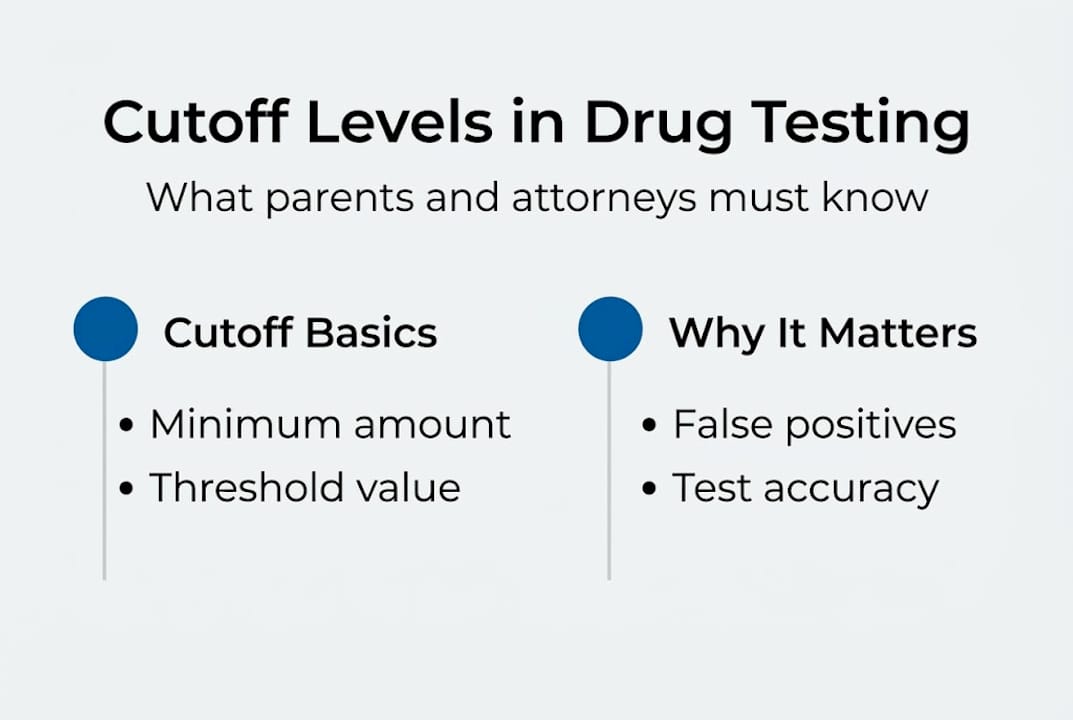
A cutoff level is the minimum concentration of a substance in a sample required for a test to report positive. These levels are not universal. Cutoff levels vary widely by lab and jurisdiction, and many child welfare programs use thresholds far lower than federal standards, which significantly increases the risk of false positives from everyday sources like poppy seeds or prescribed medications.
| Standard | THC cutoff (urine) | Amphetamine cutoff |
|---|---|---|
| Federal (SAMHSA) | 50 ng/mL | 500 ng/mL |
| Some child welfare labs | 20 ng/mL or lower | 100 ng/mL or lower |
That gap matters enormously in family court. A parent who tests negative under federal standards could test positive under a more sensitive threshold used by a state child welfare contractor.
Common sources of false positives include:
- Ibuprofen and other NSAIDs triggering THC or PCP screens
- Cold medications containing pseudoephedrine flagging amphetamine panels
- Poppy seed foods producing opiate positives
- Passive smoke exposure in certain test types
- Hair treatments affecting hair strand test results
As noted in research on hair strand testing, false positives and edge cases require Medical Review Officer (MRO) review and expert interpretation before results are treated as conclusive. An MRO is a licensed physician trained to evaluate drug test results in the context of a person’s full medical history.
Learn more about cutoff levels for drug tests and the role of an MRO in challenging or confirming results.
Pro Tip: Before accepting any positive result as definitive, request the full test documentation including the lab’s cutoff thresholds, chain of custody records, and confirmation testing results. Then request MRO review if any discrepancy exists.
Beyond the test: Accountability, rehabilitation, and context
Accurately reading test results is only part of the story. Context and demonstrated progress matter immensely to the courts, and attorneys who ignore this dimension leave significant persuasion on the table.
Courts are not only asking whether a parent used a substance. They are asking whether that parent poses a present risk to the child. Testing provides accountability and progress tracking but must be placed in the context of full evidence, and rehabilitation records like clean tests and treatment completion can meaningfully mitigate the weight of past use.
What rehabilitation evidence actually helps
The following types of evidence carry real weight in court:
- Consecutive clean drug tests over a documented period
- Enrollment in or completion of a licensed treatment program
- Attendance records from support groups such as AA or NA
- Letters from therapists, counselors, or case managers
- Employer verification of consistent, sober work performance
- Negative results from random or scheduled monitoring programs
Courts actively look for a trajectory, not a snapshot. A parent who tested positive a year ago but has since completed treatment and produced twelve consecutive clean tests is in a fundamentally different position than one still in active use.
Understanding how drug testing supports rehab progress helps clients think of testing as a tool for demonstrating recovery, not just a hurdle. A rehab testing checklist can help families and attorneys organize evidence before court dates.
Pro Tip: Keep a recovery binder with dated records of every test result, treatment session, and support group attendance. Courts respond to organized, timestamped evidence. It shows intentionality and good faith.
A closer look: Why drug testing shouldn’t be viewed as an absolute
Family law practitioners sometimes make a critical error: they treat a positive drug test as the end of the argument. It rarely is, and inconsistent standards risk unfair outcomes because testing does not assess actual parenting risk, only the presence of a substance. Courts are being urged to view test results as expert opinion, not absolute fact.
A parent who smokes cannabis in a state where it is legal, stores it safely, and never uses it around the child may test positive. That result looks identical on paper to a parent who uses fentanyl around the child daily. The test cannot distinguish between them. That is why context is not optional. It is essential.
Attorneys should argue for contextual evidence alongside every test result. Push for full expert review, especially in cases involving lower-than-federal cutoff thresholds. Understand the limitations of each testing method. Hair strand tests detect historical use, not present impairment. Urine tests can flag yesterday’s prescribed medication.
Our perspective at CountryWideTesting.com is that drug testing serves justice only when it is interpreted carefully. Review testing policies and standards to understand how different jurisdictions handle these results.
Get professional drug testing support for your case
When the stakes are this high, the quality and credibility of your testing matters. Families and attorneys need results that are legally defensible, produced by certified labs, and fully compliant with chain-of-custody requirements.
CountryWideTesting.com offers lab testing services processed through SAMHSA, CLIA, and CAP-certified laboratories, giving family law cases the evidentiary foundation they need. For at-home preliminary screening, the 12-panel drug test cup offers fast, multi-substance detection. Whether you need one-time testing or ongoing monitoring support, CountryWideTesting.com connects attorneys and families to reliable, court-ready solutions designed to support fair outcomes.
Frequently asked questions
Can I request a drug test of my co-parent in a custody case?
Yes, you can request drug testing if you have credible evidence of substance use, but courts decide based on facts, not one party’s request alone. Document any incidents carefully before making the request.
What happens if someone refuses a court-ordered drug test?
Refusing a court-ordered test is typically treated as a positive result and can directly affect custody decisions, including supervised visitation or temporary loss of parenting time.
Are all positive drug tests accurate in family law cases?
No. False positives occur due to medications, certain foods, or labs using lower-than-federal cutoff thresholds, so every positive result should be reviewed by a qualified medical expert before being accepted as conclusive.
Does one failed drug test automatically result in losing custody?
A single positive test rarely causes outright custody loss. Courts examine patterns over time, the substance involved, the context of use, and whether the parent is actively addressing the issue.
How can clean drug tests impact family law cases?
Consistently clean tests combined with treatment participation demonstrate recovery progress to the court and can support petitions for expanded custody or lifted visitation restrictions.