
Drug Testing in Criminal Defense: Impact on Case Strategy
Drug testing results can make or break a defense—yet too often, they are accepted at face value without proper scrutiny. For criminal defense attorneys in the United States, understanding what these tests actually reveal—and where their vulnerabilities lie—can shift the outcome of substance-related cases. With evolving technologies and protocols shaping both admissibility and reliability, mastering the nuances of drug testing as legal evidence is essential to protect your clients and strengthen your courtroom strategy.
Table of Contents
- Defining Drug Testing In Criminal Defense
- Why This Distinction Matters For Your Defense
- Common Testing Methods And Their Vulnerabilities
- Key Drug Testing Methods And Protocols
- Immunoassays: The Initial Screening Problem
- Confirmatory Testing: Gas Chromatography-Mass Spectrometry
- Hair And Oral Fluid Testing: Newer Methods
- Chain Of Custody: Your Exclusion Pathway
- Legal Standards Governing Drug Evidence
- Fourth Amendment: Search And Seizure Protections
- Daubert Standards: Scientific Reliability
- Chain Of Custody And Admissibility
- Expert Testimony And Challenge Strategy
- Role Of Drug Tests In Case Strategy
- Early Case Assessment And Plea Negotiation
- Bail And Pretrial Detention Strategy
- Sentencing Mitigation And Alternative Programs
- Probation Compliance And Violation Strategy
- Building Your Testing Challenge Strategy
- Risks, Challenges, And Defense Pitfalls
- False Positives And Cross-Contamination
- Chain Of Custody Breakdown
- Inadequate Confirmatory Testing
- Expert Witness Gaps And Procedural Errors
- Neglecting Alternate Explanations
Key Takeaways
| Point | Details |
|---|---|
| Understanding Drug Testing | Drug testing identifies the presence of substances, but does not prove impairment or frequency of use. It’s crucial for defense attorneys to grasp what these results mean legally. |
| Challenges to Admissibility | Chain of custody and procedural errors can lead to evidence being excluded; securing proper documentation is essential. |
| Importance of Confirmatory Testing | Many tests fail to include confirmatory methods like GC-MS; challenge the admissibility of findings based on this lack. |
| Impact on Case Strategy | Drug test results influence bail, sentencing, and probation; strategically leverage or dispute these findings to shape defense outcomes. |
Defining Drug Testing in Criminal Defense
Drug testing in criminal defense isn’t simply about identifying substances in a client’s system. It’s a multifaceted legal tool that fundamentally shapes case strategy, sentencing recommendations, and plea negotiations. Understanding what drug testing actually measures—and what it doesn’t—is critical to building an effective defense.
At its core, drug testing identifies the presence or absence of controlled substances in a person’s body. The results become evidence that prosecutors use, judges consider during sentencing, and probation officers cite when recommending conditions. But here’s what matters: drug testing doesn’t prove impairment, frequency of use, or addiction status. It simply shows a substance was present at a specific moment in time.
Why This Distinction Matters for Your Defense
The gap between what testing shows and what it’s interpreted to mean creates opportunities. A positive result doesn’t tell you when the substance entered the body, how much was consumed, or whether your client was under the influence. Yet prosecutors often present these results as definitive proof of guilt or violation.
Drug testing operates across multiple stages of criminal proceedings:
- Pretrial screenings to assess flight risk and condition bail
- Probation and parole monitoring to detect violations
- Sentencing recommendations based on substance abuse history
- Drug court eligibility and program progression
- Rehabilitation verification to demonstrate compliance
Each stage carries different legal implications. Advanced testing methodologies have increased accuracy, but reliability concerns around search and seizure protections, specimen handling, and confirmatory procedures remain central to your defense strategy.
Common Testing Methods and Their Vulnerabilities
Understanding which testing method was used directly impacts your cross-examination strategy. Urine tests dominate criminal justice systems because they’re cost-effective and detect drug metabolites for several days—sometimes longer. However, they’re also the most vulnerable to contamination, false positives, and chain-of-custody breaches.
Other methods include:
- Mouth swab tests for rapid screening with shorter detection windows
- Hair testing for longer historical detection but questionable reliability
- Blood tests for more precise substance identification
- Laboratory confirmatory testing using gas chromatography-mass spectrometry (GC-MS)
Testing results are only as credible as the procedures used to collect, handle, and analyze the sample—and that’s where your defense lives.
Many jurisdictions still rely on initial screening results without requiring confirmatory testing. This is your leverage point. Standard protocols and transparent methodologies exist, but not all labs follow them consistently.
Here’s a comparison of common drug testing methods and their courtroom vulnerabilities:
| Testing Method | Typical Use in Criminal Cases | Key Vulnerability | Preferred Scenario |
|---|---|---|---|
| Urine Testing | Most pretrial and probation cases | Prone to contamination and false positives | Cost-effective mass screening |
| Hair Analysis | Long-term drug use evidence | Environmental contamination, variability | Alleged chronic use cases |
| Oral Fluid (Swab) | Recent use detection, quick results | Short detection window, inconsistent results | Roadside or rapid response |
| Blood Analysis | Confirm substance presence | Invasive collection, requires lab precision | Impairment or fatality cases |
| GC-MS Confirmation | Laboratory confirmation, trial evidence | Expensive, sometimes skipped by labs | High-stakes litigation |
Pro tip: Request discovery of the complete testing report immediately, including the specific methodology used, the lab’s accreditation status (SAMHSA, ISO, CLIA, CAP standards), chain of custody documentation, and any quality assurance records—gaps in this documentation often provide grounds for excluding results.
Key Drug Testing Methods and Protocols
The method used to test your client determines what evidence is admissible, how you’ll challenge accuracy, and whether results hold up under cross-examination. Different testing approaches have different vulnerabilities, and prosecutors often don’t disclose these limitations upfront.
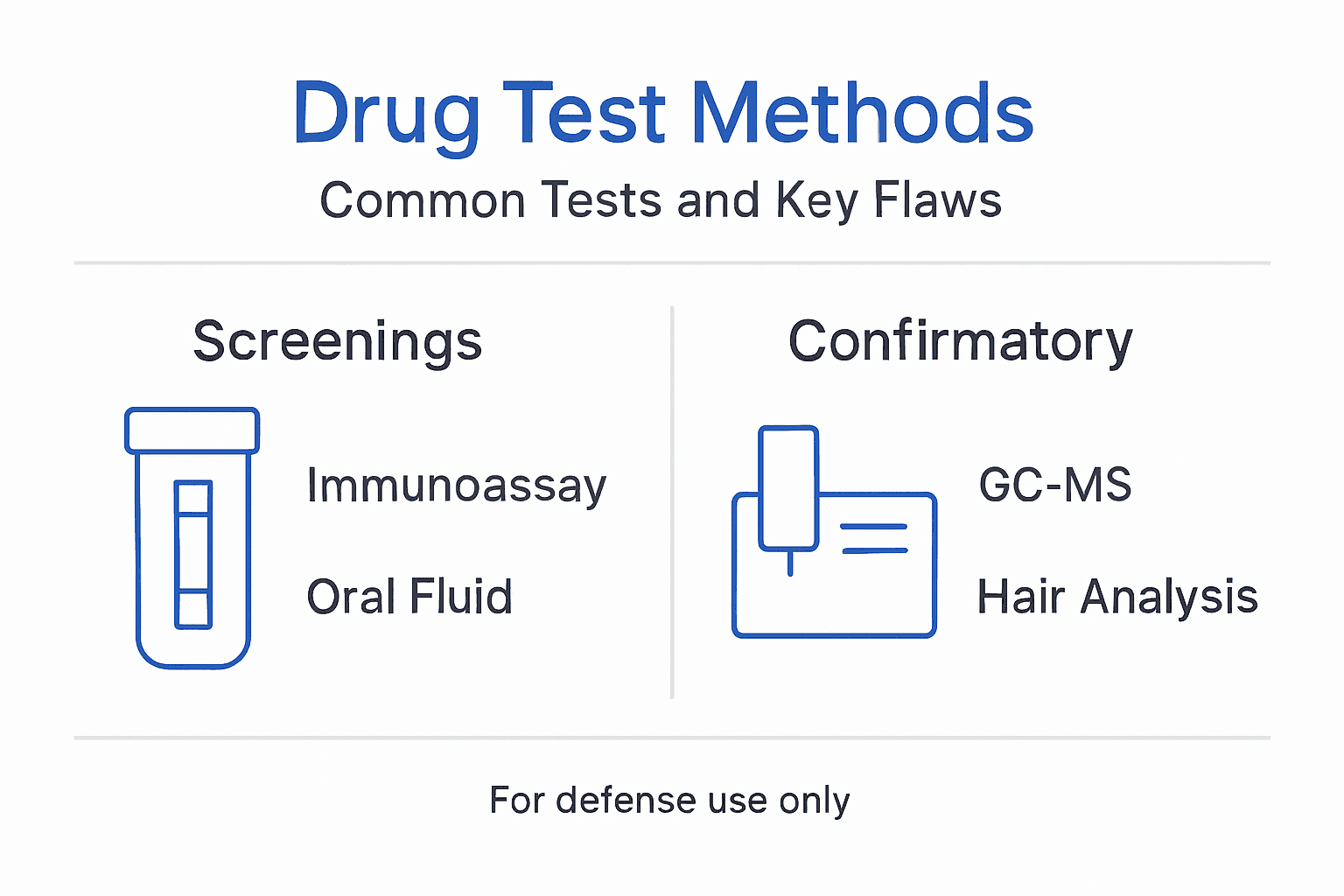
Every testing method starts with specimen collection, proceeds through analysis, and ideally includes confirmatory testing. The chain matters because each step creates opportunities to exclude evidence. If the lab skipped confirmatory testing or failed to follow standardized protocols, that’s your case.
Immunoassays: The Initial Screening Problem
Most criminal cases begin with immunoassay screening tests—rapid, inexpensive, and notoriously prone to false positives. These tests use antibodies to detect drug metabolites, but they’re crude tools. They can’t distinguish between drugs and structurally similar compounds, over-the-counter medications, or residual substances from months past.
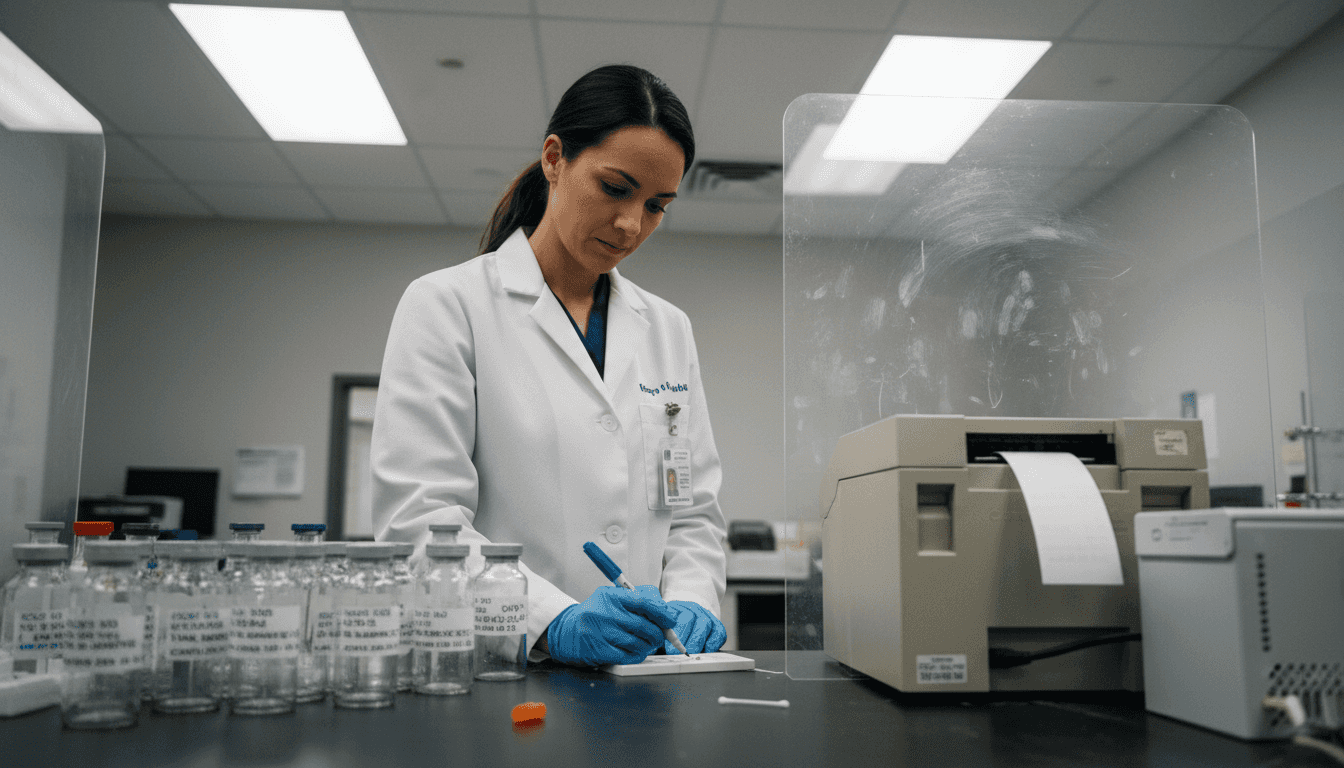
Immunoassay results alone are never legally defensible.
They’re designed as preliminary filters, not proof. Yet many prosecutors present screening results as definitive evidence without requiring confirmation. This is where you push back hard. Proper laboratory protocol standards require confirmatory testing using chromatographic methods before any result should be admissible.
Confirmatory Testing: Gas Chromatography-Mass Spectrometry
Gas chromatography-mass spectrometry (GC-MS) is the gold standard for confirming drug presence. It separates compounds and identifies their molecular structure with precision. If the lab used GC-MS correctly, results are difficult to challenge on scientific grounds.
But here’s what matters: Did they actually perform it? Many labs screen with immunoassays and skip confirmation entirely unless questioned. Request the complete lab report. If confirmatory testing wasn’t performed, the evidence is incomplete and challengeable.
GC-MS requires:
- Proper calibration and maintenance documentation
- Quality control samples run alongside your client’s specimen
- Method validation records
- Analyst credentials and certification status
Hair and Oral Fluid Testing: Newer Methods
Hair analysis claims to detect drug use over months, but reliability remains contested. Hair grows at different rates, environmental contamination happens, and results are subject to interpretation. Courts increasingly scrutinize hair evidence because the science remains inconsistent.
Oral fluid testing (mouth swab) detects recent use within hours to days. It’s less invasive than urine testing and harder to adulterate. However, detection windows are shorter, and some substances show up inconsistently depending on oral pH and salivary flow.
These methods are advancing, but they’re newer and less standardized than urine testing.
Confirmatory testing using validated methods and proper documentation is non-negotiable for admissibility—missing this step is your strongest exclusion argument.
Chain of Custody: Your Exclusion Pathway
No matter which method was used, chain of custody breaks everything. If the specimen wasn’t properly labeled, stored at correct temperatures, or documented through every transfer, the result is contaminated evidence.
Request these specific documents:
- Initial collection form with witness signatures
- Storage temperature logs
- Every person who handled the specimen
- Transfer documentation with dates and times
- Lab receipt and sign-in records
Gaps in this chain give you grounds to exclude the entire result.
Pro tip: Obtain the testing lab’s complete Standard Operating Procedures (SOPs) for the specific method used on your client’s specimen, then compare them to what was actually documented in the case file—discrepancies between written protocols and actual practice often provide grounds for exclusion motions.
Legal Standards Governing Drug Evidence
Drug evidence doesn’t magically become admissible just because a lab produced results. Courts apply strict legal standards rooted in constitutional protections, evidentiary rules, and scientific reliability requirements. Understanding these standards is where you build your exclusion strategy.
The foundation rests on two key principles: Fourth Amendment protection against unreasonable searches and Daubert standards for scientific evidence admissibility. If either is violated, the evidence doesn’t make it to trial.
Fourth Amendment: Search and Seizure Protections
Drug testing involves bodily intrusion or biological sample collection. This triggers Fourth Amendment scrutiny. Even if your client consented, the scope of testing must remain reasonable. Testing for substances beyond what was authorized is a Fourth Amendment violation.
For example, a court-ordered urine test for methamphetamine doesn’t authorize testing for marijuana. The prosecution exceeded the warrant’s scope. That additional result gets excluded.
Key Fourth Amendment questions to raise:
- Was the test authorized by valid court order or warrant?
- Did the testing scope exceed what was ordered?
- Were proper procedures followed during collection?
- Was the specimen properly secured against contamination or tampering?
Daubert Standards: Scientific Reliability
Daubert v. Merrell Dow Pharmaceuticals established the framework courts use to evaluate whether scientific evidence is reliable enough for admission. Your expert witness testimony challenging the testing methodology directly invokes Daubert.
Under Daubert, testing methodology must meet these criteria:
- Has the method been tested and validated?
- Is it subject to peer review and publication?
- What’s the known or potential error rate?
- Are there established standards and procedures?
- Is the method generally accepted in the scientific community?
If the lab used an outdated method, skipped validation steps, or lacks proper quality controls, you have a Daubert challenge. Regulatory compliance frameworks require valid and reproducible testing data before results should be accepted as evidence.
Chain of Custody and Admissibility
Even perfect testing methodology fails if chain of custody is broken. Courts assume specimens are contaminated or misidentified when custody documentation gaps exist. This isn’t about doubt—it’s about legal foundation.
Below is a summary of common legal flaws that undermine drug test admissibility:
| Flaw Type | Impact on Case | Example Documentation Gap |
|---|---|---|
| Chain of Custody Break | Evidence exclusion | Missing storage temperature logs |
| Lack of Confirmation | Weakens prosecution | No GC-MS test report |
| Outdated Protocol | Opens Daubert challenge | Absent method validation records |
| Analyst Inqualification | Discredits reliability | No certification proof attached |
Missing documentation elements that undermine admissibility:
- No witness signature at collection
- Gaps in custody transfer documentation
- No temperature control logs
- Unclear specimen identification
- Missing lab receipt documentation
Evidence with broken chain of custody is legally presumed unreliable, giving you grounds to exclude it entirely.
Expert Testimony and Challenge Strategy
You’ll need an expert witness to challenge testing methodology, error rates, and lab protocols. Your expert doesn’t have to prove the results are wrong—only that the methodology doesn’t meet scientific reliability standards.
Specific vulnerabilities to explore with your expert:
- Immunoassay false positive rates
- Lack of confirmatory testing
- Lab certification status
- Analyst training and credentials
- Quality control failure documentation
Pro tip: Request the complete Daubert foundation before trial: all method validation studies, error rate documentation, peer-reviewed publications supporting the testing methodology, and the lab’s proficiency test results—missing documentation creates powerful Daubert challenges.
Role of Drug Tests in Case Strategy
Drug testing results don’t just sit in case files as passive evidence. They actively drive prosecutorial decisions, influence judicial rulings, and determine whether your client gets bail, probation, or a cell. Understanding how to leverage—or dismantle—this evidence shapes your entire defense strategy.
Your approach depends on whether testing helps or hurts your client. Sometimes a negative result becomes your strongest defense. Other times, a positive result requires reframing the narrative entirely. The key is using testing strategically at every critical juncture.
Early Case Assessment and Plea Negotiation
Before any trial discussion happens, prosecutors evaluate drug testing results to decide charges and sentencing recommendations. A positive result strengthens their leverage; a negative result weakens it. This determines your opening negotiating position.
Consider this scenario: Your client tests positive for methamphetamine, but chain of custody documentation is incomplete. You now have negotiating power. The prosecutor knows the result may be excluded, so they’re more willing to discuss a better plea offer.
Early testing assessment questions:
- Was the specimen properly collected and documented?
- Was confirmatory testing performed?
- Are there procedural vulnerabilities?
- Does a negative result contradict the prosecution’s narrative?
- Can testing results support treatment-based alternatives?
Bail and Pretrial Detention Strategy
Drug test results directly impact bail conditions and pretrial detention decisions. A positive result increases flight risk assessments and leads to stricter conditions or higher bail. This is where testing has immediate, tangible consequences.
If testing shows substance use but your client has stable employment, family ties, and no prior failures to appear, you have counter-evidence. Testing becomes just one data point in a broader mitigation narrative.
Conversely, understanding testing limitations and procedural errors allows you to challenge whether results are even reliable enough to influence bail decisions at this critical stage.
Sentencing Mitigation and Alternative Programs
At sentencing, judges rely heavily on drug test results to assess substance abuse severity and recommend treatment versus incarceration. A pattern of positive results strengthens the prosecution’s argument for custody. Negative results or inconsistent results suggest your client’s substance use is manageable or exaggerated.
This is where drug courts and diversion programs enter the picture. Many jurisdictions offer alternatives if testing demonstrates commitment to sobriety. Strategic testing becomes your evidence of rehabilitation and change.
Alternative sentencing pathways include:
- Drug court with regular testing requirements
- Probation with conditional testing
- Treatment-based sentencing
- Community service with monitoring
Probation Compliance and Violation Strategy
Once your client is on probation, drug testing becomes ongoing surveillance. Regular positive results lead directly to revocation hearings and incarceration. This is where prevention becomes critical.
But violation charges also create opportunities. A failed test can be challenged on the same grounds as trial evidence: chain of custody issues, lack of confirmatory testing, or procedural violations. Don’t assume a positive result during probation is automatically admissible in a violation hearing.
Drug testing shapes case outcomes at every stage—from bail decisions through sentencing and into probation—making strategic testing knowledge essential for defense planning.
Building Your Testing Challenge Strategy
Whether testing helps or hurts, you need a comprehensive challenge framework. Request all documentation immediately. Don’t wait for trial to discover chain of custody gaps or missing confirmatory tests.
Your challenge arsenal includes:
- Fourth Amendment search and seizure challenges
- Daubert admissibility challenges
- Chain of custody attacks
- Lab certification and protocol disputes
- Expert testimony on testing limitations
Pro tip: Obtain complete discovery on drug testing at the earliest possible moment—initial police reports, lab certifications, analyst credentials, and quality assurance records—then have a toxicology expert review before any plea discussions, giving you concrete leverage in early negotiations.
Risks, Challenges, and Defense Pitfalls
Drug testing evidence seems objective and scientific until you examine it closely. Most defense attorneys miss critical vulnerabilities that could exclude results entirely. The risks are substantial, the challenges are real, and the pitfalls are easy to fall into without proper preparation.
Your biggest mistake is accepting test results at face value. The second biggest is failing to request complete documentation early. These oversights cost cases and client freedom.
False Positives and Cross-Contamination
False positives are far more common than prosecutors acknowledge. Immunoassay screening tests react to structurally similar compounds, over-the-counter medications, and food substances. Your client may test positive for amphetamines after eating poppy seed bagels or taking cold medicine.
Cross-contamination happens during collection and analysis. If specimens aren’t properly separated, metabolites from one sample migrate to another. Lab staff errors, inadequate cleaning between samples, and improper storage all introduce contamination risks.
Common false positive triggers:
- Cold medications containing pseudoephedrine or phenylephrine
- Poppy seeds in food or baked goods
- Ibuprofen or other NSAIDs
- Secondhand smoke exposure
- Diet pills or supplements
Chain of Custody Breakdown
Chain of custody isn’t bureaucratic busywork. It’s your constitutional safeguard. Every gap—missing signature, undocumented storage, unclear transfers—creates reasonable doubt about specimen integrity.
Most labs have sloppy documentation. Specimens sit in unsecured areas. Transfer logs are incomplete. Nobody tracked temperature control. These aren’t rare problems; they’re systemic. Common procedural inconsistencies and documentation failures persist across labs because nobody challenges them thoroughly.
Red flags that undermine admissibility:
- Missing collection witness signature
- Gaps in time between collection and lab receipt
- No documented temperature maintenance
- Illegible handwriting on labels
- No sequential numbering system
- Unclear custody transfer documentation
Inadequate Confirmatory Testing
Many jurisdictions still present screening results as final evidence without performing confirmatory testing. This is indefensible. Screening tests are preliminary filters, not proof. Yet prosecutors use them anyway because nobody objects.
Your job is to object loudly and early. If confirmatory testing wasn’t performed, argue admissibility is improper. The evidence is incomplete. A screening result without confirmation violates scientific standards and introduces unreliability.
Insist on confirmatory testing using GC-MS. If the lab didn’t perform it, that’s your exclusion argument.
Expert Witness Gaps and Procedural Errors
Many defense attorneys fail to hire toxicology experts early enough. You need expert review of methodology, error rates, lab protocols, and analyst credentials before trial. Waiting until trial preparation wastes leverage and misses discovery opportunities.
Lab analysts may lack proper certification. Quality control samples may be missing. Method validation may be incomplete. Proficiency testing documentation may be absent. These aren’t technical niceties; they’re foundational reliability issues.
Overreliance on test results without exploring alternate explanations or questioning laboratory practices is the fastest way to lose a case you could have won.
Neglecting Alternate Explanations
A positive test result doesn’t tell you when the substance entered your client’s system, how much was consumed, or the source. Yet prosecutors present results as definitive proof of guilt. You need to present competing narratives.
Alternate explanations include:
- Unwitting exposure through secondhand smoke
- Environmental contamination
- Passive absorption from contact
- Prescription medication misidentification
- Lab error or cross-contamination
- Testing procedure violations
Pro tip: Hire a board-certified toxicology expert during initial discovery, not trial preparation—this allows early identification of lab vulnerabilities, false positive risks, and procedural errors that strengthen plea negotiations and provide concrete exclusion grounds.
Take Control of Drug Testing Challenges in Criminal Defense
Navigating drug testing evidence can feel overwhelming when accuracy, chain of custody, and confirmatory protocols are under scrutiny. The detailed vulnerabilities discussed in “Drug Testing in Criminal Defense: Impact on Case Strategy” highlight how critical reliable, regulated testing methods are to your defense strategy. Whether you need trustworthy urine tests, mouth swab kits, or laboratory confirmation, ensuring samples are processed by certified labs following strict standards is vital to protect your client’s rights and strengthen your position.
Access dependable drug and alcohol testing solutions designed to meet both individual and organizational needs at CountryWideTesting.com. With partnerships that guarantee SAMHSA, ISO, CLIA, and CAP accreditation, you can secure valid, scientifically sound test results that withstand legal challenges. Explore our comprehensive range of testing options and lab services to stay ahead in criminal defense proceedings and avoid costly pitfalls. Start defending smarter today by visiting CountryWideTesting.com and equip yourself with the quality testing resources your cases demand.
Frequently Asked Questions
What is drug testing in criminal defense?
Drug testing in criminal defense involves identifying the presence or absence of controlled substances in a person’s body, which can influence case strategy, sentencing recommendations, and plea negotiations.
How do drug test results impact sentencing in criminal cases?
Drug test results provide evidence of substance use that judges consider when making sentencing decisions, potentially affecting whether a defendant is incarcerated or offered treatment alternatives.
What are common vulnerabilities in drug testing methods?
Common vulnerabilities include false positives from immunoassay tests, issues in the chain of custody, and lack of confirmatory testing, all of which can undermine the reliability of the evidence.
How can defense attorneys challenge drug test evidence?
Defense attorneys can challenge drug test evidence based on chain of custody issues, violations of Fourth Amendment rights, the absence of confirmatory testing, and by utilizing expert testimonials to question the methodology used.
Recommended
- 7 Key Types of Drug Testing for Criminal Defense Attorneys
- Drug Testing for Individuals: What You Need to Know
- Master the Drug Screening Process for Family Law Cases
- Court Ordered Drug Testing: What HR Needs to Know
- Legal Limbo Extends: YNW Melly Murder Retrial Pushed to 2027 – Stevie The Manager aka Stangr The Man