
Court Ordered Drug Testing: What HR Needs to Know
Managing employees who are subject to court-ordered drug testing presents complex challenges for American human resources professionals. Legal requirements can shift from state to state, and test methods range from urine to hair follicle to blood. Understanding court-ordered drug testing procedures is crucial for protecting employee rights, preventing legal disputes, and sustaining performance in compliance-sensitive roles. This guide brings clarity to the intersection of legal mandates, privacy, and effective HR policy.
Table of Contents
- Defining Court Ordered Drug Testing Procedures
- Types of Drug Tests Used by Courts
- Legal Framework and Authority for Testing
- Court-Ordered Testing in Workplace and HR Policy
- Employer Obligations, Compliance, and Common Pitfalls
Key Takeaways
| Point | Details |
|---|---|
| Court-Ordered Drug Testing | Used in legal contexts like probation and custody disputes to verify substance use and ensure public safety. |
| Testing Methods | Common methods include Urine, Hair Follicle, Blood, and Breath testing, each with its own pros and cons regarding detection and invasiveness. |
| Legal Framework | Governed by constitutional standards that balance individual rights with governmental interests, ensuring reasonable and justified testing procedures. |
| Employer Responsibilities | Employers must maintain confidentiality, follow standardized protocols, and document testing processes to avoid legal and operational risks. |
Defining Court Ordered Drug Testing Procedures
Court-ordered drug testing represents a legal mechanism used in various legal proceedings to monitor and verify an individual’s substance use status. These procedures are critical in contexts such as criminal probation, child custody disputes, and workplace rehabilitation programs. Court-ordered drug testing protocols can vary significantly depending on jurisdictional requirements and specific case circumstances.
The primary objectives of court-ordered drug testing include:
- Ensuring public safety
- Monitoring substance abuse treatment compliance
- Providing objective evidence of an individual’s drug use status
- Supporting legal decision-making processes
Typically, these testing procedures involve multiple methodologies, each with distinct detection windows and accuracy levels. The most common testing methods include:
- Urine Testing: Most frequently used method
- Hair Follicle Testing: Provides longer detection history
- Blood Testing: Most precise but invasive method
- Breath Testing: Useful for recent alcohol consumption
The U.S. Supreme Court has established legal precedents that balance individual privacy rights with governmental interests in maintaining public safety. These guidelines help ensure that drug testing procedures remain constitutional and minimally intrusive.
Procedural Considerations:
- Testing frequency must be clearly defined
- Collection methods should follow strict chain-of-custody protocols
- Laboratories must use certified testing techniques
- Results require careful documentation and interpretation
Pro tip: Always consult legal counsel to understand specific court-ordered drug testing requirements in your jurisdiction, as procedures can vary significantly between different states and legal contexts.
Types of Drug Tests Used by Courts
Courts utilize multiple drug testing methodologies to ensure accurate substance use verification across different legal proceedings. Drug testing methods vary significantly in detection windows, accuracy, and invasiveness, making the selection process critical for legal professionals.
The primary drug testing methods used by courts include:
- Urine Testing: Most common and cost-effective
- Hair Follicle Testing: Provides extended historical detection
- Blood Testing: Highest accuracy but most invasive
- Breath Testing: Specific for alcohol consumption
- Saliva Testing: Non-invasive with quick results
Each testing method offers unique advantages and limitations. Biological sample drug tests differ in their detection capabilities and are selected based on specific legal requirements and monitoring objectives.
Comparative Analysis of Drug Testing Methods:
The table below highlights the business implications and procedural impact of each court-ordered drug testing method:
| Testing Method | Business Impact | Procedural Complexity | Common Application |
|---|---|---|---|
| Urine Testing | Low-cost, quick results | Requires certified lab | Criminal cases |
| Hair Follicle Test | High expense, long detection | Specialized lab handling | Child custody |
| Blood Testing | Precise, invasive, time-intensive | Medical personnel required | DUI investigations |
| Breath Testing | Instant results, alcohol only | Simple, on-site equipment | Workplace screening |
-
Urine Testing
- Lowest cost
- Detects recent drug use
- Most frequently used in court settings
- Limited detection window (typically 2-7 days)
-
Hair Follicle Testing
- Provides 90-day historical drug use pattern
- More expensive
- Difficult to manipulate
- Preferred for long-term substance abuse monitoring
-
Blood Testing
- Most precise method
- Immediate and accurate results
- Most invasive procedure
- Highest cost
- Limited to very specific legal scenarios
Courts prioritize testing methods that balance accuracy, cost-effectiveness, and minimal intrusion into individual privacy.
Pro tip: Always consult forensic experts and legal counsel to determine the most appropriate drug testing method for specific court-mandated requirements.
Legal Framework and Authority for Testing
Constitutional drug testing standards are rooted deeply in Fourth Amendment interpretations, which balance individual privacy rights against compelling governmental interests. The legal landscape surrounding court-ordered drug testing has evolved significantly, creating nuanced frameworks for when and how testing can be mandated.
Key legal principles governing drug testing authority include:
- Protection of individual constitutional rights
- Compelling government interests in public safety
- Proportional intrusion into personal privacy
- Demonstration of reasonable justification
- Adherence to due process requirements
Drug courts have developed specialized legal mechanisms that integrate judicial oversight with rehabilitation objectives. Judicial drug testing policies represent a sophisticated approach to managing substance abuse through legal intervention, focusing on treatment and monitoring rather than purely punitive measures.
Legal Authorization Contexts:
-
Criminal Probation
- Mandatory testing as condition of release
- Regular monitoring of substance abstinence
- Direct court supervision
-
Child Custody Proceedings
- Testing to ensure child welfare
- Evaluating parental fitness
- Protecting child’s best interests
-
Workplace Compliance
- Federal and state regulatory requirements
- Safety-sensitive positions
- Performance and behavioral assessments
The Supreme Court recognizes that certain public safety scenarios may warrant suspicionless drug testing, establishing precedents that prioritize collective security.
Pro tip: Consult legal counsel to understand the specific jurisdictional nuances of drug testing authorization, as requirements can vary significantly across different states and contexts.
Court-Ordered Testing in Workplace and HR Policy
Navigating the complex landscape of court-ordered drug testing challenges requires HR professionals to develop sophisticated, empathetic workplace policies that balance legal compliance with employee support. These unique scenarios demand nuanced approaches that protect both organizational interests and individual employee rights.
Key Workplace Considerations for Court-Ordered Testing:
- Managing testing schedule conflicts
- Protecting employee privacy
- Maintaining workplace productivity
- Ensuring legal compliance
- Supporting employee rehabilitation
Probation-related workplace drug testing introduces multiple complex dynamics that HR departments must carefully manage. The intersection of legal mandates and workplace performance creates unique challenges requiring strategic policy development.
HR Policy Recommendations:
-
Establish Clear Communication Protocols
- Define testing expectations upfront
- Create confidential reporting mechanisms
- Develop supportive intervention strategies
-
Flexible Scheduling Accommodations
- Allow time for mandatory court-ordered tests
- Minimize workplace disruption
- Provide reasonable scheduling alternatives
-
Legal Compliance Frameworks
- Document all testing-related interactions
- Maintain strict confidentiality
- Develop non-discriminatory testing procedures
Successful workplace drug testing policies prioritize rehabilitation and support over punitive measures.
Pro tip: Develop a comprehensive written policy that clearly outlines procedures for employees under court-ordered testing, ensuring transparency and legal compliance.

Employer Obligations, Compliance, and Common Pitfalls
Employer drug testing obligations involve complex legal requirements that demand meticulous attention to employee rights, confidentiality, and precise procedural protocols. HR professionals must navigate these intricate landscapes with strategic precision and comprehensive understanding.
Key Employer Compliance Requirements:
- Maintain strict confidentiality of testing results
- Follow legal reporting protocols
- Protect employee privacy rights
- Ensure non-discriminatory testing practices
- Document all testing-related interactions
Potential Legal and Operational Risks:
-
Confidentiality Breaches
- Unauthorized disclosure of test results
- Violation of employee privacy laws
- Potential legal litigation
-
Inconsistent Testing Procedures
- Lack of standardized testing protocols
- Uneven application of drug testing policies
- Risk of discriminatory practices
-
Insufficient Documentation
- Inadequate record-keeping
- Missing critical testing information
- Limited legal defensibility
Drug court compliance strategies require comprehensive understanding of legal mandates and organizational responsibilities. Successful implementation depends on clear communication, consistent procedures, and a supportive approach to employee rehabilitation.
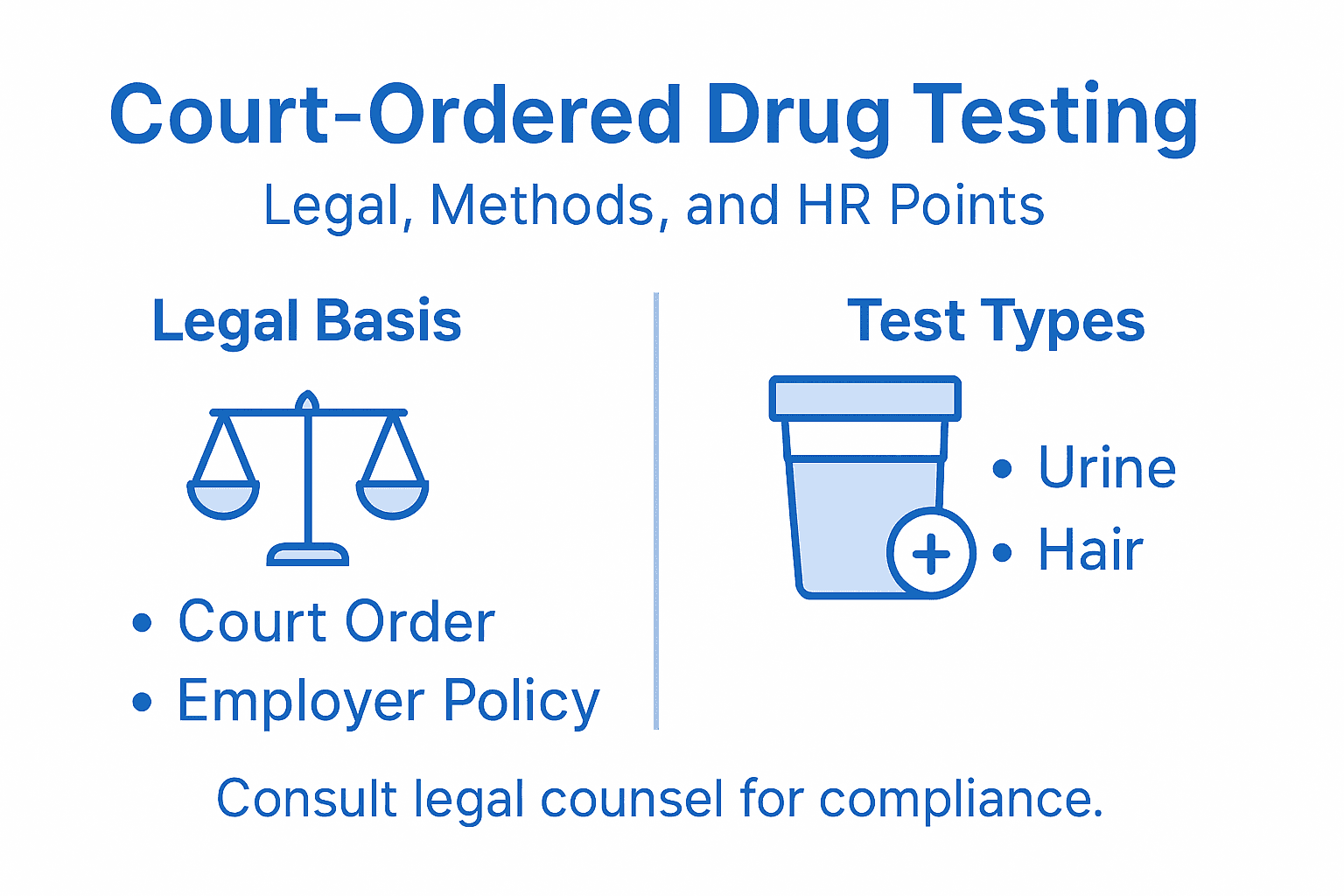
Below is a summary of crucial employer obligations and the risks if these are neglected:
| Employer Duty | Consequence of Neglect | Best Practice |
|---|---|---|
| Maintain confidentiality | Potential lawsuits, privacy breach | Secure data handling |
| Use standardized protocols | Discrimination claims, inconsistency | Staff training |
| Keep thorough records | Legal vulnerability, lost evidence | Detailed documentation |
| Follow reporting rules | Failed compliance audits | Regular policy reviews |
Effective workplace drug testing policies balance legal compliance with employee support and rehabilitation potential.
Pro tip: Develop a comprehensive, written drug testing policy that clearly outlines procedures, consequences, and support mechanisms to ensure legal compliance and employee understanding.
Simplify Court Ordered Drug Testing with Reliable Solutions
Navigating the complexities of court ordered drug testing can be overwhelming for HR professionals and employers. Challenges such as maintaining confidentiality, ensuring compliance with legal frameworks, and selecting the right testing methods are critical pain points highlighted in the article. At CountryWideTesting.com, we understand these challenges and offer trustworthy drug and alcohol testing services designed to meet stringent regulatory standards including SAMHSA, ISO, CLIA, and CAP certifications. Whether you need urine testing kits or laboratory testing services, our platform connects you with certified laboratories that help you stay compliant and support employee rehabilitation.
Take control of your workplace drug testing policies today with solutions tailored to court ordered requirements. Visit CountryWideTesting.com to explore our comprehensive range of testing options including urine drug tests and lab-supported services. Don’t let uncertainty impact your compliance or employee trust act now to secure reliable, legally compliant drug testing solutions that protect both your organization and its people.
Frequently Asked Questions
What is court-ordered drug testing?
Court-ordered drug testing is a legal process used to monitor an individual’s substance use status, typically in contexts such as criminal probation, child custody disputes, or workplace rehabilitation programs.
What are the most common methods of drug testing used by courts?
The most common methods of drug testing include urine testing, hair follicle testing, blood testing, breath testing, and saliva testing, each with its own detection windows and levels of accuracy.
What legal considerations should HR professionals be aware of regarding court-ordered drug testing?
HR professionals should understand individual privacy rights, compelling government interests, and ensure their practices comply with due process requirements, particularly in relation to confidentiality and non-discriminatory testing.
How can HR departments effectively manage court-ordered drug testing processes?
HR departments can manage these processes by establishing clear communication protocols, offering flexible scheduling for tests, ensuring legal compliance, and maintaining detailed documentation of all interactions related to drug testing.