
Why test for alcohol in family law? Safety, evidence & strategy
TL;DR:
- Alcohol testing provides objective evidence to protect children and support fair custody decisions.
- Various testing methods differ in detection windows, accuracy, and invasiveness, requiring strategic selection.
- Properly drafted testing orders with clear protocols ensure enforceability and meaningful court outcomes.
Roughly 10% of U.S. children live with a parent who abuses alcohol, yet proving impairment in court is rarely straightforward. Family law attorneys know the frustration: a concerned parent raises credible allegations, a judge needs objective evidence, and the legal framework for ordering tests can feel murky. Alcohol testing bridges that gap. When used strategically, it protects children, provides courts with reliable data, and gives both sides a fair evidentiary foundation. This guide walks through why courts order testing, which methods hold up under scrutiny, how to structure enforceable orders, and what results actually mean for custody and visitation outcomes.
Table of Contents
- The role of alcohol testing in family law cases
- Methods of alcohol testing: strengths, weaknesses, and detection windows
- Strategic implementation: orders, logistics, and enforcement
- Legal and practical outcomes: how test results shape custody and visitation
- A real-world perspective: what most legal professionals overlook about alcohol testing in family law
- Reliable alcohol testing solutions for family law professionals
- Frequently asked questions
Key Takeaways
| Point | Details |
|---|---|
| Child safety focus | Alcohol testing in family law prioritizes the best interests and safety of the child when substance abuse is suspected. |
| Multiple test options | Different alcohol tests vary in detection window, practicality, and effectiveness for court evidence. |
| Strategic legal planning | Effective test orders should include clear definitions, randomized protocols, and enforceable consequences to ensure compliance. |
| Impact on custody | Test results directly influence court decisions around visitation rights, treatment obligations, or parental supervision. |
| Avoiding common pitfalls | Understanding test limitations and proper order structure helps prevent disputes over reliability, process, or fairness. |
The role of alcohol testing in family law cases
Family courts operate under one governing principle: the best interest of the child. When alcohol misuse enters the picture, that principle demands action. Judges cannot rely on one parent’s word against another’s, and children rarely make reliable witnesses. Objective testing fills that evidentiary void.
Courts do not order testing casually. There is generally an evidentiary threshold that must be met before a judge will compel a parent to submit to alcohol screening. Common triggers include:
- Allegations by the other parent supported by specific incidents or witness accounts
- Prior DUI arrests or convictions, especially recent ones
- Child neglect or abuse reports involving alcohol
- Behavioral concerns flagged by teachers, pediatricians, or counselors
- Parenting evaluator recommendations based on observed impairment
The data behind these concerns is sobering. Approximately 8% of caregivers involved in child welfare cases meet criteria for alcohol dependence, a rate significantly higher than the general population. That figure matters in court because it signals a systemic risk, not just an isolated parental failing.
“Alcohol testing is ordered to protect the child’s best interests when parental ability may be impaired.”
Understanding the drug screening for family law process is essential before you draft your first motion. Courts expect attorneys to demonstrate familiarity with testing protocols, not just the legal standard. Judges are increasingly sophisticated about what different tests can and cannot prove, and vague orders create enforcement nightmares.
Beyond the evidentiary threshold, timing matters. A parent who completed a rehabilitation program two years ago and a parent actively drinking present very different risk profiles. Testing orders should reflect that distinction. Blanket, open-ended orders without defined endpoints frustrate compliance and can feel punitive rather than protective, which undermines the court’s stated goal.
Finally, remember that testing serves both sides. A parent falsely accused of alcohol abuse benefits enormously from a clean test result. Objective data cuts both ways, and that symmetry is what makes alcohol testing a genuinely fair tool in family law rather than a weapon for the accusing party.
Methods of alcohol testing: strengths, weaknesses, and detection windows
Once a need for testing is identified, selecting the appropriate method is critical for both evidentiary reliability and suitability to case specifics. Not all tests are created equal, and choosing the wrong one can produce results that opposing counsel will successfully challenge.
Various testing methods have different detection periods and reliability profiles. Here is a practical comparison:
| Test type | Detection window | Best use case | Invasiveness |
|---|---|---|---|
| Urine EtG | 72 to 80 hours | Recent use, random testing | Low |
| PEth blood | 2 to 4 weeks | Confirming recent heavy use | Moderate |
| Hair follicle | 3 to 6 months | Chronic pattern documentation | Low |
| Breathalyzer | Real-time only | Immediate impairment checks | Very low |
| SCRAM monitor | Continuous | High-risk, ongoing monitoring | Moderate |
| CDT blood | 2 to 4 weeks | Chronic heavy use indicator | Moderate |
Each method has a situational sweet spot. Urine EtG testing is the workhorse of family law cases because it is affordable, non-invasive, and catches recent use within a window that matters for parenting time. PEth blood tests are harder to defeat because they measure a direct metabolite of alcohol and are less susceptible to incidental exposure claims. Hair testing is powerful for establishing a historical pattern but cannot confirm sobriety in the recent past.
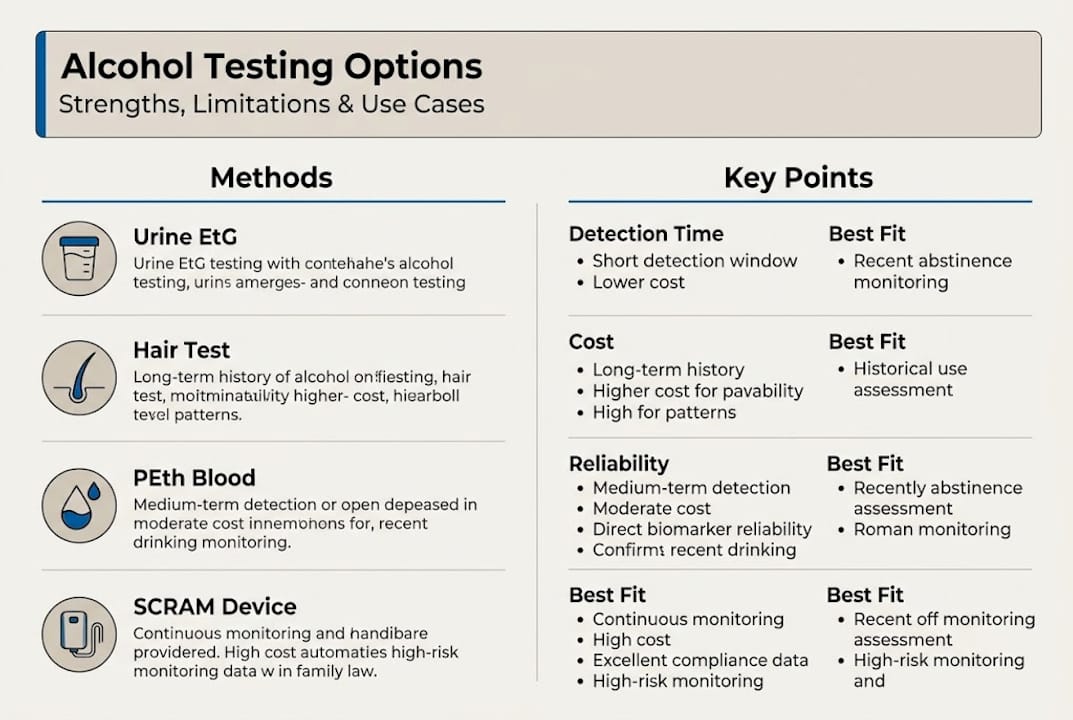
For high-risk situations, SCRAM continuous alcohol monitoring provides real-time data that no other method can match. It is particularly useful when a parent has a documented history of binge drinking or has violated prior court orders. Explore the full range of alcohol testing methods to understand which formats your jurisdiction’s courts find most persuasive.

One question attorneys often ask is whether alcohol shows up on a drug test panel. Standard urine drug screens typically do not include alcohol unless specifically ordered. Make sure your test order explicitly names the analytes required.
Pro Tip: Match the test type to the alleged behavior pattern. If the concern is weekend binge drinking before custody exchanges, random urine EtG with short notice windows is far more effective than a scheduled monthly test the parent can game.
Strategic implementation: orders, logistics, and enforcement
Knowing which test to use is only half the battle. Effective orders and careful administration are the difference between solid evidence gathering and a procedural quagmire.
“Testing must be strategically planned to avoid loopholes and non-enforceability.”
A well-drafted testing order addresses several specific elements:
- Define a positive result. Specify the cutoff concentration, not just “a positive test.” EtG positives at 100 ng/mL are interpreted differently than those at 500 ng/mL.
- Address missed tests. A missed test should be treated as a positive result unless the parent provides documented proof of an emergency within a defined timeframe.
- Establish a retest protocol. For any disputed result, outline who pays for confirmation testing, which lab performs it, and the timeline for results.
- Define consequences for refusal. Refusal should carry immediate, automatic consequences, such as suspension of unsupervised parenting time, pending a hearing.
- Set a review schedule. Build in a 90-day or 6-month review so the court can assess compliance and adjust the plan accordingly.
Random testing consistently outperforms scheduled testing for deterrence. When a parent knows a test could come at any time, the behavioral impact is far greater. Notification methods matter too. Third-party testing services that use randomized call-in systems remove the attorney from the logistics and reduce accusations of bad faith.
Logistical realities like travel and work schedules need to be addressed upfront. A parent who travels frequently for work needs a protocol that accommodates remote testing locations without creating easy excuses for non-compliance. Reviewing strategies to reduce errors in legal alcohol testing can help attorneys anticipate common procedural pitfalls before they become courtroom problems.
For broader context on how alcohol awareness programs intersect with legal strategy, alcohol awareness strategies offer useful framing for graduated compliance plans.
Pro Tip: Include a graduated compliance plan in your order from the start. Define what consistent negative results over 6 months will earn the parent in terms of expanded parenting time. This creates a positive incentive structure, not just a punitive one.
Legal and practical outcomes: how test results shape custody and visitation
Once implemented, how test results are interpreted and acted on can have lifelong consequences for both the parent and the child. Results are rarely black and white, and attorneys who treat them as such do their clients a disservice.
Test results can trigger supervised visitation, treatment mandates, or significantly strengthen a custody case. Here is how different outcomes typically play out:
| Result type | Likely court response | Strategic implication |
|---|---|---|
| Positive test | Supervised visits, treatment referral | Document pattern; seek compliance plan |
| Missed or refused test | Treated as positive; immediate restriction | Use as evidence of non-cooperation |
| Consistent negatives | Gradual restoration of parenting time | Build toward reunification |
| Isolated positive | Case-by-case review | Context matters; avoid overreaction |
| False positive claim | Retest required | Chain of custody documentation critical |
The best interest standard always governs interpretation. A single positive EtG result after a parent attended a work event where alcohol was served is a very different situation than a pattern of positive results across multiple test dates. Courts are capable of making that distinction when attorneys present context clearly.
Negative results are underused as a strategic tool. If your client is the accused parent and tests consistently clean, those results are powerful evidence against unfounded allegations. Documenting a clean testing history through the family law drug screening process creates a formal record that can shift the narrative entirely.
Edge cases require particular care:
- Isolated DUI: One past DUI without recent incidents does not automatically justify ongoing testing orders, particularly if treatment was completed.
- False positives: Certain foods, medications, and mouthwashes can trigger EtG positives. A robust retest protocol protects both sides.
- Chronic versus episodic abuse: Courts respond differently to a parent with a 10-year drinking history versus one who had a crisis period and has since stabilized.
The goal is always proportionality. Overly restrictive orders that do not account for compliance progress can harm the parent-child relationship without meaningfully improving child safety.
A real-world perspective: what most legal professionals overlook about alcohol testing in family law
Here is something we see repeatedly: attorneys treat alcohol testing as a reactive measure rather than a proactive one. A parent shows up intoxicated to an exchange, a crisis erupts, and suddenly everyone is scrambling to get a testing order in place. By then, the evidentiary window has closed and the damage is done.
The smarter approach is to build testing frameworks into parenting plans early, especially in cases where alcohol use has been raised even informally. Strategic timing and careful selection of test types can make or break a family law case, and waiting for a visible incident means you have already lost the best evidence.
False positives are also dramatically underestimated as a litigation risk. Attorneys who do not build retest protocols into their orders find themselves in expensive, time-consuming disputes over a single result. Investing in error reduction in family law testing procedures from the start saves significant courtroom time.
Finally, graduated parenting plans that reward compliance consistently produce better long-term outcomes for children than permanent restrictions. Collaboration between legal counsel, therapists, and testing providers creates a support structure that actually works.
Reliable alcohol testing solutions for family law professionals
When your cases demand dependable, court-ready alcohol testing, having the right partner matters.
CountryWideTesting.com offers lab testing services backed by SAMHSA, CLIA, and CAP-certified laboratories, with strict chain-of-custody protocols that hold up in court. Whether you need rapid turnaround for an urgent motion or a long-term monitoring solution for a complex custody case, Nationwide alcohol testing options are available for legal professionals. Custom testing programs designed specifically for family law cases, including random notification systems and compliance reporting, can be arranged to fit your clients’ court orders precisely.
Frequently asked questions
What triggers court-ordered alcohol testing in family law?
Allegations of impairment, evidence of neglect, DUI history, or behavioral concerns flagged by third parties usually prompt a judge to order alcohol testing. Courts require some evidentiary basis before compelling a parent to submit to screening.
How long can alcohol be detected in common family law tests?
Urine EtG detects alcohol use up to 72 to 80 hours after consumption, PEth blood testing covers 2 to 4 weeks, and hair follicle tests can capture a pattern spanning several months.
What are possible outcomes of a positive alcohol test in family court?
Supervised visitation, mandated treatment, or custody restrictions are the most common judicial responses to a confirmed positive result, depending on the pattern and context.
Can a single DUI lead to loss of custody?
A single DUI does not automatically cause custody changes unless it directly affects the child’s safety or demonstrates a broader pattern of impaired parenting.
How should attorneys address potential false positives in alcohol testing?
Attorneys should insist on clear retest protocols and documented chain-of-custody procedures from the outset so that any disputed result can be efficiently and fairly challenged.