
Compliant Laboratory Standards: Key Examples for Labs
TL;DR:
- Laboratory compliance requires documented procedures, validated environmental controls, and traceable data systems. Maintaining a culture of continuous quality and digital integration is essential for inspection readiness and audit success.
Compliant laboratory standards are the documented practices, controls, and quality systems that laboratories must follow to meet regulatory requirements from bodies like the FDA, ISO, OECD, and USP. Frameworks such as Good Laboratory Practice (GLP), Good Manufacturing Practice (GMP), ISO 17025, and ISO 15189 define what these standards look like in practice. For compliance officers and lab professionals, knowing concrete examples of compliant laboratory standards is the difference between passing an audit and triggering a nonconformance finding. This article breaks down the most critical examples across documentation, environmental controls, data integrity, and quality management.
1. What are examples of compliant laboratory standards under GLP?
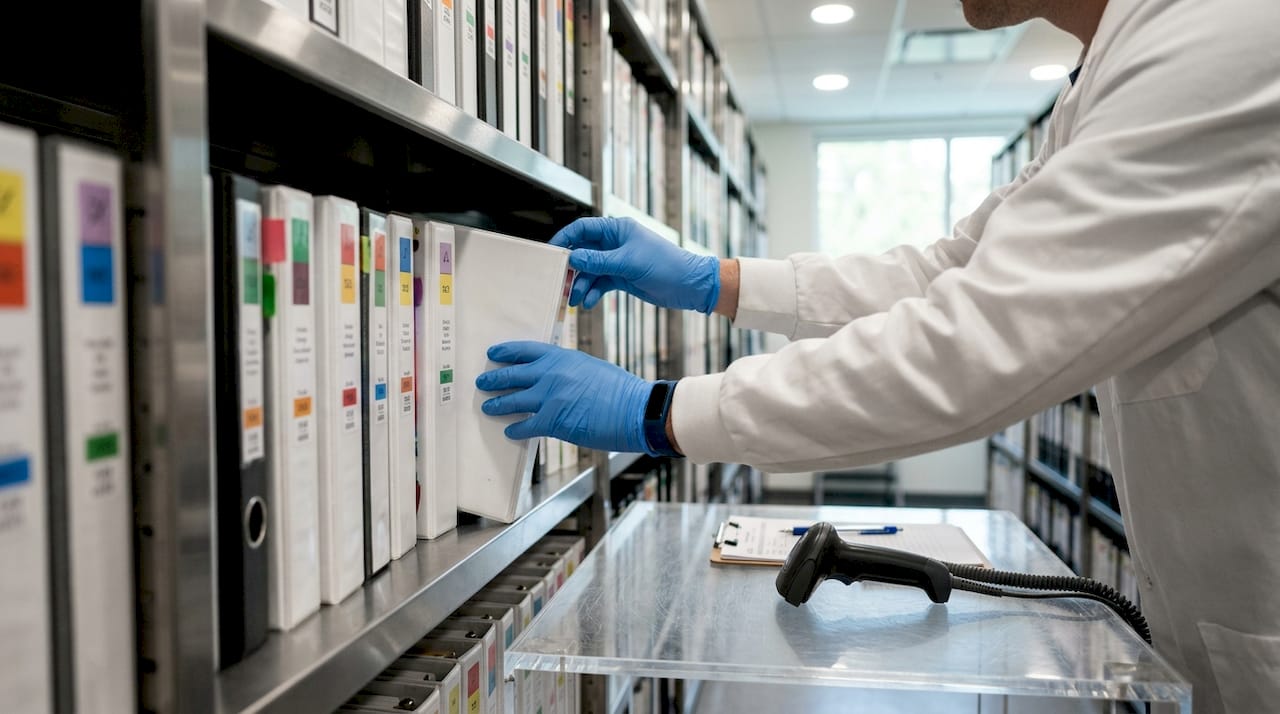
GLP compliance, as required for FDA-regulated nonclinical studies, centers on documentation that proves every step of a study was controlled and traceable. Missing required documentation is the primary cause of noncompliance findings during FDA inspections. That single fact explains why documentation is not a formality. It is the foundation of the entire compliance structure.
The core GLP documentation requirements include:
- Signed study protocols with version history: Every protocol must carry a principal investigator signature and a clear record of any amendments.
- Time-stamped raw data with analyst signatures: Raw data must be recorded at the time of observation, not reconstructed later.
- Current calibration certificates: Equipment used in a study must have traceable, up-to-date calibration records attached.
- QA statements in final reports: A quality assurance unit must certify that inspections occurred and findings were addressed.
- Standard Operating Procedures (SOPs): SOPs must cover every routine activity, from sample receipt to data archiving.
Pro Tip: Archive all study-related documents in a controlled system that prevents deletion. Regulators expect to see an unbroken chain of custody from raw data to final report.
2. SOPs and quality management under ISO 17025 and ISO 15189
ISO 17025 and ISO 15189:2022 both require laboratories to maintain a documented quality management system, but the SOP categories they demand go well beyond basic procedure writing. USP 2025 and ISO 15189:2022 identify eleven key SOP categories that are critical for laboratory compliance. That list covers the full lifecycle of laboratory work, from how documents are created to how errors are corrected.
The most important SOP categories for accredited labs include:
- Document and record control: Procedures for creating, reviewing, approving, and retiring documents.
- Handling nonconforming work: A defined process for identifying, quarantining, and investigating results that fall outside accepted criteria.
- Corrective and Preventive Action (CAPA): A structured method for root cause analysis and follow-up verification.
- Personnel competency and training records: Documented proof that staff are qualified for every test method they perform.
- Internal audits: Scheduled reviews of all quality system elements, with written findings and closure records.
Reliability of microbiological data depends more on adherence to good laboratory practices than on equipment sophistication. That principle applies across all ISO-accredited labs. A well-written SOP executed consistently outperforms expensive instrumentation operated without discipline.
A common and costly failure is document sprawl. Contradictory SOPs trigger audit nonconformance even when the underlying lab work is sound. Conducting a gap analysis to align all procedures, training records, and method validation documents before an audit is not optional. It is the minimum standard for inspection readiness.
3. Environmental and equipment compliance: GMP cleanrooms and calibration
GMP-compliant laboratories operating in pharmaceutical or peptide manufacturing must meet strict environmental controls. ISO Class 7 cleanroom standards require controlled particle counts, temperature ranges, and humidity levels that directly prevent contamination. These are not aspirational targets. They are measurable thresholds that inspectors verify with documented monitoring logs.
| Compliance area | Standard requirement | Audit evidence required |
|---|---|---|
| Cleanroom classification | ISO Class 7 particle count limits | Continuous environmental monitoring logs |
| Equipment calibration | Biannual schedule with traceable standards | Current calibration certificates on file |
| Cleaning validation | Validated protocols for each surface and agent | Cleaning records with analyst signatures |
| Internal audits | Scheduled reviews of all GMP elements | Written audit reports with CAPA closure |
Biannual equipment calibration with traceable standards is one of the five core GMP practices that reduce contamination and improve traceability. Calibration is not just about accuracy. It creates a documented chain of evidence that links every test result to a verified instrument state.
Pro Tip: Link calibration certificates directly to the instruments in your equipment log. Inspectors will cross-reference test records against calibration dates, and any gap will generate a finding.
Validated cleaning procedures are equally critical. A cleaning protocol that has not been formally validated, meaning tested and documented to prove it removes contaminants to an acceptable level, does not meet GMP requirements regardless of how thorough it appears in practice. Validated cleaning procedures prevent cross-contamination and are a non-negotiable element of compliant lab practices.
4. How do laboratories ensure data integrity and inspection readiness?
Data integrity is the compliance area that receives the most scrutiny during audits. Audit trails must log every data modification with user ID, date, and reason for the change. Overwriting data without explanation is a critical compliance failure that can invalidate an entire study.
The key practices for maintaining data integrity include:
- Unalterable audit trails: Every change to a record must be logged automatically, with the original value preserved.
- Version-controlled documents: No document should exist in two current versions simultaneously.
- Electronic linkage of records: Training status, calibration records, and test methods should connect within a single system.
- Daily quality controls embedded in workflows: Compliance checks should happen during routine work, not only before inspections.
“Laboratories that treat inspection readiness as a daily habit rather than a pre-audit sprint consistently outperform those that do not.” — Inside the Inspection-Ready QC Laboratory
Integrated Laboratory Information Management Systems (LIMS) can automatically block personnel from conducting tests if their training has expired or if equipment calibration is overdue. That kind of system-level control removes human error from the compliance equation. It also creates the electronic linkage that system integration requires for audit success.
Embedding quality controls into daily laboratory workflows shifts the entire culture from reactive to proactive. Labs that operate this way do not scramble before audits. They are already ready.
5. Standard laboratory protocols compared: GLP, GMP, ISO 17025, and USP
Different laboratory types require different standard protocols. Choosing the wrong framework, or applying multiple frameworks without understanding their scope, creates gaps that auditors will find.
| Standard | Primary focus | Best-fit laboratory type |
|---|---|---|
| FDA GLP | Nonclinical study integrity and documentation | Toxicology, pharmacology, and safety testing labs |
| GMP | Manufacturing process control and contamination prevention | Pharmaceutical, peptide, and compounding labs |
| ISO 17025 | Technical competence and measurement traceability | Testing and calibration laboratories |
| ISO 15189 | Medical laboratory quality and patient safety | Clinical and diagnostic laboratories |
| USP 2025 | Microbiological and pharmaceutical testing practices | Microbiology and quality control labs |
ISO 15189:2022 implementation requires leadership involvement, targeted staff training, and quality indicators aligned to the laboratory’s specific scope. That requirement distinguishes ISO 15189 from more generic quality frameworks. It demands that the quality system reflect the actual work being done, not a generic template. You can learn more about the practical impact of ISO certification in drug testing and how it affects legal and operational outcomes.
USP 2025 microbiological practices emphasize aseptic technique, equipment control, and diligent training as the foundation of reproducible results. These are not supplementary guidelines. They are the baseline for any lab producing microbiological data that will be used in regulatory submissions.
For labs operating under multiple standards, the most practical approach is to build a single quality management system that satisfies the overlapping requirements of each framework. The 2026 laboratory testing standards guidance covers how to align USP, ISO, and GMP requirements within one cohesive system.
Key takeaways
Compliant laboratory standards require documented procedures, traceable equipment records, validated environmental controls, and integrated data systems working together as a single quality framework.
| Point | Details |
|---|---|
| GLP documentation is non-negotiable | Signed protocols, time-stamped raw data, and QA statements are the minimum for FDA compliance. |
| SOPs must be consistent and current | Contradictory or outdated SOPs are a leading cause of audit nonconformance findings. |
| Environmental controls require proof | ISO Class 7 cleanroom monitoring and biannual calibration must be documented, not just performed. |
| Data integrity depends on audit trails | Every data change must be logged with user ID, date, and reason to satisfy inspector requirements. |
| System integration prevents failures | LIMS that link training, calibration, and test methods block unauthorized testing before it happens. |
Why compliance culture matters more than compliance checklists
I have reviewed enough lab quality systems to know the difference between a lab that is compliant on paper and one that is genuinely inspection-ready. The gap is almost always cultural, not technical.
Labs that treat compliance as a checklist exercise tend to have the right documents but the wrong habits. They produce SOPs that sit in a binder and calibration logs that get updated the week before an audit. When an inspector asks a technician to walk through a procedure, the disconnect between the written SOP and actual practice becomes obvious within minutes.
The labs that consistently pass audits with minimal findings do something different. They embed quality controls into every shift. A technician who cannot proceed with a test because the LIMS has flagged an expired training record is not being slowed down. That technician is being protected from generating data that will be challenged later.
Document sprawl is the most underestimated compliance risk I see. A lab can have excellent individual procedures and still fail an audit because two SOPs contradict each other on sample handling. A thorough gap analysis, done annually and not just before accreditation renewal, catches these inconsistencies before inspectors do.
The direction of lab compliance in 2026 is clear. Digital integration, continuous monitoring, and leadership-driven quality culture are replacing the episodic, paper-heavy approach that defined the previous decade. Labs that invest in that shift now will spend far less time and money on remediation later.
— Alan
Countrywidetesting: lab-grade compliance for drug testing programs
Compliance does not stop at the laboratory door. For employers and organizations that rely on drug testing as part of their regulatory programs, the quality of the testing service matters as much as the quality of the internal lab.
Countrywidetesting partners with licensed laboratories that meet SAMHSA, ISO, CLIA, and CAP standards, bringing the same level of regulatory rigor to workplace drug testing that clinical labs apply to diagnostic work. The QuickScreen 10 Panel Saliva Drug Test delivers fast, defensible results backed by certified lab processing. For organizations that need full laboratory confirmation services, Countrywidetesting’s lab testing services provide a compliant, end-to-end solution for employer and federal drug testing programs.
FAQ
What is GLP compliance in a laboratory?
GLP, or Good Laboratory Practice, is an FDA-regulated framework requiring signed study protocols, time-stamped raw data, calibration certificates, and QA statements to ensure nonclinical study integrity. Missing any of these elements is a primary cause of noncompliance.
How many SOP categories does ISO 15189:2022 require?
ISO 15189:2022 and USP 2025 together identify eleven key SOP categories, including document control, CAPA, nonconforming work handling, and personnel competency records, as critical for laboratory compliance.
What is an ISO Class 7 cleanroom standard?
An ISO Class 7 cleanroom limits airborne particle counts to defined thresholds and requires controlled temperature and humidity, with continuous environmental monitoring logs as documented proof of compliance.
Why do laboratories fail audits despite having SOPs?
The most common reason is document sprawl, where contradictory SOPs exist across the quality system. A single inconsistency in documentation can trigger a nonconformance finding even when the underlying lab work is sound.
What does a LIMS do for compliance?
A Laboratory Information Management System (LIMS) links personnel training records, equipment calibration status, and validated test methods electronically, automatically preventing unauthorized testing when any compliance requirement is overdue.