
ISO Certification in Drug Testing: Legal Impact
Choosing the right drug testing provider is a high-stakes decision for compliance officers working in regulated American industries. Without effective accreditation, even well-intentioned programs face legal threats and operational setbacks when results are challenged in court or by regulators. Understanding ISO/IEC 17025 accreditation gives you the confidence to partner with laboratories that deliver reliable, defensible results and keep your company’s compliance on solid ground.
Table of Contents
- Defining ISO Certification for Drug Testing
- Key ISO Standards for Drug Testing Labs
- Certification Process and Laboratory Requirements
- Legal Compliance and Regulatory Framework
- Risks, Costs, and Common Pitfalls
Key Takeaways
| Point | Details |
|---|---|
| ISO/IEC 17025 Accreditation | Ensures drug testing laboratories meet international standards for competence and reliability, critical for legal defensibility. |
| Rigorous Quality Management | Documentation, method validation, and staff competence are essential for producing credible and legally defensible test results. |
| Importance of Scope Verification | Confirm that a laboratory’s certification scope covers the specific substances and methods relevant to your testing needs. |
| Financial and Legal Risks | Utilizing non-accredited labs can lead to significant financial liabilities and diminished credibility due to unreliable test results. |
Defining ISO Certification for Drug Testing
ISO certification in drug testing refers to formal recognition that a laboratory meets international standards for competence and reliability. When a testing facility earns ISO accreditation, it demonstrates that its operations, staff, equipment, and quality systems align with globally recognized benchmarks. This certification matters because it signals legal defensibility and scientific validity.
ISO/IEC 17025 is the international standard that defines how testing and calibration laboratories should operate. It establishes requirements across two critical areas:
- Technical requirements covering methodology, equipment calibration, and measurement accuracy
- Management system requirements addressing staff competence, documentation, and quality control procedures
For drug testing specifically, ISO/IEC 17025 accreditation means a laboratory has undergone rigorous third-party assessment. Auditors verify that the facility can consistently produce accurate, legally defensible test results. This becomes crucial when results appear in court proceedings or regulatory compliance audits.
The standard requires laboratories to validate all testing methods before use. Staff must demonstrate technical competence through training and certification. Equipment must be calibrated regularly and traceable to recognized national standards. Quality control procedures ensure that every batch of tests meets predetermined accuracy thresholds.
A rigorous quality management system validates methods, ensures competent staff, and produces legally defensible results that courts and regulators accept.
Your compliance team should understand what ISO certification actually guarantees. It certifies laboratory competence, not the absence of human error. It means results follow consistent protocols and meet international standards. It provides documentation that demonstrates good faith compliance efforts.
When evaluating testing providers, look beyond the ISO label itself. Confirm the scope of accreditation covers the specific substances your company tests for. Verify the accrediting body operates under recognized international guidelines. Check that the certificate remains current through regular surveillance audits.
ISO certification differs from other laboratory credentials. CLIA certification (Clinical Laboratory Improvement Amendments) covers clinical labs in the United States. SAMHSA certification addresses federal drug testing programs. ISO/IEC 17025 operates as the foundational international standard that often complements these other requirements, making it valuable across multiple regulatory frameworks.
Companies implementing drug testing programs benefit from understanding this distinction. A lab may hold multiple certifications simultaneously. The combination of certifications determines what testing results are legally acceptable in your jurisdiction and industry context.
Here is a comparison of major laboratory certifications relevant to drug testing programs:
| Certification Type | Geographic Focus | Primary Use | Recognition Level |
|---|---|---|---|
| ISO/IEC 17025 | International | Drug testing, calibration labs | Globally accepted standard |
| CLIA | United States only | Clinical laboratory testing | Required for US healthcare |
| SAMHSA | United States only | Federal workplace drug programs | Federal program mandatory |
Pro tip: When selecting a drug testing provider, request verification of ISO/IEC 17025 accreditation and confirm the scope document explicitly lists the specific drug classes and testing methodologies your organization requires.
Key ISO Standards for Drug Testing Labs
Drug testing labs rely on specific ISO standards to demonstrate competence and produce legally defensible results. The primary framework that governs these operations is ISO/IEC 17025:2017, which sets general requirements for competence, impartiality, and consistent operation of testing laboratories worldwide.
ISO/IEC 17025:2017 addresses both management and technical requirements. This means your testing provider must meet standards across two distinct areas:
- Management requirements covering organizational structure, documentation, personnel qualifications, and quality assurance procedures
- Technical requirements addressing methodology validation, equipment calibration, measurement uncertainty, and result reporting
The standard ensures reliable testing results that are recognized and accepted internationally. When a lab holds ISO/IEC 17025:2017 accreditation, it demonstrates proper processes, traceability, and quality assurance needed for credible results in legal proceedings and regulatory audits.
Beyond ISO/IEC 17025:2017, quality management systems in drug testing laboratories must follow guidance from international organizations. The United Nations Office on Drugs and Crime provides frameworks emphasizing validated methodologies, quality protocols, and management accountability to harmonize standards worldwide.
Compliance officers should understand what these standards actually require. ISO standards don’t specify which testing methods to use. Instead, they mandate that whatever methods a lab selects must be scientifically validated and properly documented.
Quality management systems establish the backbone that ensures every test follows identical protocols, maintains equipment reliability, and produces consistent results regardless of who performs the analysis.
The standards require documented procedures for everything. Staff training records must exist and be current. Equipment maintenance logs must demonstrate regular calibration. Quality control samples must be analyzed with every batch of real samples. This documentation becomes critical if your company faces litigation.

Labs must also demonstrate measurement uncertainty. This means they must quantify how accurate their results actually are. A test might detect a substance at 100 nanograms per milliliter, but measurement uncertainty might be plus or minus 15 nanograms. This transparency protects your organization from defending false claims about precision.
Personnel competence represents another critical requirement. Lab directors must have specific qualifications. Analysts must complete formal training programs. Supervisors must document ongoing professional development. These requirements ensure that the person reporting your test results has legitimate expertise.
Regular audits verify compliance with ISO standards. Third-party accrediting bodies conduct surveillance audits annually and comprehensive reassessments every two years. This continuous oversight prevents labs from cutting corners after initial accreditation.
Pro tip: Request your testing provider’s current ISO/IEC 17025:2017 accreditation certificate and review the scope document to confirm it covers your specific testing requirements and includes all substance classes your organization tests for.
Certification Process and Laboratory Requirements
Obtaining ISO/IEC 17025 accreditation requires laboratories to follow a structured pathway involving application, assessment, and ongoing compliance. The process typically takes several months and demands significant organizational commitment before a lab can legitimately claim ISO certification for drug testing operations.
The certification journey begins with a formal application to an authorized accrediting body. The lab must document that it meets foundational requirements before the assessment even starts. This includes establishing quality policies, identifying staff competencies, and validating testing methodologies specific to the substances your organization requires.
The ISO/IEC 17025 certification process involves submitting documentation, undergoing a thorough accreditation assessment, and demonstrating compliance with both management and technical requirements. Here’s what labs must address:
- Management requirements covering organizational structure, quality policies, personnel records, and document control systems
- Technical requirements including validated methods, calibrated equipment, measurement uncertainty calculations, and quality control procedures
- Sample handling establishing chain of custody protocols and secure storage procedures
Once the application is submitted, an authorized body conducts an on-site assessment. Assessors review documented procedures, interview staff, observe testing activities, and verify that equipment functions correctly. They check whether staff qualifications match their assigned responsibilities.
Labs must demonstrate quality management system implementation. This means documented procedures, staff competence validation, analytical method testing, and strict sample custody protocols are in place and functioning. Internal audits must occur regularly to catch problems before external assessors find them.
Successful accreditation provides global recognition and improves confidence in test results, but only if the laboratory maintains compliance year after year through surveillance audits.
After passing the initial assessment, labs receive ISO/IEC 17025 accreditation with a defined scope. The scope specifies exactly which substances and testing methods the lab can perform under that certification. A lab cannot test for substances outside its accredited scope without losing credibility.
Maintaining accreditation requires continuous work. Accrediting bodies conduct surveillance audits annually and comprehensive reassessments every two years. Labs must document corrective actions for any findings and demonstrate that systems continue operating effectively.
Personnel requirements never stop. Lab directors, supervisors, and analysts must maintain current qualifications through continuing education. Training records must document what competencies each person possesses and when refresher training occurred.
Equipment demands ongoing attention. Instruments require regular calibration verified by documented maintenance logs. Quality control samples must be analyzed with every batch of real samples to prove the equipment performs reliably.
Pro tip: When evaluating a testing provider’s credentials, request their accreditation certificate with the explicit scope attachment and verify it was issued within the past two years, confirming current surveillance audit compliance.
Legal Compliance and Regulatory Framework
ISO/IEC 17025 accreditation directly impacts your company’s legal position in drug testing programs. The certification demonstrates that your testing provider operates within internationally recognized standards, which protects your organization from liability claims and regulatory scrutiny.
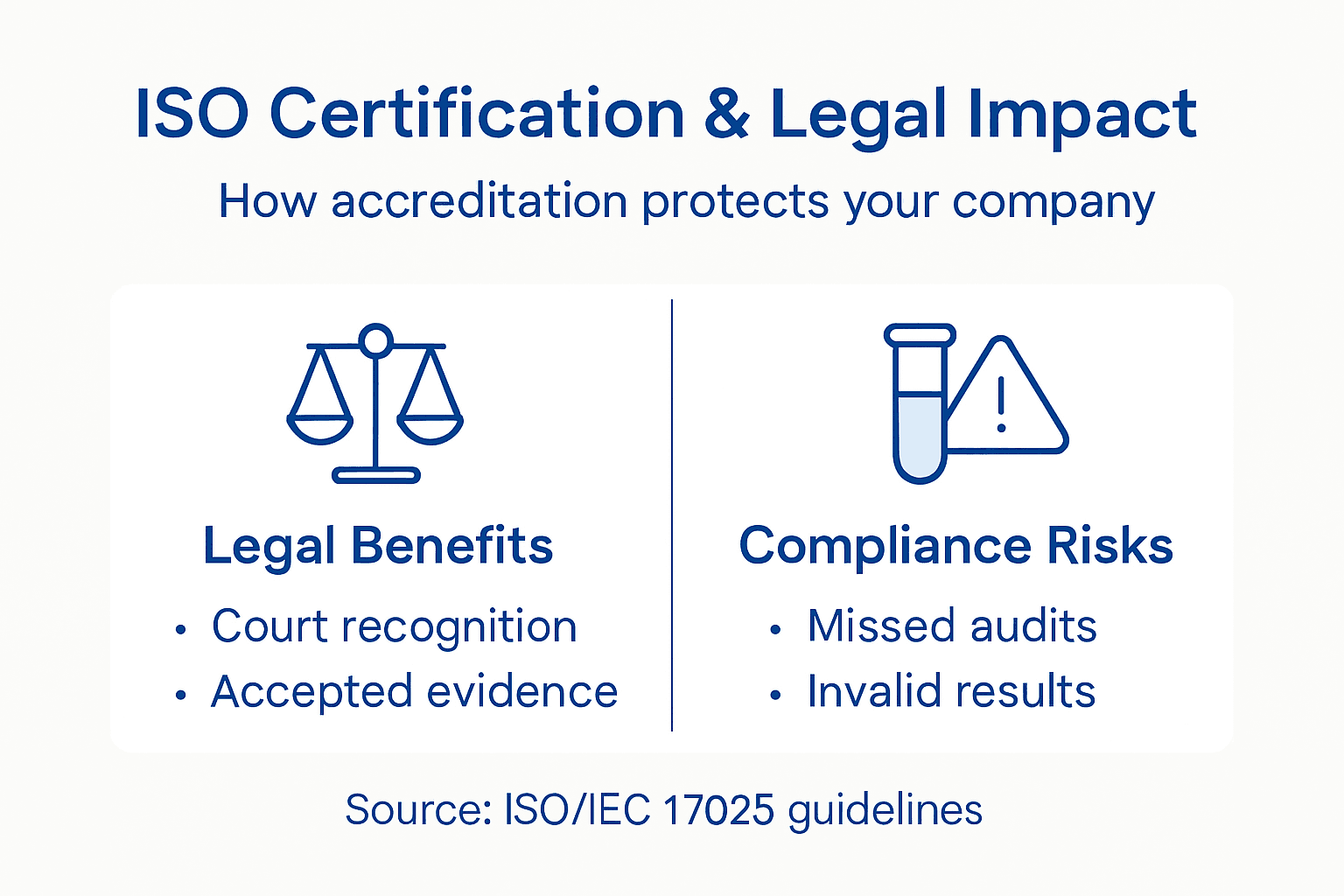
Courts and regulatory agencies recognize ISO/IEC 17025 as evidence of laboratory competence. When test results appear in litigation or administrative hearings, judges and arbitrators expect to see documentation proving the lab followed rigorous protocols. ISO accreditation provides exactly that documentation.
ISO standards support legal compliance by providing internationally recognized frameworks for conformity assessment. Adherence to these standards facilitates acceptance of test results by regulatory authorities and legal systems across countries. This matters because your company faces potential liability if test results later prove unreliable.
Your compliance obligations vary by jurisdiction and industry. Some requirements mandate ISO accreditation explicitly. Others require that testing providers meet “recognized standards”—which ISO/IEC 17025 satisfies. Here’s what you need to understand:
- Chain of custody documentation proving samples were handled securely from collection through analysis
- Method validation showing the testing procedures detect substances accurately
- Staff competence records confirming analysts have proper qualifications and training
- Equipment maintenance logs demonstrating instruments function reliably
ISO/IEC 17025 accreditation ensures drug testing labs maintain quality and traceability by establishing these requirements. Many legal jurisdictions and regulatory bodies require or recognize ISO 17025 to ensure reliability of drug testing results used in employment, criminal justice, or medical decisions.
The legal defensibility of your test results depends directly on laboratory practices. If an employee challenges a positive test result in court, the judge will examine whether the lab followed validated procedures, maintained equipment properly, and documented everything correctly. ISO accreditation proves compliance with these standards.
Without ISO accreditation or equivalent certification, your company risks having test results excluded as evidence or facing expensive litigation defending testing procedures that lack independent validation.
Regulatory agencies increasingly expect ISO accreditation from testing providers. Federal contractors must ensure testing facilities meet specific standards. State agencies overseeing professional licenses often require accredited laboratories. Even private employers face litigation risk when using non-accredited labs.
Your company’s drug testing policy should explicitly require accredited providers. This protects you legally by demonstrating reasonable care in selecting testing partners. Documentation showing you verified accreditation becomes crucial if your testing program ever faces legal challenge.
Different regulatory frameworks apply in different contexts. Employment testing may require SAMHSA certification. Clinical testing may require CLIA accreditation. Criminal justice contexts often demand ISO/IEC 17025 specifically. Understanding which standards apply to your situation prevents costly compliance mistakes.
Pro tip: Include accreditation verification in your vendor selection process and require testing providers to provide current ISO/IEC 17025 certificates before contracting, creating documented evidence of your due diligence.
Risks, Costs, and Common Pitfalls
Using non-accredited or inadequately accredited testing providers exposes your company to substantial financial and legal risks. When test results prove unreliable, you face liability claims, regulatory penalties, and damage to your organization’s credibility.
Labs without ISO/IEC 17025 accreditation operate without independent verification of their competence. This creates vulnerability. If an employee disputes a positive result, you cannot reference industry-standard protocols to defend the test’s validity. Courts question results lacking accreditation more readily than results from certified laboratories.
Failure to obtain or maintain ISO 17025 certification exposes labs to legal liabilities, reputational damage, and financial losses due to inaccurate or non-defensible test results. The certification process involves significant costs related to preparation, documentation, external assessments, and ongoing compliance monitoring.
Common pitfalls that compromise testing programs include:
- Inadequate staff training leaving analysts unfamiliar with proper procedures
- Poor documentation making it impossible to prove what actually happened during testing
- Failure to maintain equipment calibration rendering results scientifically unreliable
- Overlooking continual improvement requirements allowing quality to degrade over time
The financial investment in ISO accreditation is substantial. Initial certification can cost laboratories between $15,000 and $50,000 depending on complexity and scope. Annual surveillance audits cost another $5,000 to $15,000 yearly. These expenses exist because proper quality systems demand resources.
These are typical costs and audit time frames for ISO/IEC 17025 accreditation:
| Cost/Activity | Typical Amount/Frequency | Business Impact |
|---|---|---|
| Initial Certification | $15,000 - $50,000 once | High upfront investment |
| Annual Surveillance Audit | $5,000 - $15,000 per year | Ongoing operational expense |
| Comprehensive Reassessment | Every 2 years | Ensures continued credibility |
Common challenges implementing ISO standards include establishing effective quality management systems, adequately training personnel, validating test methods, and maintaining audit trails. Laboratories often face risks such as compromised test result integrity and legal challenges if quality systems are weak or poorly documented.
When quality systems fail, your company inherits the consequences: excluded evidence, employee litigation, and regulatory investigations that damage operations and reputation simultaneously.
Many labs cut corners on documentation thinking it saves time. They skip internal audits, delay equipment calibration, or provide minimal staff training. These shortcuts eventually surface during legal discovery or regulatory inspection, transforming cost savings into expensive problems.
Chain of custody violations represent a frequent pitfall. If samples sit unattended, move between locations without proper tracking, or lack secure storage, test results become legally questionable. One unguarded sample ruins credibility for your entire program.
Method validation gaps also undermine programs. Some labs use testing procedures that work in practice but lack documented scientific validation. When challenged in court, the lab cannot demonstrate the method detects substances accurately or produces reliable results.
Your company bears responsibility for provider competence. Selecting low-cost testing options without verifying accreditation creates liability. When test results later prove questionable, you face employee claims that the testing was unfair or unreliable.
Pro tip: Budget for accredited testing providers as a compliance cost, not a discretionary expense, and request quarterly compliance reports from your provider to catch documentation gaps before they create legal exposure.
Ensure Your Drug Testing Program Meets the Highest ISO Standards
Understanding the legal impact of ISO certification in drug testing is crucial to protect your company from costly liabilities and regulatory challenges. As the article highlights, only laboratories with rigorous ISO/IEC 17025 accreditation consistently deliver legally defensible, scientifically validated results that withstand scrutiny in court and audits. Avoid risks related to poor documentation, equipment calibration failures, or unqualified personnel by partnering with trusted providers certified to meet these high standards.
Take control of your drug testing compliance today with CountryWideTesting.com. Our platform connects you directly to licensed laboratories that comply with ISO, SAMHSA, CLIA, and CAP requirements. Whether you need urine or mouth swab tests for employment, federal, or organizational screening, we ensure your samples are processed reliably and securely. Start by exploring our comprehensive lab testing services and experience peace of mind knowing your testing program is backed by certified expertise. Visit CountryWideTesting.com now and safeguard your business with industry-leading drug testing solutions.
Frequently Asked Questions
What is ISO certification in drug testing?
ISO certification in drug testing is formal recognition that a laboratory meets international standards for competence and reliability, ensuring its testing operations, staff, and quality systems are aligned with globally recognized benchmarks.
Why is ISO/IEC 17025 accreditation important for drug testing labs?
ISO/IEC 17025 accreditation is essential because it verifies that a laboratory can consistently produce accurate and legally defensible test results, which is crucial for legal proceedings and regulatory compliance audits.
How does ISO certification impact the legal defensibility of drug test results?
ISO certification enhances the legal defensibility of drug test results by providing documentation that proves compliance with rigorous protocols, enabling courts and regulatory agencies to accept the results as credible evidence in litigation or regulatory assessments.
What are common pitfalls to avoid when using drug testing providers?
Common pitfalls include inadequate staff training, poor documentation practices, failing to maintain equipment calibration, and neglecting chain of custody protocols, all of which can compromise the integrity of test results and expose your organization to legal risks.