
CLIA's Impact on Drug Testing Compliance for Employers
TL;DR:
- Most employment drug tests are considered forensic and generally exempt from CLIA requirements.
- On-site tests classified as waived still require a CLIA waiver and confirmatory lab testing.
- Proper documentation and confirmation of positive results are essential to maintain compliance.
Most employers assume all workplace drug testing falls under the same regulatory umbrella. That assumption can get you in trouble. The Clinical Laboratory Improvement Amendments, better known as CLIA, govern laboratory testing on human specimens, but the rules are far more nuanced than a simple yes-or-no requirement. Depending on whether you’re running employment screening, using an on-site clinic, or ordering medical tests, your obligations shift considerably. This article breaks down exactly where CLIA applies, where it doesn’t, and what HR professionals need to do right now to stay compliant and avoid costly mistakes.
Table of Contents
- What is CLIA and why does it matter for drug testing?
- Is workplace drug testing subject to CLIA requirements?
- How does CLIA impact on-site drug screening and clinics?
- Best practices for compliant workplace drug testing
- The real compliance challenge: What HR gets wrong about CLIA
- Streamline your drug testing with certified solutions
- Frequently asked questions
Key Takeaways
| Point | Details |
|---|---|
| CLIA regulates clinical tests | CLIA sets federal standards for labs testing human specimens used in health care. |
| Employment drug testing is exempt | Most workplace drug tests are forensic and don’t require CLIA certification. |
| On-site tests need waivers | Clinics and employers using instant on-site tests for employees need CLIA waivers and should confirm positives. |
| Use certified labs for compliance | Employers should use SAMHSA-certified labs and always confirm positive results to stay compliant. |
What is CLIA and why does it matter for drug testing?
CLIA stands for the Clinical Laboratory Improvement Amendments, a set of federal regulations first enacted in 1988 and administered by the Centers for Medicare and Medicaid Services (CMS). Its core purpose is to ensure that laboratory testing performed on human specimens meets consistent standards for accuracy, reliability, and timeliness. As the regulation states, CLIA establishes federal quality standards for laboratory testing on human specimens.
For HR professionals, understanding CLIA starts with knowing what it actually regulates. CLIA applies to tests that are used for health assessment, disease diagnosis, prevention, or treatment decisions. Think of it as the quality assurance framework for clinical medicine. When a doctor orders a blood glucose test or a urine culture, CLIA-certified labs are responsible for making sure those results are accurate enough to drive medical decisions.
Here’s why that matters for your drug testing program:
- Health assessment tests require CLIA-certified labs because the results can directly influence medical treatment.
- Employment drug screens are primarily forensic in nature and often fall outside CLIA’s direct reach.
- On-site point-of-care tests may still require a CLIA waiver if they are conducted in a clinical setting.
- Confirmatory testing sent to a lab carries different requirements depending on the testing purpose.
A useful way to understand CLIA certification explained is to think of it as a quality license for clinical labs. Without it, a lab cannot legally perform tests that influence patient care. But note that the word “clinical” is the key distinction. Not every test involving a human specimen is clinical in the regulatory sense.
Statistic spotlight: More than 320,000 laboratory entities in the United States are currently regulated under CLIA, covering everything from hospital labs to physician offices.
For HR teams building a drug testing program, the starting question is not simply “Is our lab CLIA certified?” It’s “What type of testing are we doing, and does CLIA even apply to it?” Reviewing CLIA regulations for HR gives you a much clearer picture of where your program sits within this regulatory landscape.
Is workplace drug testing subject to CLIA requirements?
This is where most employers get confused. The short answer is: standard employment drug testing is generally not subject to CLIA. The reason comes down to a critical distinction between forensic testing and medical testing.
Forensic testing is performed for legal, investigative, or employment purposes. The results are used to make decisions about employment eligibility, criminal cases, or regulatory compliance, not to diagnose or treat a medical condition. Because of this, workplace drug testing for employment is generally considered forensic and exempt from CLIA requirements.
Medical testing, by contrast, produces results that a physician uses to guide patient care. A urine test ordered by a doctor to detect a kidney infection is medical. A urine drug screen ordered by HR to check a job applicant is forensic.
Types of drug testing commonly exempt from CLIA include:
- Employment pre-hire and post-accident screens
- Drug tests conducted for criminal investigations
- Screens required under federal Department of Transportation (DOT) mandates using SAMHSA-certified labs
- Forensic specimen analysis for legal proceedings
Here’s a quick comparison to keep your program on track:
| Testing type | CLIA required? | Governing standard | Typical setting |
|---|---|---|---|
| Employment drug screen | No (forensic) | SAMHSA / DOT | Certified collection site |
| Medical diagnostic test | Yes | CLIA | Clinical lab |
| On-site waived test (clinic) | Waiver required | CLIA waiver program | Clinic or workplace clinic |
| Criminal forensic screen | No | Chain-of-custody rules | Certified forensic lab |
“The regulatory line between forensic and medical testing isn’t always obvious. When in doubt, the test’s purpose determines its classification, not just its method.”
Understanding forensic drug testing helps employers see that compliance isn’t one-size-fits-all. A program mixing pre-employment screens with occupational health evaluations may straddle both categories, and that’s where mistakes happen.
How does CLIA impact on-site drug screening and clinics?
If your company operates an on-site clinic or uses point-of-care test devices such as instant urine cups, the CLIA picture changes. These rapid tests are classified as “waived” tests under CLIA because they are simple to perform and carry a low risk of error when used correctly. But “waived” does not mean “unregulated.”
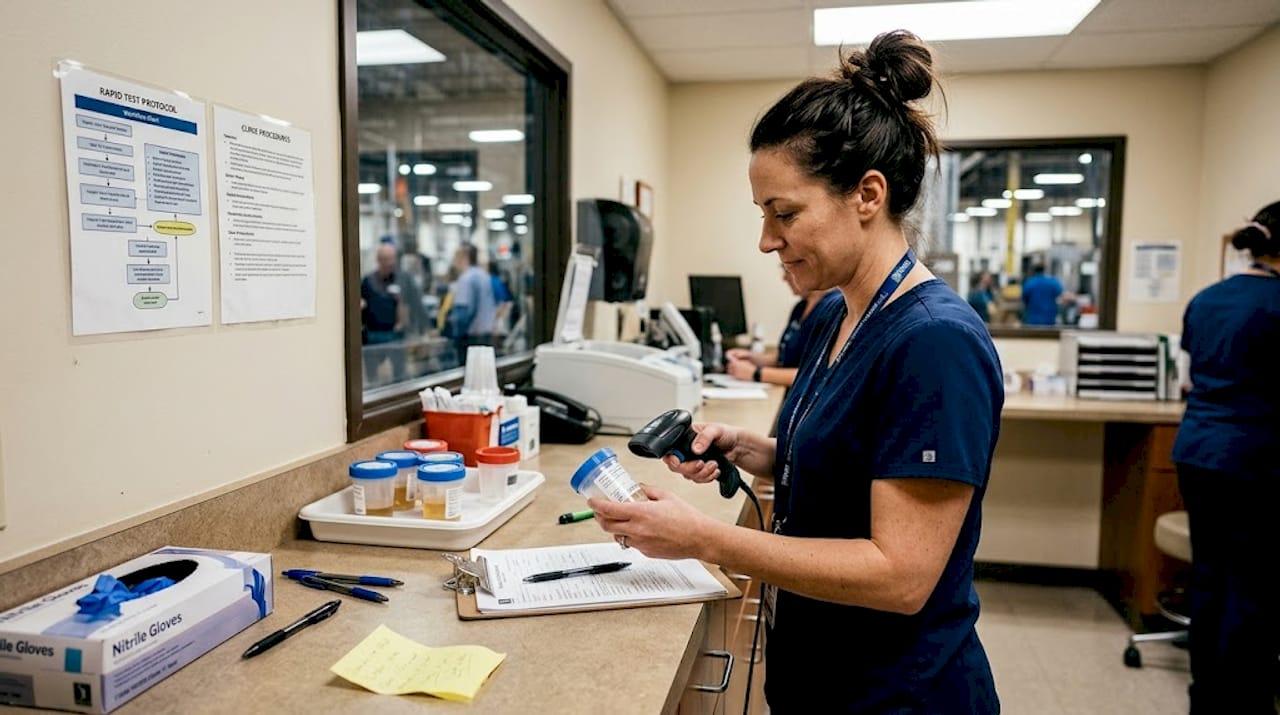
Any facility performing waived tests to support patient care, including occupational health clinics and on-site medical units, needs a CLIA waiver and should confirm all positive results with a certified laboratory.
Here’s how to navigate this process:
- Determine your facility type. If your on-site location functions as a clinic (providing medical evaluations, not just forensic screens), CLIA likely applies.
- Apply for a CLIA certificate of waiver. The application is submitted through CMS and is renewed every two years. Fees are modest, typically a few hundred dollars.
- Follow manufacturer instructions exactly. CLIA waivers are granted based on tests being used as directed. Deviation can invalidate your waiver and expose you to liability.
- Send all positive results for confirmatory testing. On-site rapid tests are screening tools only. A positive result from an instant cup is not a final answer.
- Document everything. Maintain records of test lots, expiration dates, results, and chain-of-custody documentation.
Pro Tip: Even if your workplace drug testing is forensic and CLIA-exempt, confirming positive rapid test results with a certified lab is a best practice that protects you legally and keeps your process defensible.
For clinics managing this workflow, reviewing clinic drug screening compliance resources helps prevent the most common procedural gaps. Understanding the importance of confirmatory testing is equally important because a contested result without lab confirmation can unravel an otherwise solid testing program.
Best practices for compliant workplace drug testing
Knowing where CLIA applies is only half the battle. Building a compliant, defensible drug testing program means combining the right labs, the right procedures, and the right documentation habits.
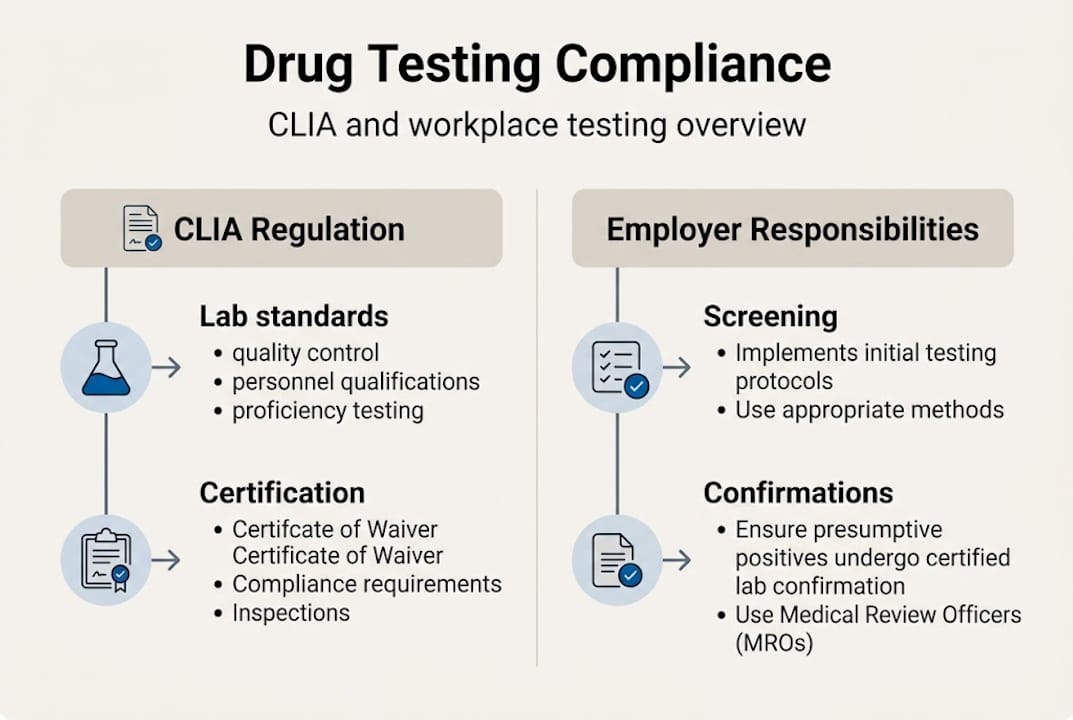
Use SAMHSA-certified labs for employment screening. SAMHSA certification sets the gold standard for forensic drug testing in employment contexts. These labs use rigorous chain-of-custody procedures and quality controls that hold up in legal challenges.
Separate medical from forensic testing workflows. If your company offers occupational health services alongside employment drug screening, keep those workflows distinct. Medical tests need CLIA-compliant labs. Forensic screens need SAMHSA-certified labs. Mixing them creates compliance risk and muddies your documentation.
Always confirm positive results. As confirmed by federal guidance, employers should confirm positive results and distinguish medical from forensic testing to avoid compliance errors. A rapid-test positive confirmed by a certified lab is nearly unassailable. A positive result from only a rapid test is a liability.
Here’s a quick compliance comparison to guide your internal review:
| Practice | Compliant approach | Common mistake |
|---|---|---|
| Lab selection | Use SAMHSA-certified lab for employment | Using any accredited lab without checking forensic certification |
| Positive result handling | Confirm with GC-MS or LC-MS lab test | Acting on rapid test alone |
| Test categorization | Separate medical vs. forensic workflows | Treating all tests the same |
| Documentation | Full chain-of-custody records | Incomplete or missing records |
Additional practices to strengthen your program:
- Train HR staff on the difference between CLIA and SAMHSA requirements.
- Review your policy annually to reflect regulatory updates.
- Use top drug testing kits that meet quality thresholds for your testing type.
- Consult the SAMHSA confirmation lab test FAQ to understand what confirmatory testing looks like in practice.
Pro Tip: When building your drug testing policy, document not just what tests you use but why. Showing regulatory intent in your records strengthens your defense if a result is ever challenged.
The real compliance challenge: What HR gets wrong about CLIA
After working in this space, one pattern emerges consistently: HR teams overestimate how much CLIA governs their employment drug testing, and then underestimate how much they still need to do to stay compliant. Those two errors compound each other in frustrating ways.
Some teams spend resources auditing CLIA compliance for forensic screens that are simply exempt, while simultaneously failing to confirm positive results or document chain-of-custody properly. That’s the real risk. It’s not usually a failure to get CLIA certified. It’s a failure to understand that forensic testing carries its own equally demanding standards.
The most overlooked pitfall? Treating a rapid, on-site screen as a final result. Whether it’s forensic or clinical, a rapid positive is a lead, not a conclusion. Skipping confirmatory testing is where programs collapse under legal scrutiny.
Our practical recommendation: lean on SAMHSA-certified labs for all employment testing, maintain clear clinic workflow compliance insights, and never let documentation slide. The employers who avoid regulatory trouble aren’t necessarily the most sophisticated. They’re the most consistent.
Streamline your drug testing with certified solutions
Understanding the CLIA landscape is step one. Implementing a compliant, efficient program is step two, and that’s where having the right partner makes the difference.
At CountryWideTesting.com, we connect HR teams and employers with lab testing services backed by SAMHSA-certified, CLIA-compliant laboratories. Whether you need bulk employment screening, confirmatory lab testing, or a reliable rapid test option, our platform makes compliance straightforward. You can also order an at-home drug test kit for flexible screening needs. Stop guessing about which tests meet which standards and start running a program that’s built for audit-ready compliance from day one.
Frequently asked questions
Do all drug tests for employees require CLIA certification?
No, standard employment drug tests performed in forensic or SAMHSA-certified labs are exempt from CLIA requirements. Workplace drug testing for employment is generally considered forensic and therefore falls outside CLIA’s scope.
When does a clinic or employer need a CLIA waiver for drug testing?
A CLIA waiver is needed when performing on-site waived tests, such as instant urine screens with patient-specific results, in a clinical setting. Clinics need a CLIA waiver for on-site waived tests and should always confirm positive results with a certified laboratory.
Should employers confirm positive drug test results even if using a SAMHSA-certified lab?
Yes, confirming all positives ensures accuracy and compliance with regulatory standards. Always confirm positives in employment drug testing, regardless of the initial screening method used.
What is the difference between forensic and medical drug testing?
Forensic testing is for legal or employment purposes and is exempt from CLIA, while medical testing impacts diagnosis or treatment and is regulated under CLIA. Workplace drug testing for employment is generally considered forensic and exempt, while medically ordered tests are fully regulated by CLIA.