
Alcohol screening compliance: employer guide to safer workplaces
Missing a single Clearinghouse query or running random tests at the wrong rate can cost your organization more than $9,000 per violation, and that’s before any legal exposure or workplace incident enters the picture. Alcohol screening compliance sounds straightforward until you’re staring down a DOT audit with incomplete records. According to federal employer guidelines, alcohol screening compliance refers to an employer’s duty to follow legal and procedural standards for workplace alcohol testing in safety-sensitive roles. This guide breaks down exactly what that means, who it applies to, and how your organization can stay on the right side of the law.
Table of Contents
- Understanding alcohol screening compliance
- When and how alcohol testing is required
- Key employer responsibilities for compliance
- Common compliance failures and penalties
- Non-DOT workplaces: state laws and best practices
- How CountryWideTesting.com supports your compliance program
- Frequently asked questions
Key Takeaways
| Point | Details |
|---|---|
| DOT compliance is mandatory | Employers in safety-sensitive industries must rigorously adhere to federal alcohol testing rules. |
| Know the testing triggers | Pre-employment, random, post-accident, and reasonable suspicion testing each have unique requirements. |
| Documentation protects you | Maintain clear records and regularly audit processes to minimize compliance risk. |
| Violations are costly | Common errors can result in fines of $9,000 or more per violation. |
| State rules vary for non-DOT | Check state laws if you operate outside DOT regulation and establish best practice voluntary programs. |
Understanding alcohol screening compliance
Alcohol screening compliance is not a single checkbox. It’s a layered system of policies, procedures, approved devices, and trained personnel that employers must maintain continuously. The goal is to protect workers in safety-sensitive roles from the risks posed by alcohol impairment on the job.
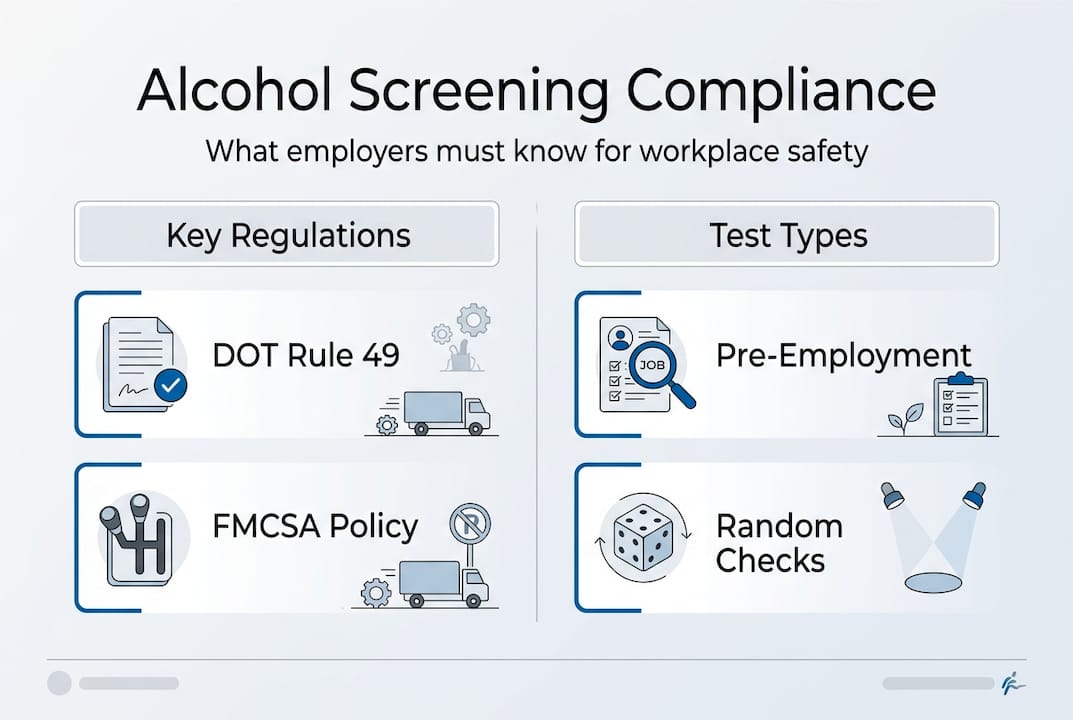
For DOT-regulated employers, the rules are federal and non-negotiable. DOT regulations such as 49 CFR Part 40 and FMCSA Part 382 require employers to use approved devices and trained personnel for all alcohol testing. Non-DOT employers, on the other hand, operate under a patchwork of state laws and voluntary programs. Understanding compliance in workplace drug screening is the first step toward building a defensible program.
“Compliance is not just about passing an audit. It’s about creating a culture where safety-sensitive employees know the rules and trust the process.”
The stakes are real. The FMCSA has recorded over 326,000 violations related to drug and alcohol compliance since 2020. That number reflects how often even experienced employers get it wrong.
| Regulatory framework | Applies to | Key standard |
|---|---|---|
| 49 CFR Part 40 | All DOT-regulated employers | Testing procedures and device approval |
| FMCSA Part 382 | Commercial motor vehicle operators | Random rates, Clearinghouse queries |
| State laws | Non-DOT employers | Varies by state |
| Voluntary programs | Any employer | Best practices, no federal mandate |
When and how alcohol testing is required
Not every alcohol test is triggered the same way. Each testing scenario has its own rules, timelines, and consequences. Getting these wrong is one of the fastest ways to rack up violations.
Required test types under DOT regulations include pre-employment, random (at a minimum 10% annual rate), reasonable suspicion, post-accident (within 8 hours for alcohol), return-to-duty, and follow-up screening. Pre-employment alcohol testing is actually optional under DOT rules, which surprises many HR professionals.
Here’s how BAC outcomes translate into consequences:
| BAC result | Consequence |
|---|---|
| Below 0.02 | No action required |
| 0.02 to 0.039 | Removed from duty for minimum 8 hours |
| 0.04 or higher | Immediate removal, SAP referral required |
| Refusal | Treated same as 0.04 or higher |
A BAC at or above 0.02 triggers a confirmation test, while a result of 0.04 or higher, or a refusal, disqualifies the employee from safety-sensitive duties immediately. Refusals include failing to provide a sample, leaving the testing site, or any other behavior that obstructs the process.
- Confirm the testing scenario matches a required or permitted category.
- Use only federally approved evidential breath testing devices.
- Ensure a trained Breath Alcohol Technician (BAT) administers the test.
- Document results immediately and notify the Designated Employer Representative (DER).
- Follow the correct removal or return-to-duty protocol based on BAC outcome.
Pro Tip: Post-accident alcohol tests must happen within 8 hours. If that window closes, document why the test wasn’t completed. Missing the window without documentation is itself a violation.
Understanding alcohol testing for workplace safety goes beyond knowing the rules. It means building a process that executes correctly under pressure. Reviewing examples of alcohol screening tests used in HR settings can help your team prepare for real scenarios. For broader context, drug-free workplace guidelines from SAMHSA offer a solid policy foundation.
Key employer responsibilities for compliance
Knowing when to test is only half the battle. The operational side of compliance requires consistent execution across multiple functions, from policy writing to record retention.
Here are the core steps every DOT-regulated employer must take:
- Develop a written alcohol testing policy that covers all required test types and employee rights.
- Designate a DER (Designated Employer Representative) who manages testing logistics and communicates with service agents.
- Partner with a qualified consortium or TPA (Third-Party Administrator) to manage random pool selection and testing coordination.
- Query the FMCSA Clearinghouse before hiring safety-sensitive employees and annually for current employees.
- Train supervisors to recognize signs of alcohol impairment and initiate reasonable suspicion testing correctly.
- Retain all records for the required retention periods, including test results, refusals, and training documentation.
- Audit your program regularly to catch rate errors, documentation gaps, or service agent failures before a federal auditor does.
“Employers face penalties up to $15,000 per violation for non-compliance, and service agents who fail to meet standards can expose employers to additional liability.”
This is directly supported by ODAPC employer guidelines, which outline every responsibility listed above. Skipping even one step, like failing to query the Clearinghouse before a new hire’s first safety-sensitive assignment, can result in a costly violation.
Pro Tip: Use a compliance calendar to track annual Clearinghouse query deadlines, random testing rate periods, and supervisor training renewals. Automation reduces human error significantly.
If you’re building your program from scratch, start with setting up DOT drug testing and then layer in your alcohol screening methods to ensure full coverage.
Common compliance failures and penalties
Even organizations with established programs get cited. The most common failures aren’t dramatic oversights. They’re procedural gaps that compound over time.
Top compliance violations employers face:
- Missing or incomplete Clearinghouse queries for new hires or annual checks
- Running random testing pools at rates below the required federal minimum
- Using non-approved testing devices or unqualified technicians
- Failing to document post-accident testing attempts and outcomes
- Inadequate supervisor training records
- Incomplete or missing return-to-duty and follow-up testing documentation
The numbers behind these failures are significant. FMCSA data shows 326,795 total violations since 2020, with penalties averaging over $9,000 per infraction. That’s not a rounding error. For a mid-size fleet or transportation company, a cluster of violations from a single audit can reach six figures.
| Violation type | Typical penalty range |
|---|---|
| Missed Clearinghouse query | Up to $15,000 per instance |
| Incorrect random testing rate | Up to $15,000 per violation |
| Failure to remove employee after positive test | Up to $15,000 |
| Inadequate record retention | Varies by severity |
Audit failures often trace back to one root cause: no one owned the compliance function. When responsibility is spread across HR, safety, and operations without clear accountability, things fall through the cracks. Reviewing an alcohol testing compliance guide specific to your industry can help you identify gaps before regulators do.
Non-DOT workplaces: state laws and best practices
DOT employers aren’t the only ones with compliance concerns. Non-DOT workplaces face a different but equally important set of considerations.
There is no federal alcohol testing mandate for non-DOT employers, but that doesn’t mean you’re off the hook. States like Tennessee tie workers’ compensation premium discounts to participation in certified drug-free workplace programs, which often include alcohol screening requirements. Other states restrict when and how employers can test, particularly around pre-employment and random testing.
Best practices for non-DOT employers:
- Write a clear, legally reviewed alcohol testing policy before testing anyone
- Specify which positions are subject to testing and under what circumstances
- Use HHS-certified laboratories to ensure result integrity
- Train supervisors on reasonable suspicion documentation
- Handle all results confidentially to protect employee privacy
- Review ADA obligations before taking adverse action based on test results
- Consult state law before implementing random testing programs
Voluntary programs can be powerful tools for reducing liability and promoting safety, but they must be designed carefully. Reviewing alcohol testing protocols for HR gives you a practical framework for building a program that holds up legally and operationally.
How CountryWideTesting.com supports your compliance program
Building a compliant alcohol screening program requires reliable tools, certified lab partnerships, and products that meet federal standards. That’s exactly what CountryWideTesting.com delivers.
Whether you’re a DOT-regulated fleet manager or an HR professional building a voluntary workplace program, CountryWideTesting.com offers alcohol testing products and lab services backed by SAMHSA, CLIA, and CAP-certified laboratories. From evidential breath testing supplies to urine-based screening panels, the platform gives you access to compliant, audit-ready solutions without the complexity of managing multiple vendors. You can also access educational resources and employer-focused testing guides to keep your team informed and your program current. When compliance is on the line, having a trusted testing partner matters.
Frequently asked questions
Who is required to comply with alcohol screening regulations?
All DOT-regulated safety-sensitive employers must comply with federal alcohol testing rules. Non-DOT employers may face state or local requirements, or choose to adopt voluntary programs.
What happens if an employee refuses an alcohol test?
Refusal is treated the same as a BAC of 0.04 or higher and results in immediate removal from safety-sensitive duties, including failure to provide a sample or leaving the testing site.
How long must alcohol screening records be retained?
DOT-regulated employers must retain alcohol screening records for five years, covering test results, refusals, and related documentation.
What is the most common alcohol compliance violation?
Missed Clearinghouse queries and incorrect random testing rates account for a significant share of the tens of thousands of FMCSA violations recorded since 2020.
Are there federal requirements for alcohol screening in non-DOT workplaces?
No federal mandate exists for non-DOT employer testing, but state laws and industry best practices strongly advise implementing a written screening policy.