
Why Test for Synthetic Drugs: A 2026 Safety Guide
TL;DR:
- Standard drug tests often fail to detect synthetic drugs because they rely on antibody recognition, which most novel substances evade. Advanced laboratory methods like LC-MS/MS can identify over 2,000 compounds, including new synthetics, by analyzing molecular structures precisely. Continuous updates to testing panels and tiered workflows improve detection, clinical care, workplace safety, and public health responses.
Synthetic drug testing is the process of identifying novel psychoactive substances and designer compounds that evade detection by standard drug panels. This distinction matters because the gap between what standard tests catch and what people are actually using has never been wider. Fentanyl analogues, synthetic cannabinoids, and nitazene opioids now appear in the illicit supply at concentrations that can be lethal at microgram doses. For individuals, employers, and healthcare professionals, understanding why test for synthetic drugs is no longer optional. It is a clinical and safety necessity.
Why do standard drug tests fail to detect synthetic drugs?
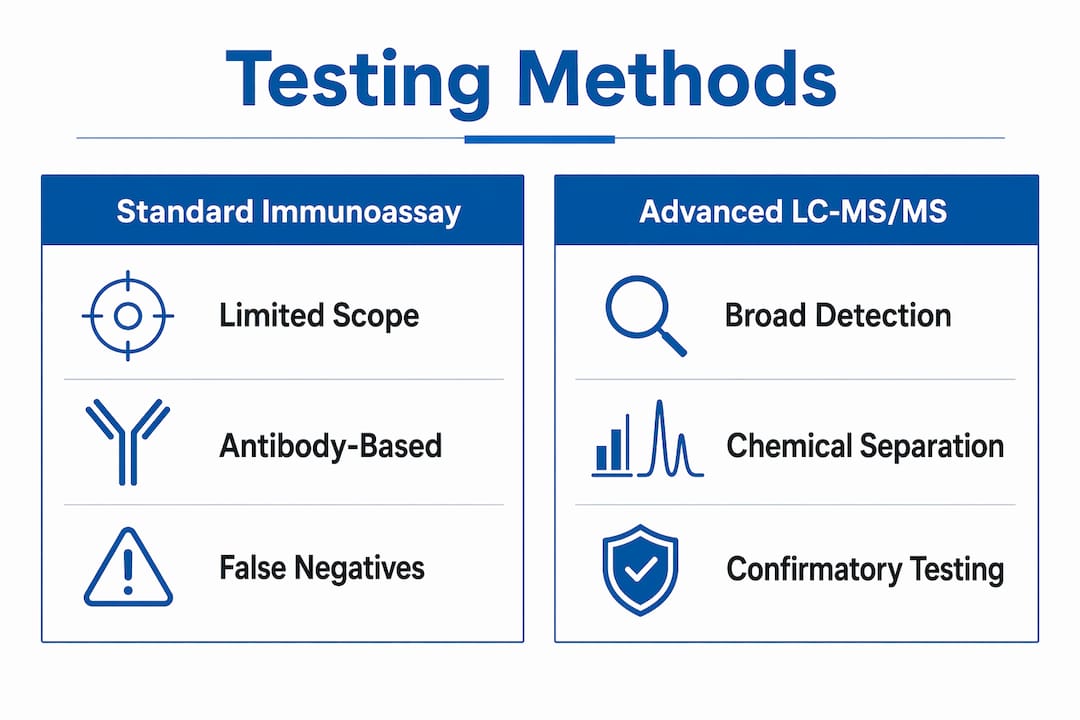
Standard urine immunoassay panels fail to detect most synthetic drugs because they rely on antibody binding, and synthetic compounds are engineered to avoid that binding. Immunoassays work through competitive antibody recognition. When a drug molecule does not match the antibody’s target shape, the test returns a negative result, even if the substance is present at a dangerous level. Structural novelty of NPS causes a direct mismatch with the antibodies built into standard panels.
The practical consequence is severe. Standard panels often exclude ketamine, gamma-hydroxybutyrate, psilocybin, and synthetic cathinones entirely. These are not obscure compounds. They appear regularly in emergency department presentations and workplace incidents. A person who has consumed a synthetic cannabinoid like XLR-11 or a cathinone like alpha-PVP will test negative on a routine 10-panel urine screen.
Nitazene opioids illustrate the problem sharply. False negatives occur frequently with nitazene analogues and orphine compounds because their molecular structures differ enough from morphine and codeine to escape antibody detection. Nitazenes are estimated to be many times more potent than fentanyl, yet a standard opioid immunoassay strip will not flag them.
The consequences extend beyond clinical settings. In workplace drug testing, a negative standard test cannot reliably exclude synthetic drug use. An employee impaired by a synthetic cannabinoid passes a routine screen and returns to safety-critical work. That is not a theoretical risk. It is a documented pattern in industries from transportation to construction.
Pro Tip: If a patient or employee presents with signs of intoxication but tests negative on a standard panel, request a confirmatory LC-MS/MS analysis before ruling out synthetic drug involvement.
The substances most commonly missed by standard panels include:
- Synthetic cannabinoids (e.g., JWH-018, XLR-11, AB-FUBINACA)
- Synthetic cathinones (e.g., mephedrone, MDPV, alpha-PVP)
- Nitazene opioids (e.g., isotonitazene, metonitazene)
- Novel benzodiazepines (e.g., etizolam, flualprazolam)
- Fentanyl analogues not covered by standard fentanyl antibodies
What advanced methods exist for accurate synthetic drug detection?
The most reliable approach to synthetic drug detection combines rapid screening with confirmatory laboratory analysis. This tiered strategy catches what immunoassays miss while keeping costs manageable. Tiered testing workflows combining rapid screens with confirmatory LC-MS/MS analysis improve both accuracy and practical feasibility for clinical and occupational settings.
Liquid chromatography-mass spectrometry (LC-MS/MS)
LC-MS/MS is the gold standard for confirmatory synthetic drug testing. It separates compounds by chemical properties and identifies them by molecular weight and fragmentation pattern. This method detects substances at very low concentrations, which matters enormously for nitazenes and fentanyl analogues that are active at microgram or nanogram levels. High-resolution mass spectrometry also supports suspect screening, meaning labs can search for compounds they did not originally target.
Expanded and updated drug panels
Advanced forensic labs maintain reference libraries that are continuously updated as new compounds emerge. Advanced forensic labs can screen over 2,000 compounds, far exceeding the 10 to 12 substances covered by a standard urine panel. That scale of coverage transforms what is detectable in a single sample.
The table below compares standard immunoassay testing with advanced laboratory methods across key performance factors.
| Factor | Standard immunoassay | Advanced LC-MS/MS panel |
|---|---|---|
| Compounds detected | 10–12 common drugs | 2,000+ including novel synthetics |
| Synthetic cannabinoid detection | Rarely | Yes, with updated libraries |
| Nitazene opioid detection | No | Yes, with HRMS |
| Turnaround time | Minutes (point-of-care) | Hours to days (lab-based) |
| Cost per test | Low | Higher, but falling |
| Confirmatory value | Presumptive only | Legally and clinically defensible |
Pro Tip: Use a rapid immunoassay as a first-pass screen, then route any clinically suspicious negative to an LC-MS/MS confirmatory test. This approach balances speed with accuracy.
The main limitation of advanced methods is cost and access. Not every clinic or employer has direct access to a SAMHSA-certified or CAP-accredited laboratory. This is where working with a testing partner that maintains those accreditations becomes critical. Countrywidetesting connects individuals, employers, and healthcare professionals to lab testing services that meet SAMHSA, ISO, CLIA, and CAP standards, covering synthetic drug panels that go well beyond routine screens.
How does synthetic drug testing impact individuals, employers, and healthcare professionals?
The importance of synthetic drug testing plays out differently depending on who is doing the testing and why. The stakes, however, are equally high across all three groups.
For healthcare professionals
Accurate synthetic drug identification changes clinical outcomes. A physician treating an overdose patient needs to know whether the substance involved is a fentanyl analogue, a nitazene, or a synthetic cannabinoid. Each requires a different treatment approach. Naloxone reverses opioid toxicity, but the dose required for a nitazene overdose may differ from a heroin overdose. Misidentification leads to under-treatment. Confirmed identification enables antidote protocol guidance and directs the clinical team toward the right intervention. Healthcare professionals who rely on drug testing kits for healthcare providers need panels that include synthetic opioids and novel psychoactives, not just traditional substances.

For employers
Workplace safety depends on knowing what employees have actually consumed, not just what a standard panel can detect. Synthetic cannabinoids produce impairment comparable to THC but test negative on most workplace screens. Employers in safety-sensitive industries face real liability when a worker causes an accident while impaired by a substance the test did not cover. Workplace compliance and drug testing protocols must account for synthetic substances to be legally and operationally sound.
For individuals
People seeking answers about their own health or a family member’s substance use face the same detection gap. A negative home test result is not reassurance when the substance in question is a synthetic cannabinoid or a novel opioid. Testing synthetic drugs at home with a standard kit provides false confidence. Individuals need access to expanded panels or laboratory confirmation to get a reliable answer.
The core benefits of synthetic drug testing across all three groups include:
- Accurate diagnosis and targeted treatment in emergency and clinical care
- Workplace safety and regulatory compliance in safety-sensitive industries
- Harm reduction through identification of dangerous emerging substances
- Public health surveillance data that informs policy and resource allocation
- Legal defensibility in workplace and forensic contexts
What challenges and solutions exist in keeping synthetic drug testing current?
The synthetic drug market moves faster than most testing programs. Manufacturers of novel psychoactive substances deliberately alter molecular structures to stay ahead of legal scheduling and detection methods. This creates what researchers call “identification lag,” where labs are testing for last year’s compounds while the street supply has already shifted.
Rapid emergence and variation in synthetic drugs cause labs to test for outdated compounds while use trends move on. The result is a systematic blind spot in both public health surveillance and workplace screening. A lab that has not updated its reference library in 12 months may be missing the most dangerous substances currently in circulation.
Four actions close this gap:
- Update testing panels continuously. Labs must refresh reference libraries as new compounds are identified, not on an annual cycle.
- Integrate forensic data into policy. Scheduling decisions by the DEA and FDA depend on confirmed laboratory identification of new substances.
- Build interdisciplinary teams. Clinicians, toxicologists, and public health officials need shared data pipelines, not siloed reporting.
- Invest in HRMS infrastructure. High-resolution mass spectrometry is the only method that reliably identifies structurally novel compounds on first encounter.
Testing for synthetic drugs is vital not only for detection but also for enabling public health agencies to issue timely alerts and direct resources to where harm is actually occurring. Accurate lab identification is the first link in the chain from street sample to public health response.
Interdisciplinary collaboration and toxicology data integration into real-time surveillance are the mechanisms that transform individual test results into community-level harm reduction. No single clinic or employer can solve this alone. The role of compliance in workplace drug screening extends beyond individual organizations to the broader public health infrastructure that depends on accurate, current data.
Key Takeaways
Synthetic drug testing requires advanced laboratory methods because standard immunoassay panels cannot detect the structural novelty of most novel psychoactive substances, creating critical gaps in clinical care, workplace safety, and public health surveillance.
| Point | Details |
|---|---|
| Standard tests have hard limits | Immunoassay panels miss synthetic cannabinoids, cathinones, and nitazene opioids entirely. |
| LC-MS/MS is the confirmatory standard | High-resolution mass spectrometry identifies 2,000+ compounds, including structurally novel synthetics. |
| Tiered testing is the best workflow | Combine rapid screening with lab confirmation to balance speed, cost, and accuracy. |
| Identification lag is a real risk | Labs must update reference libraries continuously as new synthetic compounds emerge. |
| All three audiences face real stakes | Clinicians, employers, and individuals each face distinct but equally serious consequences from missed detection. |
What I’ve learned from watching programs rely on outdated panels
The most common mistake I see is organizations treating a negative drug test as a clean bill of health. That assumption was reasonable 15 years ago. It is not reasonable now. Synthetic cannabinoids became widely available before most workplace panels were updated to include them. Nitazenes entered the opioid supply before most clinical labs had reference standards for them. The gap between what is circulating and what standard tests detect is not a minor technical footnote. It is the central problem in drug testing today.
What actually works is a two-track approach. Use rapid point-of-care tests for speed and initial triage. Route any clinically or operationally suspicious result to a SAMHSA-certified or CAP-accredited lab for LC-MS/MS confirmation. This is not expensive relative to the cost of a missed diagnosis or a workplace accident. The resistance I encounter most often is institutional inertia. Programs that have used the same 10-panel urine screen for 20 years are reluctant to change, even when the evidence is clear.
The public health dimension is the one most employers and clinicians underestimate. Every confirmed identification of a new synthetic compound feeds into early warning systems. Those systems trigger public health alerts, inform prescribing guidance, and shape scheduling decisions. A single well-equipped lab that identifies a new nitazene analogue in a patient sample can set off a chain of responses that prevents deaths in other cities. That is the real argument for investing in modern testing infrastructure. It is not just about the individual in front of you.
— Alan
Countrywidetesting’s approach to synthetic drug screening
Synthetic drug detection requires more than a standard urine cup. Countrywidetesting provides access to laboratory testing services backed by SAMHSA, ISO, CLIA, and CAP-certified labs, with expanded panels that go beyond routine screens to include synthetic opioids, novel cannabinoids, and designer stimulants.
Individuals, employers, and healthcare professionals can order comprehensive lab screening directly through Countrywidetesting, with results processed by accredited laboratories and supported by compliance documentation. Whether you need a single confirmatory test or a full workplace screening program, Countrywidetesting offers testing solutions built for the substances that are actually in circulation in 2026, not just the ones from a decade ago.
FAQ
Why do standard drug tests miss synthetic opioids?
Standard immunoassay tests are calibrated to detect specific molecular structures. Synthetic opioids like nitazenes have different structures than traditional opioids, so they do not bind to the antibodies in standard panels and return false negatives.
What is the most accurate method for synthetic drug testing?
LC-MS/MS combined with high-resolution mass spectrometry is the most accurate method. It can identify over 2,000 compounds, including structurally novel synthetics that immunoassays cannot detect.
Can you test for synthetic drugs at home?
Standard at-home tests do not reliably detect most synthetic drugs. For accurate results, a laboratory-based confirmatory test using an expanded panel is required.
Why does synthetic drug testing matter for employers?
Synthetic cannabinoids and other novel substances cause impairment but test negative on standard workplace panels. Employers in safety-sensitive industries face liability and compliance gaps when their testing program does not cover these substances.
How often should synthetic drug testing panels be updated?
Testing panels should be updated continuously as new compounds are identified, not on an annual cycle. Identification lag, where labs test for outdated compounds while the market has shifted, is a documented public health risk.