
Drug testing trends in 2026: compliance guide
Saliva drug tests have surged over 40% in usage among US employers between 2023 and 2026. This dramatic shift reflects broader changes in workplace drug testing driven by cannabis legalization, privacy concerns, and rapid technological advances. Employers and HR professionals face mounting pressure to balance safety requirements with evolving legal frameworks while selecting methods that respect employee rights. Understanding these trends is critical for developing compliant, effective drug testing policies in 2026.
Table of Contents
- Introduction To Drug Testing In 2026
- Regulatory Landscape And Compliance Challenges
- Technological Advances In Drug Testing Methods
- Comparison Of Drug Testing Methods
- Privacy And Ethical Considerations In Drug Testing
- Common Misconceptions About Workplace Drug Testing
- Implementing Effective Drug Testing Policies In 2026
- Explore Our Comprehensive Drug Testing Solutions
- Frequently Asked Questions About Drug Testing Trends In 2026
Key takeaways
| Point | Details |
|---|---|
| Legal complexity | Cannabis legalization in 38 states creates federal-state conflicts requiring careful policy navigation. |
| Technology evolution | Saliva tests and at-home kits offer rapid, non-invasive alternatives with accuracy rates exceeding 95% when lab-confirmed. |
| Detection realities | Drug tests detect metabolites, not impairment, with cannabis detection windows ranging from 3 to over 30 days in urine. |
| Privacy priorities | Employees demand transparent consent processes and secure data handling in testing programs. |
| Policy updates | Regular reviews ensure alignment with 2026 regulatory changes and technological capabilities. |
Introduction to drug testing in 2026
Workplace drug testing has transformed significantly in recent years. Legal cannabis access, technological innovation, and heightened privacy awareness have reshaped how employers approach substance screening. Organizations must now navigate a complex environment where traditional urine testing faces competition from oral fluid methods and at-home collection kits.
Employers prioritize drug testing for several reasons. Safety-sensitive positions require verification that workers can perform duties without impairment risk. Regulatory compliance demands testing in transportation, healthcare, and federal contracting sectors. Insurance providers often incentivize or require screening programs to reduce liability exposure.
Several current drug testing trends define the 2026 landscape:
- Rapid oral fluid testing adoption driven by convenience and reduced invasiveness
- At-home collection kits that maintain lab confirmation standards
- Enhanced focus on THC testing protocols amid widespread cannabis legalization
- Integration of mobile technology for scheduling and result delivery
- Increased emphasis on reasonable suspicion testing over random screening
These shifts reflect employer recognition that outdated testing approaches create unnecessary friction with candidates and employees. Modern programs balance detection capabilities with respect for personal dignity. Organizations that update their strategies gain competitive advantages in talent acquisition while maintaining safety standards.
The move toward less invasive methods addresses long-standing employee concerns about privacy. Traditional urine collection requires supervised bathroom access, creating uncomfortable situations. Oral fluid collection occurs in open settings with simple swab procedures. This difference improves acceptance rates and reduces administrative burden.
Technology enables faster results without sacrificing accuracy. Some oral fluid testing methods deliver preliminary findings within minutes, allowing immediate decision-making for reasonable suspicion scenarios. Lab confirmation remains available when needed, combining speed with reliability.
Regulatory landscape and compliance challenges
Navigating drug testing regulations in 2026 requires understanding multiple legal layers. Federal guidelines establish baseline requirements for certain industries. State laws add protections for employees, particularly regarding cannabis use. Local ordinances may impose additional restrictions. This patchwork creates compliance challenges for multi-state employers.
Federal regulations govern safety-sensitive positions in transportation, aviation, and other regulated sectors. The Department of Transportation maintains strict testing requirements including specific drug panels and procedures. Federal contractors must comply with Drug-Free Workplace Act provisions. These mandates remain unchanged despite state-level cannabis legalization.
State laws increasingly protect off-duty cannabis use for medical or recreational purposes. Some jurisdictions prohibit pre-employment testing for marijuana. Others prevent adverse employment actions based solely on positive THC results. Employers operating in multiple states need jurisdiction-specific policies addressing these variations.
SAMHSA guidelines continue evolving to reflect scientific understanding and legal developments. Recent updates clarify oral fluid testing protocols and establish standardized procedures. Organizations following 2026 drug screening standards benefit from clear frameworks that withstand legal scrutiny.
Common compliance pitfalls include:
- Applying uniform policies across states with conflicting cannabis laws
- Failing to update written policies when procedures change
- Not training supervisors on reasonable suspicion indicators and legal limits
- Inadequate documentation of testing decisions and processes
- Ignoring disability accommodation requirements for prescription medications
Addressing these issues requires proactive policy development. Start by identifying which positions genuinely require testing based on safety risks and regulatory obligations. Document clear criteria for pre-employment, reasonable suspicion, post-accident, and random testing. Establish consistent procedures that apply fairly across your workforce.
Employers should consult legal counsel familiar with workplace drug testing after legalization trends. State-specific guidance prevents costly violations and discrimination claims. Regular policy audits ensure drug testing policy requirements remain current as laws evolve.
Technological advances in drug testing methods
Testing technology has advanced dramatically, offering employers more options than ever. Saliva testing represents the most significant shift. Non-invasive collection, shorter detection windows for recent use, and reduced privacy concerns drive adoption. Many organizations now use oral fluid methods for reasonable suspicion testing when immediate results guide safety decisions.
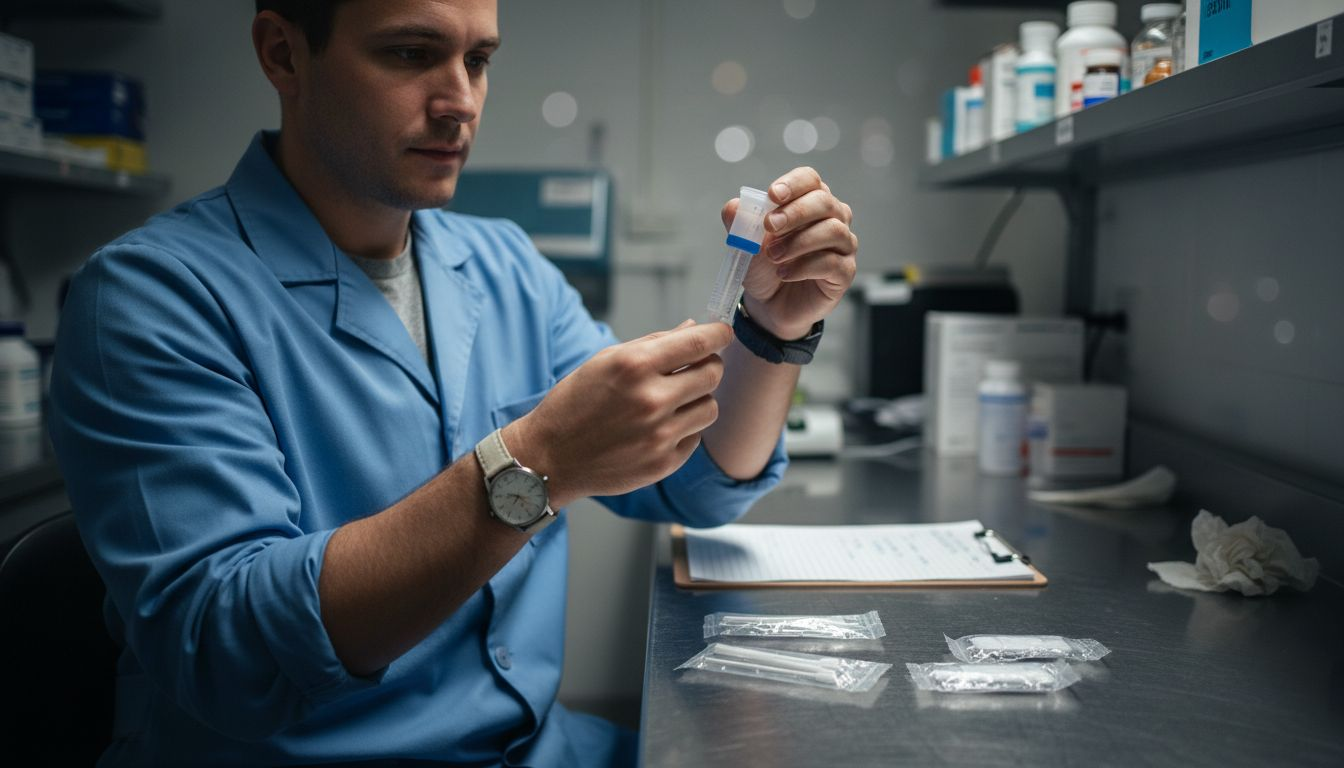
At-home collection kits expand testing accessibility while maintaining accuracy. These systems allow employees to collect samples privately and ship them to certified laboratories. When combined with professional analysis, at-home drug testing kits achieve accuracy rates exceeding 95%. This approach works well for pre-employment screening and follow-up testing.
Rapid testing devices deliver preliminary results within minutes. While not replacing confirmatory lab analysis for adverse employment decisions, rapid tests help supervisors assess situations requiring immediate action. A positive rapid test typically triggers removal from duty pending confirmation, protecting workplace safety without permanent consequences based on preliminary findings.
Mobile technology integration streamlines testing administration. Scheduling apps connect employees with collection sites. Digital chain of custody documentation reduces paperwork errors. Secure portals deliver results to authorized personnel while protecting confidential medical information. These systems improve efficiency and compliance simultaneously.
Key benefits of modern testing methods include:
- Reduced collection time and employee disruption
- Lower false positive rates with advanced detection chemistry
- Flexible testing locations including mobile collection services
- Faster turnaround enabling quicker hiring decisions
- Better detection of synthetic drugs and emerging substances
Pro Tip: When evaluating new laboratory drug screening tools, verify they meet relevant certification standards. SAMHSA, CLIA, and CAP accreditation ensure results withstand legal challenges and provide reliable information for employment decisions.
Employers implementing new technologies should train staff on proper procedures. Even simple oral fluid collection requires following manufacturer protocols to ensure valid samples. Understanding how to conduct drug testing in the workplace properly prevents wasted resources and legal exposure.
Comparison of drug testing methods
Selecting appropriate testing methods requires understanding how different approaches compare across critical factors. Each method offers distinct advantages and limitations affecting suitability for specific situations.
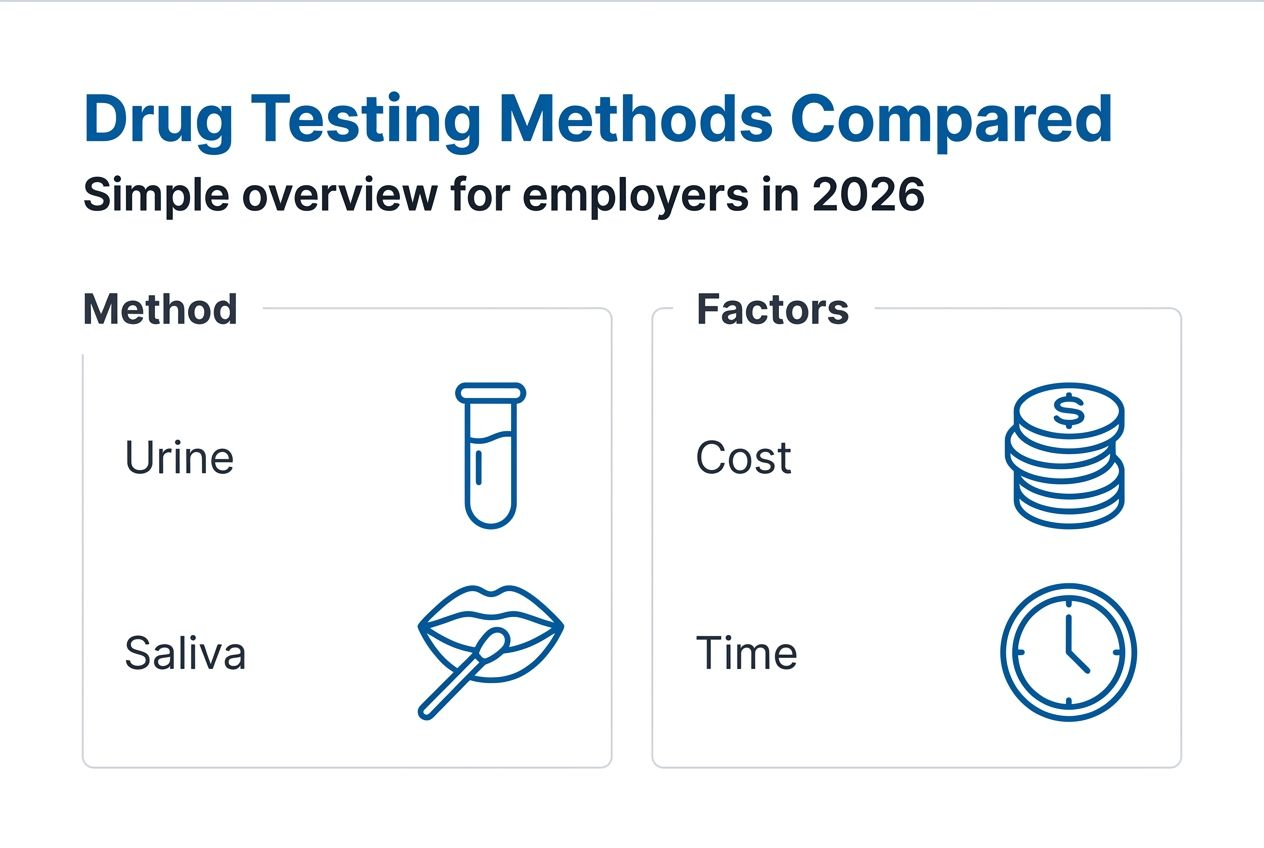
| Method | Detection Window | Accuracy | Invasiveness | Cost | Turnaround |
|---|---|---|---|---|---|
| Urine | 2-30+ days | High (98%+) | Moderate | Low | 24-72 hours |
| Saliva | 24-48 hours | High (90%+) | Low | Moderate | 10 min - 48 hours |
| At-home | Varies by type | High (95%+) | Low | Moderate | 3-5 days |
| Hair | 90 days | Very High | Low | High | 5-7 days |
| Blood | Hours to days | Very High | High | Very High | 24 hours |
Detection windows vary significantly based on substance type, usage frequency, and individual metabolism. Cannabis metabolite detection windows range from 3 to over 30 days in urine depending on consumption patterns. Occasional users may test positive for several days. Chronic users can show detectable levels for weeks after cessation.
Saliva testing offers shorter detection windows, typically capturing use within the past 24 to 48 hours. This characteristic makes oral fluid ideal for detecting recent consumption or impairment-correlated use. Rapid oral fluid tests demonstrate sensitivity rates above 90% for key drugs including amphetamines, cocaine, opiates, and THC.
Accuracy considerations extend beyond sensitivity rates. Specificity matters equally, indicating how well tests avoid false positives. Modern testing technologies achieve excellent performance on both measures when laboratories follow proper protocols. Confirmation testing using gas chromatography-mass spectrometry eliminates false positives from screening immunoassays.
Invasiveness affects employee acceptance and program success. Urine collection requires privacy for the donor but often involves observed collection for chain of custody integrity. This requirement creates discomfort and resentment. Oral fluid collection occurs in open areas with minimal dignity concerns, improving cooperation.
Cost analysis should consider total program expenses, not just per-test prices. Urine testing offers the lowest per-sample cost but requires dedicated collection facilities and trained staff. Oral fluid methods cost more per test but reduce facility and labor expenses. At-home kits add shipping costs but eliminate collection site fees.
Pro Tip: Match testing methods to your specific needs rather than selecting one approach for all situations. Use oral fluid for reasonable suspicion and post-accident testing where recent use matters most. Reserve urine or hair testing for pre-employment and random screening when longer detection windows serve your objectives.
Employers can compare drug test types to understand which substances each method detects most effectively. Some drugs appear more readily in certain biological matrices, influencing method selection for comprehensive screening.
Privacy and ethical considerations in drug testing
Employee privacy concerns increasingly influence drug testing policy design. Workers expect employers to collect, store, and use testing data responsibly. Programs that ignore privacy principles face employee opposition and potential legal liability.
Biometric privacy laws in states like Illinois and Texas impose strict requirements on how employers handle biological samples and resulting data. These regulations mandate written consent, specify permissible data uses, and require secure storage with defined retention limits. Violations carry significant penalties including private rights of action for affected employees.
Informed consent represents a cornerstone of ethical testing programs. Employees should understand what substances tests detect, how samples are collected and analyzed, who receives results, and what consequences positive findings trigger. Written consent forms document this understanding and protect both parties.
Data security protocols must protect sensitive medical information from unauthorized access. Test results may reveal prescription medication use, medical conditions, or other private health details. Storing results separately from personnel files, limiting access to designated staff, and using secure electronic systems help maintain confidentiality.
Transparent communication builds trust in testing programs. Explain why testing occurs, how it protects workplace safety, and what support resources exist for employees facing substance use challenges. Organizations that frame testing as a safety measure rather than a punitive tool see better acceptance.
Key privacy best practices include:
- Obtain explicit written consent before each test
- Limit testing to job-relevant substances for safety-sensitive positions
- Use Medical Review Officers to interpret positive results and verify legitimate prescriptions
- Provide clear appeals processes for disputed results
- Destroy samples and records after legally required retention periods
- Never share results with unauthorized parties without employee consent
Employers should review drug testing policy requirements for privacy provisions that protect both organizational interests and employee rights. Balanced policies acknowledge legitimate privacy concerns while maintaining effective safety programs.
Common misconceptions about workplace drug testing
Several persistent myths about drug testing lead employers to make poor policy decisions. Understanding testing limitations prevents unrealistic expectations and improves program effectiveness.
Misconception one: Drug tests detect impairment. Tests actually identify metabolites indicating past use, not current intoxication. Someone who used cannabis days ago may test positive while completely unimpaired. Conversely, a person under the influence of short-acting drugs might test negative hours after use. This distinction matters critically in post-accident investigations and reasonable suspicion scenarios.
Misconception two: All positive results indicate drug abuse. Many legitimate medications trigger positive screening results. Prescription opioids, amphetamines for ADHD, and other therapeutic drugs cause positive findings. Medical Review Officers evaluate these situations, verifying prescriptions and determining whether results indicate policy violations or lawful medication use.
Misconception three: Passive exposure causes positive tests. Modern testing cutoff levels prevent positive results from secondhand marijuana smoke or other environmental exposure. While extremely high concentrations might theoretically cause detectable levels, normal workplace or social exposure does not produce positive tests at standard thresholds.
Misconception four: All testing methods offer equal reliability. Accuracy varies significantly across testing technologies and laboratories. SAMHSA-certified labs following strict protocols deliver highly reliable results. Non-certified facilities or improperly stored samples may produce questionable findings. Always verify laboratory credentials before selecting testing partners.
Misconception five: Passing one test means an employee is drug-free. Testing captures specific windows. Someone who uses substances strategically can avoid detection. Random testing programs combined with reasonable suspicion protocols provide more comprehensive coverage than predictable pre-employment screening alone.
Understanding common drug testing misconceptions helps employers set realistic program goals. Testing serves as one tool in comprehensive safety programs, not a complete solution for workplace substance issues.
Implementing effective drug testing policies in 2026
Developing compliant, effective drug testing policies requires systematic planning and regular updates. Follow these steps to create programs aligned with current legal and technological realities.
-
Assess genuine business needs and safety requirements. Identify safety-sensitive positions requiring testing versus roles where screening offers minimal risk reduction. Focus resources where they provide maximum safety value.
-
Research applicable federal, state, and local regulations. Compile requirements for your industry and locations. Note conflicts between jurisdictions, particularly regarding cannabis testing and off-duty conduct protections.
-
Draft clear written policies specifying when testing occurs and what substances are screened. Include pre-employment, reasonable suspicion, post-accident, random, and return-to-duty testing circumstances. Define consequences for positive results and refusals.
-
Select testing methods appropriate for each scenario. Use rapid oral fluid tests for reasonable suspicion situations requiring immediate decisions. Reserve comprehensive urine panels for pre-employment and random screening. Consider at-home options for remote workers.
-
Establish relationships with certified laboratories and Medical Review Officers. Verify SAMHSA certification for federally-mandated testing. Ensure labs meet CLIA and CAP standards for non-federal programs.
-
Train supervisors on recognizing impairment indicators and following procedures. Document training to demonstrate good faith efforts at consistent policy application. Emphasize that testing alone does not prove impairment.
-
Communicate policies clearly to all employees. Provide written materials during onboarding and periodic reminders. Make policies easily accessible through employee handbooks and online resources.
-
Implement privacy protections and data security measures. Limit access to test results. Use Medical Review Officers to maintain medical confidentiality. Store information securely with defined retention periods.
-
Review and update policies annually. Monitor legal developments in your jurisdictions. Assess whether current testing methods still serve your needs effectively. Adjust procedures as regulations and technology evolve.
Pro Tip: Pilot new testing methods with small employee groups before full implementation. Gather feedback about collection procedures, communication clarity, and perceived fairness. Address concerns before expanding programs organization-wide.
Employers can reference guides on how to conduct drug testing in the workplace for detailed procedural steps. Systematic approaches combining legal compliance with practical administration create sustainable programs.
Balancing rapid results with confirmation testing protects both safety and fairness. Preliminary positive findings may justify temporary work restrictions pending lab confirmation. Never take final adverse employment actions based solely on unconfirmed screening results. This two-step approach prevents false positive consequences while enabling prompt safety responses.
Understanding drug testing policy requirements helps employers avoid common implementation errors. Policies must align with actual practices to withstand legal scrutiny and maintain employee trust.
Explore our comprehensive drug testing solutions
Navigating 2026 drug testing trends requires reliable partners offering current technology and regulatory expertise. CountryWideTesting.com provides the testing solutions employers need to maintain compliant, effective programs.
Our laboratory drug testing services meet SAMHSA, CLIA, and CAP certification standards. We offer comprehensive panels detecting traditional and emerging substances. Fast turnaround times support hiring decisions without unnecessary delays.
For organizations requiring federally-compliant confirmation testing, our Phamatech zero tolerance confirmation test delivers accurate SAMHSA seven-panel results. This mail-in option works perfectly for remote employees and decentralized workforces.
The 12 panel at-home drug test provides convenient screening for a wide range of substances. Easy-to-use collection cups paired with professional laboratory analysis ensure reliable results while respecting privacy. Contact us to customize testing solutions matching your specific compliance requirements and operational needs.
Frequently asked questions about drug testing trends in 2026
Can saliva tests fully replace urine tests for federal compliance?
No. While SAMHSA has approved oral fluid testing protocols, most federal programs still require urine collection. Department of Transportation regulations continue mandating urine tests for safety-sensitive positions. Organizations subject to federal testing requirements must confirm which specimen types their regulator accepts before switching methods.
How should employers handle drug testing with conflicting state and federal cannabis laws?
Employers must comply with the most restrictive applicable law. For non-federally mandated positions, state protections for lawful off-duty cannabis use generally apply. Safety-sensitive roles under federal jurisdiction remain subject to zero-tolerance THC policies regardless of state legalization. Consult employment counsel to navigate these conflicts in your specific situation.
What steps can improve employee acceptance of drug testing programs?
Transparent communication about testing purposes and procedures builds acceptance. Emphasize safety goals rather than punitive intentions. Choose less invasive collection methods when possible. Provide clear information about confidentiality protections and Medical Review Officer evaluations. Offer employee assistance programs for those facing substance use challenges.
How often should employers review and update their drug testing policies?
Annual policy reviews ensure alignment with evolving regulations and technology. Review immediately after significant legal changes in your jurisdiction, such as new cannabis laws or testing restrictions. Also reassess when implementing new testing methods or expanding program scope.
Are at-home tests legally valid for pre-employment screening?
Yes, when properly administered. At-home collection kits that use certified laboratory analysis meet the same standards as traditional collection site testing. Ensure your testing partner maintains proper chain of custody documentation and uses accredited laboratories. Many employers successfully use at-home options for remote candidates and employees.