
Safe School Drug Testing: A Compliance Checklist
Safe school testing requires a written policy, legal review, accredited confirmatory labs, documented chain-of-custody, and a student-support-first response to any positive result. Skip any one of these and you’re exposed, legally and ethically. Before you schedule a single collection, make sure your program includes:
- A board-approved written policy with defined scope and consent procedures
- Confirmatory testing at a SAMHSA-certified, CLIA/CAP/ISO-accredited laboratory
- Documented chain-of-custody from collection to result
- Confidentiality protocols that limit who sees results and when
- An intervention pathway, not just a punishment list
The legal foundation here isn’t guesswork. Vernonia School District v. Acton and Board of Education v. Earls) give schools the authority to test students in competitive extracurriculars, while SAMHSA and the Office of National Drug Control Policy (ONDCP) set the operational and lab standards that keep a program defensible.
Key Takeaways
A safe school testing program depends on written policy, legal review, accredited lab confirmation, documented chain-of-custody, and a support-first response to positive results.
| Point | Details |
|---|---|
| Legal boundaries are set | Vernonia and Earls permit testing for competitive extracurriculars, not the entire student body. |
| Confirm every positive at a lab | Onsite kits screen only; accredited labs confirm results in about 24 to 48 hours. |
| Chain-of-custody protects everyone | Sealed containers, signed transfer logs, and secure storage preserve both privacy and evidence. |
| Pair testing with support | Assessment, referral, and reduced consequences for self-reporters improve outcomes over punishment alone. |
| Countrywidetesting supplies the full chain | Onsite kits, SAMHSA-certified lab confirmation, and chain-of-custody supplies in one order. |
Table of Contents
- Preflight Checklist: 10 Steps Before Any Testing Day
- What Legal Standards Govern School Drug Testing?
- Which Specimen Type and Lab Should Schools Use?
- How Should Collection Protect Privacy and Chain-of-Custody?
- What Happens After a Positive Test Result?
- Day-of Logistics: Consent, Staffing, and Cost Control
- How Does CountryWideTesting.com Support Compliant Programs?
- Ready to Build a Compliant Testing Program?
- Frequently Asked Questions
- Sources
Preflight Checklist: 10 Steps Before Any Testing Day
Nothing about testing day should be improvised. Work through this sequence before you announce a start date:
- Legal review of your draft policy by district counsel, referencing current case law and your state’s own constitutional standards.
- Form an advisory committee with parents, coaches, counselors, and students, per ONDCP guidance.
- Finalize the written policy covering scope, selection, consent, and consequences.
- Collect signed consent forms from parents and student assent where applicable.
- Set a notification timeline of at least 90 days before the first test.
- Choose specimen types based on your population and detection needs.
- Vet and select an accredited lab (SAMHSA, CLIA, CAP, or ISO).
- Train and credential collection staff.
- Document chain-of-custody procedures in writing, with sample forms attached.
- Build a parent communications plan, including FAQ handouts and a point of contact.
Before test day arrives, confirm the lab’s accreditation certificate is current, courier pickup is scheduled, and you have private, appropriate collection space on-site.
What Legal Standards Govern School Drug Testing?
Testing programs have to be tailored to the law, not just to good intentions, and every program needs written policy backed by legal counsel. The U.S. Supreme Court has drawn the boundaries twice. In Vernonia School District v. Acton, the Court upheld testing for student athletes. In Board of Education v. Earls, it extended that authority to students in any competitive extracurricular activity. Neither ruling permits blanket testing of an entire student body, and some state constitutions offer broader privacy protections than the federal floor. States and districts also layer on their own procedural rules. New Jersey, for example, requires public hearings and documented random-selection methodology before a district can adopt a testing policy, and other states apply similar constraints.
A defensible written policy should spell out:
- Scope: exactly which students and activities are covered, and why
- Selection method: how students are chosen (random, suspicion-based, or both)
- Consent and assent: parent consent forms and age-appropriate student assent
- Confidentiality rules: who sees a result and under what circumstances
- Confirmatory testing: the standard applied to any preliminary positive
- Appeals process: how a student or parent can contest a result
- Consequences and intervention pathways: what happens next, and who coordinates it
Consult counsel before finalizing any of this, and document the district’s specific justification for testing along with any community approval steps your state requires.
Which Specimen Type and Lab Should Schools Use?
Use lab-based confirmatory testing for any positive result. Onsite kits are useful only as a preliminary screen, never as the final word. Each specimen type comes with its own tradeoffs for a school setting. Oral fluid and breath tests offer a short detection window and are easy to collect with minimal privacy concerns, which makes them practical for same-day athletic events. Urine remains the most established option with well-documented procedures and broad lab support, though it demands more careful collection protocols to guard against tampering. Hair testing extends the detection window to months rather than days, useful for programs focused on patterns of use rather than a single incident.
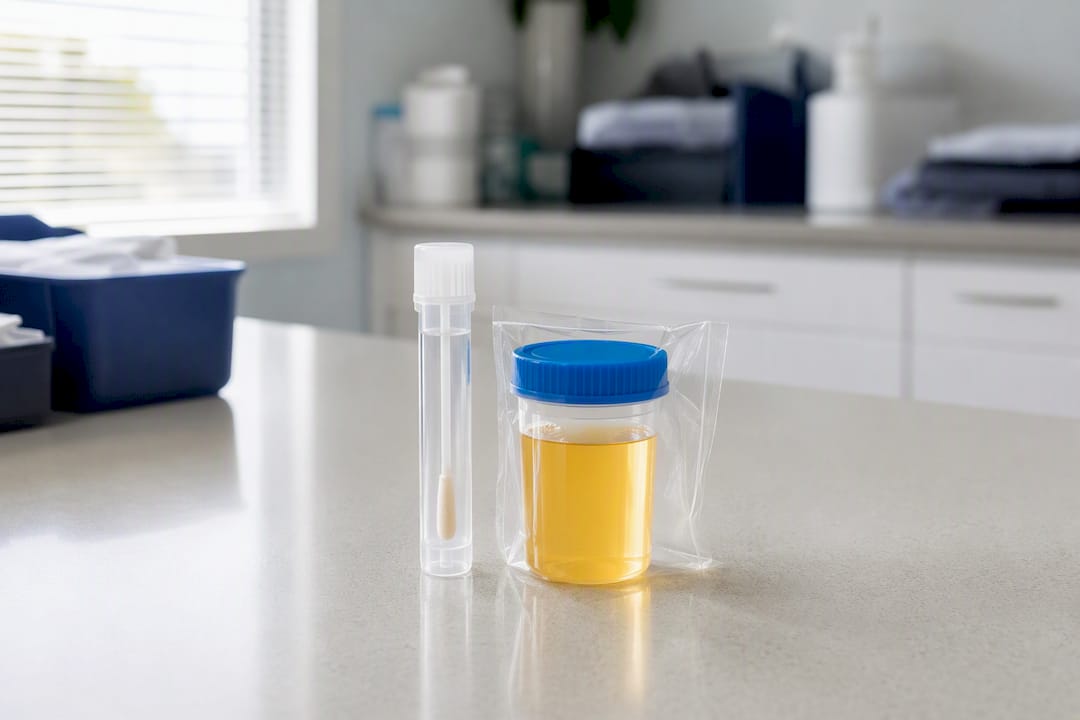
Turnaround matters, too. Labs typically return confirmatory results in 24 to 48 hours, while onsite kits provide an immediate preliminary read that still requires lab confirmation if positive. Accuracy at the confirmatory stage is not a minor detail. The independent laboratory used in the Vernonia case reported 99.94% accuracy, which is the benchmark accredited labs are still expected to meet.
Before signing with any lab, verify:
- SAMHSA certification for urine-based testing
- CLIA, CAP, or ISO accreditation covering the lab’s broader operations
- Documented GC/MS or equivalent confirmatory methods for any preliminary positive
- Written courier and transport procedures protecting chain-of-custody
Your policy should state plainly whether the school or the parent covers the cost of confirmatory testing. Leaving that unresolved invites disputes at the worst possible moment.
How Should Collection Protect Privacy and Chain-of-Custody?
Collection has to minimize intrusion while still preserving the evidentiary value of every sample. That balance is the whole job. A practical sequence looks like this:
- Verify student identity and issue a unique specimen ID before collection begins.
- Offer a same-sex observer option and limit observation to the minimum necessary for accuracy.
- Use a private collection room with no accessible sink or other water source.
- Seal the specimen container in the student’s presence and apply tamper-evident labels.
- Complete chain-of-custody paperwork immediately, with a signature at every handoff.
- Store retained samples in secure, refrigerated storage pending confirmation or appeal.
Hygiene matters as much as procedure. Collection points need single-use supplies, PPE for staff, and a cleaning routine between students, particularly during flu season or any communicable illness concern on campus.
Pro Tip: Skip the guesswork on tampering. A collection enclosure with no accessible sink, combined with bluing agents in the toilet tank and a documented temperature or creatinine check, closes off the most common ways students attempt to adulterate a urine sample.
Programs that follow ONDCP’s operational recommendations on chain-of-custody documentation tend to hold up better under both parent scrutiny and legal challenge.
What Happens After a Positive Test Result?
Any preliminary positive has to follow a fixed sequence, not an improvised one. That sequence should run:
- Quarantine the specimen immediately and log it in the chain-of-custody record.
- Send it to an accredited lab for confirmatory testing (GC/MS or equivalent).
- Notify only the designated staff, then the parents or guardians, per written policy.
- Offer assessment, referral, and support resources alongside any disciplinary step.
- Document the outcome and preserve the student’s right to appeal.
Your policy should also state clearly who pays for confirmatory testing and any retest, whether that’s the district or the family. Consider building in reduced consequences for students who self-report or engage voluntarily with treatment. That single design choice does more to encourage help-seeking than any punitive measure on its own.
- Keep the confirmation and notification steps confidential and limited to a named list of staff.
- Route every positive through the same support-first pathway, regardless of the student’s activity or status.
- Preserve documentation long enough to support any appeal timeline in your policy.
Peer-reviewed reviews consistently find that testing works better as one piece of a broader substance-use strategy than as a stand-alone disciplinary tool. The evidence on deterrence alone is mixed at best.
Day-of Logistics: Consent, Staffing, and Cost Control
Testing day runs smoothly when consent windows, trained collectors, and a communications plan are locked in well ahead of time. Start collecting signed consent at least 90 days before the first test, and track opt-in and opt-out status the same way you’d track any other compliance record.
- Staffing: credentialed collectors, a designated privacy officer, and a scheduled courier pickup
- Rehearsal: a mock run before the first real testing day catches gaps in space, timing, and paperwork
- Cost planning: budget separately for preliminary screening, confirmatory lab fees, retests, and counseling referrals
- Vendor bundles: a single supplier for chain-of-custody kits and lab services cuts down on coordination errors
A step-by-step collection guide is worth keeping on hand for staff training, especially in the first season of a new program.
How Does CountryWideTesting.com Support Compliant Programs?
CountryWideTesting.com supplies the pieces that map directly to the trust signals covered above: lab confirmation, chain-of-custody kits, and collection supplies aligned with SAMHSA, CLIA, CAP, and ISO standards. Services include:
- Onsite screening kits for preliminary testing
- Lab-based confirmatory GC/MS mail-in options
- Chain-of-custody forms and documentation supplies
- Staff training resources for collection procedures
Before you commit to any partner, ask for documented accreditation credentials and written courier handling and turnaround procedures. A drug testing checklist can help your committee compare vendors against the same standard every time.
A Note From an Implementation Lead
What actually saves a program in year one: documenting everything, over-communicating with parents before they ask, and running a small pilot before scaling district-wide. Watch for perception problems around fairness, not just legal ones, and never let testing operate without a counseling or student assistance team behind it.
Ready to Build a Compliant Testing Program?
CountryWideTesting.com gives schools a single source for the entire testing chain instead of piecing together a lab, a kit supplier, and a training vendor separately. That matters most in year one, when staff are still learning the process and every gap in documentation is a liability waiting to surface.
Getting started is straightforward: assess your specific needs (specimen type, expected volume, athletic season timing), request a quote or sample kit, pilot the program with one team or grade before scaling, then expand. Ask for lab accreditation documentation, order chain-of-custody kits alongside your first collection run, and confirm courier pickup windows before you set a testing date. The SAMHSA seven-panel mail-in confirmation test is a practical starting point for districts that need confirmatory testing built into their first order. Visit Countrywidetesting to request a quote for your program.
Frequently Asked Questions
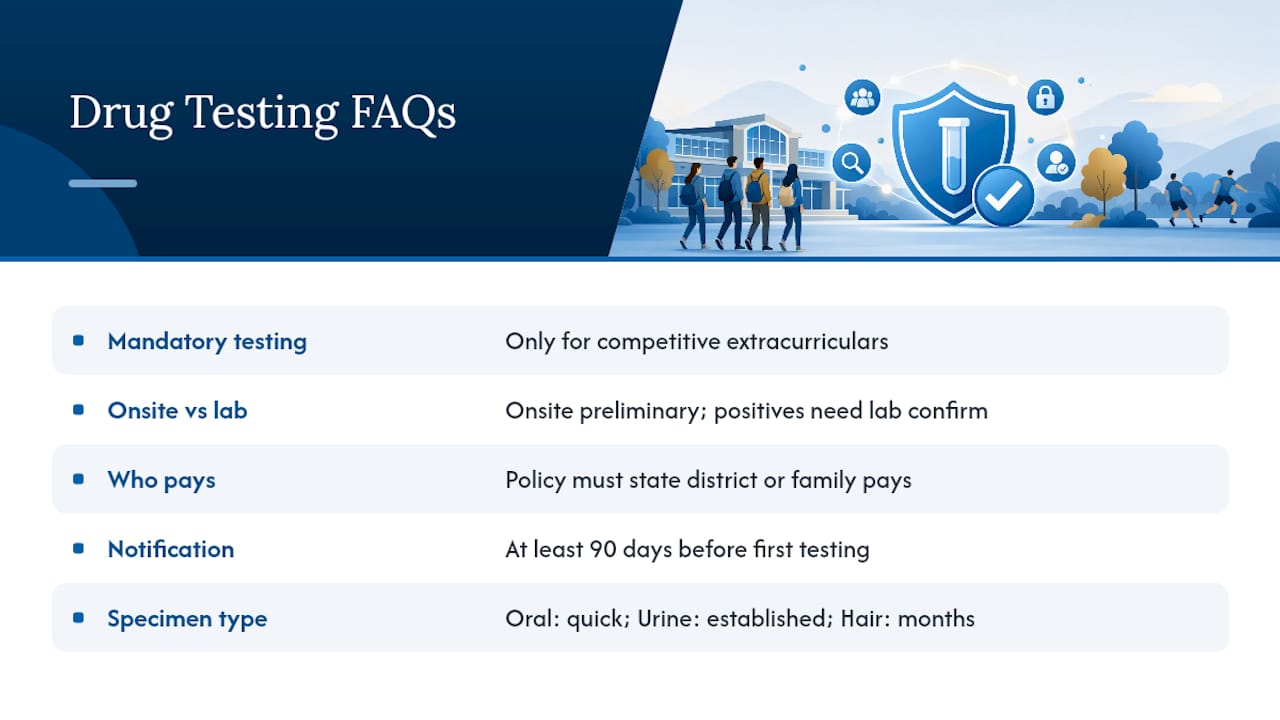
Can schools legally require drug testing for all students? No. Supreme Court precedent limits mandatory testing to students in competitive extracurricular activities, including athletics, not the general student body.
What’s the difference between onsite screening and lab confirmation? Onsite kits give an immediate preliminary result. Any positive must go to an accredited lab for confirmatory testing before any action is taken.
Who should pay for confirmatory lab testing? Policy should specify this explicitly, whether the district or the family covers the cost, to avoid disputes when a confirmation is needed quickly.
How far in advance should schools notify families about testing? At least 90 days before the first testing date, giving time for consent collection, committee review, and community communication.
What specimen type works best for school testing programs? It depends on your goals. Oral fluid suits quick athletic-event screening, urine offers the most established procedures, and hair extends detection over months.
This article is general information, not a substitute for advice from a qualified doctor. Consult a qualified healthcare professional about your own circumstances before acting on anything here.
Sources
- Vernonia School District v. Acton — UMKC Law
- Random drug testing in schools — BMC/PMC review
- What You Need to Know About Starting a Student Drug-Testing Program — ONDCP / OJP
- What You Need to Know About Starting a Student Drug-Testing Program — ONDCP / OJP (ERIC copy)