
Step by Step Railroad Drug Testing: 2026 Federal Guide
TL;DR:
- Railroad drug testing is a federally mandated process that screens safety-sensitive employees for drugs and alcohol under FRA and DOT regulations. Proper setup, documentation, and timing are essential to maintain compliance and avoid invalidating test results or regulatory liability.
Railroad drug testing is a federally mandated process that systematically screens safety-sensitive employees for drug and alcohol use under the authority of the Federal Railroad Administration (FRA) and the Department of Transportation (DOT). The standard industry term for this program is an FRA-regulated drug and alcohol testing program, though safety managers commonly search for step by step railroad drug testing guidance when building or auditing their protocols. 49 CFR Part 40 governs every procedural detail, from specimen collection through result reporting. Getting each step right is not optional. A single procedural error can invalidate a test, delay return-to-duty decisions, and expose your railroad to regulatory liability.
What prerequisites are required before starting railroad drug testing?
A compliant railroad drug testing program requires specific personnel, documentation, and infrastructure before the first specimen is ever collected. Skipping the setup phase is the most common reason programs fail audits.
Personnel roles you must assign
Three roles are non-negotiable under federal regulation:
- Designated Employer Representative (DER): The internal point of contact who receives test results, makes removal decisions, and manages the overall program.
- Collector: A trained individual certified to collect urine specimens following DOT protocols. Collectors must complete qualification training and proficiency demonstrations.
- Medical Review Officer (MRO): A licensed physician trained to review laboratory results, evaluate legitimate medical explanations for positive results, and report verified outcomes to the DER.
Your DER does not need to be a physician, but must understand FRA Part 219 and DOT drug testing setup requirements thoroughly.
Documentation and lab certification
The Custody and Control Form (CCF) is the federal document that travels with every specimen from collection through laboratory analysis. Every field on the CCF must be completed accurately. Minor errors on the CCF can invalidate a test result entirely. That means a failed test could be thrown out on a technicality, or a valid negative result could be delayed, pulling an employee off duty unnecessarily.
Laboratories must hold SAMHSA certification (also called HHS certification) to process federally mandated specimens. Urine remains the primary specimen type for railroad drug testing. Oral fluid testing is federally authorized as an alternative, but full implementation requires at least two HHS-certified oral fluid labs to be operational before railroads can adopt it broadly.
| Prerequisite | Requirement |
|---|---|
| Employee categories | All safety-sensitive positions under FRA Part 219 |
| Specimen type | Urine (primary); oral fluid pending lab certification |
| Laboratory | SAMHSA/HHS-certified facility |
| Federal form | DOT Custody and Control Form (CCF) |
| Key personnel | DER, certified collector, licensed MRO |
Pro Tip: Designate a backup DER before your program launches. If your primary DER is unavailable during a post-accident event, you need someone with equal authority and training ready to act immediately.
How do you conduct each step of the railroad drug testing process?
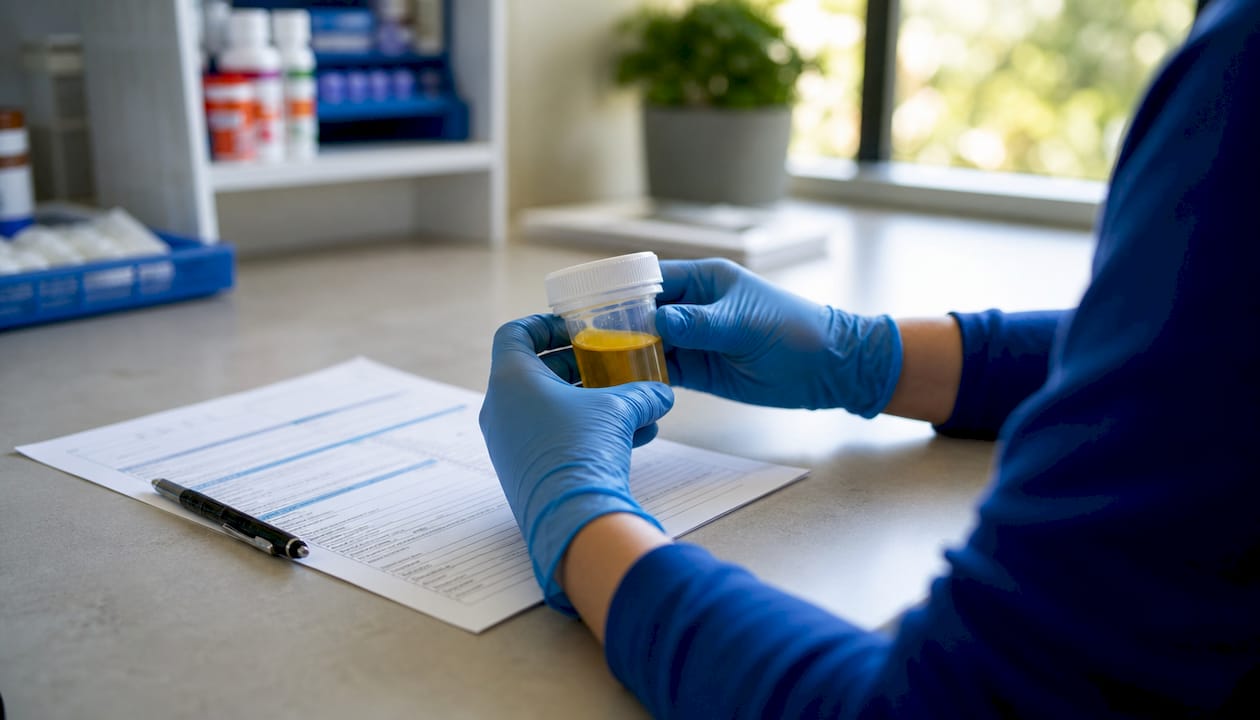
The railroad drug testing process follows a defined sequence. Each step has timing mandates, documentation requirements, and procedural standards that cannot be reordered or skipped.
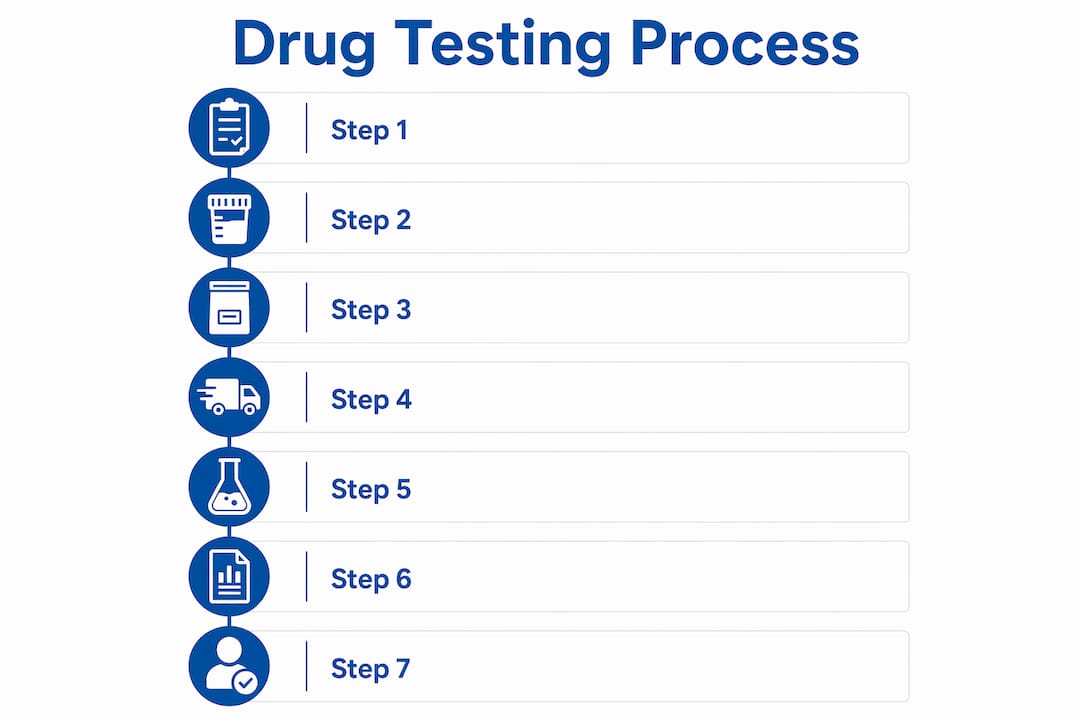
Step 1: Determine the testing reason
Railroad drug testing occurs under six categories: pre-employment, random, reasonable suspicion, post-accident, return-to-duty, and follow-up. Each category has its own trigger, timing rule, and documentation requirement. Post-accident testing is incident-driven, not suspicion-driven. Qualifying accidents mandate immediate testing unless you can document that the employee had zero involvement in the incident.
Step 2: Notify the employee
Notification must happen without advance warning for random and post-accident categories. The employee reports directly to the collection site. Any delay between notification and arrival at the collection site must be documented. For post-accident events, the clock starts immediately.
Step 3: Collect the specimen within required time windows
Timing is one of the most misunderstood aspects of the railroad drug testing process. DOT requires alcohol testing to be attempted within 2 hours of the qualifying event and stopped after 8 hours. Drug testing must be completed within 32 hours. Missing these windows does not eliminate your obligation. You must document why testing was not completed on time and report accordingly.
The collector verifies the employee’s identity, explains the collection process, and instructs the employee to provide a urine specimen. The collection must follow DOT direct observation protocols when required, such as after a prior positive result or a return-to-duty test.
Step 4: Complete the CCF and ship the specimen
The collector completes the CCF at the collection site. The employee signs the form. The specimen is sealed in the employee’s presence and shipped to the SAMHSA-certified laboratory. Any break in chain of custody at this stage can compromise the result.
Step 5: Laboratory analysis
The laboratory runs an initial immunoassay screen on the specimen. Any specimen that screens positive goes through a confirmatory test using gas chromatography-mass spectrometry (GC-MS). GC-MS is the federal gold standard for confirmation because it identifies the specific substance and quantity with high accuracy. A specimen is not reported as positive until it clears both the screen and the confirmation.
Step 6: MRO review and result reporting
The MRO receives the laboratory result and contacts the employee directly if the result is positive, adulterated, or substituted. The employee has the right to explain a legitimate medical reason for the result. The MRO evaluates that explanation and either verifies the result as positive or cancels it. The MRO then reports the verified result to the DER.
Step 7: Employee rights and split specimen
Every employee who tests positive has the right to request a retest of the split specimen (Bottle B) at a second SAMHSA-certified laboratory. The employee must make this request through the MRO within 72 hours of being notified of the positive result. The split specimen retest is a federal right, not an employer option.
Pro Tip: Train your DER to document the exact time of every notification and collection attempt. Time-stamped records are your primary defense during an FRA audit of post-accident testing.
| Testing stage | Key requirement |
|---|---|
| Alcohol testing window | Attempt within 2 hours; stop after 8 hours |
| Drug testing window | Complete within 32 hours |
| Confirmation method | GC-MS at SAMHSA-certified lab |
| Split specimen request | Employee must request within 72 hours via MRO |
| Direct observation | Required for return-to-duty and follow-up collections |
What happens after a positive test or rule violation?
A verified positive result triggers a mandatory sequence under FRA Part 219. The DER must remove the employee from all safety-sensitive duties immediately. That removal is not discretionary.
The employee must then be evaluated by a Substance Abuse Professional (SAP). The SAP conducts a clinical assessment, recommends education or treatment, and determines when the employee is ready for a return-to-duty test. Completing the SAP process restores regulatory eligibility. However, the SAP process does not guarantee reinstatement. The railroad employer holds final authority over whether to return the employee to a safety-sensitive position.
After the employee passes the return-to-duty test and receives SAP clearance, federal law requires a minimum of six unannounced follow-up tests within the first 12 months. The SAP may extend follow-up testing beyond 12 months based on clinical judgment. These tests are in addition to the employee’s regular random testing obligations and cannot be waived by the employer.
Common documentation pitfalls at this stage include:
- Failing to record the exact date and time of employee removal from duty
- Missing the SAP referral deadline or using an uncertified SAP
- Allowing the employee to return to duty before receiving written MRO clearance
- Failing to schedule the minimum six follow-up tests within the required 12-month window
- Not retaining all related records for the federally required retention period
How do you maintain ongoing compliance in your testing program?
Ongoing compliance requires active management of your random testing pool, record retention, and quality control. A program that passes its first audit can still fail the next one if administrative processes slip.
FRA random drug testing rates range from 25% to 50% of covered employees annually, depending on employee category. Random alcohol testing is set at 10%. These rates are minimums, not targets. Your selection pool must include all safety-sensitive employees, and selections must be made using a scientifically valid random method.
Pro Tip: Use a third-party consortium to manage your random selection pool if your railroad employs fewer than 50 covered employees. Consortium pools increase the statistical validity of random selections and reduce your administrative burden significantly.
Key ongoing compliance requirements:
- Retain all drug and alcohol testing records for the periods specified under DOT regulations (ranging from 1 to 5 years depending on record type)
- Conduct annual reviews of your DER’s training and collector qualifications
- Audit CCF completion accuracy quarterly to catch documentation errors before an FRA inspection does
- Monitor regulatory updates from the FRA and DOT, particularly around oral fluid testing implementation timelines
- Maintain a written testing policy that reflects current federal requirements and distribute updates to all covered employees
For a detailed look at building a compliant random testing workflow that meets FRA standards, the process mirrors DOT fleet requirements with railroad-specific modifications.
| Compliance area | Requirement |
|---|---|
| Random drug testing rate | 25%–50% of covered employees annually |
| Random alcohol testing rate | 10% of covered employees annually |
| Record retention | 1–5 years depending on record type |
| Oral fluid testing | Authorized but pending two HHS-certified labs |
| Policy updates | Required whenever federal regulations change |
Key Takeaways
A compliant railroad drug testing program requires accurate documentation, strict timing adherence, and active management of random testing pools, follow-up obligations, and personnel qualifications.
| Point | Details |
|---|---|
| CCF accuracy is critical | Minor errors on the Custody and Control Form can invalidate test results and delay return-to-duty decisions. |
| Timing windows are mandatory | Alcohol testing must be attempted within 2 hours; drug testing must be completed within 32 hours of the qualifying event. |
| SAP clearance is not reinstatement | Completing the SAP process restores regulatory eligibility, but the employer makes the final call on returning an employee to safety-sensitive duty. |
| Follow-up testing is non-negotiable | Federal law requires a minimum of six unannounced follow-up tests within 12 months after a return-to-duty test. |
| Random rates require active management | FRA mandates 25%–50% random drug testing and 10% random alcohol testing annually for covered employees. |
What I’ve learned from watching railroad drug testing programs fail audits
The programs that fail FRA audits almost never fail on the science. The laboratory work is solid. The MRO does the job correctly. The failure point is almost always administrative, and it almost always traces back to the CCF or the timing log.
I’ve seen programs where the DER was excellent at managing the SAP process but had never actually read the CCF instructions. One transposed digit in the specimen ID field, and a positive result gets canceled. That employee goes back to work. The railroad thinks it passed the test. Nobody wins.
The other pattern I see constantly is post-accident testing that starts late because nobody on site knew who to call or what the 2-hour alcohol window actually meant in practice. The regulation is clear. The training is often not. Railroads that invest in tabletop exercises for post-accident scenarios, where the DER, supervisor, and collector practice the notification and collection sequence under a simulated time pressure, perform dramatically better during real events.
The SAP process also creates false confidence. Safety managers sometimes assume that once an employee enters the SAP pipeline, the compliance obligation is met. The follow-up testing schedule is where programs quietly fall apart. Six tests in 12 months sounds manageable until you realize those tests must be unannounced, spread across the year, and documented with the same precision as any other federal test. Build a calendar. Assign ownership. Treat follow-up testing as a standing operational task, not a one-time event.
— Alan
Countrywidetesting supports your railroad compliance needs
Railroad safety managers need a testing partner that understands federal timelines, chain-of-custody requirements, and the difference between a screening result and a verified MRO report.
Countrywidetesting works with SAMHSA-certified, CAP-accredited, and CLIA-compliant laboratories to process urine specimens for federally mandated programs. The platform offers lab screening services built for employer and federal compliance needs, with nationwide collection site access and support for both standard and directly observed collections. Whether you are setting up a new program or auditing an existing one, Countrywidetesting provides the testing infrastructure and documentation support that railroad safety managers require to stay compliant with FRA and DOT regulations.
FAQ
What is railroad drug testing under federal law?
Railroad drug testing is a federally regulated program under FRA Part 219 and 49 CFR Part 40 that requires safety-sensitive railroad employees to be screened for drugs and alcohol across six testing categories, including random, post-accident, and return-to-duty.
How long does a railroad have to complete post-accident drug testing?
DOT requires alcohol testing to be attempted within 2 hours of the qualifying event and stopped after 8 hours. Drug testing must be completed within 32 hours.
What is the role of the MRO in railroad drug testing?
The Medical Review Officer reviews laboratory results, contacts employees with positive results to evaluate legitimate medical explanations, and reports verified outcomes to the Designated Employer Representative.
Can an employee return to work after a positive railroad drug test?
An employee must complete a SAP evaluation, pass a return-to-duty test, and receive MRO clearance before returning to safety-sensitive duties. The railroad employer holds final authority on reinstatement even after regulatory clearance is granted.
What are the FRA random testing rates for railroads?
FRA requires random drug testing at rates between 25% and 50% of covered employees annually, and random alcohol testing at 10% of covered employees annually.