
Drug Testing Compliance Guide 2026 for Employers
TL;DR:
- Employer drug testing compliance in 2026 faces complex federal and state regulations, requiring regular policy updates and training. Key changes include the enforcement of observed collection rules, inclusion of fentanyl in testing panels, and the reclassification of medical marijuana to Schedule III. Employers must continuously adapt by mapping state laws, updating procedures, and ensuring laboratory and staff certification to maintain legal and safety standards.
Drug testing compliance is defined as an employer’s documented adherence to federal, state, and local regulations governing workplace substance screening programs. The 2026 regulatory environment is the most complex employers have faced in over a decade. The Department of Transportation (DOT) issued a major observed collection rule effective june 10, 2026. The Department of Justice (DOJ) reclassified medical marijuana to Schedule III on april 22, 2026. State cannabis protections now cover workers in at least 8 states. Every HR professional and compliance officer needs a current drug testing compliance guide for 2026 to avoid legal exposure and maintain a safe workplace.

What are the major 2026 federal drug testing regulation updates?
Federal drug testing rules changed significantly this year. Three updates stand out as the most operationally urgent for employers.
The DOT observed collection rule (effective june 10, 2026)
DOT now requires directly observed urine collections when oral fluid testing is unavailable due to a lack of certified laboratories. That situation describes most employers right now. Oral fluid testing under DOT is authorized but not yet operational in early 2026 because no labs hold the required certification. Urine collection remains the primary method until labs are certified and an 18-month grace period expires.
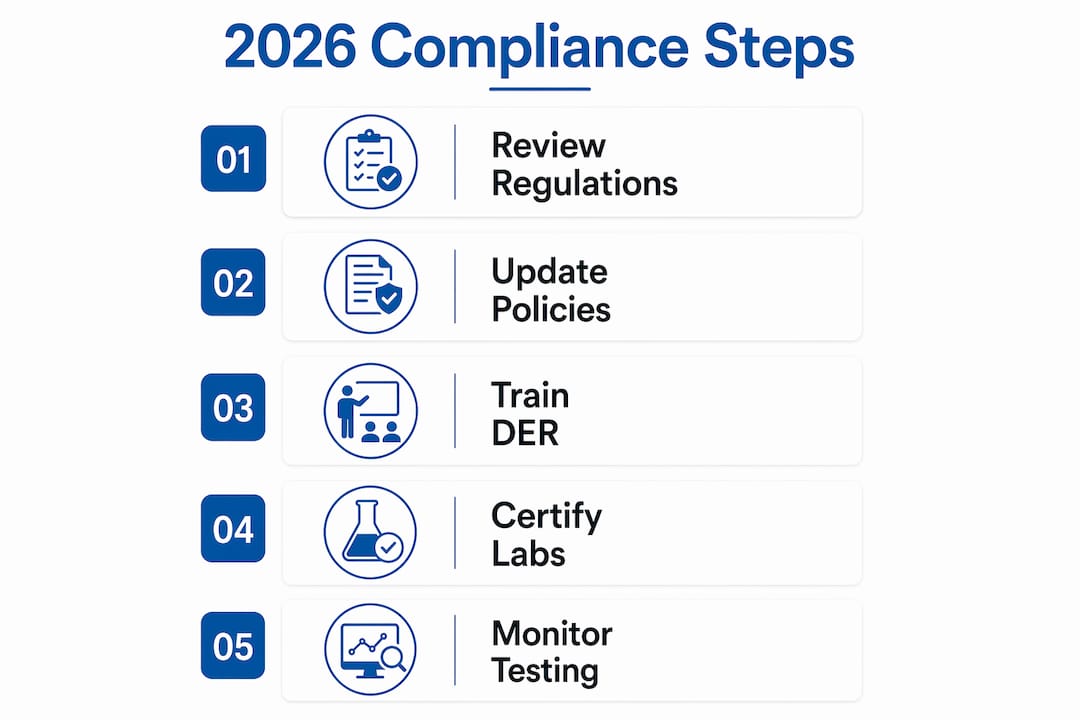
The rule also clarifies terminology. The standard shifts from “gender” to “sex” when describing observer matching requirements. If a same-sex observer is unavailable, the Designated Employer Representative (DER) must be directly involved. Employers who do not have standing DER orders covering this scenario are out of compliance as of june 10, 2026.
Fentanyl and norfentanyl added to DOT panels
DOT is adding fentanyl and norfentanyl to mandatory drug testing panels, with a final rule expected in 2026. This change reflects the scale of the opioid crisis and its presence in safety-sensitive industries. Employers in transportation, aviation, and pipeline sectors should update their Medical Review Officer (MRO) contracts and collector training now, before the final rule takes effect.
FMCSA Clearinghouse Phase II
FMCSA Clearinghouse Phase II enforces automatic CDL downgrades for commercial drivers with unresolved drug or alcohol violations. Drivers cannot return to safety-sensitive functions without completing a full return-to-duty process. That process includes a Substance Abuse Professional (SAP) evaluation, treatment, a negative return-to-duty test, and a follow-up testing schedule. Employers who skip any step face federal enforcement action.
- DOT observed collection rule: effective june 10, 2026
- Oral fluid testing: authorized but not yet operational
- Fentanyl panel expansion: final rule expected in 2026
- FMCSA Clearinghouse Phase II: CDL downgrades now automatic for unresolved violations
- DOJ marijuana reclassification: Schedule III as of april 22, 2026
Pro Tip: Update your DER standing orders before june 10, 2026. Document the same-sex observer protocol in writing so collectors know exactly what steps to follow when an observer is unavailable.
How do evolving state cannabis laws affect 2026 workplace policies?
State cannabis law is now the most unpredictable variable in workplace drug testing compliance. At least 8 states prohibit adverse employment actions based on off-duty, legal cannabis use. Those states include California, Connecticut, Montana, Nevada, New Jersey, New York, Rhode Island, and Washington. That list is not static. Employers with workers in multiple states face a patchwork of rules that a single national policy cannot address.
The DOJ’s reclassification of medical marijuana to Schedule III complicates this further. Reclassification does not legalize marijuana under federal law, but it does change how ADA accommodation requests are evaluated. Employees in states with strong cannabis protections may now have stronger grounds to request accommodations. HR professionals need legal counsel to assess each jurisdiction individually.
Here is a practical approach to state-level compliance mapping:
- List every state where you employ workers. Include remote employees. Their home state law applies.
- Identify which states restrict adverse action for off-duty cannabis use. California AB 2188 is the most cited example, but the list grows each legislative session.
- Review your current policy language. Policies written before 2024 almost certainly do not reflect current state protections.
- Consult employment counsel for each high-risk jurisdiction. SAMHSA advises that generic policies are risky given varying state laws, and recommends hiring employment counsel to customize policies per jurisdiction.
- Document your accommodation review process. When an employee requests a medical marijuana accommodation, the interactive process must be documented in writing.
Pro Tip: Do not rely on a policy template downloaded before 2025. State cannabis laws changed in multiple jurisdictions in 2025 and 2026. A policy that was compliant 18 months ago may expose you to litigation today.
What steps build a compliant 2026 workplace drug testing program?
A compliant drug testing program in 2026 requires more than a written policy. It requires a living system that responds to regulatory changes as they happen.
Policy structure and review triggers
Employers should integrate automated review triggers into their drug testing policies. An annual review is the minimum. Immediate reviews are required after events like new substances added to testing panels, changes in applicable law, workplace incidents that reveal policy gaps, or expansion into new jurisdictions. The DOJ marijuana reclassification in april 2026 is exactly the kind of event that should trigger an immediate policy review, not a wait until the next annual cycle.
FCRA compliance and adverse action procedures
FCRA-compliant pre-adverse and adverse action notifications are required when a drug test result affects an employment decision. The process has specific steps: provide the candidate with a pre-adverse action notice, give them time to dispute the result, then issue a final adverse action notice if the decision stands. Skipping or compressing these steps is a leading cause of litigation in drug testing programs. Compliance professionals consistently identify FCRA procedure failures as the most common and costly legal mistake employers make.
Essential elements of a compliant 2026 policy
- Written policy covering all testing types: pre-employment, random, post-accident, reasonable suspicion, and return-to-duty
- Clear definition of safety-sensitive positions and applicable regulations (DOT vs. non-DOT)
- Disclosure and authorization forms that meet FCRA requirements
- DER designation and documented training records
- State-specific addenda for jurisdictions with cannabis protections
- Accommodation request procedures aligned with ADA and state law
- Documented chain of custody procedures for all specimen types
DER training and documentation
The DER is the linchpin of any compliant program. This person manages collector communications, handles observed collection logistics, and coordinates with MROs on results. Under the june 2026 DOT rule, DERs carry new responsibilities around observer matching. Every DER should receive updated training before june 10, 2026, and that training should be documented. Undocumented training is treated the same as no training during a DOT audit.
What practical tools support effective drug testing compliance in 2026?
Specimen selection, laboratory certification, and testing logistics are where compliance either holds or breaks down in practice.
Urine vs. oral fluid testing in 2026
Urine testing remains the standard for DOT-regulated employers. Oral fluid testing is authorized under DOT rules but not yet operational because no laboratories hold the required certification as of early 2026. Non-DOT employers have more flexibility. Oral fluid tests, including products like the QuickScreen 12 Panel Saliva Drug Test, are useful for observed collection scenarios where urine collection is logistically difficult. Saliva tests also reduce the risk of specimen adulteration, which is a growing concern in urine testing programs.
Laboratory certification standards
Laboratory selection is not optional for regulated employers. DOT-regulated programs require SAMHSA-certified laboratories. Non-DOT employers should prioritize labs holding CAP (College of American Pathologists) accreditation and CLIA certification. Countrywidetesting partners with certified labs meeting these standards, giving employers a direct path to compliant lab testing without sourcing labs independently.
Random testing rates and follow-up testing
DOT sets minimum random testing rates by industry. FMCSA currently requires random alcohol testing at 10% and drug testing at 50% of the average number of driver positions. These rates can change, and employers must track the current published rate for their industry. Follow-up testing after a return-to-duty event requires a minimum of 6 tests in the first 12 months, with testing continuing for up to 5 years per SAP direction.
| Testing method | Regulatory status in 2026 | Best use case |
|---|---|---|
| Urine (lab-based) | DOT primary method | All regulated employers |
| Oral fluid (lab-based) | Authorized, not yet operational under DOT | Non-DOT employers, observed collection |
| Oral fluid (rapid) | Non-DOT use only | On-site screening, reasonable suspicion |
| Hair follicle | Not DOT-authorized | Non-DOT background screening |
Pro Tip: For non-DOT programs, a rapid 10-panel saliva test gives you an observed, tamper-resistant result in minutes. Use it for reasonable suspicion situations where speed matters.
Key Takeaways
Drug testing compliance in 2026 requires employers to act on federal regulatory changes, map state cannabis laws by jurisdiction, and build policy review systems that respond to legal changes as they occur.
| Point | Details |
|---|---|
| DOT observed collection rule | Effective june 10, 2026; DER standing orders for same-sex observer scenarios are mandatory. |
| Marijuana reclassification | DOJ moved medical marijuana to Schedule III on april 22, 2026, changing ADA accommodation analysis. |
| State cannabis law mapping | At least 8 states restrict adverse action for off-duty cannabis use; generic policies create legal risk. |
| FCRA adverse action procedures | Pre-adverse and adverse action notifications are legally required and the most common source of litigation. |
| Policy review triggers | Annual review is the minimum; immediate review is required after any law change or panel update. |
What I’ve learned after watching compliance programs fail in real time
The employers who get into trouble in 2026 are not the ones who ignored drug testing entirely. They are the ones who built a policy in 2021, filed it, and assumed it still worked. Regulations do not send you a reminder when they change. The DOT observed collection rule, the DOJ marijuana reclassification, and FMCSA Clearinghouse Phase II all landed within months of each other. A program that was fully compliant in january 2026 could be out of compliance by july if no one reviewed it.
The second pattern I see consistently is underinvesting in DER training. The DER is not an administrative role. Under the june 2026 rules, a DER who does not know how to handle a same-sex observer shortage creates a compliance failure at the collection site. That failure shows up in a DOT audit, not in a policy document. Training records matter as much as the training itself.
The third thing I would tell any HR professional right now: stop treating state cannabis law as a footnote. California AB 2188, New York’s off-duty protections, and similar laws in 6 other states mean that a positive THC result no longer automatically justifies an adverse action. The legal exposure from getting this wrong is significant. Build the state-specific addenda into your policy now, before you face an accommodation request you are not prepared to handle.
The employers who navigate 2026 well are the ones who treat compliance as an ongoing operational function, not a one-time document exercise.
— Alan
How Countrywidetesting supports your 2026 compliance program
Keeping up with 2026 drug testing regulations requires reliable testing products and certified lab partners, not just policy documents.
Countrywidetesting offers lab screening and urine test services through laboratories certified to SAMHSA, CAP, CLIA, and ISO standards, covering both DOT-regulated and non-DOT employer programs. For on-site screening needs, the QuickScreen product line includes rapid saliva tests across 10 and 12 panels, suited for reasonable suspicion and non-DOT observed collection scenarios. Every product and lab service is aligned with current federal standards. HR professionals and compliance officers can order directly through Countrywidetesting without sourcing labs or products through separate vendors.
FAQ
What is the DOT observed collection rule effective in 2026?
The DOT rule, effective june 10, 2026, requires directly observed urine collections when oral fluid testing is unavailable due to a lack of certified labs. It also mandates DER involvement when a same-sex observer cannot be provided at the collection site.
How does the DOJ marijuana reclassification affect workplace drug testing?
The DOJ moved medical marijuana from Schedule I to Schedule III on april 22, 2026. This does not legalize marijuana federally, but it changes how employers must evaluate ADA accommodation requests from employees who use medical cannabis in states where it is legal.
Which states prohibit adverse employment action for off-duty cannabis use?
At least 8 states currently restrict adverse employment actions based on off-duty legal cannabis use, including California, New York, New Jersey, Nevada, Connecticut, Montana, Rhode Island, and Washington. Employers with workers in these states need state-specific policy addenda.
What FCRA steps are required when a drug test affects a hiring decision?
Employers must issue a pre-adverse action notice, allow the candidate time to dispute the result, and then issue a final adverse action notice if the decision stands. Skipping or compressing these steps is one of the most common causes of drug testing litigation.
How often should a workplace drug testing policy be reviewed?
Policies require at minimum an annual review, plus an immediate review after any change in law, new substances added to testing panels, workplace incidents, or expansion into new jurisdictions. The 2026 DOJ marijuana reclassification is a clear example of an event requiring immediate review.