
Oral fluid drug testing: workplace reliability and fast results
Saliva drug testing has a reputation problem. Many HR professionals assume it’s a shortcut or a less accurate alternative to urine testing, while employees worry about privacy and false positives. Neither assumption is entirely right. Oral fluid testing has matured significantly, with SAMHSA-defined cutoffs now standardizing results for legal and compliance use. This guide cuts through the confusion, explaining exactly how oral fluid testing works, where it fits in a compliant drug testing program, and when it’s the smarter choice over urine or other methods.
Table of Contents
- What is oral fluid drug testing?
- Why employers and HR choose oral fluid testing
- Limitations and edge cases for oral fluid testing
- When is oral fluid drug testing the best fit?
- How to choose the right drug test for your needs
- What most guides miss about oral fluid drug testing
- Get reliable oral fluid testing solutions
- Frequently asked questions
Key Takeaways
| Point | Details |
|---|---|
| Observed and fast | Oral fluid drug testing is quick, non-invasive, and prevents tampering. |
| Best for recent use | It’s ideal for detecting drug use within a short time window, such as post-accident or suspicion testing. |
| Know the limitations | It may not catch long-past use or all drug types and cannot prove current impairment. |
| Regulatory status | Only certain certified labs can process DOT-compliant oral fluid tests in 2026. |
| Choose by need | Select the test method based on compliance, risk of tampering, and detection window required. |
What is oral fluid drug testing?
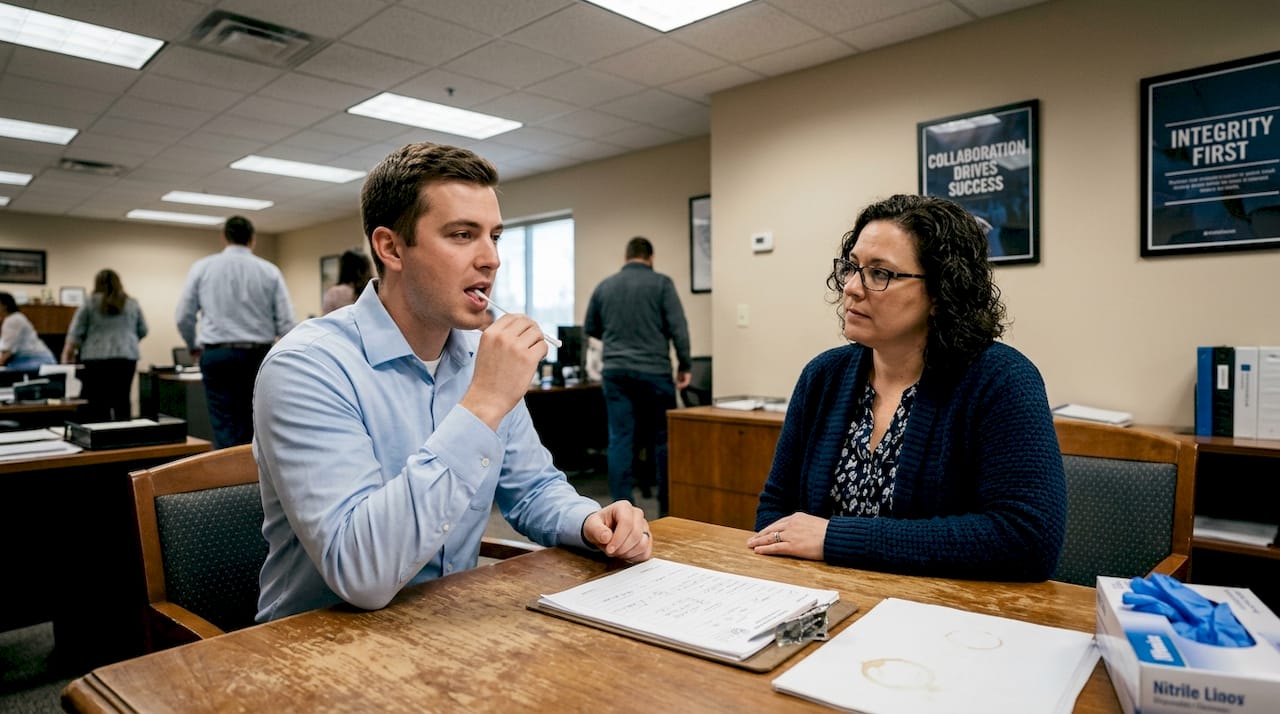
Oral fluid drug testing collects saliva, typically using a swab placed inside the cheek or under the tongue, to detect drug metabolites in the body. The process is quick, non-invasive, and can be observed directly by a collector, which eliminates the opportunity for sample tampering or substitution. That last point matters more than most people realize.
The test works by identifying chemical traces left behind after the body processes drugs. These metabolites enter saliva through blood and oral tissue. Because collection happens in plain sight, there’s no bathroom required and no opportunity to swap samples.
Substances commonly detected include:
- THC (marijuana)
- Cocaine and metabolites
- Amphetamines and methamphetamine
- Opioids including fentanyl and oxycodone
- PCP (phencyclidine)
- Benzodiazepines
- Buprenorphine
- Barbiturates
The oral fluid test thresholds set by SAMHSA ensure that results are consistent and legally defensible across labs and collection sites. This standardization is what makes oral fluid testing credible in compliance-heavy environments.
| Testing context | Oral fluid fit? |
|---|---|
| Pre-employment screening | Yes, fast and observed |
| Random workplace testing | Yes, minimal disruption |
| Post-accident investigation | Yes, detects very recent use |
| DOT-regulated positions | Conditional (HHS lab required) |
| Home or personal testing | Yes, simple collection |
Available saliva test panels now cover up to 10 substances at once, making them practical for most standard workplace programs. With a foundation laid, let’s look deeper into why employers and HR departments find oral fluid testing especially valuable.
Why employers and HR choose oral fluid testing
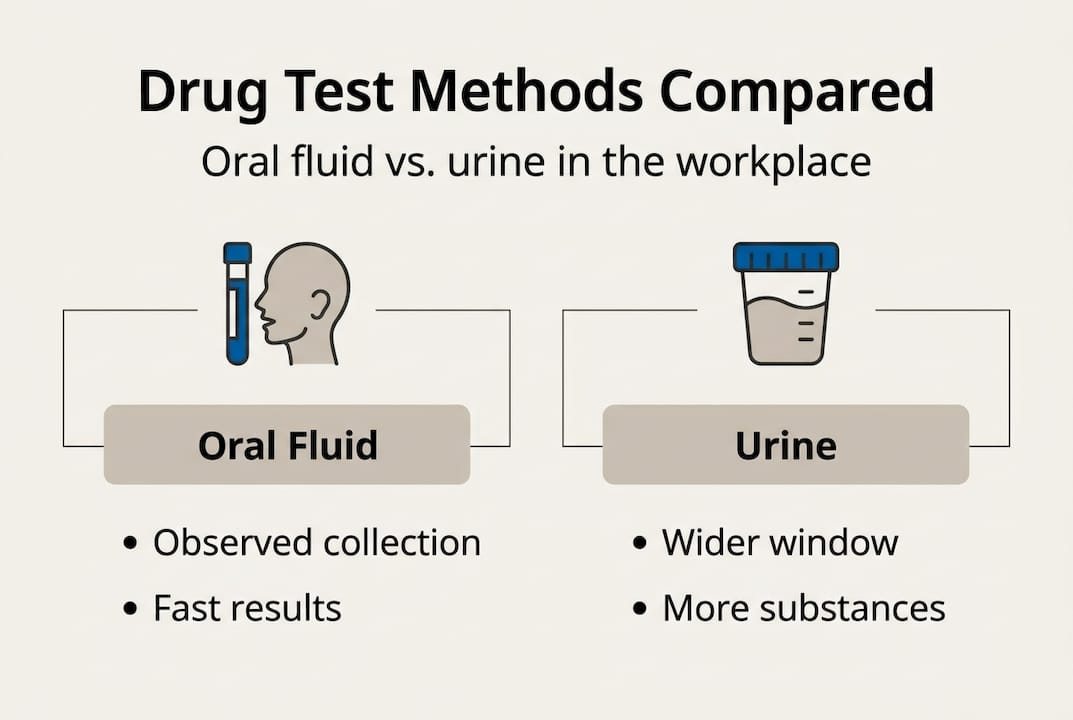
The single biggest advantage oral fluid testing offers employers is observed collection. Unlike urine testing, where the donor steps into a private restroom, saliva collection happens in full view. This removes the most common forms of cheating, including synthetic urine, dilution, and sample substitution.
Speed is the second major factor. Lab-based results typically come back within 24 to 36 hours, according to DOT collection guidelines. On-site devices deliver instant reads. For time-sensitive situations like post-accident testing or reasonable suspicion cases, that speed is operationally critical.
Key employer benefits at a glance:
- No private restroom needed for collection
- Directly observed, reducing fraud risk significantly
- Fast turnaround supports quick hiring and safety decisions
- Less dignity-sensitive than urine collection for employees
- Easy to deploy in field locations or remote worksites
| Feature | Oral fluid | Urine |
|---|---|---|
| Observed collection | Yes | Rarely |
| Detection window | Hours to 1 day | Days to weeks |
| Tamper resistance | High | Moderate |
| Privacy sensitivity | Low | Higher |
| Lab turnaround | 24-36 hours | 24-72 hours |
Understanding the value of employee drug testing goes beyond just catching drug use. A well-run program signals to your workforce that safety is taken seriously, which reduces liability and builds a stronger safety culture.
Pro Tip: If you’re setting up a DOT drug test program, oral fluid can complement your existing urine protocol for non-regulated positions, giving you flexibility without sacrificing compliance.
While the benefits are compelling, it’s essential to recognize the limitations and edge cases for oral fluid drug testing.
Limitations and edge cases for oral fluid testing
Oral fluid testing is not a universal solution. Its most significant limitation is the detection window. Most drugs are only detectable in saliva for a few hours to about 24 hours after use, compared to several days or even weeks in urine. That means someone who used marijuana three days ago could test clean on a saliva test but positive on a urine screen.
Several real-world factors can also interfere with results:
- Food and drink: Eating or drinking within 10 minutes of collection can dilute the sample or introduce contaminants.
- Mouthwash: Alcohol-based mouthwash used shortly before the test may affect results.
- Dry mouth: Certain medications or medical conditions reduce saliva flow, making collection difficult or producing insufficient volume.
- Novel substances: Newer synthetic drugs may not appear on standard panels.
- Matrix effects: Compounds in saliva can sometimes interfere with specific immunoassay reactions.
“Oral fluid testing does not prove current impairment. A positive result indicates recent use, not that the individual was impaired at the time of the test.” NYSP Oral Fluid FAQ
This distinction matters enormously in post-accident scenarios. If an employee tests positive after a workplace incident, a saliva result shows they used a substance recently, but it does not establish that they were impaired at the moment of the accident. Legal counsel and HR should understand this clearly before acting on results alone.
For a deeper comparison, reviewing urine vs oral tests helps clarify which method fits which scenario. Employers handling post-accident drug test concerns should factor these limitations into their response protocols. Given these downsides, it’s critical to know when and how oral fluid testing is best used and how it stacks up against alternatives.
When is oral fluid drug testing the best fit?
Oral fluid testing shines in specific, well-defined scenarios. It’s the strongest choice when you need to detect very recent drug use, when observed collection is a priority, and when speed matters more than a long detection window.
Scenarios where oral fluid testing excels:
- Reasonable suspicion testing when impairment is suspected right now
- Post-accident testing within hours of an incident
- Pre-employment screening when fast onboarding timelines matter
- Random testing programs where observed collection reduces fraud risk
- Personal or home testing for recent use confirmation
For DOT-regulated employers, the picture is more nuanced. The DOT has authorized oral fluid testing, but as of early 2026, only labs with full HHS certification can process these samples. That certification rollout is still limited, which means many regulated employers are still relying primarily on urine for DOT compliance.
Pro Tip: Use a standing order in your drug testing policy that allows the collector to choose between urine and oral fluid based on circumstances. This gives you legal flexibility while staying compliant with DOT drug test requirements.
For transportation compliance, including truck driver drug testing in 2026, always verify that your testing vendor uses an HHS-certified lab before switching to oral fluid for regulated positions. Having examined when oral fluid testing shines, let’s clarify how these insights apply in the real world.
How to choose the right drug test for your needs
Choosing between oral fluid and urine testing is not about which is better overall. It’s about which fits your specific situation. The Federal Register drug testing regulations make clear that both oral fluid and urine tests have defined roles, and the right choice depends on your detection window needs, tamper risk, and compliance obligations.
| Factor | Choose oral fluid | Choose urine |
|---|---|---|
| Detection window needed | Recent use (hours) | Past use (days/weeks) |
| Tamper risk | High concern | Lower concern |
| Regulatory requirement | Non-DOT or DOT with HHS lab | DOT standard |
| Collection setting | Field, remote, no restroom | Clinic or controlled facility |
| Speed priority | Immediate or same-day | 24-72 hour acceptable |
Decision checklist for method selection:
- Is this position DOT-regulated? If yes, confirm HHS-certified lab availability before using oral fluid.
- Is the test post-accident or reasonable suspicion? Oral fluid is ideal for detecting very recent use.
- Is tampering a documented concern in your workforce? Oral fluid’s observed collection reduces that risk.
- Does your policy require a specific detection window? Urine is better for longer lookback periods.
- Are you combining methods? Some employers use oral fluid for on-site screening and urine for lab confirmation.
For DOT testing program setup, document your method selection rationale in your written policy. Regulators and legal teams will want to see that your choices were deliberate and compliance-driven, not just convenient. Now that you know how to select the right method, let’s focus on what most guides don’t discuss to avoid costly mistakes.
What most guides miss about oral fluid drug testing
Most articles on oral fluid testing focus on the convenience angle. Fast, easy, no restroom required. That framing is accurate but incomplete, and it leads some organizations to adopt oral fluid testing without fully thinking through the policy implications.
Here’s the uncomfortable reality: convenience can create compliance gaps. If you switch to oral fluid primarily because it’s easier to administer, you may inadvertently miss chronic drug users whose use falls outside the short detection window. That’s a liability issue, not just a testing gap.
The smarter approach is to treat oral fluid as one tool in a broader strategy. Confirm any preliminary positive with a certified lab. The value of lab-based drug testing is not just accuracy; it’s legal defensibility. A confirmed, lab-processed result holds up in court and in regulatory audits. An unconfirmed on-site result does not.
Hybrid strategies, combining oral fluid for immediate post-accident or suspicion testing with urine for pre-employment and random programs, give you the best of both methods. A thoughtful, documented policy built around actual risk scenarios will always outperform a one-size-fits-all approach.
Get reliable oral fluid testing solutions
Building a compliant drug testing program means having access to the right tools at every stage, from instant on-site screening to certified lab confirmation.
At Countrywide Testing, we offer a full range of lab testing services aligned with SAMHSA and DOT standards, so your results are always legally defensible. Need to confirm a preliminary positive? Our mail-in confirmation test gives you certified lab results without the complexity. For immediate screening, the 10 panel saliva test covers the most common substances quickly and accurately. Whether you’re an HR team managing a large workforce or an individual who needs a fast, reliable answer, we have the right solution ready.
Frequently asked questions
What drugs can oral fluid testing detect?
Oral fluid tests detect THC, cocaine, amphetamines, opioids, PCP, benzodiazepines, fentanyl, and more based on standardized cutoff levels set by SAMHSA.
How fast are oral fluid drug test results?
Lab results typically return within 24 to 36 hours, while on-site collection devices can deliver instant results at the point of collection.
Does oral fluid drug testing prove impairment?
No. Oral fluid tests confirm recent drug use but cannot establish that a person was impaired at any specific moment, which is a critical legal distinction in post-accident cases.
Is oral fluid testing DOT-compliant in 2026?
The DOT has authorized oral fluid testing, but HHS lab certification is required to process results, and that rollout remains limited as of mid-2026, so most regulated employers still use urine as the primary method.
What are the main limitations of oral fluid testing?
The primary limitations include a short detection window, potential interference from food or mouthwash, and the inability to detect all substances or confirm impairment at the time of testing.