
Step-by-step guide to implementing an alcohol testing policy
TL;DR:
- Implementing a clear, compliant alcohol testing policy sets safety expectations and reduces legal risks.
- Supervisors need proper training and consistent enforcement to ensure effective testing and documentation.
- Combining testing with education and a safety culture enhances long-term workplace safety and trust.
Alcohol-related incidents cost American employers billions each year in lost productivity, liability claims, and damaged reputations. One unclear or missing workplace alcohol policy can expose your organization to regulatory fines, lawsuits, and preventable injuries. Whether you manage a small business or a large workforce in a DOT-regulated industry, the stakes are real. This guide walks you through every stage of building a compliant, effective alcohol testing policy, from understanding why you need one to rolling it out and avoiding the mistakes that trip up even experienced HR teams.
Table of Contents
- Why implement an alcohol testing policy?
- Preparing your policy: What you need to get started
- Step-by-step: Creating and launching your alcohol testing policy
- Avoiding pitfalls: Common mistakes and how to handle challenges
- Our perspective: The real-world value and limits of alcohol testing policies
- How we can help you succeed
- Frequently asked questions
Key Takeaways
| Point | Details |
|---|---|
| Clear policies deter misuse | A formal alcohol testing policy sets expectations and safeguards employees and your organization. |
| Compliance requires preparation | Thoroughly preparing materials, training, and legal review ensures your policy stands up to scrutiny. |
| Testing works best with education | Policies are most effective when paired with supervisor education and open communication. |
| Ongoing review matters | Regular policy updates and employee reinforcement prevent compliance gaps and build trust. |
Why implement an alcohol testing policy?
Workplace alcohol misuse is not a rare edge case. It shows up in near-misses, absenteeism, and, in the worst situations, serious accidents. When an incident happens and you have no documented policy, your legal exposure grows fast. A clear, written alcohol testing policy does three things at once: it sets expectations, deters misuse, and gives you a defensible process if you ever need to act on a positive result.
For employers in safety-sensitive industries, this is not optional. The Department of Transportation, the Federal Aviation Administration, and other regulatory bodies mandate formal alcohol testing programs for covered employees. But even outside regulated industries, a policy signals to your workforce that safety is a genuine priority, not just a poster on the break room wall.
Understanding alcohol testing and workplace safety also means recognizing when tests are triggered. The testing triggers that most policies rely on include:
- Post-accident: After an incident meeting defined severity thresholds
- Reasonable suspicion: When a trained supervisor observes specific behavioral signs
- Random: Unannounced, using a scientifically valid random selection method
- Return-to-duty and follow-up: After a violation, before and after an employee resumes safety-sensitive work
Here is something many employers overlook: testing alone is not enough. Multi-level interventions that combine policy with education are measurably more effective than testing programs that operate in isolation. A breathalyzer program without training, communication, and a support structure is just a compliance checkbox.
“An alcohol testing program is only as strong as the culture it operates in. Rules without education rarely change behavior long-term.”
Pairing your testing policy with supervisor training and employee education is what turns a compliance requirement into a genuine safety tool.
Preparing your policy: What you need to get started
Before you write a single line of policy language, you need to understand the legal landscape your organization operates in. Requirements vary significantly depending on your industry, state, and whether your employees are covered under federal regulations.

DOT requires written policies, supervisor training, and use of certified labs and Breath Alcohol Technicians (BATs) for covered employers. State laws may add additional requirements or restrictions, especially around employee privacy and how you can act on test results. If your workforce is unionized, your collective bargaining agreement may also shape what testing looks like.
Here is a quick overview of what you need to gather before drafting your policy:
| Preparation item | Why it matters |
|---|---|
| Written policy draft template | Ensures nothing is missed and gives you a starting point |
| Legal review (state and federal) | Catches compliance gaps before they become liabilities |
| Certified testing provider | Required for DOT; best practice for all employers |
| Supervisor training materials | Mandatory for DOT; critical for consistent enforcement |
| Employee communication plan | Reduces resistance and confusion at rollout |
For alcohol screening compliance, engaging the right stakeholders early is just as important as the paperwork. Bring HR, legal counsel, safety officers, and, where appropriate, employee representatives into the conversation before you finalize anything. This prevents the policy from feeling like something imposed from above, which is one of the fastest ways to generate pushback.
Pro Tip: Review your existing substance abuse policy, if you have one, before starting from scratch. Many organizations can build on what they already have rather than rebuilding entirely.
Also think about which alcohol screening methods you will use. Breath alcohol testing is the most common for workplace programs, but your certified provider can help you match the method to your operational needs.
Step-by-step: Creating and launching your alcohol testing policy
With your groundwork in place, here is a practical sequence for building and rolling out your policy:
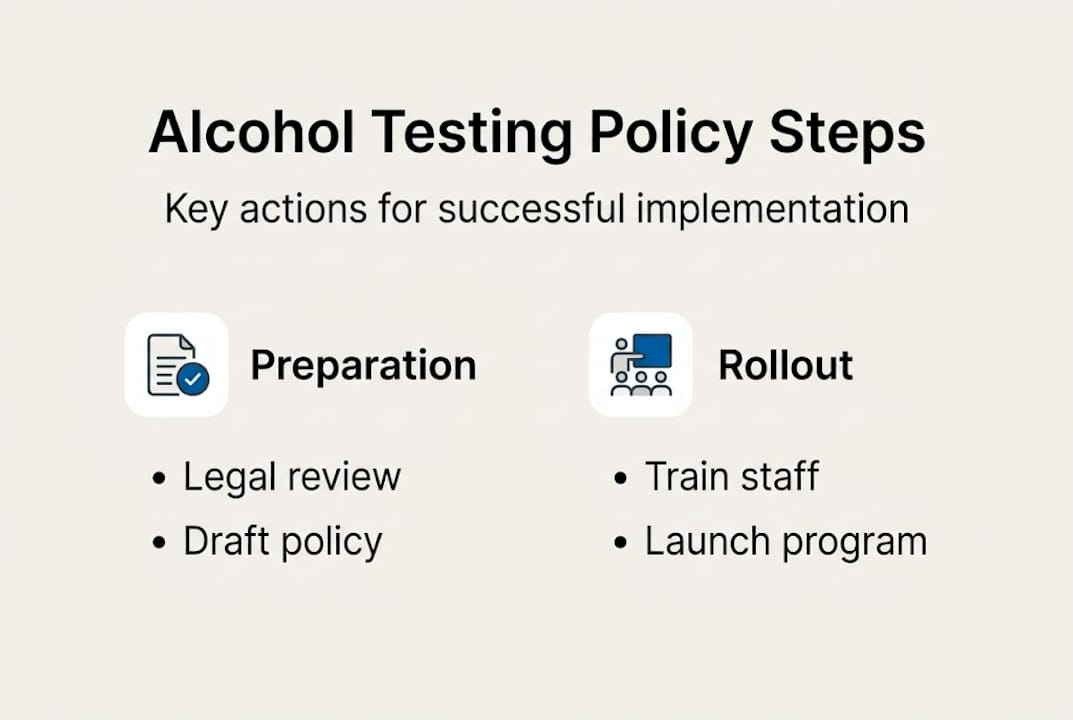
- Draft the policy. Start with your organization’s specific risk profile, industry regulations, and workforce structure. Define which employees are covered, which testing triggers apply, what the consequences of a positive result are, and how the testing process works from start to finish.
- Legal and HR review. Have legal counsel and your HR lead review the draft for compliance with federal, state, and local law. Revise based on their feedback before moving forward.
- Train your supervisors. DOT requires supervisors to receive training on recognizing the signs of alcohol misuse and documenting observations correctly. Even if you are not DOT-regulated, this training is essential. An untrained supervisor who acts on gut feeling rather than documented behavior creates serious legal risk.
- Select your certified lab or BAT. Choosing a certified provider is non-negotiable for DOT employers and strongly recommended for everyone else. Look for labs that meet SAMHSA, CLIA, or CAP standards.
- Communicate the policy. Distribute the written policy to all covered employees and require signed acknowledgment. Transparency here protects you legally and reduces confusion.
- Run education sessions. Explain the why behind the policy, not just the rules. Employees who understand the safety rationale are more likely to support the program.
- Go live and document everything. Keep records of policy distribution, acknowledgments, training completion, and all tests conducted.
For a closer look at the drug testing compliance process and examples of testing protocols, those resources can help you tailor each step to your specific situation.
| Policy element | DOT-regulated employers | Non-regulated employers |
|---|---|---|
| Written policy | Required | Strongly recommended |
| Supervisor training | Required (60 min minimum) | Best practice |
| Certified BAT/lab | Required | Best practice |
| Random testing | Mandatory for covered roles | Optional but common |
| Employee acknowledgment | Required | Recommended |
Avoiding pitfalls: Common mistakes and how to handle challenges
Even well-intentioned alcohol testing programs run into problems. Knowing where others go wrong helps you avoid the same traps.
Inadequate supervisor training is the most common failure point. Supervisors who cannot articulate why they suspected impairment, or who skip documentation steps, can undermine the entire enforcement process. A single poorly handled reasonable-suspicion case can expose your organization to a discrimination claim.
Outdated or vague policy language is another frequent issue. If your policy was written five years ago and has not been reviewed since, it may no longer reflect current regulations or your actual workplace practices. Vague language around consequences or procedures gives employees and their attorneys room to challenge enforcement.
Here are the most common mistakes to watch for:
- Failing to update the policy when regulations or operations change
- Not requiring signed employee acknowledgment of the policy
- Using non-certified testing providers or improper chain-of-custody procedures
- Applying consequences inconsistently across employees or roles
- Ignoring employee privacy rights during the testing process
Examples of alcohol screening tests can help you understand what a proper, defensible testing procedure looks like in practice.
Handling positive results consistently is critical. Every employee in the same role should face the same process after a confirmed positive. Inconsistency is one of the fastest paths to a wrongful termination or discrimination claim.
“Consistency is not just a legal protection. It is what makes employees trust that the policy is about safety, not selective enforcement.”
Pro Tip: Schedule an annual policy review on your HR calendar now. Regulations change, your workforce evolves, and your policy needs to keep pace.
Finally, remember that testing deters use, but the evidence for injury prevention from testing alone is limited. Education, open communication, and a culture where employees feel safe raising concerns are what close the gap.
Our perspective: The real-world value and limits of alcohol testing policies
After working with employers across industries, we have seen a consistent pattern: organizations that treat alcohol testing as a pure compliance exercise get compliance results. Organizations that treat it as part of a broader safety culture get something more valuable, a workforce that actually looks out for each other.
A written policy and certified testing process are essential guardrails. They protect you legally and set a clear standard. But the alcohol policy compliance guide we always point employers to emphasizes something that does not show up in regulations: trust.
Rigid enforcement without communication breeds resentment. Employees who feel surveilled rather than supported are less likely to flag a coworker who needs help. The most effective programs we see pair firm, consistent rules with genuine education and a pathway for employees who have a problem to get support before a crisis forces the issue. That combination, clear policy plus human support, is what actually moves the needle on safety.
How we can help you succeed
Building a compliant alcohol testing policy is a process, and you do not have to figure it out alone. At Countrywide Testing, we work with employers across industries to make testing setup straightforward and fully compliant.
Our lab testing services connect you with SAMHSA, CLIA, and CAP-certified laboratories that meet DOT and non-regulated employer requirements alike. We offer fast turnaround, nationwide coverage, and support for both one-time and ongoing testing programs. Whether you are setting up your first alcohol testing policy or auditing an existing one, we can help you select the right testing methods, connect with certified providers, and keep your documentation airtight. Reach out to our team and let us take the complexity out of compliance.
Frequently asked questions
What are the legal requirements for workplace alcohol testing policies?
Requirements vary by state, but DOT-regulated employers must have written policies, provide supervisor training, and use certified testing facilities and BATs. Non-regulated employers should consult state law and legal counsel.
How often should random alcohol testing occur?
Frequency depends on your industry and risk level, but random testing is mandatory for DOT-covered roles, with specific minimum annual rates set by each DOT agency.
Does alcohol testing really prevent workplace accidents?
Testing deters use, but evidence for injury prevention from testing alone is limited. Pairing testing with education and clear policy produces the strongest safety outcomes.
Who needs to be trained before implementing alcohol testing?
Supervisors are the priority. DOT requires 60 minutes of training for supervisors to recognize alcohol misuse signs and handle procedures correctly, and this standard is a smart benchmark for all employers regardless of regulatory status.