
Drug Testing Frequency for U.S. Employers: DOT's Six Tests Rule
DOT/FMCSA-covered employees fall under fixed, binding testing frequencies, including a follow-up minimum of 6 tests in the first 12 months after a return to duty. Private employers face no equivalent federal ceiling or floor. Your frequency should track job risk, state law, and a written policy applied the same way every time.
TL;DR:
- Employers should base testing frequency on job risk, legal requirements, and policy consistency, with safety-sensitive roles requiring more frequent testing.
- Federal regulations mandate unannounced, evenly spread random testing for FMCSA-covered employees, with a minimum of six follow-up tests in the first year after a positive result.
- Non-DOT employers should typically conduct annual or incident-driven testing, with last chance agreements often using monthly testing for a year after violations.
- All testing plans must include written notice, clear scope, selection methods, confidentiality, and procedures for positive results to ensure defensibility.
- Chain-of-custody, lab accreditation, and coordination with Medical Review Officers and Substance Abuse Professionals are critical to maintaining compliance across all testing activities.
Table of Contents
- What Factors Determine How Often You Should Drug Test Employees?
- What Do Federal and Industry Rules Require?
- When Should You Test, and What Type Applies?
- How Often Should Non-DOT Employers Actually Test?
- How Do You Operationalize Your Testing Schedule?
- Who Actually Handles Employer Testing Programs at Scale?
- Why Frequency Should Follow Risk, Not Habit
- Build a Compliant Testing Program Without Guessing at the Rules
- Sources
What Factors Determine How Often You Should Drug Test Employees?
The right frequency isn’t a number you pick once and forget. It shifts based on who you employ, what they do, and what your state allows.
Start with the safety-sensitive divide. A forklift operator, a delivery driver, or a machine press technician creates risk the moment attention lapses. An accountant working remotely does not carry the same operational hazard, even if company policy applies to both. Courts and regulators generally give employers more latitude to test safety-sensitive roles more frequently and with less advance notice.
Industry mandate versus voluntary program is the second fork. If your drivers fall under FMCSA jurisdiction, your random testing rate is not a policy choice. It is set by regulation, and selections must be unannounced and spread reasonably through the calendar year. Outside those federally regulated positions, you set your own cadence, which is where most of the judgment calls happen.
A documented history changes the math too. An employee returning under a last chance agreement typically involves monthly testing for a probationary period, a practice that’s become standard enough to be considered a norm rather than punitive overreach.
Several other variables shape your defensible frequency:
- Prior positive results or safety incidents at the location or role level
- Union contracts, which require bargaining before frequency changes take effect
- State statutes that mandate written notice or restrict random testing to safety-sensitive positions
- Whether your industry carries third-party liability exposure (transportation, healthcare, childcare)
Skipping any of these when you set frequency is how well-intentioned policies turn into wrongful-termination or discrimination claims.
What Do Federal and Industry Rules Require?
Some employers don’t get to choose their testing frequency. Federal rules dictate it, and the rules are specific.
FMCSA-covered employers must select drivers for random testing using an unannounced, scientifically valid method that gives every covered employee an equal chance of being picked, spread across the calendar year rather than clustered in a single quarter. You cannot tip employees off, and you cannot let managers hand-pick who gets tested.
Statistic Callout: DOT return-to-duty follow-up testing requires a minimum of 6 tests during the first 12 months after a positive result, with the Substance Abuse Professional authorized to extend follow-up testing for up to 60 months total.
Behind these numbers sits SAMHSA’s Mandatory Guidelines, which set the federal testing panels, cutoff levels, and technical reporting standards used across federal workplace programs. The Federal Register’s authorized panel notice confirms the specific analytes and confirmatory cutoffs labs must use.
Two roles matter here beyond the employer:
- The Medical Review Officer (MRO) reviews every non-negative result before it becomes final, ruling out legitimate medical explanations.
- The Substance Abuse Professional (SAP) sets the follow-up testing schedule after a violation, and employers cannot shorten or override that schedule on their own.
If your workforce includes DOT-covered positions, these rules apply regardless of what your internal HR policy says. Federal requirements set the floor.
When Should You Test, and What Type Applies?
Frequency isn’t one number. It depends on the occasion, and each occasion has its own legal footing.
- Pre-employment. Test after a conditional job offer, not before. Testing every applicant before an offer invites disparate-impact claims if your process isn’t applied uniformly.
- Random. For covered positions, selection must follow the unannounced, equal-chance method described above. For non-covered roles, employers commonly set their own percentage, provided it is applied consistently across similarly situated employees.
- Reasonable suspicion. This requires objective, documented indicators, slurred speech, odor, unsafe operation of equipment, not a hunch. Train supervisors to write down what they observed, not what they assumed.
- Post-accident. Test when the incident meets a defined threshold (injury requiring treatment, property damage over a set amount, citation issued), and document why the threshold was met.
- Return-to-duty and follow-up. Governed by the SAP’s plan, with the 6-tests-in-12-months floor and up to 60 months of possible follow-up.
How Often Should Non-DOT Employers Actually Test?
Here’s where most HR teams get stuck. You have discretion, but discretion without a defensible framework is a liability.
For office and administrative roles with no safety-sensitive function, annual testing or incident-driven testing (post-accident, reasonable suspicion) is typically sufficient and easier to defend than aggressive random screening that has no connection to job risk.
Last chance agreements deserve their own mention. Monthly testing for twelve months after a policy violation is the most commonly used structure, and it works because it’s intensive enough to demonstrate a genuine behavior change while having a defined end date. The tradeoff: it demands consistent lab turnaround and careful recordkeeping, since a missed or late test can undo the agreement’s protective value for both sides.
Whatever frequency you land on, your policy should spell out:
- Notice: how and when employees learn about the policy and any changes to it
- Scope: which roles are covered and why
- Selection method: how random tests are chosen and by whom
- Consequences: what happens after a positive, refusal, or dilute result
- Confidentiality: who sees results and how records are stored
- Appeals: how an employee can contest a result or process error
- ADA/EEO protections: how prescribed medications and disability accommodations are handled
Pro Tip: Keep a one-page written rationale for your chosen frequency, tied to incident data, industry benchmarks, or insurance/liability requirements. If you’re ever challenged, that document is the difference between “we followed a defensible process” and “we made this up.”
For a deeper walk-through of policy language, see why employer drug test policies matter for safety and how to structure a compliant pre-employment testing policy.
How Do You Operationalize Your Testing Schedule?
A policy on paper means nothing if the execution is inconsistent. This is where most compliance gaps actually happen.
Your random-selection method needs to be genuinely random and documented as such, whether that’s a third-party administrator’s software or a verified internal process. Regulators and courts want to see that the method gives equal chance of selection, not that a manager eyeballed a roster.
Notice matters just as much as the mechanism. Employees should receive written policy documentation and sign an acknowledgment before testing begins, not after a positive result triggers a dispute.
When a result comes back non-negative, the MRO reviews it first. If it’s confirmed positive, the SAP builds the follow-up schedule, and you cannot compress or waive that schedule to move faster than the SAP recommends.
A few operational essentials round out a defensible program:
- Retain testing records per your state’s retention requirements, and separate medical information from personnel files to respect ADA and privacy obligations (see HIPAA compliance considerations for employers)
- Negotiate frequency and consequences with union representatives before implementation; unilateral changes to testing terms can trigger unfair labor practice charges
- Build a duty-of-care framework around testing, not just a testing schedule in isolation, as outlined in this employer duty of care guide
- Review your process annually against incident data, not just calendar habit
For the step-by-step mechanics, how to conduct compliant workplace drug testing walks through lab coordination and MRO handoffs in more detail.
Who Actually Handles Employer Testing Programs at Scale?
Setting a defensible frequency is only half the job. Someone has to run the program week after week without missing a follow-up window or mishandling a chain of custody.
Countrywidetesting works with laboratories that meet SAMHSA, ISO, CLIA, and CAP standards, the same technical bar federal programs require. That matters most during return-to-duty follow-up, where missing even one of the six required tests in the first year can restart the compliance clock.
Employer-facing services include:
- Nationwide lab testing with confirmed chain-of-custody handling for DOT and non-DOT programs
- At-home collection kits with lab confirmation, useful for employers managing remote or multi-site workforces
- Support coordinating MRO review and SAP-directed follow-up schedules
- Educational resources for building or updating a written testing policy
Why Frequency Should Follow Risk, Not Habit
Too many employers set testing frequency based on what a competitor does or what feels sufficiently cautious, rather than what the job actually requires. That’s backwards, and it creates two failure modes at once: over-testing low-risk roles invites morale problems and legal exposure, while under-testing safety-sensitive positions leaves real hazards unaddressed.
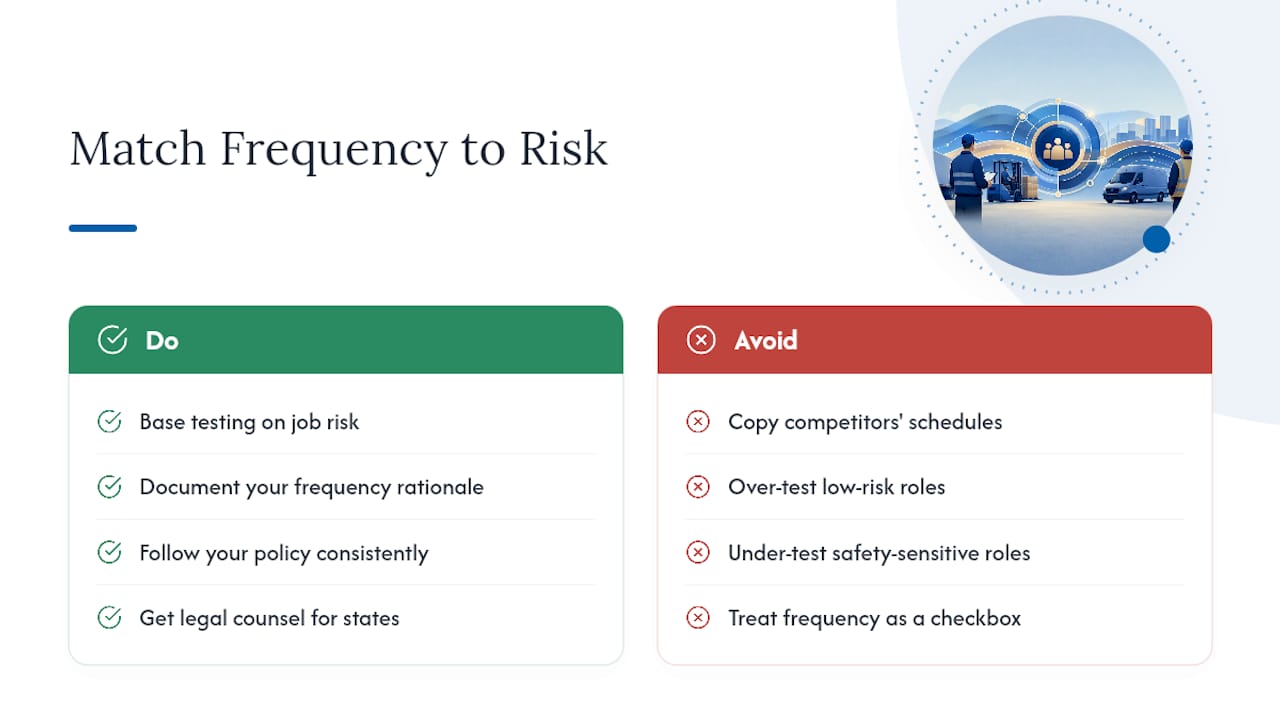
The federal rules exist because certain jobs carry public safety consequences that justify a fixed, non-negotiable frequency. Everywhere else, the honest answer is that frequency is a risk management decision, not a compliance checkbox. Document why you chose your numbers, follow them consistently, and get legal counsel involved before you finalize anything state-specific. That’s not caution for its own sake. It’s how you keep a testing program defensible when someone challenges it.
If you’re building or revising a program, talk to people who run compliant testing operations every day rather than guessing at what “reasonable” looks like.
— Alan
Build a Compliant Testing Program Without Guessing at the Rules
Getting frequency right is only useful if the testing behind it holds up, chain of custody, lab accreditation, and MRO/SAP coordination all have to function together. Countrywidetesting gives employers access to labs meeting SAMHSA, ISO, CLIA, and CAP standards, so your DOT follow-up schedule, random selections, and post-accident tests all route through the same compliant process.
Whether you need ongoing laboratory drug testing services for a multi-site workforce, at-home collection options for remote employees, or a straightforward way to handle a single reasonable-suspicion test, the setup works the same way: order through Countrywidetesting, and the lab and reporting infrastructure handles the rest. Start by reviewing lab testing services for your program and requesting a quote for your specific testing volume and roles.
This article is general information, not a substitute for advice from a qualified lawyer. Consult a qualified legal professional about your own circumstances before acting on anything here.
Sources
- Employer FAQs | US Department of Transportation
- Frequently Asked Questions (FAQs) and Answers About Federal Workplace Drug Testing | SAMHSA
- Mandatory Guidelines for Federal Workplace Drug Testing Programs: authorized testing panels (Federal Register, 2026)
- How often should selections take place under an employer’s random testing program? | FMCSA
- Drug testing in the workplace (Texas Workforce Commission guidance)