
DOT Oral Fluid Testing: 2026 Rules and Employer Action Steps
DOT authorizes oral fluid (saliva) drug testing under 49 CFR Part 40, but widespread use depends on HHS certifying at least two oral fluid laboratories. Until that happens, most employers are still running urine tests, including directly observed collections in situations where oral fluid would otherwise apply.
Here’s what that means for your program right now:
- Standing orders: Review your policy language so it reflects urine as the current default, with oral fluid noted as a future option.
- Collection sites: Ask your provider whether they have oral fluid-qualified collectors and devices staged, even though certified labs aren’t yet processing DOT specimens.
- DER/TPA coordination: Contact your designated employer representative or third-party administrator now to confirm they’re tracking HHS certification announcements on your behalf.
Key Takeaways
DOT permits oral fluid testing under Part 40, but employers can’t fully implement it until HHS certifies two oral fluid laboratories and publishes the corresponding grace-period dates.
| Point | Details |
|---|---|
| Two-lab threshold | HHS must certify two oral fluid labs before split-specimen reconfirmation and broad implementation are possible. |
| Interim urine rule | Directly observed collections currently default to urine until oral fluid infrastructure is certified. |
| — | The sunset clock for interim urine provisions starts on the day HHS certifies the second lab. |
| Collector qualification | Oral fluid collectors need separate training and device proficiency, distinct from urine collector credentials. |
| Countrywidetesting readiness | Countrywidetesting supplies certified-lab-backed testing kits and compliance guides to help employers prepare before certification lands. |
Table of Contents
- What the DOT Rule Actually Changed
- Where Oral Fluid Testing Stands Today
- Your Pre-Certification Readiness Checklist
- Collector Qualifications and Device-Handling Rules
- How a Positive Result Gets Verified
- How Countrywidetesting Supports Your Program
- Pages to Bookmark for Certification Updates
- What Employers Get Wrong About This Transition
- Get Ready for Oral Fluid Testing With Countrywidetesting
- Sources
What the DOT Rule Actually Changed
The Final Rule published in May 2023 added oral fluid testing as an alternate methodology under Part 40. That’s a significant shift. It doesn’t replace urine testing. It gives employers a second option, provided the lab infrastructure exists to support it.
The rule attaches one hard condition: DOT requires two separate HHS-certified oral fluid laboratories before employers can broadly implement the method. That two-lab threshold exists so a specimen can be split and reconfirmed at an independent lab if a driver challenges a positive result, mirroring how urine split-specimen testing already works.
DOT made oral fluid optional by design. The agency’s own reasoning, laid out in the Final Rule, frames it as a way to broaden collection options and cut down on specimen tampering, not to force a wholesale switch from urine.
A few things to keep in mind about the current framework:
- Oral fluid remains employer choice, not a DOT mandate, once certification is complete.
- The Part 40 regulatory text covers collector qualifications, device requirements, and direct observation rules.
- A supplemental Federal Register notice from May 2026 clarified observation procedures and terminology tied to the rollout.
Where Oral Fluid Testing Stands Today
DOT’s own tracking page for HHS-certified oral fluid laboratories and collection devices currently lists no labs certified for DOT program use. That single fact drives almost everything else in this article: no certified labs means no employer can implement oral fluid testing as a matter of routine practice yet, no matter how ready their collection sites are.
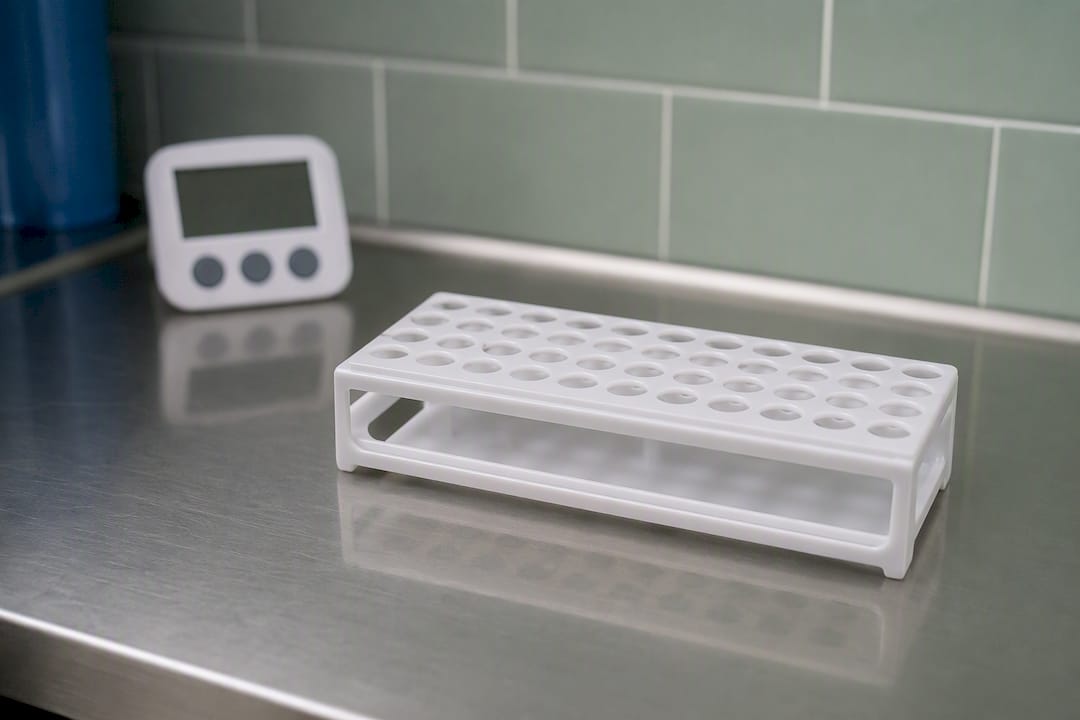
The number that matters most here is two. DOT needs two independently certified oral fluid labs operating before the interim urine provisions sunset. One lab alone can’t support split-specimen reconfirmation, so the requirement stays at two regardless of how close a single lab gets to certification.
In the meantime, the 2026 Federal Register notice confirms DOT’s interim approach: directly observed collections must use urine, not oral fluid, when observation is triggered under existing Part 40 criteria. That interim rule doesn’t sit indefinitely. It’s tied to a specific mechanic.
- The clock on a grace period starts the day HHS certifies the second oral fluid lab.
- DOT will publish that certification date, and the resulting sunset date for the interim urine provision, through a dedicated Federal Register notice.
- Employers don’t need to guess when this shifts. DOT has committed to formal notice rather than a quiet policy update.
Your Pre-Certification Readiness Checklist
Certification could arrive with limited lead time once HHS finalizes it, so the employers who avoid scrambling are the ones who prepare now. Here’s the order of operations that makes sense for most DOT-regulated programs.
- Write your standing order. Decide, in writing, when your program will use oral fluid versus urine once both are available, and have your DER sign off on it.
- Audit collection-site capability. Confirm your collection provider has collectors qualified specifically for oral fluid, since that credential is separate from urine collector qualification.
- Check device and CCF readiness. Ask whether your provider’s oral fluid devices are staged and whether staff know how to document expiration dates and volume indicators on the chain of custody form.
- Talk to your consortium or TPA. Get clarity on turnaround expectations and split-specimen logistics once certified labs come online.
- Train collectors now. DOT’s temporary mock-monitor relief lets you run practice collections ahead of certification, though you should document that devices used in training aren’t yet HHS-approved for live specimens.
- Update observer procedures. Revisit your policy language on same-sex observer requirements and how it applies to transgender and nonbinary employees, since directly observed urine collections remain the interim norm.
Pro Tip: Don’t wait for the certification notice to start collector training. Mock collections are permitted under the current relief window, and getting your team device-proficient early means zero downtime once oral fluid testing actually goes live.
Collector Qualifications and Device-Handling Rules
Oral fluid collection isn’t a variation on urine collection. It’s a distinct skill set with its own qualification requirement, and DOT treats the two as separate credentials even after full implementation. A collector certified for urine specimens can’t simply switch to oral fluid devices without separate training to proficiency on that specific device.
Device handling carries its own failure points. Collectors must check expiration dates before every collection and reject any expired device outright. Labs, in turn, can reject a specimen if the chain of custody form is missing expiration data and the date can’t be verified from the specimen bottle itself, according to DOT’s device and CCF handling guidance.
- Insufficient oral fluid volume, often from dry mouth, requires a documented fallback procedure. Most protocols default to urine when oral fluid collection fails.
- Misdocumented CCF entries are among the most common corrective-action triggers collectors report, right alongside expired devices.
- A rejected specimen due to device or documentation error typically means starting the collection process over, so getting it right the first time matters.
Pro Tip: Build a quick pre-collection checklist for your collectors: expiration date, volume indicator, CCF fields. Thirty seconds of verification prevents a rejected specimen and a frustrated driver.
How a Positive Result Gets Verified
A positive oral fluid result doesn’t trigger a different process than a positive urine result. The Medical Review Officer verification pathway stays identical regardless of specimen type, and employee rights to challenge or explain a result remain unchanged.
- Split-specimen testing depends entirely on having two HHS-certified labs in place, since a driver’s right to a reconfirmation test requires an independent lab to run it.
- Substance Abuse Professional evaluation and return-to-duty testing obligations apply the same way they always have, with no reduced or added burden tied to specimen type.
- Follow-up testing frequency and duration follow existing Part 40 rules, not a separate oral fluid track.
That parity is one of the strongest arguments for oral fluid testing once it’s available: it slots into your existing MRO and SAP workflow rather than requiring a parallel compliance process.
How Countrywidetesting Supports Your Program
Countrywidetesting works with labs that meet SAMHSA, CLIA, and CAP standards, so employers get consistent chain-of-custody handling whether they’re ordering urine kits today or preparing for oral fluid down the line. The site’s oral fluid drug testing resource walks through device reliability and collection basics for programs getting ready ahead of certification.
- Lab testing services backed by certified laboratory partnerships for confirmatory and split-specimen needs.
- Saliva and urine kit supply for both DOT-regulated and non-regulated screening programs.
- Employer-facing guides covering DOT program setup and standing-order documentation.
Reach out to Countrywidetesting now to line up your collection supplies and lab support before the certification window opens.
Pages to Bookmark for Certification Updates
Three official sources will tell you exactly when the rules shift, and none of them require guesswork or third-party interpretation.
- DOT’s Part 40 regulatory text for the full procedural framework, including collector qualifications and direct observation criteria.
- DOT’s HHS-certified oral fluid labs page, which will update the moment a second lab earns certification.
- The Federal Register, where DOT will publish the formal notice announcing certification and the resulting grace-period sunset date, following the pattern set by the May 2026 clarification notice.
What Employers Get Wrong About This Transition
Most compliance advice on oral fluid testing treats it as a switch you flip once HHS finalizes certification. That’s not how this works, and employers who wait for the announcement before doing anything will find themselves behind, not ahead.
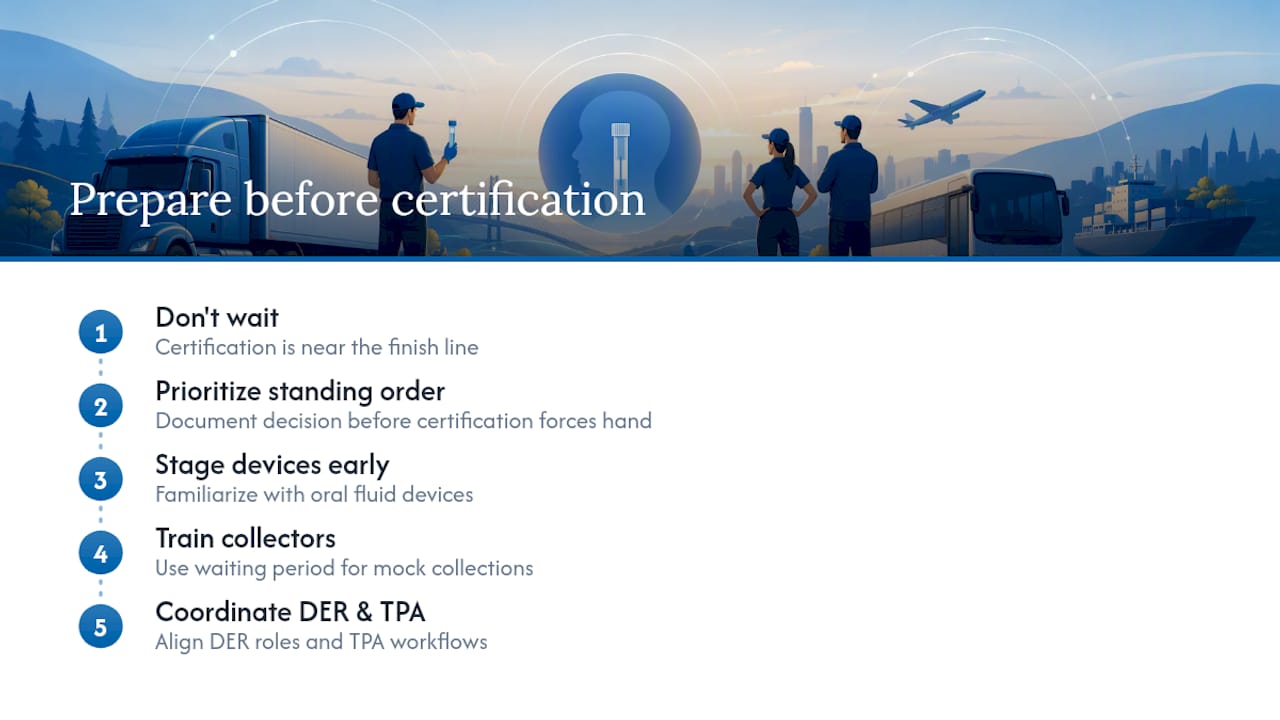
The certification trigger isn’t the starting line. It’s closer to the finish line of a process that should already be underway: collector training, device familiarization, standing-order language, and DER coordination. DOT built in mock-collection relief specifically because it expects employers to prepare during the waiting period, not after it ends.
I’d also push back on the idea that oral fluid testing is primarily about convenience. The Final Rule’s own reasoning centers on reducing specimen tampering and expanding observation options, not on speeding up collections for their own sake. Employers who frame this purely as “faster testing” will miss the split-specimen and observation nuances that actually determine whether their program holds up to a challenge.
Prioritize your standing order first. Everything else, device staging, training, TPA coordination, flows from having that decision documented before certification forces your hand.
— Alan
Get Ready for Oral Fluid Testing With Countrywidetesting
Countrywidetesting gives DOT-regulated employers a single source for both the urine testing you rely on today and the saliva-based devices you’ll need once HHS certification clears the way, without juggling separate vendors for each specimen type.
That matters because switching supply chains mid-transition is exactly the kind of disruption safety managers can’t afford. Countrywidetesting’s lab testing services connect employers to SAMHSA, CLIA, and CAP-compliant labs now, so your confirmatory testing and MRO workflow are already dialed in before oral fluid becomes an option. If your program also needs adjunct screening, such as a 12-panel multi-drug test kit for non-DOT purposes, that same relationship covers it without adding another supplier to manage.
Get in touch with Countrywidetesting today to review your current testing setup and prepare your collection-site supplies ahead of HHS certification.
Sources
- Procedures for Transportation Workplace Drug and Alcohol Testing Programs: Addition of Oral Fluid Specimen Testing for Drugs; Final Rule
- HHS Certified Oral Fluid Laboratories and Oral Fluid Collection Devices
- Procedures for Transportation Workplace Drug and Alcohol Testing Programs (supplemental / clarification notice)