
Avoid a $50,000 EEOC Settlement: EEOC Drug Testing Steps for HR
Employers may test for current illegal drug use under EEOC guidance, but the moment a result touches a lawful prescription or a disability, the rules tighten fast. You must give the person a chance to explain, engage the ADA interactive process where warranted, and route results through a Medical Review Officer using HHS/SAMHSA-certified lab practices. Skip any of that, and you’re not running a drug-free workplace program. You’re building a discrimination case.
TL;DR:
- Employers can legally require drug tests for current illegal drug use before offers but must avoid assumptions about prescriptions or recovery status.
- Confirmatory testing with a certified lab and input from a Medical Review Officer are essential steps before disciplinary action on positive results.
- Testing protocols like applicant, random (in safety-sensitive roles), reasonable suspicion, and post-accident must follow strict legal and procedural standards.
- Policies must clearly define scope, triggers, and appeal processes, and vendors should meet HHS certification and chain-of-custody requirements.
- Positive results alone should never trigger immediate discipline; instead, employers must verify lawful medication use and engage in an ADA interactive process.
Table of Contents
- What EEOC Drug Testing Guidance Requires From Employers
- When Testing Is Lawful: Applicants, Random Screens, and Reasonable Suspicion
- Handling a Positive Test Without Triggering an EEOC Complaint
- The HHS and SAMHSA Standards Behind Every Compliant Test
- Building a Compliant Policy and Overseeing Your Testing Vendor
- Unions, Federal Employees, and When to Call in Counsel
- Your Compliance Checklist: From Notification to MRO Verification
- Balancing Safety and ADA Protections: A Closing Thought
- Where CountryWideTesting.com Fits Into Your Compliance Program
- Sources
- FAQ
What EEOC Drug Testing Guidance Requires From Employers
The EEOC treats current illegal drug use differently than almost any other health-related issue in employment law. Tests that screen specifically for illegal drug use aren’t classified as medical examinations under the ADA, which means employers can require them at stages where a true medical exam would be off limits. That distinction matters because it lets employers ask applicants directly about current illegal drug use, even before extending a job offer.
The catch is that “current illegal drug use” is narrower than most managers assume. Someone taking a prescribed opioid for chronic pain isn’t using drugs illegally, and someone in recovery from a past addiction still carries ADA protection for that history. The EEOC has been explicit that employers cannot assume a positive result means illegal activity, particularly with legally prescribed medications like codeine or oxycodone.
Where employers get into trouble:
- Asking disability-related questions before a conditional offer, even informally, rather than sticking to drug-use questions that current EEOC guidance allows pre-offer.
- Treating any positive screen as automatic grounds for rejection without asking about lawful prescriptions first.
- Failing to separate “uses drugs illegally” from “has a disability that requires medication,” which are legally distinct categories with different protections.
- Applying assumptions about addiction history to someone who has completed treatment and isn’t currently using.
Get the sequence right: drug-use questions are fair game early, disability questions wait until after a conditional offer, and every positive result gets a follow-up conversation before any decision gets made.
When Testing Is Lawful: Applicants, Random Screens, and Reasonable Suspicion
Not every testing scenario carries the same legal footing, and treating them all the same is how policies fall apart under scrutiny. Here’s how the major categories break down:
- Applicant testing. Employers can require a drug test as a condition of a job offer, and refusal or a positive result can lawfully disqualify a candidate, since current illegal drug users aren’t protected under the ADA when the employer is acting on that drug use specifically.
- Random testing. This holds up best in safety-sensitive or federally regulated positions, such as transportation or aviation roles, where a random draw isn’t targeting anyone unfairly. Outside those designated categories, random testing without a clear, documented rationale invites disparate-treatment claims.
- Reasonable suspicion testing. This requires observable, documented facts, not a hunch. Slurred speech, erratic behavior, or a smell of alcohol noted by a trained supervisor holds up far better than a vague sense that “something seemed off.”
- Post-accident testing. This works best when tied to a specific incident and applied consistently across similar events, not selectively after some accidents but not others.
Federal contractors and safety-sensitive industries often follow separate testing models, described in SAMHSA’s model drug-free workplace plan, which lists applicant, random, reasonable suspicion, post-accident, and follow-up testing as the standard categories most programs are built around.
Handling a Positive Test Without Triggering an EEOC Complaint
A positive screen is a starting point, not a verdict. The single biggest mistake employers make is moving straight from a lab result to a disciplinary decision without the intermediate steps that keep a program defensible.
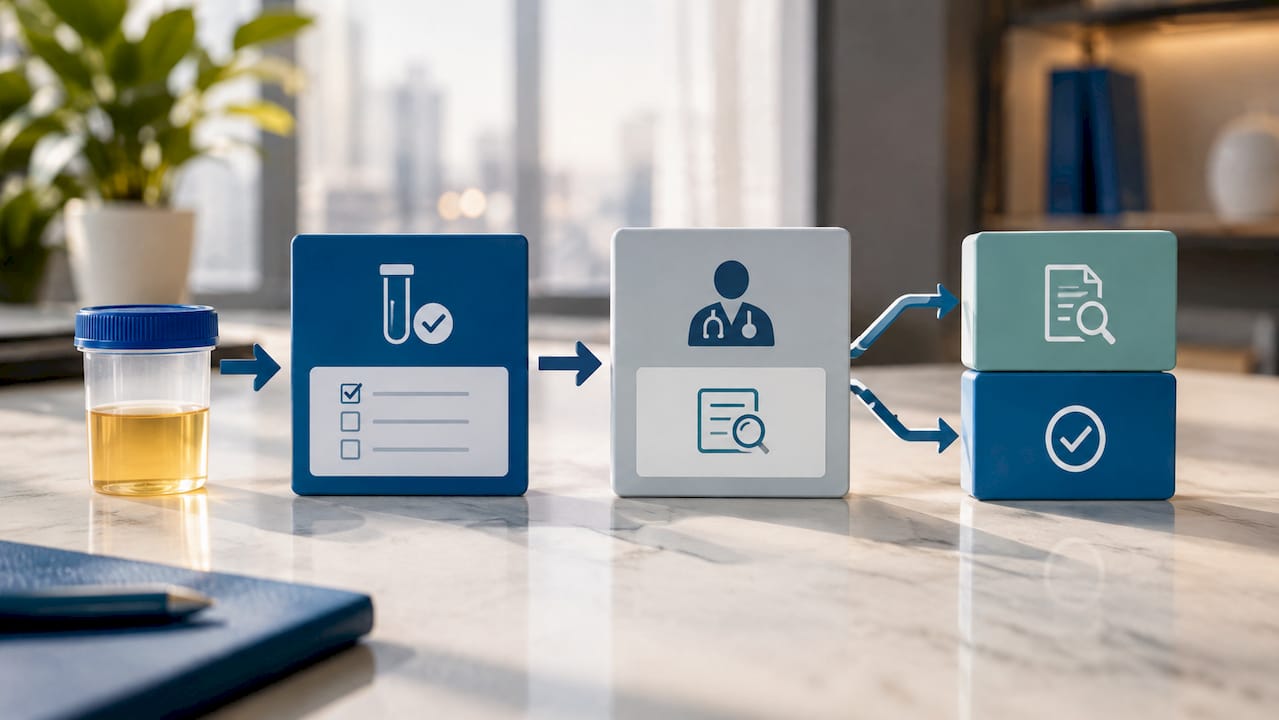
Confirmatory testing through a certified lab, verified by a Medical Review Officer, comes first. An MRO reviews the result, contacts the individual, and determines whether a legitimate medical explanation, like a valid prescription, accounts for the finding. This step alone resolves a meaningful share of positive screens without any need for discipline.
Beyond the MRO step, a defensible process includes:
- Giving the employee or applicant a real opportunity to explain the result before any adverse action, consistent with EEOC guidance on prescription opioid use.
- Starting the ADA interactive process the moment a disability or treatment program enters the picture, rather than waiting for a formal accommodation request.
- Requesting only limited, job-related documentation describing functional limitations, not a full medical history, as outlined in EEOC guidance for health care providers.
- Keeping chain-of-custody records, MRO reports, and all related documentation confidential and separate from general personnel files, a practice detailed further in our guide to HIPAA compliance in drug testing.
The stakes here are real. The EEOC’s settlement with Randstad, which cost the staffing firm $50,000, shows what happens when an employer skips the interactive process and acts on assumptions instead of documented facts.
Pro Tip: Adverse action should rest on demonstrated illegal use, an inability to safely perform essential job functions, or a direct threat, not simply on a positive result tied to a prescribed medication.
The HHS and SAMHSA Standards Behind Every Compliant Test
Behind every legally sound drug test sits a set of federal technical standards most HR teams never read directly but should understand at a working level. The HHS Mandatory Guidelines for Federal Workplace Drug Testing Programs set the authorized analytes, cutoff levels, and lab procedures that federal testing programs must follow, and private employers frequently mirror them for defensibility even when not legally required to.
Recent updates matter here. Fentanyl has been added to authorized testing panels, reflecting how far synthetic opioids have moved into mainstream drug-use patterns, and the panels get revisited on a recurring basis rather than staying static for years at a time.
When evaluating a testing vendor, look for:
- HHS certification and current NLCP (National Laboratory Certification Program) status for any lab processing samples.
- Documented chain-of-custody procedures from specimen collection through final reporting.
- Support for both urine and oral fluid testing, since panels and detection windows differ meaningfully between the two.
- MRO review built into the standard workflow, not offered as a costly add-on.
Lab reporting language, terms like “negative dilute” or “positive with medical review pending,” directly shapes what HR can and can’t act on, so training whoever reviews results matters as much as picking the right lab.
Building a Compliant Policy and Overseeing Your Testing Vendor
A written policy only protects you if it’s specific enough to apply consistently. Vague language (“employees may be tested as needed”) is exactly what plaintiffs’ attorneys look for.
- Define scope and triggers clearly. Name which positions are safety-sensitive, when random testing applies, and what counts as reasonable suspicion.
- Build in an explanation and appeals step. Every policy needs a documented path for employees to respond before discipline is finalized.
- Set a consistent disciplinary framework. Inconsistent enforcement, testing one employee’s odd behavior but not another’s, is a common source of disparate-treatment claims.
- Vet vendors on certification, not just price. Require HHS/SAMHSA and NLCP alignment, MRO services, documented chain-of-custody, and realistic turnaround times, points covered in our breakdown of why third-party labs matter for workplace testing.
Employers also carry responsibility for validating that their selection procedures are job-related and consistent with business necessity, even when a third-party vendor runs the actual testing, per EEOC guidance on employment tests.
Pro Tip: Train supervisors to log specific, observable behaviors, not general impressions, the moment they suspect impairment. A note like “employee stumbled twice, speech slurred, 2:15 PM” holds up far better in a dispute than “seemed off today.”
Unions, Federal Employees, and When to Call in Counsel
Standard policy templates break down in a few specific situations. Unionized workplaces generally must bargain over testing terms and penalties before implementing or changing them, since these terms typically qualify as mandatory subjects of bargaining. Federal employees and many federal contractors operate under separate Mandatory Guidelines and authorized panels that differ from private-sector norms, so a one-size policy won’t transfer cleanly.
Employers should also weigh Title VII, the ADA, and FMLA together when shaping drug-free workplace policies, as SAMHSA’s federal law resource outlines. When a case involves union agreements, federal contracts, or a workers’ compensation claim tangled up with a positive test, loop in labor counsel before acting. Guessing here is expensive.
Your Compliance Checklist: From Notification to MRO Verification
A repeatable process beats improvising each time a result comes back. Walk through this sequence for every positive screen:
- Notification. Document the date, test type, and who was informed.
- MRO review. Record the MRO’s determination and any medical explanation provided.
- Explanation window. Log the date the employee was given to respond and what was said.
- Accommodation check. Note whether an ADA interactive process was triggered and what documentation was requested.
- Follow-up. Track any accommodation granted, denied, or still under review.
On the vendor side, confirm certified-lab status, NLCP alignment, specimen-handling procedures, and privacy safeguards before signing a contract, not after a dispute forces the question.
Companies](https://www.samhsa.gov/substance-use/drug-free-workplace/employer-resources/federal-laws) with drug-free workplace programs report using some form of pre-employment or random testing, which makes a documented, repeatable process less of a nice-to-have and more of the baseline expectation regulators and courts will hold you to.
Balancing Safety and ADA Protections: A Closing Thought
Workplace safety and disability rights aren’t opposing goals, though plenty of HR teams treat them that way under pressure. A consistently applied, job-related testing program protects both. The employers who get burned are usually the ones who skip documentation, not the ones who test.
When a case sits in gray territory, a mixed medication history, an ambiguous accident, don’t guess. Use certified labs, lean on your MRO, and get counsel involved before the situation hardens into a claim.
— Alan
Where CountryWideTesting.com Fits Into Your Compliance Program
Platforms exist that offer employers a straightforward path to HHS/SAMHSA-aligned lab testing without building that infrastructure from scratch. Instead of managing separate vendors for collection, lab analysis, and MRO review, some platforms connect employers to certified labs and support the required documentation trail.
When evaluating any testing vendor, check for NLCP-aligned lab partnerships, documented chain-of-custody procedures, and MRO support built into the process rather than sold separately. Countrywidetesting’s lab testing services page lays out available panels and turnaround options for employers setting up or refreshing a compliance program. For a broader look at building policy language and testing procedures, our drug testing compliance guide for employers is a useful next stop before you finalize a vendor contract.
This article is general information, not a substitute for advice from a qualified lawyer. Consult a qualified legal professional about your own circumstances before acting on anything here.
FAQ
Can employers ask job applicants about current drug use?
Yes. Questions about current illegal drug use are allowed even before a conditional offer, since current illegal drug users aren’t protected under the ADA when an employer acts on that use.
What should HR do when a drug test comes back positive?
Route the result through a Medical Review Officer for verification, then give the individual a chance to explain lawful medication use before taking any disciplinary action.
Does the EEOC require accommodations for employees on prescribed medication?
Yes, when a disability is involved. Employers should start the ADA interactive process and may request limited, job-related documentation rather than a full medical history.
Are random drug tests legal for all employees?
Random testing holds up best for safety-sensitive or federally designated positions; applying it broadly without a documented rationale increases legal risk.
How does state marijuana legalization affect EEOC drug testing guidance?
Marijuana remains a federally controlled substance, so EEOC guidance doesn’t override state legalization, but employers should still document business necessity and apply policies consistently across employees.