
Drug Panels in School Safety: What Educators Must Know
TL;DR:
- Drug panels in schools detect controlled substances through biological sample analysis within legal boundaries. They serve as a tool for school safety when paired with counseling, education, and transparent policies. Proper interpretation, trust, and integration into a comprehensive program are crucial for effectiveness and compliance.
Drug panels in schools are defined as structured screening tests that detect the presence of controlled substances in students’ biological samples, most commonly urine. The role of drug panels in school safety is specific and legally bounded: U.S. Supreme Court rulings limit random, suspicionless testing to students who voluntarily participate in competitive extracurricular activities. That boundary matters enormously for administrators and policymakers designing compliant programs. When drug panels are implemented correctly, within legal limits and paired with counseling and education, they serve as one effective tool in a broader school safety strategy.
How do drug panels work in school safety programs?

Drug panels detect controlled substances by analyzing biological samples against threshold concentrations for specific drug classes. Urine tests are the most common format for school drug panels, while hair, saliva, and sweat tests exist but see less use due to higher cost and procedural complexity. Each test type carries different detection windows. Urine panels typically identify use within the past few days to a week, while hair tests can flag use over a longer period.
Standard school drug panels screen for drug classes including marijuana, cocaine, amphetamines, opiates, and phencyclidine (PCP). The panels do not detect every psychoactive substance on the market. That limitation is significant: a student using a novel synthetic compound may test negative even when actively impaired.
Sample collection follows strict protocols to protect privacy and chain of custody. Students typically provide samples in a private setting, and results go only to designated school officials, not into general academic files. Trained professionals must interpret results rather than administrators acting on raw data alone, because prescription medications, dietary supplements, and lab errors can all produce unexpected readings.
- Urine panels: most common, cost-effective, detect use within days
- Saliva panels: less invasive, shorter detection window, useful for recent use
- Hair panels: longest detection window, higher cost, less common in schools
- Sweat patches: rare in school settings, used in specialized monitoring programs
Pro Tip: Never act on a positive result without medical review. A student taking a prescribed stimulant for ADHD will trigger an amphetamine flag. Trained interpretation prevents false conclusions and protects the school from legal exposure.
School districts that have implemented random drug testing report decreased substance use among tested students in extracurricular activities. The deterrent effect works partly because students choose to participate in activities where drug-free conduct is an explicit expectation.
What are the legal and ethical limits of drug testing in schools?
The Fourth Amendment prohibits unreasonable searches, and drug testing qualifies as a search under constitutional law. The Supreme Court addressed this directly in Vernonia v. Acton and extended its reasoning in Board of Education v. Earls, which permits suspicionless testing only for students in competitive extracurricular activities, not the general student population. That distinction is not a technicality. It is the legal foundation every school policy must rest on.
Ethical obligations go beyond constitutional minimums. Schools must communicate testing policies clearly before students enroll in any program subject to screening. Privacy regulations require that medical information, including prescription drug disclosures that explain a positive result, stays separate from disciplinary files. Mixing medical data with academic or conduct records exposes schools to liability and erodes student trust.
Key ethical requirements for any compliant program include:
- Written policy disclosure before testing begins
- Clear definition of consequences for refusal (most schools treat refusal as a failed test)
- A confidential process for students to disclose prescription medications
- Results shared only with designated personnel, not teachers or coaches
- No criminal referral for a positive test unless separate criminal conduct is involved
Pro Tip: Build your policy around support, not punishment. Schools that frame drug testing as a health and safety measure, rather than a disciplinary tool, see better cooperation from students and parents alike.
Surprise testing or punitive “gotcha” tactics damage the trust that makes adolescent health programs work. Trust is the mechanism through which drug testing influences student decisions. Without it, the program becomes adversarial and loses its deterrent value.
How should schools integrate drug panels into prevention programs?
Drug panels produce the most benefit when they are one component of a comprehensive prevention program, not the entire program. The American Academy of Pediatrics warns that poorly designed drug testing harms trust and can backfire when it operates without counseling, education, and family involvement. A positive test result is a data point, not a verdict. What happens after the result determines whether the program helps or harms.
Effective integration requires collaboration between administrators, school counselors, parents, and health professionals. Each group plays a distinct role. Administrators set policy and maintain compliance. Counselors manage follow-up with students who test positive. Parents provide consent and reinforce messaging at home. Health professionals interpret ambiguous results and guide appropriate responses.
The table below outlines how different drug panel approaches fit within a school prevention program:
| Test type | Procedure | Typical program outcome |
|---|---|---|
| Urine panel | Collected on-site, sent to certified lab | Identifies recent use; triggers counseling referral |
| Saliva panel | Collected on-site, rapid result | Screens for very recent use; used for reasonable suspicion cases |
| Hair panel | Collected on-site, lab analysis | Detects longer-term patterns; used in specialized monitoring |
| Lab-confirmed urine | Initial screen plus lab confirmation | Reduces false positives; required before any disciplinary action |
Consequences for positive tests in most school programs focus on suspension from extracurricular activities and mandatory counseling, not academic penalties or criminal referral. That approach keeps the focus on student health rather than punishment. Schools that follow this model report better outcomes and fewer legal challenges.
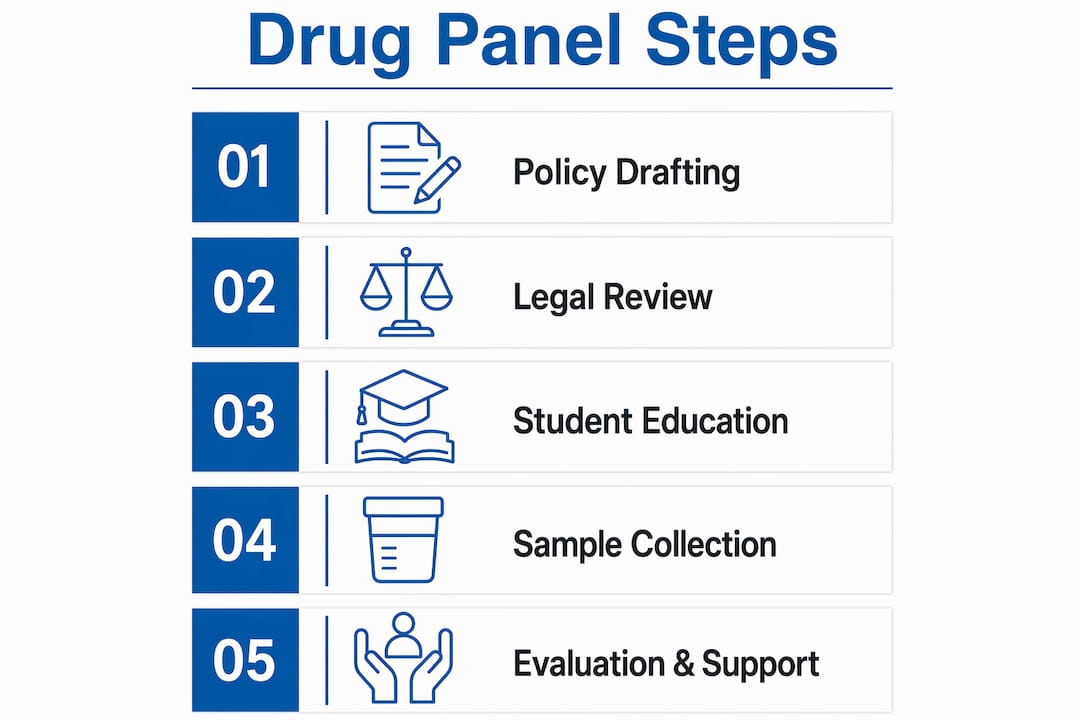
A step-by-step implementation guide helps administrators sequence the process correctly: policy drafting, legal review, parent notification, staff training, testing rollout, and follow-up protocols. Skipping any step creates gaps that undermine both compliance and effectiveness.
What are the most common misconceptions about school drug panels?
Misconceptions about drug testing in schools create real policy errors. Administrators who misunderstand the legal scope risk implementing programs that expose the district to litigation. Parents who misunderstand the purpose may withdraw students from beneficial extracurricular programs unnecessarily.
The most damaging misconceptions, and how to address them:
- “Schools can test any student at any time.” False. The Supreme Court permits random testing only for voluntary participants in competitive extracurriculars. Testing the general student body without suspicion is unconstitutional.
- “A positive result means a student is an addict.” False. A single positive result indicates recent exposure to a substance. It requires professional interpretation, not immediate disciplinary action.
- “Drug testing replaces the need for drug education.” False. Testing without education and counseling produces worse outcomes. The American Academy of Pediatrics is explicit on this point.
- “Refusal to test has no consequences.” Incorrect in most districts. Most schools treat refusal as equivalent to a failed test, which means loss of extracurricular privileges. Policies must state this clearly in writing.
- “Drug panels catch everything.” They do not. Panels test for specific drug classes. Novel synthetic substances, certain prescription drugs misused recreationally, and substances below detection thresholds will not appear.
Managing refusals is one of the most legally sensitive areas of any program. Student handbooks must detail the refusal process, including consequences and the right to disclose prescription medications, before any testing begins. Schools that skip this step face the highest litigation risk.
The trust dimension is equally important. Drug testing without transparency and genuine student support severely damages the student-adult relationship that makes prevention work. Programs built on surveillance rather than support consistently underperform.
Key Takeaways
Drug panels enhance school safety most effectively when they operate within legal boundaries, use trained interpretation, and connect positive results to counseling rather than punishment.
| Point | Details |
|---|---|
| Legal scope is narrow | Random testing is constitutional only for students in competitive extracurricular activities, per Supreme Court rulings. |
| Panels have detection limits | Standard urine panels screen for common drug classes but miss novel synthetics and substances below threshold. |
| Trained interpretation is required | Prescription medications and lab errors can cause false positives; medical review must precede any disciplinary action. |
| Prevention programs need more than testing | Drug panels work best alongside counseling, education, and family involvement, not as stand-alone tools. |
| Policy transparency protects everyone | Written policies covering refusal consequences and prescription disclosure are legally required before testing begins. |
Drug panels work best when schools lead with trust
After years of watching school drug testing programs succeed and fail, the pattern is clear. The programs that work are not the ones with the most tests or the strictest consequences. They are the ones where students, parents, and administrators all understand the purpose before a single sample is collected.
The legal guardrails from Vernonia and Earls are not obstacles. They are actually good policy design. Limiting testing to students who voluntarily join extracurricular programs means the students being tested have already opted into a community with explicit behavioral expectations. That context makes the deterrent effect real. A student who wants to play varsity soccer or join the debate team has a concrete reason to stay drug-free that goes beyond fear of getting caught.
Where I see programs go wrong is when administrators treat a positive result as the end of the conversation rather than the beginning. A 16-year-old who tests positive for marijuana needs a counselor, not a suspension letter. The data on this is consistent: punitive responses without support do not reduce substance use. They reduce trust, and reduced trust makes every other prevention effort harder.
The other failure mode is implementing testing without the surrounding infrastructure. A drug panel without a counseling referral pathway, a parent communication plan, and a trained staff interpreter is just a liability waiting to happen. Schools that build compliant drug testing workflows from the start avoid most of the legal and relational problems that derail programs later.
Drug panels are a legitimate and useful tool. They are not a solution on their own. The schools that get this right treat testing as one signal in a larger system designed to keep students healthy and supported.
— Alan
Countrywidetesting supports schools with reliable drug panel programs
Schools that implement drug panel programs need more than a test kit. They need certified lab results, legally defensible procedures, and products that meet SAMHSA, CLIA, and CAP standards.
Countrywidetesting provides lab-certified drug testing services built for organizations that require accurate, compliant results. From urine panels that screen for the most common drug classes to lab confirmation services that protect schools from acting on false positives, Countrywidetesting connects administrators with the testing infrastructure their programs require. For schools building or updating a drug panel program, working with a certified provider removes the guesswork from compliance and result accuracy. Visit Countrywidetesting to review school-appropriate testing options and find the right fit for your district’s needs.
FAQ
What is the legal basis for drug testing in schools?
The U.S. Supreme Court established in Vernonia v. Acton and Board of Education v. Earls that schools may conduct random, suspicionless drug testing only for students participating in competitive extracurricular activities. Testing the general student body without individualized suspicion is unconstitutional under the Fourth Amendment.
Which drugs do school panels typically detect?
Standard school drug panels test urine for marijuana, cocaine, amphetamines, opiates, and PCP. They do not detect all psychoactive substances, and trained professionals must review results before any action is taken.
What happens if a student refuses a drug test?
Most school districts treat refusal as equivalent to a failed test, resulting in loss of extracurricular privileges. Written policies must state this consequence clearly before any testing program begins.
Can a prescription medication cause a false positive?
Yes. Prescription stimulants, opioid pain medications, and certain over-the-counter drugs can trigger positive readings on standard panels. Schools must have a confidential process for students to disclose prescriptions, and medical review must occur before any disciplinary response.
How do drug panels fit into broader school safety measures?
Drug panels work best as one component of a prevention program that also includes drug education, counseling, and family engagement. Testing alone, without support structures, produces worse outcomes and can damage the student-adult trust that makes prevention effective.