
May 31, 2027 Deadline: DOT CCF Form Steps for U.S. Employers
The 2026 Federal Drug Testing Custody and Control Form is the version DOT-regulated employers must plan around now. It is effective from April 27, 2026, to April 30, 2029. Employers may still use the 2023 CCF through May 31, 2027 without extra paperwork; after that date, a Memorandum for the Record is required when using the 2023 form. [2026 CCF approval] Verify your form source with your HHS-certified lab, retire expired stock, and confirm your collectors know which version is currently in play.
TL;DR:
- Employers should verify they are using the 2026 CCF from HHS-certified labs now to ensure compliance before the May 31, 2027, deadline.
- The 2023 CCF can only be used without a Memorandum for the Record until May 31, 2027; after that, its use requires detailed documentation.
- The federal regulation mandates the use of the current official form, including specific employer, MRO, and collector contact details, with limited preprinting allowed.
- Properly following the step-by-step collection process reduces form errors, which are the leading cause of test cancellations.
- Regular inventory checks and collector retraining are essential to prevent costly form-related errors and upcoming documentation issues.
Table of Contents
- What Changed in the 2026 Revised CCF (And the Dates You Can’t Miss)
- Why the Federal CCF Is Mandatory Under §40.40
- Where to Get an Approved CCF (And How to Confirm It’s Legitimate)
- The Collector’s Step-by-Step Checklist for a Clean CCF
- What Actually Causes Cancellations, and When You Need an MFR
- Why This Form Deserves More Attention Than It Gets
- Sources
What Changed in the 2026 Revised CCF (And the Dates You Can’t Miss)
The 2026 CCF received formal approval from DOT’s Office of Drug and Alcohol Policy and Compliance, with OMB sign-off attached to the same notice. That approval sets two fixed dates every compliance calendar needs:
- Effective date: April 27, 2026
- Expiration date: April 30, 2029
- 2023 CCF grace period: usable without a Memorandum for the Record through May 31, 2027 [2026 CCF approval]
The grace period exists so employers aren’t forced to destroy usable inventory overnight. But it has a hard edge. Once May 31, 2027 passes, any collection completed on a 2023 CCF requires a Memorandum for the Record under §40.205(b)(2), documenting why the older form was used and confirming the collection otherwise met requirements.
Order new forms now rather than waiting for old stock to run out. A buffer period before the grace period ends is advisable to allow your lab time to process the transition and prevent using outdated forms on test day.
Why the Federal CCF Is Mandatory Under §40.40
DOT doesn’t leave form selection to employer discretion. 49 CFR § 40.40 requires the Federal CCF for every DOT-regulated collection and bars the use of non-Federal or expired versions outright. That single rule is why a generic custody form, even one that looks similar, can invalidate a test.
The regulation also specifies what has to appear on the form itself:
- Employer name, address, and Designated Employer Representative (DER) contact information
- Medical Review Officer (MRO) name and address, correctly identified rather than left blank or generic
- A direct collector telephone number, not a call center line, per the regulation’s contact rules
- Compatibility and security obligations for any eCCF system used at the collection site
Limited preprinting is allowed for repeat-use fields such as employer and MRO information; however, donor-specific and collection-specific fields must be completed during the collection event. [49 CFR §40.40]
Where to Get an Approved CCF (And How to Confirm It’s Legitimate)
Your HHS-certified laboratory is the primary source for both paper and electronic CCFs, and DOT ODAPC maintains a suppliers and documents list as a secondary check. Use only forms obtained from HHS-certified laboratories or the ODAPC official list; avoid third-party generic forms not authorized by these sources. [DOT ODAPC forms guidance]
Before you deploy any eCCF platform at a collection site, confirm three things:
- The primary lab supports it. Ask directly whether the eCCF integrates with their intake process.
- The split lab supports it too. A mismatch here creates chain-of-custody problems after the fact, not before.
- The MRO’s system can receive it. An eCCF that stalls at the MRO’s desk defeats the purpose of going electronic.
Manage expiration dates on physical CCF stock as a controlled inventory item, with reorder points aligned to collection volumes. [CCF inventory best practices]
Pro Tip: Set a calendar reminder approximately three months before May 31, 2027, to confirm collection sites have transitioned fully from the 2023 CCF and are aware of the MFR requirement. [2023 CCF grace period]
The Collector’s Step-by-Step Checklist for a Clean CCF
Errors on the CCF are the leading cause of avoidable test cancellations, and most of them cluster around the same handful of fields. SAMHSA’s instructions for the urine CCF break the process into numbered steps, and collectors who follow them in order rarely produce a form that gets kicked back.
- STEP 1, donor identification. Confirm the donor’s name, Social Security number or employee ID, and, where applicable, the CDL state and license number. These fields must be accurate, not just legible; preprinted employer information should already be correct before the donor arrives.
- STEP 2, donor remarks. If the donor wants to note something (a medication, a concern about the collection), it goes in this section, not scrawled elsewhere on the form.
- Refusal handling. If a donor refuses to provide a specimen or refuses to sign, document the refusal plainly and immediately. Don’t leave the field blank and hope it gets sorted out later.
- STEP 4, collector chain-of-custody. The collector signs, dates, and times the form, selects the delivery service, and places Copy 1 inside the specimen bag before sealing it.
- STEP 5, donor certification. The donor signs to certify the specimen is theirs. Wet-ink signatures remain standard on paper forms; electronic signatures are acceptable on a compatible eCCF, but if the donor refuses to sign electronically, fall back to a printed form on the spot.
For eCCF collections, print Copy 1 for the specimen bag regardless of how the rest of the record is stored electronically. Where QR labels are used, SAMHSA recommends a second internal QR label inside the bag as backup in case the external label gets damaged in transit. A form completed correctly at every step is still only as good as the seal on the bag it travels in, so double-check that seal before the donor leaves the room.
Pro Tip: Keep a laminated version of the SAMHSA step sequence taped inside every collection kit. Collectors under time pressure skip steps from memory far more often than they skip steps they can see printed in front of them.
What Actually Causes Cancellations, and When You Need an MFR
Five errors account for most CCF-related cancellations: an expired form, missing or incorrect MRO contact information, illegible entries, a missing collector or donor signature, and specimen ID numbers that don’t match between the form and the bottle label. Every one of these is preventable with a 30-second visual check before the donor leaves the collection site.
After May 31, 2027, use of the 2023 CCF requires a mandatory Memorandum for the Record under §40.205(b)(2) documenting why the older form was used and confirming compliant collection. [MFR requirement] Before that date, no MFR is needed for using the 2023 form. After it, skipping the MFR turns a minor paperwork lag into a documentation gap that auditors will flag immediately.
Reduce your exposure with three controls:
- Run a monthly inventory check on CCF stock at every collection site.
- Retrain collectors on STEP 4 and STEP 5 whenever cancellation rates tick up.
- Ask your laboratory partner to flag form-version errors during precollection audits, not after specimens arrive.
Why This Form Deserves More Attention Than It Gets
Most compliance teams treat the CCF as paperwork. Alan sees it differently. It’s the single document that determines whether a drug test holds up legally, and a clerical slip on it can undo weeks of otherwise flawless collection procedure. That’s the gap: employers invest heavily in vetting collection sites and labs, then let the form itself run on autopilot.
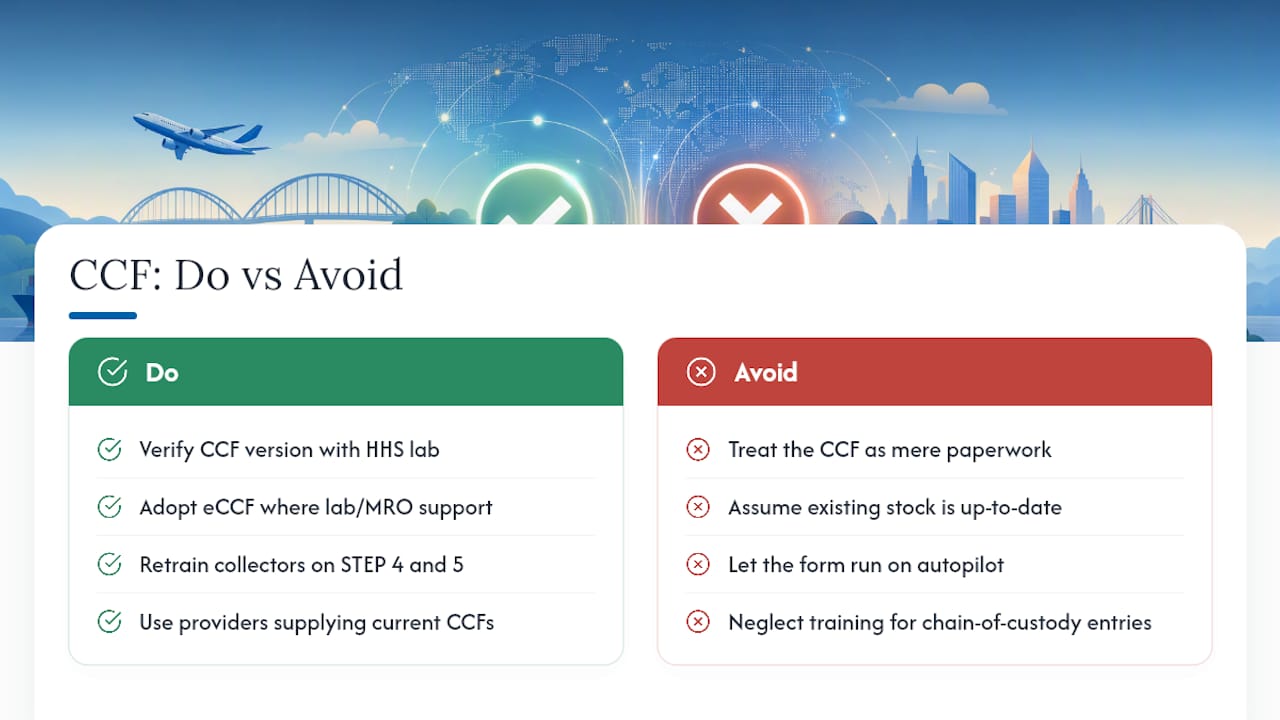
The practical fix isn’t complicated. Verify your CCF version directly with your HHS-certified lab rather than assuming your current stock is current. Where your lab and MRO both support it, move toward eCCF, since it closes off a large share of the illegible-entry and missing-field problems that plague paper forms. And retrain collectors specifically on STEP 4 and STEP 5, since chain-of-custody entries and donor certification are where most defensible cancellations originate.
If you need a refresher on the mechanics, Countrywidetesting’s guide to completing a chain of custody form walks through each section in practical terms., and.
— Alan
Some providers work with HHS-certified laboratories to keep employers stocked with current, compliant testing supplies and to support the collection procedures this article covers. If your organization needs laboratory drug testing services that stay aligned with the current CCF version, that’s a direct way to close the gap between policy and practice, especially if your last supply order predates the 2026 revision.
Sources
- Revised CCF 2026 - Notice | US Department of Transportation
- Instructions for completing the Federal Drug Testing Custody and Control Form for Urine Specimen Collection | SAMHSA