
DOT Employers: Return to Duty Drug Test and 3 Business Day Reporting
Returning to safety-sensitive DOT work after a positive drug test, alcohol violation, or refusal requires two specific things: a clearance from a qualified Substance Abuse Professional, and a negative, directly observed return-to-duty (RTD) test. Until both happen and the employer reports the result, federal rules keep the employee in prohibited status. There’s no shortcut around either step.
TL;DR:
- The return-to-duty process must follow strict steps: immediate removal, SAP assessment, treatment, follow-up evaluation, and a directly observed negative RTD test.
- Employers must ensure the RTD test is directly observed by a same-sex collector and report results within three business days to avoid delays.
- An RTD test can double as a pre-employment test only if explicitly labeled as a DOT RTD test and conducted under observation; unobserved pre-employment tests do not qualify.
- Follow-up testing occurs for at least 12 months after clearance, with unannounced, directly observed tests that cannot be scheduled in advance.
- Most delays stem from administrative errors like late reporting or unobserved collections, not from the clinical assessment itself.
Table of Contents
- What Is the DOT Return to Duty Process?
- Who Has to Go Through Return-to-Duty Testing?
- What Does the SAP Actually Control?
- Why Must the RTD Test Be Directly Observed?
- Can an RTD Test Double as a Pre-Employment Test?
- How Fast Must Clearinghouse Reporting Happen?
- What Does Follow-Up Testing Look Like After RTD Clearance?
- What Should Employers Do to Avoid RTD Mistakes?
- What Happens If an Employee Fails or Refuses the RTD Test?
- How CountryWideTesting Supports RTD Collections
- The Bottlenecks Nobody Talks About
- Order DOT-Compliant RTD Testing Through CountryWideTesting
- Sources
What Is the DOT Return to Duty Process?
The RTD process follows a fixed sequence under 49 CFR Part 40, Subpart O, and skipping ahead invalidates the whole thing. Here’s the order that regulation demands:
- Immediate removal. The employee stops performing safety-sensitive functions the moment a violation is confirmed, and the employer refers them to a Substance Abuse Professional (SAP).
- Initial SAP evaluation. The SAP assesses the employee and issues written recommendations for education or treatment.
- Treatment completion. The employee follows through on whatever the SAP prescribed, whether that’s a short education course or an extended treatment program.
- SAP follow-up evaluation. The SAP re-evaluates and determines whether the employee is ready for return-to-duty drug testing.
- The RTD test itself. A directly observed, negative test clears the employee to resume duties, paired with a follow-up testing plan.
Every step has to happen in that order, and reporting has to keep pace with it. A driver who finishes treatment early doesn’t get to reschedule the RTD test until the SAP formally signs off.
Who Has to Go Through Return-to-Duty Testing?
Not every workplace drug test triggers this process, but a few specific events do:
- A verified positive drug test result
- A confirmed alcohol test at or above 0.04 breath alcohol concentration
- A refusal to test, including diluted or adulterated specimens treated as refusals
- “Actual knowledge” by the employer of prohibited drug use, on-duty alcohol use, or a pre-duty/post-accident alcohol violation
The rules apply broadly across DOT-regulated safety-sensitive positions: commercial truck and bus drivers under FMCSA, transit operators under FTA, and other DOT-covered roles wherever agency-specific drug and alcohol rules apply. Once a trigger event occurs, the employee enters prohibited status immediately. They cannot perform any safety-sensitive function, not even for a single shift, until the entire RTD sequence closes out.
What Does the SAP Actually Control?
The Substance Abuse Professional isn’t a counselor offering suggestions. Under federal guidance, the SAP functions as the regulatory gatekeeper for the entire RTD pathway, and nothing moves forward without their sign-off.
- The SAP documents an initial clinical assessment and issues written treatment or education recommendations.
- Employers must provide a list of qualified SAPs under §40.287, but the employee chooses which one to see.
- The SAP performs a follow-up evaluation and determines RTD eligibility only after treatment is complete.
- The SAP also designs the follow-up testing plan the employee will face for months or years afterward.
SAP determinations aren’t advisory. Employers who treat them as prerequisites, not recommendations, avoid the reporting headaches that come from moving too fast.
Pro Tip: Ask your SAP referral list to include professionals who explicitly work with DOT-regulated employees. A SAP unfamiliar with 49 CFR Part 40 timelines can slow the whole process down without meaning to.
Why Must the RTD Test Be Directly Observed?
Direct observation isn’t optional, and there are no exceptions based on gender or which drug panel is used. A same-sex or same-gender observer watches the entire specimen collection, and this requirement applies to every RTD and follow-up test, not just the first one.
- RTD and all follow-up drug tests require direct observation under 49 CFR 40.67(b).
- Drug RTD tests use urine specimen collection under observation; alcohol RTD tests use breath or saliva testing appropriate to that violation type.
- A collection that isn’t observed, or one flagged as invalid, does not satisfy the RTD requirement, no matter how negative the result looks.
Employers who assume a standard, unobserved collection will do the job often discover the mistake only after the Clearinghouse rejects the report.
Can an RTD Test Double as a Pre-Employment Test?
Sometimes, yes. If an employer would otherwise need to run both a pre-employment test and an RTD test on the same day, a single test can satisfy both requirements. But the exception is narrow.
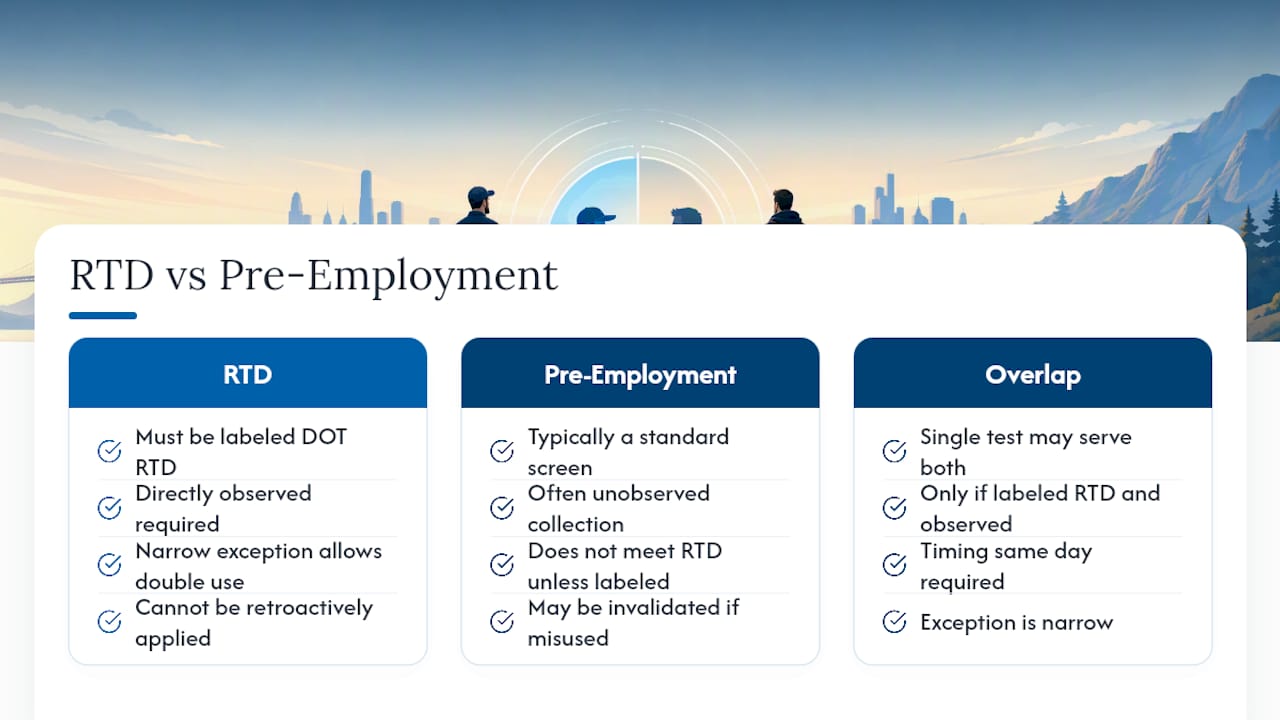
The test has to be explicitly labeled and administered as a DOT RTD test, and it must be directly observed. A standard, unobserved pre-employment screen cannot retroactively count as an RTD test just because the timing lines up. This distinction trips up more employers than almost any other part of the process, usually when someone tries to save a step and ends up invalidating the result entirely. For more on how these test types differ, DOT test types and RTD overlap breaks down the practical differences.
How Fast Must Clearinghouse Reporting Happen?
Timing here is unforgiving, and the order of operations matters as much as the deadlines themselves.
- Employers must report a negative RTD result to the Clearinghouse by the close of the third business day after receiving it.
- SAPs must report initial assessment completion and RTD eligibility by the close of the business day the determination is made, according to FMCSA’s Clearinghouse guidance.
- A violation record stays visible in the Clearinghouse until RTD is complete, and then for five years from the violation date.
Misordered reporting is a quiet trap: a driver can be clinically cleared by their SAP and still show as prohibited if the paperwork lands out of sequence. That single administrative slip can keep an otherwise-qualified driver off the road for weeks longer than necessary.
What Does Follow-Up Testing Look Like After RTD Clearance?
Passing the RTD test doesn’t end the scrutiny. It starts a monitoring period that follows the employee, not the employer.
- At minimum, the employee faces six unannounced follow-up tests within the first 12 months after returning to duty.
- The SAP can require more tests, or extend the follow-up period up to 60 months, depending on the case.
- Every follow-up test is directly observed, and by design, employees are never given the schedule in advance under 49 CFR 40.307.
- These obligations transfer with the employee. Changing employers or taking a break in service doesn’t erase the remaining follow-up tests.
What Should Employers Do to Avoid RTD Mistakes?
A clean RTD process comes down to speed and precision. Here’s the sequence that keeps things moving without errors:
- Provide the SAP referral list immediately after removing the employee from duty.
- Schedule the RTD test as soon as the SAP issues clearance, not before.
- Confirm the collection site uses DOT-qualified collectors and SAMHSA-certified labs.
- Verify the site can provide a same-sex observer for direct observation before the appointment, not the day of.
- Report results to the Clearinghouse within the mandated window and retain all documentation.
The most common mistakes are avoidable: late reporting, using the wrong test type, or relying on collection sites that don’t actually offer observed collections. A guide like how to set up a DOT drug testing program covers the broader compliance framework employers need around RTD specifically.
Pro Tip: Assign one internal point person to track SAP deadlines and Clearinghouse reporting dates. Most RTD delays come from nobody owning the follow-through, not from the regulation itself.
What Happens If an Employee Fails or Refuses the RTD Test?
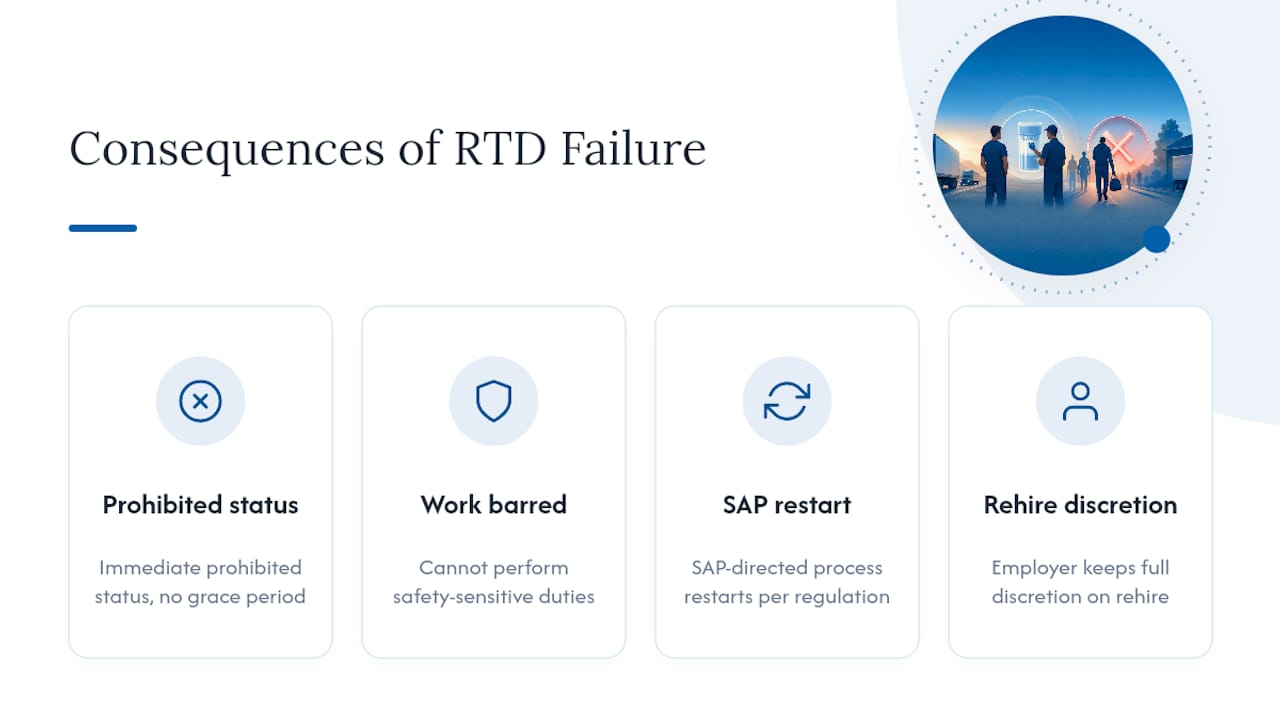
A failed or refused RTD test keeps the employee in prohibited status immediately, with no grace period. They cannot perform safety-sensitive work, and the SAP-directed process restarts as required by regulation. Employers also retain full discretion on rehire, even after RTD is eventually completed. For a fuller breakdown of what a failure means practically, see what happens after a failed drug test.
How CountryWideTesting Supports RTD Collections
Getting an RTD collection right the first time matters more than almost any other test in the DOT system, because a single procedural error resets the clock. CountryWideTesting works alongside SAMHSA-certified, CLIA and CAP-accredited labs to support directly observed collections that hold up under Clearinghouse scrutiny.
- Lab partners provide documentation formatted for DOT audit and Clearinghouse reporting requirements.
- Collection coordination confirms same-sex observer availability before scheduling, not after.
- Employer resources cover recordkeeping standards alongside the testing itself.
Employees navigating SAP evaluations sometimes benefit from outside perspective on clinical communication too. Resources on addiction care and patient advocacy can help employees understand what a thorough SAP evaluation should look like.
The Bottlenecks Nobody Talks About
The RTD process rarely fails on the clinical side. It fails on administration: late Clearinghouse reports, RTD tests run without observation, or employers assuming a pre-employment test covers RTD when it doesn’t. Fix the paperwork discipline, and the clinical timeline mostly takes care of itself.
— Alan
Order DOT-Compliant RTD Testing Through CountryWideTesting
CountryWideTesting gives employers a direct path to DOT-compliant RTD collections without chasing down a lab network on your own. Where generic clinic referrals leave gaps in documentation, CountryWideTesting coordinates with SAMHSA-certified, CLIA and CAP-accredited labs that produce Clearinghouse-ready paperwork the first time.
That matters most when a driver’s prohibited status hinges on getting the observation, the specimen type, and the reporting deadline all correct in one pass. Employers can order DOT-compliant lab testing services directly through CountryWideTesting and get collection coordination built around direct observation requirements from the start. If your organization needs a testing partner ready for RTD, follow-up, or standard DOT compliance work, visit Countrywide Testing to get started or reach out to the support team for a quote on ongoing testing volume.
This article is general information, not a substitute for advice from a qualified lawyer. Consult a qualified legal professional about your own circumstances before acting on anything here.
Sources
- Employees | US Department of Transportation (ODAPC)
- Return-to-Duty | FMCSA - Department of Transportation
- The Return-to-Duty Process and the Clearinghouse — FMCSA Clearinghouse