
Post-Accident Drug Testing Explained for HR and Safety Teams
TL;DR:
- Post-accident drug testing is required for specific incidents under DOT regulations but is generally prohibited after workplace injuries in OSHA-regulated environments. Timing is critical, with alcohol testing attempted within 2 hours and drug testing completed within 32 hours after an accident, requiring proper documentation for delays. Employers must implement cause-based policies, train supervisors in real-time documentation, and keep testing records separate from incident reports to ensure compliance and protect against violations.
Post-accident drug testing is the required process of administering drug and alcohol tests to employees involved in workplace accidents to determine impairment and maintain safety and regulatory compliance. Governing bodies including the Federal Motor Carrier Safety Administration (FMCSA), the Department of Transportation (DOT), and OSHA each set distinct rules for when and how these tests must occur. Getting the protocol wrong carries real consequences: missed testing windows, improper triggers, and poor documentation all expose employers to regulatory sanctions. This guide breaks down the core rules, timing requirements, and practical steps every HR professional and safety officer needs to know.
What are the triggering criteria for post-accident drug testing?
Not every workplace accident legally requires a drug test. The triggering criteria differ significantly between DOT-regulated industries and general workplaces governed by OSHA, and confusing the two is one of the most common compliance errors employers make.
DOT and FMCSA triggers
DOT mandates post-accident drug testing for commercial motor vehicle drivers in three specific situations:
- Fatality: Any accident involving a human fatality requires testing, regardless of fault. The driver must be tested.
- Injury with citation: If someone is injured and transported for immediate medical treatment, and the driver receives a citation within the applicable testing window, testing is mandatory.
- Tow-away with citation: If a vehicle requires towing and the driver receives a citation within the regulatory window, testing is required.
The citation timing rule catches many employers off guard. A citation must be issued within the regulatory time windows to legally trigger testing. Citations received after those windows do not mandate a test. This is not a technicality. It is a compliance boundary that determines whether testing is required or optional.
OSHA’s different standard
OSHA does not mandate post-accident testing for general industry employers. Instead, OSHA prohibits blanket post-accident testing policies that automatically test every employee who reports an injury. The agency treats such policies as a form of retaliation that discourages workers from reporting incidents. Under OSHA’s framework, testing must be based on reasonable suspicion or a specific causal connection between the incident and possible impairment.
The practical difference is significant. A DOT-regulated trucking company must test after a fatal crash. A general manufacturing employer cannot automatically test every worker who sprains an ankle on the job. Both rules exist to protect safety, but they operate on entirely different logic.
How do timing requirements and testing windows work?
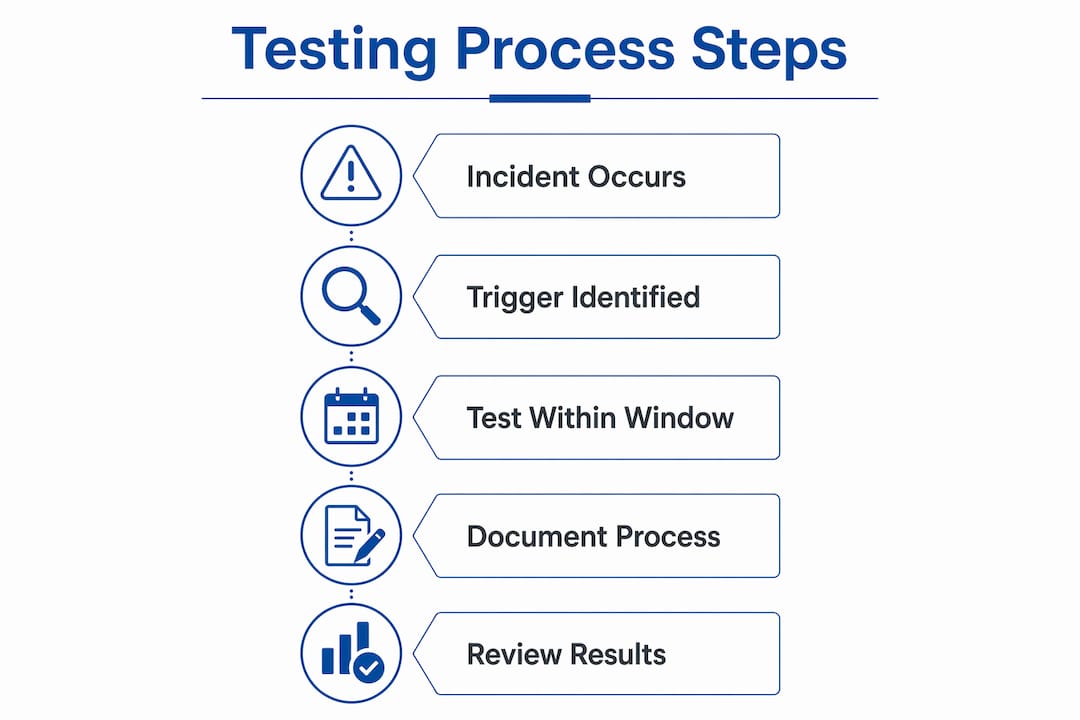
Timing is the most technically demanding part of post-accident substance testing. The FMCSA establishes a clear framework under 49 CFR 382.303, and missing any deadline creates a compliance violation even when the intent to test was present.
The sequence works as follows:
- Alcohol testing: attempt within 2 hours. After an accident, the employer must make a good-faith effort to test the driver for alcohol within 2 hours. If testing is not completed within 2 hours, the employer must document the reason in writing.
- Alcohol testing: abandon after 8 hours. If 8 hours pass without a completed alcohol test, the employer must stop attempting to test and document why the test was not completed. The 2-8-32 hour framework dictates both the testing deadlines and the mandatory documentation for any missed test.
- Drug testing: complete within 32 hours. The drug testing window is significantly longer. Employers must complete the drug test within 32 hours of the accident.
The reason for the different windows is biological. Alcohol metabolizes rapidly in the body, which is why the testing window is short. Drugs remain detectable in urine and other specimens for much longer, making a 32-hour window both practical and scientifically grounded in metabolism differences.
Pro Tip: If a driver is hospitalized and testing is physically impossible within the required window, document the barrier in writing immediately. Written documentation of a legitimate delay is your primary defense during a DOT audit. Verbal explanations after the fact do not satisfy the regulatory requirement.
Missing a window without documentation is treated as a failure to test, which carries the same regulatory weight as a missed test with no explanation. Proper written documentation is the employer’s only protection when circumstances prevent timely testing.
What practical steps help employers comply and avoid mistakes?
Compliance with post-accident testing procedures requires more than a written policy. It requires trained supervisors, clear documentation habits, and policy language that holds up under regulatory scrutiny.

Build cause-based policies, not injury-based ones
Employers must use cause-based language in their testing policies rather than automatic triggers tied to any injury requiring medical treatment. A policy that reads “all employees involved in an injury will be tested” violates OSHA’s anti-retaliation rules. A policy that reads “employees will be tested when there is reasonable suspicion of impairment or when the nature of the incident suggests substance involvement” is defensible.
Train supervisors to document in real time
Supervisors must document signs of impairment contemporaneously to justify reasonable suspicion testing. Slurred speech, unsteady movement, the smell of alcohol, and erratic behavior are all observable indicators. The documentation must be created at the time of observation, not reconstructed hours later. After-the-fact documentation increases liability and weakens the employer’s position in any dispute.
Key compliance steps for safety officers:
- Confirm whether the incident meets DOT or OSHA triggering criteria before ordering a test.
- Check whether a citation was issued within the required time window for non-fatal DOT incidents.
- Initiate alcohol testing within 2 hours of the accident for DOT-regulated drivers.
- Notify the driver that alcohol consumption is prohibited until testing is complete.
- Document any barrier to timely testing in writing, with timestamps.
- Keep drug test records separate from incident investigation records.
Pro Tip: Review your written testing policy annually. OSHA enforcement priorities shift, and a policy that was compliant two years ago may now contain language that triggers an anti-retaliation citation. A one-page policy review with legal counsel costs far less than a citation.
One rule that surprises many employers: consuming alcohol after an accident and before testing is treated as a test refusal under DOT regulations. The driver must be clearly informed of this prohibition immediately after the accident. Failure to communicate this instruction is an employer compliance gap, not just a driver error.
What are the consequences of post-accident testing errors?
Noncompliance with drug testing protocols after accidents carries consequences of multiple regulatory channels simultaneously. An employer can face OSHA citations, DOT sanctions, and internal liability exposure from a single mishandled incident.
Regulatory and operational risks:
- Missed testing windows: Failing to test within required time frames, without documented justification, is treated as a failure to test. DOT can sanction the employer and the driver.
- Test refusal: Refusing a post-accident drug or alcohol test is treated as a positive result under DOT rules. The driver faces removal from safety-sensitive duties and must complete a return-to-duty process before resuming work.
- Blanket testing citations: OSHA actively cites employers whose policies automatically test after every injury. These citations fall under the anti-retaliation provisions of the Recordkeeping Rule.
- Chilled injury reporting: When employees fear automatic drug testing after any incident, they stop reporting minor injuries. This creates hidden safety risks and distorts the employer’s OSHA 300 log.
- Audit exposure: DOT auditors review testing records as part of compliance reviews. Missing records, incomplete documentation, or testing outside proper triggers all appear as violations.
“Separate recordkeeping for incident investigations and drug testing is crucial. OSHA monitors testing policies for retaliation but does not usually access test results during routine inspections.”
The distinction between incident records and test records matters more than most employers realize. Mixing these records creates the appearance that testing outcomes influence how incidents are classified. Keeping them separate protects the employer’s credibility with both DOT and OSHA during any review. Employers who want a full picture of their compliance obligations can review federal drug testing requirements that apply across regulated industries.
Key Takeaways
Post-accident drug testing compliance requires cause-based triggers, strict timing adherence, real-time documentation, and separate recordkeeping for test results and incident investigations.
| Point | Details |
|---|---|
| DOT triggers are specific | Testing is mandatory for fatalities; injury and tow-away cases require a citation within the regulatory window. |
| The 2-8-32 rule governs timing | Attempt alcohol tests within 2 hours, abandon after 8, and complete drug tests within 32 hours of the accident. |
| OSHA bans blanket testing | Automatic testing after every injury violates anti-retaliation rules; policies must use cause-based language. |
| Documentation is your defense | Written records of testing barriers, supervisor observations, and citation timing protect employers during audits. |
| Refusal equals a positive result | Consuming alcohol before testing or refusing the test carries the same consequences as a confirmed positive under DOT rules. |
What most employers get wrong about post-accident testing
The biggest compliance gap I see is not in the testing itself. It is in the 30 minutes before the test happens.
Employers spend time and money building written policies, but they skip the supervisor training that makes those policies work. A policy that requires “reasonable suspicion documentation” is useless if the supervisor on duty does not know what to write down, or waits until the next morning to write it. By then, the moment is gone and the documentation is legally weak.
The second gap is the alcohol prohibition instruction. Drivers involved in accidents must be told immediately that they cannot consume alcohol until testing is complete. This sounds obvious. In practice, it gets skipped in the chaos following a serious incident. That omission shifts liability back to the employer.
The regulatory environment in 2026 has not gotten simpler. OSHA continues to scrutinize blanket testing policies, and DOT audits remain a real risk for carriers. The employers who handle this well are not the ones with the longest policy documents. They are the ones whose supervisors know exactly what to do in the first two hours after an accident. That comes from training, not paperwork.
Transparent communication with employees also matters more than most HR teams acknowledge. Workers who understand that testing is cause-based, not punitive, are more likely to report incidents honestly. That honesty is what makes a safety program actually work. Employers looking for a practical starting point can review what employers need to know about structuring compliant post-accident protocols.
— Alan
Countrywidetesting supports your post-accident testing program
Employers managing post-accident drug testing compliance need reliable, fast, and documented testing solutions.
Countrywidetesting offers lab-based drug testing services processed through SAMHSA, CLIA, and CAP-certified laboratories, giving employers the chain-of-custody documentation that DOT and OSHA audits require. For situations where on-site collection is needed quickly, Countrywidetesting also provides multi-panel urine test kits suitable for workplace post-accident protocols. Every product and service is designed to support compliant, defensible testing from the moment an incident occurs through final result documentation.
FAQ
What triggers a DOT post-accident drug test?
DOT mandates testing after any fatal accident, and after injury or tow-away accidents where the driver receives a citation within the required regulatory time window.
How long does an employer have to test after a workplace accident?
Under 49 CFR 382.303, alcohol testing must be attempted within 2 hours and abandoned after 8 hours. Drug testing must be completed within 32 hours of the accident.
Can an employer test every employee after any workplace injury?
No. OSHA prohibits automatic post-accident testing after every injury. Testing must be based on reasonable suspicion or a specific causal link between the incident and possible impairment.
What happens if a driver refuses a post-accident drug test?
Refusal, including consuming alcohol before the test is completed, is treated as a positive result under DOT rules. The driver is removed from safety-sensitive duties and must complete a return-to-duty process.
Does OSHA access drug test results during inspections?
OSHA does not typically access individual drug test results during routine inspections. However, OSHA does review testing policies for evidence of blanket testing or anti-retaliation violations.