
What Is Telehealth Drug Testing? A 2026 Guide
TL;DR:
- Telehealth drug testing allows individuals to collect samples at home and receive clinically reliable results digitally. This process involves kit delivery, remote observation, and lab analysis at certified facilities, ensuring privacy and accuracy. It expands access across clinical, personal, legal, and workplace contexts, transforming the future of diagnostics.
Telehealth drug testing is defined as the process of conducting drug tests remotely using digital tools, certified laboratories, and video or AI-based observation to deliver clinically reliable results without an in-person visit. The industry term for this practice is “remote drug testing,” and it sits within the broader field of telehealth diagnostics. It combines sample self-collection at home with processing at CLIA-certified labs and digital result delivery. Regulatory bodies including SAMHSA, CLIA, and CAP set the standards that make these results legally and clinically defensible. For anyone navigating substance use disorder treatment, workplace screening, or personal health monitoring, understanding how this process works is the first step toward using it effectively.
How does telehealth drug testing work?
Remote drug testing follows a structured process that mirrors in-person testing at every critical step. The difference is that technology replaces the physical clinic.
Step 1: Kit delivery. A test kit ships directly to your address. At-home lab kits typically arrive within 2–5 business days. The kit includes collection materials, instructions, and a prepaid return label.
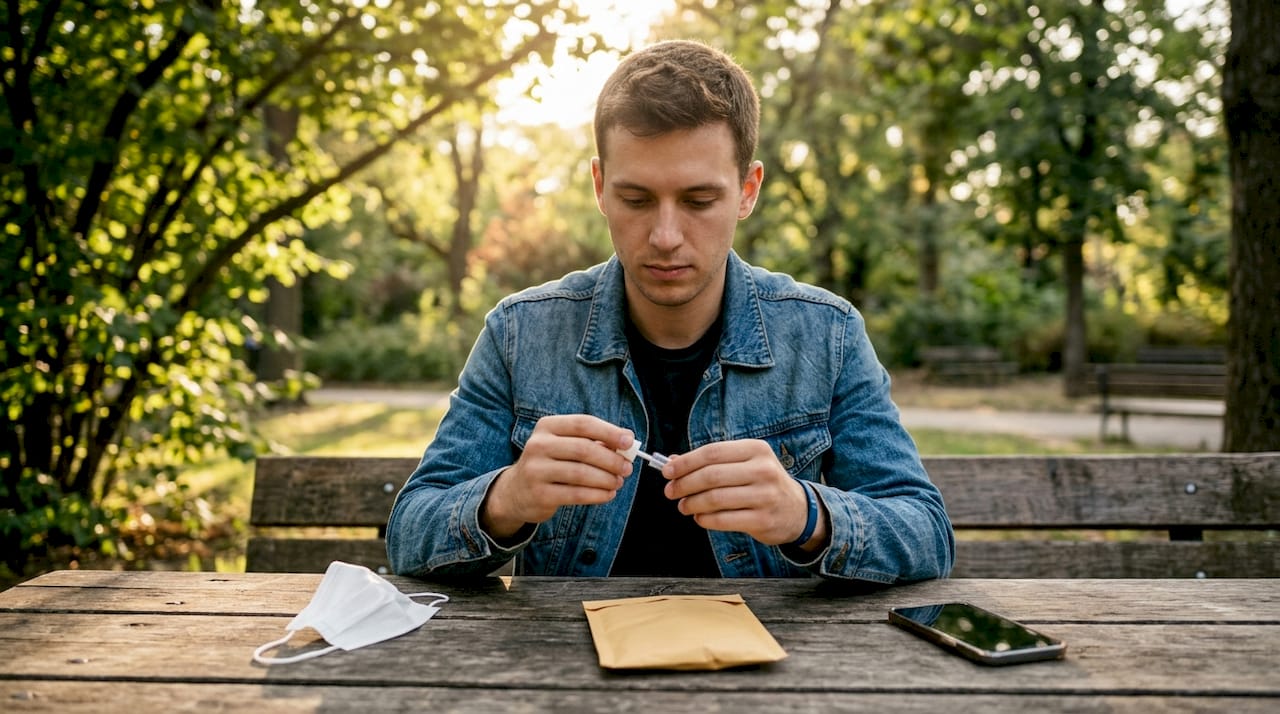
Step 2: Sample collection. You collect a sample at home. The three most common specimen types are oral fluid (mouth swab), urine, and dried blood spot. Oral fluid collection is the least invasive and the most common in telehealth programs.
Step 3: Digital observation. A clinician or an AI system watches the collection process remotely. Video-observed oral fluid self-collection achieved an 89.2% completion rate in a substance use disorder treatment pilot study. That figure confirms the method is reliable enough for clinical use, not just convenience.
Step 4: Sample mailing. You seal the sample and mail it back. Timing matters here. Samples must ship promptly and avoid weekend delays to prevent degradation. Most programs specify a mailing window of 24 hours after collection.
Step 5: Lab processing. The sample goes to a CLIA-certified laboratory for analysis. Processing takes an additional 3–5 business days. Results are then delivered through a secure digital patient portal.
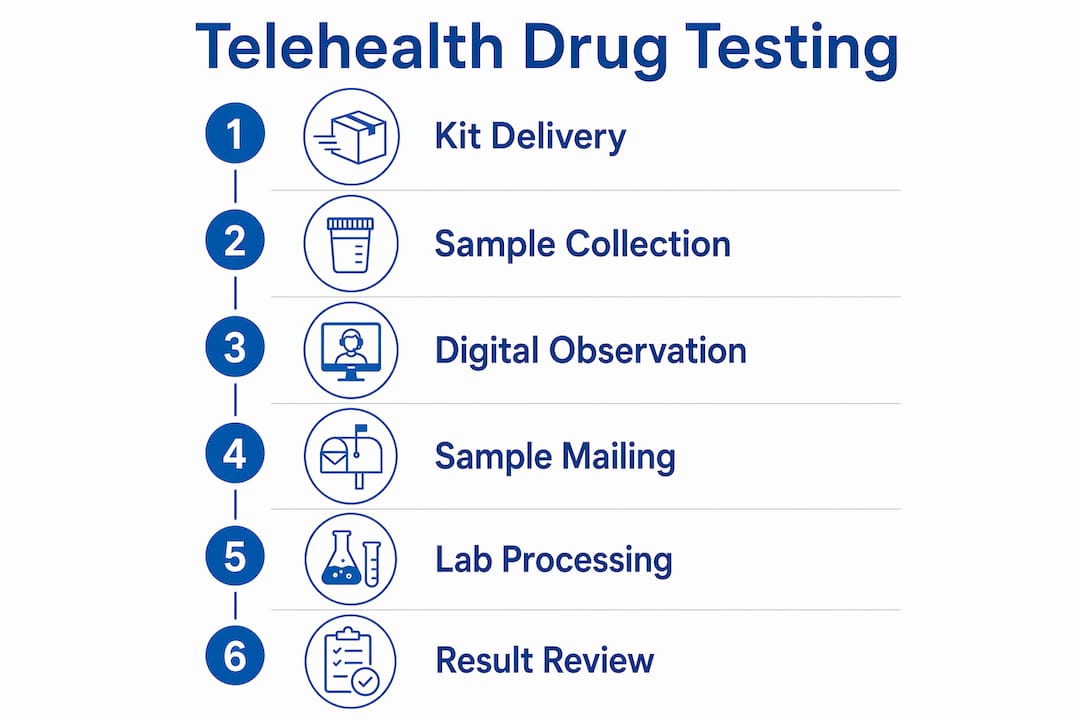
Step 6: Result review. A clinician reviews the results and contacts you if follow-up is needed. In substance use disorder programs, results feed directly into care adjustments.
Pro Tip: Mail your sample on a Monday or Tuesday. Samples mailed on Thursday or Friday risk sitting in transit over a weekend, which can compromise accuracy.
What are the benefits of telehealth drug testing?
Telehealth drug screening removes the barriers that make traditional testing hard for many people. The advantages go beyond simple convenience.
- Access for rural and mobility-limited individuals. People in areas without nearby testing facilities can now complete a clinically valid test from home. AI-powered remote testing removes barriers to in-person visits and supports ongoing opioid use disorder recovery through accurate, digitally supervised testing. That validation came from King’s College London in 2025.
- Privacy and reduced stigma. Testing at home removes the social discomfort of visiting a clinic or collection site. 61% of surveyed individuals preferred in-home testing primarily for privacy, limited transportation, and personal convenience. Privacy is not a minor perk. It is often the deciding factor in whether someone completes a test at all.
- Reduced time and logistical burden. No travel, no waiting rooms, no time off work. The entire process happens on your schedule.
- Clinical reliability. Results processed at CLIA-certified labs carry the same legal and medical weight as results from an in-person collection site. Digital observation and AI validation maintain the chain of integrity from collection to result.
- Collaborative care model. Telehealth drug screening is designed to verify treatment adherence and support patient safety, not to catch people out. That framing matters because it changes how patients engage with the process.
The combination of accessibility, privacy, and clinical-grade accuracy makes remote drug testing one of the most significant shifts in diagnostic care in recent years.
What are the technical and practical considerations?
Getting accurate results from a remote test depends on more than just following the kit instructions. Several technical and procedural factors affect the outcome.
The most common failure point in video-observed testing is not the test kit itself. Video recording and upload issues are the primary technical failure points, driven by unstable internet connections and poor camera angles. App-integrated workflows with built-in video capture have significantly higher success rates than manual recording methods.
Understanding the difference between test types also matters. Presumptive screening tests, such as rapid immunoassays, offer speed and convenience. Definitive confirmatory testing using gas chromatography/mass spectrometry (GC/MS) is required for clinical decisions, especially when complex synthetic drugs like xylazine or nitazenes are a concern. Screening tests tell you something is likely present. Confirmatory tests tell you exactly what it is.
Pro Tip: Before your collection session, test your phone camera and internet connection. Position the camera so your hands and the collection materials are both visible. This single step prevents most video observation failures.
Common pitfalls to avoid:
- Collecting the sample and waiting too long before mailing it back
- Using the wrong collection method for the test type ordered
- Storing the sample in a warm location, which accelerates degradation
- Mailing near a weekend without checking your program’s shipping guidelines
- Skipping the instructions because the process “looks simple”
Clinicians must confirm that patients understand every step of sample collection and storage to protect result integrity. That responsibility is shared. If your provider has not walked you through the steps, ask them to.
In what contexts is telehealth drug testing used?
Remote drug testing applies across a wide range of personal, clinical, legal, and workplace situations. Each context has different requirements for accuracy, documentation, and chain of custody.
| Context | Primary purpose | Key requirement |
|---|---|---|
| Substance use disorder treatment | Monitor adherence and adjust care | Clinical-grade lab confirmation |
| Workplace screening | Verify employee compliance | Chain-of-custody documentation |
| Legal and forensic use | Provide court-admissible evidence | SAMHSA-certified lab processing |
| Personal health monitoring | Self-directed wellness tracking | Rapid results, privacy |
| Probation and diversion programs | Verify abstinence for legal compliance | Observed collection, certified results |
In substance use disorder programs, at-home drug kits ship to patients at no extra cost in certain programs, with results reviewed live by clinical staff or verified digitally. This model keeps patients engaged in treatment without requiring frequent clinic visits. For healthcare providers, selecting the right kit type for each context is as important as the testing itself.
Workplace programs using remote drug testing must still meet federal and state compliance standards. Chain-of-custody documentation is non-negotiable in legal and forensic contexts. A positive result without proper documentation is not defensible in court. Personal monitoring, by contrast, has no such requirement. You are testing for your own information, and a rapid screening result is often sufficient.
Current drug testing trends show growing adoption of telehealth drug screening across all these contexts, driven by the expansion of telehealth infrastructure during and after the COVID-19 pandemic.
Key Takeaways
Telehealth drug testing delivers clinically reliable results remotely by combining certified lab analysis, digital observation, and structured sample collection protocols.
| Point | Details |
|---|---|
| Defined process | Remote testing follows the same steps as in-person testing, with digital observation replacing clinic visits. |
| Lab standards matter | CLIA, SAMHSA, and CAP certification determine whether results are clinically and legally valid. |
| Video is the weak link | Internet stability and camera setup cause more failures than the test kits themselves. |
| Two test types exist | Screening tests flag likely positives; confirmatory GC/MS tests identify specific substances for clinical decisions. |
| Context shapes requirements | Legal and workplace use requires chain-of-custody documentation; personal monitoring does not. |
Why telehealth drug testing is changing the conversation
I have spent years watching people avoid drug testing because of logistics, stigma, or geography. A rural patient driving 90 minutes to a collection site, missing half a day of work, and sitting in a waiting room is not a patient who stays engaged in treatment. That friction is not a minor inconvenience. It is a clinical barrier.
What strikes me most about the current state of remote drug testing is how quickly the accuracy argument has been settled. The 89.2% completion rate from video-observed oral fluid testing, validated in a 2026 study, is not a number you dismiss. It is comparable to what well-run in-person programs achieve. The technology has caught up to the clinical standard.
The framing shift matters too. When testing is positioned as a collaborative safety check rather than surveillance, patients engage differently. I have seen this play out in substance use disorder contexts where the same test, explained differently, produces completely different patient behavior. Providers who lead with “this helps us adjust your care” get far better cooperation than those who lead with “we need to verify compliance.”
My advice to anyone starting a telehealth drug testing program: invest in the instructions. The test kit is the easy part. Clear, step-by-step guidance on collection, storage, and mailing is what separates a clean result from a rejected sample. And for patients, ask your provider every question you have before you open the kit. There are no stupid questions when the result affects your care.
— Alan
Countrywidetesting’s remote testing options
Countrywidetesting connects individuals, employers, and healthcare providers with certified lab testing services that work within telehealth workflows. Whether you need a mail-in confirmation test, a multi-panel urine screen, or a SAMHSA-certified result for legal use, the platform covers the full range.
Countrywidetesting partners with CLIA-certified, CAP-accredited, and SAMHSA-approved laboratories to process samples collected at home. Results are delivered digitally and meet the standards required for clinical, workplace, and legal use. The lab testing services page lists available panels, turnaround times, and ordering options. For a mail-in urine confirmation test, the Phamatech mail-in urine test is a direct option with CLIA-certified processing and digital result delivery.
FAQ
What is telehealth drug testing in simple terms?
Telehealth drug testing is the process of collecting a drug test sample at home, mailing it to a certified lab, and receiving results digitally, often with video or AI observation during collection. It replaces the in-person clinic visit while maintaining clinical accuracy.
Is telehealth drug testing accurate enough for clinical use?
Yes. Video-observed oral fluid self-collection achieved an 89.2% completion rate in a 2026 clinical pilot, and AI-validated testing has been confirmed by King’s College London to deliver clinical-grade reliability for substance use disorder monitoring.
How long does a remote drug test take from start to result?
Kit delivery takes 2–5 business days, and lab processing adds another 3–5 business days after the sample arrives. Total turnaround from ordering to result is typically 6–9 days.
Can telehealth drug test results be used in court?
Results from SAMHSA-certified labs with proper chain-of-custody documentation are legally defensible. Rapid screening results without chain-of-custody documentation are not suitable for legal proceedings.
What is the difference between a screening test and a confirmatory test?
A screening test, such as a rapid immunoassay, flags a likely positive quickly but cannot identify specific substances. A confirmatory GC/MS test identifies exact substances and is required for clinical decisions, especially when synthetic drugs are involved.